Crypto Future Profit Calculator: A Guide
Use our crypto future profit calculator to accurately forecast leveraged gains. Learn to account for fees and risks to make smarter, data-driven trades.

January 28, 2026
Wallet Finder

January 27, 2026

Crypto market sentiment analysis is the art of gauging the market's collective mood to anticipate where prices might go. Think of it as taking the market's emotional temperature. When fear dominates, people sell. When greed takes over, they buy. Mastering this psychology gives you a powerful edge in navigating crypto's notorious volatility.

In traditional finance, you analyze balance sheets. In crypto, you analyze human emotion. Most crypto assets are driven by hype, speculation, and FOMO, not fundamental value. This is why sentiment analysis isn't just useful—it's essential.
Instead of getting lost in chart patterns, this approach digs into the human element that creates massive bull runs and gut-wrenching corrections. A coin's price is often a reflection of what people feel it's worth, not just what a technical indicator says.
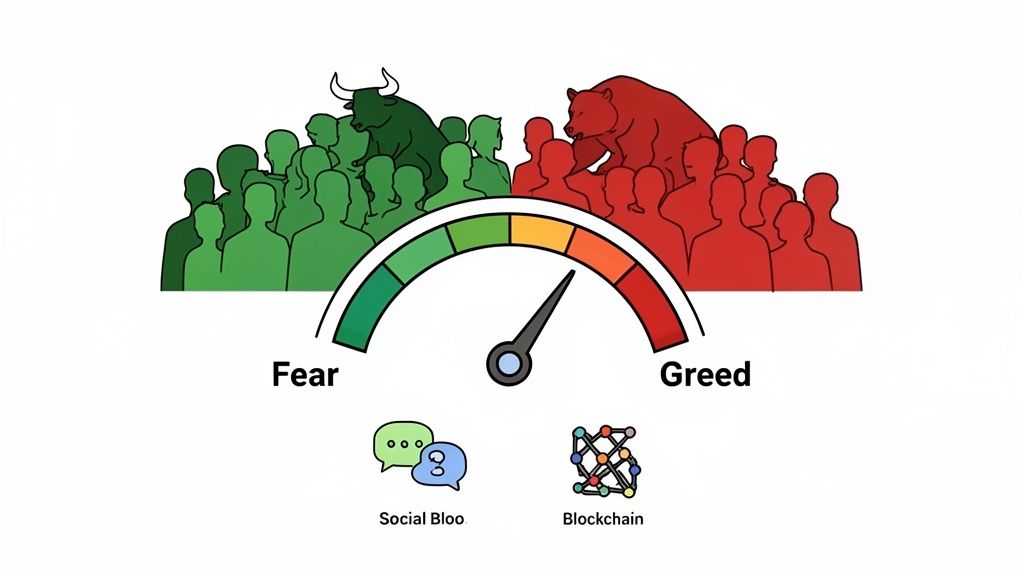
To get a full read on the market, you need to analyze data from two distinct sources: what people say (off-chain) versus what they actually do (on-chain). Combining them is where the real insights lie. The table below breaks down these two primary types of sentiment signals.
Understanding both is key. Off-chain signals tell you about the crowd's mood, while on-chain signals show you what the smart money is actually doing with their capital.
The most powerful insights come from finding a mismatch between the two. For instance, if you see widespread fear and panic on social media (off-chain) but notice large, experienced wallets are quietly buying up the dip (on-chain), that's often a screaming signal that a market bottom is near.
This guide will walk you through how to read both types of signals. You’ll learn to take the pulse of social media chatter and, more importantly, decode the hard data written directly onto the blockchain. This dual-pronged approach helps you move from being reactive to proactive, letting you anticipate market moves by understanding the emotions that drive them.

While on-chain data shows what investors do, off-chain indicators tell you what they feel. This is the collective psychology of fear, greed, and hype that floods social media, news headlines, and search engines. Learning to read this "social pulse" is a cornerstone of any solid crypto sentiment analysis.
Platforms like X (formerly Twitter), Telegram, and Reddit are massive, real-time focus groups for the crypto market. When a token or narrative starts trending, it’s a clear signal of surging public attention, which often precedes a major price move. This isn't just noise; it's a raw feed of investor emotion. A sudden spike in conversation can foreshadow a pump, while a wave of negative chatter can signal an impending dump.
To make sense of the endless chatter, analysts rely on specialized tools and indexes. These instruments distill millions of data points into a single, digestible metric. The most famous of these is the Crypto Fear & Greed Index. It’s built to measure the two primary emotions that drive markets, boiling them down to a simple score.
The Fear & Greed Index operates on a simple premise: extreme fear can cause investors to sell irrationally low, creating buying opportunities. Conversely, extreme greed can lead to irrational exuberance and overvalued assets, signaling a potential market top.
This index is a composite score calculated from several key data sources:
By blending these inputs, the index gives you a quick snapshot of whether the market is overly fearful or dangerously greedy. To dig deeper into how these metrics are analyzed, check out our guide on how NLP analyzes crypto social media data.
The real value of the Fear & Greed Index, popularized by Alternative.me, is what it reveals in a historical context. It distills market sentiment into a 0-100 score, where 0 means 'Extreme Fear' and 100 means 'Extreme Greed'.
Looking back, extreme readings have been incredible predictors of major market reversals.
Historical data shows that markets rebound 80% of the time after the index signals extreme fear (a score below 20). This makes it an invaluable tool for contrarian investors—those who buy when others are scared and sell when they're euphoric. When the index flashes 'Extreme Fear,' it’s a signal to hunt for bargains. When it screams 'Extreme Greed,' it’s a warning to consider taking profits.
While off-chain signals tell you what investors are saying, on-chain metrics show you what they’re actually doing with their money. This is the ultimate source of truth. The blockchain doesn't lie. Every transaction and every wallet movement is a verifiable data point offering an unfiltered view of market behavior.
Analyzing this data lets you see whether "smart money" is quietly buying during a panic or cashing out into a rally. This gives you a massive advantage because you’re basing decisions on concrete actions, not just public opinion.
One of the most powerful on-chain metrics is the Realized Price. This is the average price paid for every coin in circulation, calculated based on when each coin last moved. In short, it represents the market's collective cost basis.
This metric is a huge psychological line in the sand.
When the current spot price is above the Realized Price, the average investor is in profit, which supports bullish sentiment. When the price drops below it, the average holder is underwater, signaling widespread pain and potential capitulation.
This dynamic creates clear support and resistance zones. A drop below the Realized Price often marks a period of maximum fear—and maximum opportunity. During the 2022 bear market, BTC’s spot price spent months below its Realized Price of around $20,000. This was a classic sign that a market bottom was forming. You can dive deeper into concepts like this in our guide to essential on-chain metrics.
Not all market participants are created equal. New retail investors often panic-sell, while long-term holders—often called HODLers or "smart money"—are known for their patience. The HODLer Net Position Change metric tracks exactly what this experienced group is doing.
This indicator measures whether these long-term investors are accumulating more coins or distributing them. Their actions are often a leading indicator of major market shifts.
Metrics like these offer incredibly precise sentiment gauges. The HODLer cohort—who control over 70% of the BTC supply—aggressively accumulated during bear phases (adding +50,000 BTC net in Q4 2022) and distributed during bull runs (selling -30,000 BTC at the 2021 peak). You can explore more insights on how these metrics forecast market direction on amberdata.io.
When you see the market price dip below the Realized Price while HODLers are aggressively buying, it paints a clear picture of a potential bottom. This data-driven approach helps you tune out the noise and align your strategy with the market's most experienced players.
Knowing the theory is one thing; putting it to work is another. You need a structured framework to turn data into a repeatable process. This is how you stop reacting to market noise and start making disciplined, data-backed decisions.
This four-step workflow is a practical guide for weaving crypto market sentiment analysis into your trading routine.
Start with a bird's-eye view of the market's mood using off-chain indicators. Think of it like checking the weather—it gives you a general sense of the environment.
The goal is a quick "vibe check." The Crypto Fear & Greed Index is the perfect place to start. A quick glance tells you if the market is fearful or euphoric. Supplement this by checking trending crypto topics on social media.
Now, see if the blockchain data backs up the social mood. On-chain metrics show you what investors are actually doing. This is where you separate talk from action.
If social media is fearful, are long-term holders (HODLers) buying the dip? Or are they selling alongside the retail crowd? The answer is a massive signal.
By comparing what people are saying (off-chain) with what they are doing (on-chain), you can spot critical disconnects. These disconnects are often where the most profitable trading opportunities are found.
This infographic breaks down how you can use on-chain signals to validate what you're seeing.

This process simply shows that by looking at hard data like Realized Price and HODLer Net Position Change, you can build a much more solid view of the real market trend.
This is the most critical step. Compare your off-chain and on-chain findings to find confirmation (convergence) or contradiction (divergence).
Convergence is when both signals tell the same story. For example, widespread greed on social media and HODLers selling on-chain is a strong bearish signal.
Divergence is the opposite and often where the best opportunities lie. A classic bullish divergence is extreme fear on social media while on-chain data shows smart money is quietly buying.
Finally, pull your findings into a clear, actionable plan. A trading thesis is a simple statement outlining your market view and strategy based on the evidence.
This turns your crypto market sentiment analysis from research into a concrete strategy.
By following this four-step framework, you build a structured process for making sense of the market’s emotional chaos and acting with conviction.
Understanding the theory is one thing; turning emotional signals into profit is another. This requires a specialized tool to move from being a passive observer to an active participant.
Knowing the market is fearful is useful. Pinpointing exactly who is profiting from that fear and mirroring their moves? That’s where the real alpha is.
This is precisely the gap Wallet Finder.ai was built to fill. It lets you see what the most profitable traders are doing right now, on-chain. This turns abstract crypto market sentiment analysis into a sharp, actionable playbook.

The screenshot above gives you a peek at how Wallet Finder surfaces top-performing wallets, giving you a front-row seat to their recent trades and profitability. This on-chain evidence is the ultimate gut check for your sentiment reads.
Here is a powerful, repeatable strategy using this approach:
This process strips emotion from your trading. You’re not just buying because the market is down; you’re buying because you have hard, on-chain evidence that the smartest traders are accumulating.
This strategy works in reverse when the market gets greedy. When the Fear & Greed Index is screaming "Extreme Greed" (a score above 80), retail euphoria is at its peak. This is a golden opportunity to spot early exit signs.
By monitoring that same list of smart money wallets, you can get a massive head start. When alerts show these winners are taking profits, it’s a powerful warning that the rally might be running out of gas.
You can instantly verify their moves on Wallet Finder. Seeing a top trader who has held a token for weeks suddenly start to sell is a far more reliable signal than any news headline.
The final piece is validation. Never follow a wallet blindly. Verify you’re tracking a consistently profitable player.
Wallet Finder makes this simple by providing deep-dive analytics for any wallet:
In crypto, social chatter on platforms like X can be a surprisingly strong indicator. One study found that sentiment shifts on X could often predict Bitcoin's price movements. This is why combining social signals with on-chain data is so potent. Top wallets are almost always moving before the sentiment-driven pumps become obvious. By using Wallet Finder, you can see their accumulation patterns align with bubbling sentiment, turning market noise into a competitive edge. You can read more about the study's findings here.
By putting these features together, you elevate sentiment analysis from a fuzzy idea into a hard-nosed, data-driven trading system.
Ready to try it yourself? Explore the features on Wallet Finder.ai and start tracking smart money today.
Sentiment analysis gives you a powerful edge, but it's not a crystal ball. Even disciplined traders can fall into common mental traps. Knowing these pitfalls is the first step to using this tool effectively.
The most dangerous trap is confirmation bias. We are wired to favor information that confirms what we already believe. If you're bullish on a token, your brain will amplify positive tweets and dismiss negative on-chain signals. This creates a dangerous feedback loop that can blind you to real risks.
Sentiment analysis is a mirror reflecting the market's mood, not a roadmap telling you where to go. Your job is to read the reflection objectively, not hope it shows you what you want to see.
This bias is supercharged by social media echo chambers, which trap you in a bubble of one-sided opinions.
Another massive risk is sentiment manipulation. It's easy for coordinated groups to create artificial buzz around a token to fool sentiment algorithms and retail traders. A sudden explosion of social media chatter isn't always organic growth; it can be a carefully laid trap.
To protect yourself, you need a system built on objectivity and risk management. Here are a few hard-and-fast rules to keep yourself grounded:
By treating sentiment as one piece of the puzzle—and actively fighting your own biases—you can sidestep these common traps and stack the probabilities in your favor.
Even with a solid game plan, some questions always pop up when you're trying out a new strategy. Let's tackle a few of the most common ones.
Think of sentiment analysis as a probabilistic tool, not a crystal ball. It won't give you winning lottery numbers, but it can stack the odds in your favor by revealing the market's psychological state.
It's like being a professional card counter in blackjack. You don't know the next card, but you know when the deck is "hot" and it's time to increase your bet. Sentiment analysis tells you when the market's deck is loaded with fear or greed. Its power is amplified when layered with other approaches, like technical or fundamental analysis.
The goal of sentiment analysis isn't to be right 100% of the time. It's to identify high-probability moments when the market's emotional state creates a clear imbalance between risk and reward.
You don't need to break the bank to start analyzing market sentiment. There are fantastic free resources available.
Yes, and this is where things get really interesting. While building a fully automated system is a heavy lift for most, a semi-automated approach is completely within reach.
This is exactly where a tool like Wallet Finder.ai comes into play. By setting up custom Telegram alerts on a hand-picked list of proven smart-money wallets, you're essentially creating your own powerful, semi-automated signal feed.
You don't have to stare at charts all day. Just let the alerts come to you the second a top trader makes a move, giving you the chance to analyze their play and decide if you want to follow their lead.
Ready to turn market sentiment into actionable trading signals? Wallet Finder.ai lets you discover, track, and get real-time alerts on the market's top-performing wallets. Stop guessing and start following the smart money today. Find your next winning trade at Wallet Finder.ai.