Crypto Wallet Ratings: How to Find & Copy Top Traders
Unlock the power of crypto wallet ratings. Learn how to analyze performance metrics like PnL, risk, and win rate to find and copy-trade top DeFi wallets.

May 26, 2026
Wallet Finder

May 26, 2026

You've got trades on Ethereum, Solana, and Base. Some are on a DEX, some on a CEX, some came from a wallet you were watching, and a few positions are half-investment, half-experiment. You know your balances. You don't know your actual performance.
That gap is expensive.
Most traders don't blow up because they lack charts. They lose edge because they can't answer basic questions fast enough. Which setups made money. Which wallets were worth copying. Whether fees turned a “green” strategy into a drag. Whether gains were realized or still sitting on open risk. A proper profit loss app fixes that. It turns raw transactions into something you can review, compare, and act on.
The problem usually starts small. A spreadsheet feels fine when you've got one wallet, one exchange account, and a handful of spot trades. Then you add another chain. Then a perp account. Then a bot wallet. Then a few copied trades from wallets you found on-chain. At that point, your log stops being a trading tool and becomes a cleanup project.
I've seen the same pattern over and over. A trader thinks they're up because their current holdings are up. Then they check realized sales, bridge costs, gas, swap fees, and bad exits from earlier in the cycle. The picture changes fast. What looked like a strong month was often a few winners hiding a lot of sloppy execution.
Manual tracking fails in crypto for one reason. The transaction flow is too fast and too fragmented. Modern software has moved beyond static reporting because digital operations generate too much data for manual tracking to stay efficient. Finance software now emphasizes automated integration, line-item analysis, and in some cases real-time reporting instead of waiting for a static monthly review, as described in Domo's overview of profit and loss software.
Spreadsheets are fine for recordkeeping. They're weak for decision-making once your trading activity spreads across wallets, venues, and time periods.
If you're still piecing this together by hand, start with a clean framework for calculating crypto profits. The point isn't to build a prettier spreadsheet. It's to stop guessing what your trading is doing.
A crypto profit loss app is the trading version of a formal profit and loss statement. Traditional P&L reporting follows a simple structure. Revenue minus costs equals profit, then additional expenses and non-operating items lead to net income or loss over a reporting period. That accounting framework has been standardized for a long time, and modern software uses it to automate repeatable financial tracking, as explained in Workday's guide to profit and loss statements.
In crypto, the logic is the same. The inputs are just messier.
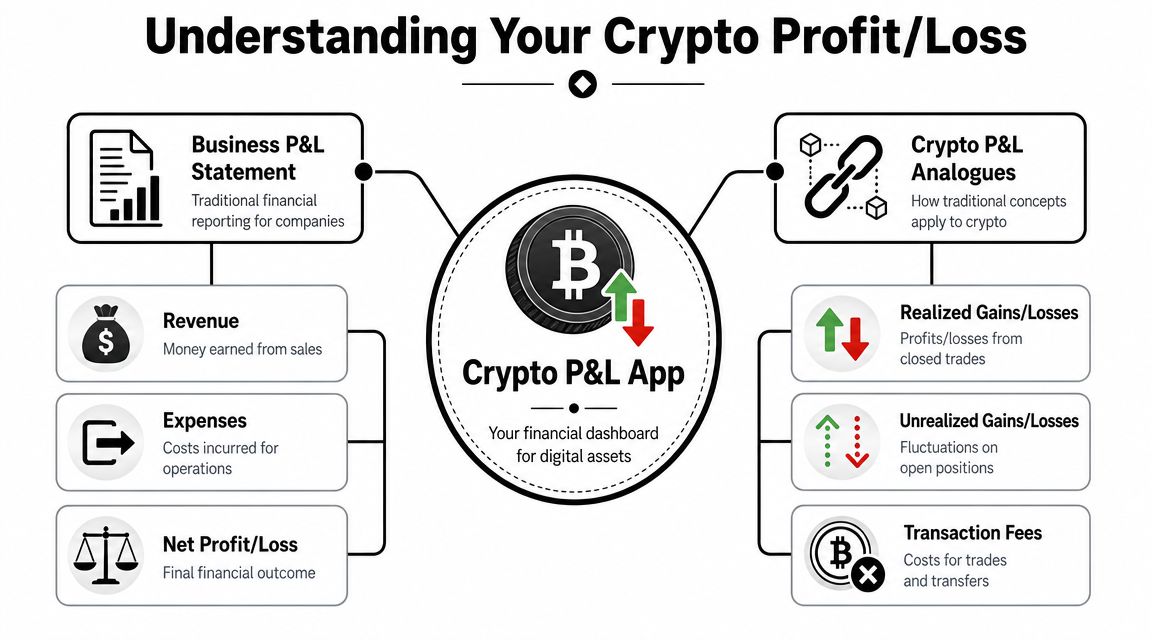
A good profit loss app doesn't just show current wallet value. It builds a historical record of what happened.
That means separating:
Many portfolio trackers offer an incomplete view. A tracker can tell you what you hold. A PnL tool should tell you how you got there, what it cost, and whether the trade worked.
Crypto adds complications that business accounting software doesn't need to solve directly.
For example:
| Traditional P&L concept | Crypto equivalent |
|---|---|
| Revenue | Proceeds from sells, rewards, or realized exits |
| Cost of goods sold | Entry cost or cost basis of acquired tokens |
| Operating expenses | Gas, swap fees, exchange fees, borrow costs |
| Net result | Realized and unrealized PnL after all costs |
That's why a generic expense app or basic portfolio dashboard usually isn't enough for active traders. Many mainstream explanations of profit and loss stop at standard line items like income, COGS, expenses, and net income over a month, quarter, or year, but they don't answer crypto workflow problems like reconciling realized versus unrealized profit, fees, and taxes across periods, as noted in Square's explanation of the P&L statement.
Practical rule: If a tool only shows current balance and percentage change, it's a portfolio viewer. If it reconstructs cost basis, fees, and closed-versus-open performance, it's a profit loss app.
That distinction matters when you're reviewing whether a copied wallet is worth following. Current holdings can look impressive. Historical trade quality tells the truth.
The difference between a toy dashboard and a useful profit loss app is whether it helps you make better trading decisions after the trade, not just admire the trade while it's open.

This is the first filter I use. If an app can't split closed PnL from open PnL, I don't trust the headline number.
A wallet can look strong because a few open positions are marked up. That doesn't mean the trader exits well. It doesn't mean the strategy is repeatable. You need both views at once. Closed performance tells you execution quality. Open performance tells you current exposure.
Most bad PnL tools understate costs. They'll show token appreciation and bury the friction.
If your fee tracking is weak, your strategy review is fiction.
That's especially dangerous in active on-chain trading where a strategy might involve repeated entries, scaling, exits, bridges, approvals, and transfers. A serious app should include line items that let you inspect cost basis and expenses in enough detail to review taxes and audit trail quality. That matters because a major underserved need in crypto tracking is reconciling realized versus unrealized profit, fees, and taxes across time periods. Basic tools often stop at current value, while a true profit loss app needs detailed line items for income, cost basis, and expenses for serious analysis and tax review.
You don't trade in one place anymore. Few serious DeFi traders do.
A usable app needs to combine activity across:
If the system treats transfers as profits, or can't understand that one wallet funded another, your reporting will be noisy from day one.
Cost basis matching changes how realized PnL appears over time. That matters when you scale in and out aggressively.
Look for support for:
You don't need accounting jargon for its own sake. You need consistency. If the method changes unannounced, your strategy review becomes impossible to compare month to month.
Every serious trader eventually wants the raw data outside the app.
That means:
A clean dashboard matters, but the best screens are the ones that answer hard questions fast.
I look for:
If a tool gives you that, it's useful. If it only gives you a total number and a pie chart, it's decoration.
A profit loss app sits close to sensitive information. Even when it's “just analytics,” it can reveal your holdings, trading patterns, linked accounts, and wallet relationships. That makes security a selection criterion, not a nice extra.

For on-chain analysis, the safest setup is usually simple. You provide a public wallet address and the tool reads public blockchain activity. No private key. No signing. No asset access.
That model fits how many traders already work when researching smart wallets. The tool doesn't need control. It needs visibility.
By contrast, exchange integrations add another risk layer because they often rely on API keys. That doesn't mean API connections are always bad. It means they must be tightly restricted.
If you connect a CEX, use the narrowest permissions possible.
A profit loss app should help you observe your trading, not gain the ability to act on your funds.
The same discipline applies to basic wallet hygiene. If you need a refresher, review these private key security best practices before connecting any tool to your stack.
Many traders skip this because it feels boring. It isn't.
Ask these questions:
If the answers are vague, that's a red flag.
This walkthrough is worth watching if you want a practical mindset for evaluating crypto tool risk before you connect anything:
Here's the short list.
Security-first tools may feel slightly less convenient at setup. That's a good trade.
Most traders choose a profit loss app the wrong way. They look at screenshots, pricing, or whatever has the cleanest landing page. The better approach is to score the app against your trading workflow.
A copy trader and a quant don't need the same thing. The copy trader needs fast clarity on wallet-level performance and execution timing. The quant needs cleaner exports, reproducible calculations, and room for custom analysis. Use the checklist below to compare options side by side, then weight the rows that match how you trade.
For a broader foundation before scoring tools, it helps to review what an app for tracking crypto portfolio should do versus what a true PnL workflow requires.
| Feature/Capability | What to Look For | Priority (for Copy Trader) | Priority (for Quant/Analyst) |
|---|---|---|---|
| Wallet and chain coverage | Supports the chains, wallets, and venues you actually use | High | High |
| Realized versus unrealized PnL | Clear split between closed trades and open positions | High | High |
| Fee tracking | Gas, swap, bridge, and exchange fees included in trade history | High | High |
| Cost basis handling | Transparent lot matching and consistent accounting method | Medium | High |
| Historical trade reconstruction | Rebuilds entries, exits, transfers, and position changes accurately | High | High |
| Dashboard clarity | Lets you find winners, losers, and drag quickly | High | Medium |
| Time-period filtering | Daily, weekly, monthly, and custom ranges for review | Medium | High |
| Export options | CSV or similar raw exports for offline work | Medium | High |
| Token-level attribution | Shows which assets drive gains and losses | High | High |
| Wallet-level attribution | Separates your wallets, tracked wallets, or strategy sleeves | High | High |
| Security model | Public address tracking or read-only API access only | High | High |
| Audit trail quality | Trade-level logs with enough detail for tax review and debugging | Medium | High |
If you're a copy trader, prioritize speed to insight:
If you're a quant or analyst, prioritize raw structure:
Don't buy based on the headline dashboard. Test whether the app can answer one of your real review questions in under a minute.
Use a simple three-part test when trialing any tool:
If the tool gets obvious history wrong, stop there. It won't get better when your activity gets more complex.
The most useful profit loss app workflow isn't passive portfolio tracking. It's using PnL data to evaluate strategies, traders, and wallets before you allocate attention or capital.

A professional setup usually follows a repeatable loop.
The key is not to confuse visibility with edge. Seeing a wallet buy a token is interesting. Understanding whether that wallet exits well, sizes well, and survives choppy conditions is where the edge starts.
Here's the workflow I'd use.
A wallet-level PnL view gets more useful when you break it into components.
| Report view | Why it matters |
|---|---|
| PnL by token | Shows whether the trader has a real edge in certain asset types |
| PnL over time | Helps spot whether results are consistent or clustered |
| Realized versus unrealized | Separates execution from mark-to-market luck |
| Position sizing patterns | Reveals conviction and risk discipline |
| Loss clusters | Shows where the strategy fails |
The best copied strategy is usually the one you understand well enough to filter, not the one you mirror trade for trade.
Real-time alerts are useful, especially for fast-moving on-chain setups. They are not a substitute for review.
If you mirror wallets in real time, keep a weekly habit:
The strongest setups combine discovery, alerts, and post-trade PnL review. That's the difference between chasing smart money and building a process around it.
A profit loss app isn't admin work for traders. It's part of the edge. Once your activity spreads across chains, wallets, and venues, you need more than a balance view. You need cost basis, fee visibility, historical trade reconstruction, and a clean split between realized and unrealized performance.
That's what turns random activity into something reviewable.
The traders who improve fastest usually do one thing well. They close the loop between discovery, execution, and review. They don't just find interesting wallets or tokens. They measure what happened after they acted, then use that feedback to size better, filter better, and stop repeating the same expensive mistakes.
If your current setup can't tell you where your profits really came from, it's time to upgrade the process.
If you want a cleaner way to connect wallet discovery with strategy analysis, Wallet Finder.ai is built for that workflow. It helps traders discover active on-chain wallets, inspect trading histories, monitor smart money activity, and turn raw wallet behavior into actionable research for copy trading and performance review.