The Chain of Markets: A Trader's Guide to DeFi

Wallet Finder

Blank calendar icon with grid of squares representing days.

June 20, 2026

You're probably looking at one chain, one DEX, and one set of wallets while the actual move started somewhere else.

That's the expensive mistake in DeFi. A meme token rips on Base, traders chase the candles, and by the time most dashboards light up, the wallets that mattered have already rotated from Ethereum, hedged on Solana, or started unloading into late liquidity. If you trade each venue as a closed system, you react to noise. If you trade the chain of markets, you start seeing cause instead of just price.

The useful lens isn't “what is pumping?” It's “where did the liquidity come from, how did it travel, and which wallets are positioned for the next hop?”

What Is a Chain of Markets

A chain of markets is a connected market structure where pricing, inventory, and information move across multiple nodes rather than staying inside one venue. In traditional commerce, the intuition is simple. Raw material costs hit processors first, then distributors, then retailers. By the time the end buyer sees a new price, several linked markets have already adjusted.

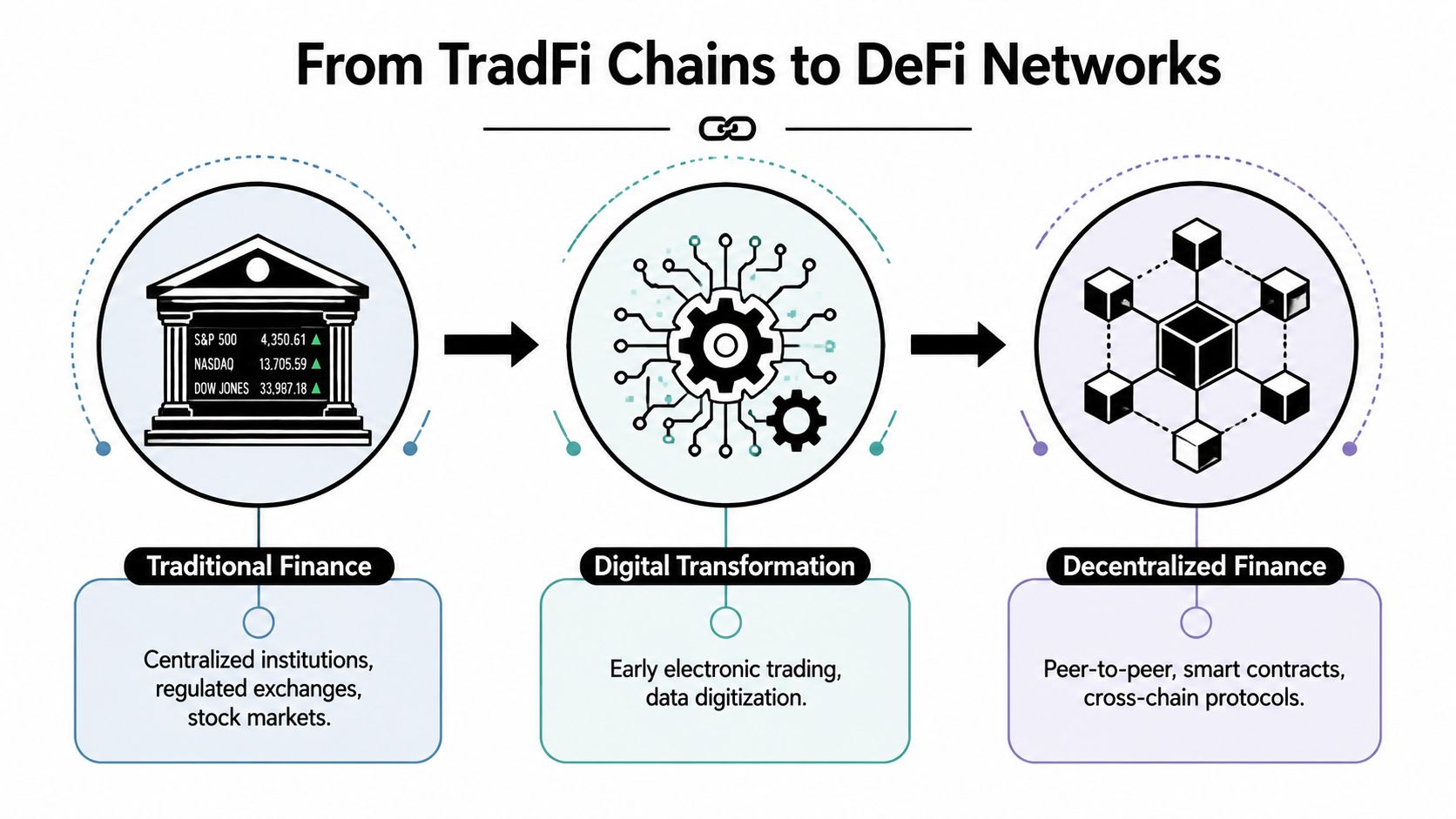
That same logic exists in finance. Organized markets have been linked for centuries, not just by assets but by the mechanisms that route price and capital. The history of stock exchanges and the Buttonwood Agreement captures two key milestones: the Amsterdam Stock Exchange was officially founded in 1602, and on May 17, 1792, 24 stockbrokers signed the Buttonwood Agreement, an early step toward the New York Stock Exchange.

A diagram illustrating a chain of markets showing the progression from raw materials to processing and retail.

The simple mental model

Think of the chain of markets as three moving parts:

  • Price transmission means one market's change bleeds into the next.
  • Inventory transmission means capital, tokens, and risk move between venues.
  • Information transmission means some participants see the shift earlier because they're closer to the source.

In DeFi, those nodes aren't factories and retailers. They're bridges, DEXs, lending protocols, perpetual venues, aggregators, and the wallets routing through them.

A trader who only reads terminal price sees the final print. A trader doing on-chain analysis for wallet behavior and token flows sees the upstream movement before the chart fully reflects it.

Practical rule: Don't define a market by its ticker. Define it by the path liquidity takes to reach that ticker.

How DeFi changes the structure

DeFi compresses the chain and makes it visible. In traditional markets, the links are often hidden behind intermediaries and reporting delays. On-chain, the path is traceable if you know where to look.

That doesn't mean the system is simpler. It means the market is more legible and more reflexive at the same time. A token on Base can depend on Ethereum-origin capital, Solana trader attention, a bridge relay, and a handful of wallets that consistently lead rotations.

Here's the key distinction:

Market viewWhat you focus onWhat you miss
Isolated market viewOne token, one chain, one chartWhere liquidity came from
Chain of markets viewWallets, bridges, venue sequence, timingLess. You see the route, not just the endpoint

If you trade long enough, you stop asking whether markets are connected. They are. The edge comes from mapping the connection fast enough to act before everyone else sees the same pattern.

Why Market Chains Matter in DeFi

Most DeFi traders don't lose because they can't read a candle. They lose because they misidentify the market they're trading.

A token on one chain is rarely driven by buyers native to that chain alone. Capital jumps through bridges, aggregators split flow across venues, and copy traders often arrive after the original thesis has already propagated. By then, the apparent “leader” wallet may just be the visible middle of the chain.

Where traders usually get trapped

A common failure pattern looks like this:

  • They copy the last visible buyer instead of tracing the first funded wallet.
  • They watch token volume but ignore bridge inflows that made the volume possible.
  • They treat each chain separately even when the same operator trades across ecosystems.
  • They overreact to local momentum without checking whether upstream liquidity is still supporting it.

That's why the chain of markets matters in DeFi. It turns a reactive process into an investigative one.

The practical payoff is simple. When you understand where capital originated and how it moved, you can separate genuine rotation from exit liquidity. You can also avoid attributing “smart money” status to wallets that are only echoing a move already underway elsewhere.

If the first meaningful signal appeared on another chain, your chart is late even when it looks early.

What changes when you trade the network

The market becomes less about isolated setups and more about connected state changes. A bridge inflow isn't just a transfer. It may be the funding leg for a cluster of swaps. A burst of new wallets in a token isn't always adoption. It can be copied deployment of the same strategy across chains.

For discretionary traders, this changes entry timing. For quant teams, it changes data design. Single-chain feature sets can capture local behavior, but they often miss the upstream trigger.

Here's the trade-off in plain terms:

ApproachStrengthWeakness
Single-chain tradingFast to monitor, simpler modelsMisses upstream capital and mirrored behavior
Cross-chain market chain trackingBetter context and earlier signalMore noisy data, more entity resolution work

The reason this matters more now is structural. Liquidity in DeFi is portable. It doesn't stay loyal to one venue. It hunts attention, volatility, and execution conditions. The traders who do best aren't just screening for what's active. They're screening for what's connected.

What works and what doesn't

What works:

  • Following funding paths from origin chain to destination chain.
  • Ranking wallets by sequence quality, not just realized PnL.
  • Watching repeated route patterns such as bridge, accumulate, distribute.

What doesn't:

  • Blind copy trading without wallet lineage.
  • Volume-only dashboards that flatten the route into one endpoint.
  • Local narratives that ignore broader liquidity conditions.

If you want fewer false starts, stop treating DeFi as a set of separate arenas. Trade it as one fragmented market linked by wallets, bridges, and timing.

Identifying Cross-Chain Market Cascades

A market cascade starts when one event forces repricing beyond its original venue. In DeFi, that event might be a liquidation cluster, a sudden bridge inflow, an oracle update, or a concentrated rotation by a small group of high-conviction wallets. The important part isn't the trigger by itself. It's how the trigger propagates.

The useful model comes from network economics. In chain-linked market research on networked price competition, markets can produce cascading price effects because each node responds not only to local demand but also to upstream and downstream pricing signals. In practice, prices depend on the topology of connected markets, not just one isolated order book.

A four-step infographic showing how market instability spreads through interconnected blockchain networks causing cascades.

Read the network, not the candle

If you want to detect a cascade early, map the route:

  1. Identify the initial shock. A sudden imbalance usually starts at one protocol or chain.
  2. Locate the transmission rails. Bridges, aggregators, and shared liquidity venues carry the reaction.
  3. Find the sensitive nodes. Thin books, reflexive communities, and highly copied wallets amplify the move.
  4. Track the feedback loop. Once copied flow joins, the second-order move often matters more than the first.

This is why network topology matters. Two tokens with similar charts can behave differently if one sits at the edge of the network and the other sits on a busy route connecting multiple chains.

The nodes that deserve attention

A cross-chain cascade usually runs through a small set of infrastructure types:

  • Bridges route the funding leg.
  • DEX aggregators fragment execution and hide simple venue-level clues.
  • Lending markets force liquidations and collateral reshuffling.
  • Perpetual venues can amplify spot moves when traders hedge or press momentum.
  • Copy-traded wallets spread the move after the original operator is already positioned.

A lot of traders look for a single “alpha wallet.” That's often too narrow. Cascades often emerge from wallet clusters behaving in sequence.

The first wallet tells you intent. The next ten tell you whether the move is becoming a market event.

A practical cascade checklist

Use this before chasing any cross-chain move:

QuestionWhy it matters
Did the move begin with price or with funding?Funding-led moves often sustain longer
Did capital bridge in before volume expanded?That suggests preparation, not reaction
Are the same wallets active on adjacent chains?Cross-chain repetition strengthens the signal
Is the destination market deep enough to absorb exits?Thin destinations can reverse violently

For traders who want a tighter operational process, it helps to study how to analyze cross-chain bridge transactions and tie those transfers back to the wallets executing the follow-up trades.

What usually breaks the analysis

Three things ruin cascade detection:

  • Stale entity mapping. One trader can control multiple wallets across chains.
  • Venue myopia. A DEX-only view misses the funding source and the hedge leg.
  • Late confirmation bias. Traders wait for all dashboards to agree, then enter into an already mature cascade.

The better approach is probabilistic. You don't need certainty. You need enough evidence that the route is real, the wallets are connected, and the destination chain is only the current stop, not the origin.

Actionable Signals from Market Chains

A chain of markets becomes tradable when you stop asking abstract questions and start watching concrete on-chain sequences. The signal isn't “activity.” The signal is ordered activity. Funding appears, then deployment, then imitation, then distribution.

One of the cleaner non-obvious examples comes from broader liquidity conditions. Q1 2025 data on Base memecoin volume and spot ETF inflows showed a 68% increase in correlation between memecoin volume spikes on Base and weekly spot ETF inflows, and the source says this trend was missed by 92% of retail analysis. The practical implication isn't that every meme rally is institutionally driven. It's that retail-only explanations can miss a real liquidity linkage.

The signals worth tracking

Here's a working table for daily monitoring.

Signal TypeOn-Chain IndicatorPotential ImplicationKey Chains/Protocols to Watch
Bridge-led fundingA token or stablecoin moves into a destination chain before local volume expandsEarly positioning before broader participationEthereum, Base, Solana, major bridge routes
Wallet clusteringSeveral wallets funded from related paths buy the same asset in close sequenceCoordinated thesis or copied executionDEXs, deployer-adjacent wallets, fresh funded addresses
Venue handoffInflows hit one venue, but real size gets deployed across multiple execution venuesAggregated execution hiding true convictionDEX aggregators, router contracts
Fast recycle behaviorWallets sell one narrative bucket and rotate into another without returning to stable inactivitySector rotation rather than isolated pump chasingMemecoins, perp hedges, ecosystem beta
Downstream imitationSmaller wallets pile in after a short lag behind known profitable walletsCopy flow is arriving. Upside may remain, but exit risk rises tooSocially visible chains and copy-traded ecosystems
Cross-chain identity mismatch“Winning” wallets on one chain resemble failed behavior from another chainApparent smart money may be recycled reputationEthereum, Base, Solana wallet history

How to read these signals in sequence

Don't score them equally. Some come early, some are late.

Early signals:

  • Bridge-led funding
  • Wallet clustering
  • Venue handoff

Middle-stage signals:

  • Fast recycle behavior
  • Repeated buys from linked entities

Late-stage signals:

  • Downstream imitation
  • Broad social attention
  • Thin liquidity absorbing larger exits

That sequencing matters because traders often treat all activity as confirmation. It isn't. A downstream copy wave can keep a trade alive, but it can also mark the point where original operators start distributing into attention.

Desk note: The highest-quality signal usually combines route evidence with wallet quality. Either one by itself can mislead you.

A sharper use of correlation

The Base memecoin and ETF-flow relationship is useful because it forces a broader frame. If larger liquidity conditions are shifting, some “on-chain only” narratives are incomplete. That doesn't mean you trade headlines. It means you monitor whether speculative flow is syncing with a broader liquidity backdrop.

You can also use the same logic to filter bad signals. If a token spikes without meaningful funding, without credible wallet clustering, and without adjacent-chain participation, it's often just local noise.

What usually works best is a short watchlist of route-based alerts:

  • Stablecoin bridge inflows into a target chain
  • First buyers with prior cross-chain activity
  • Repeat participation by the same wallet cluster
  • A second token on the destination chain catching the same group of buyers

That last one matters. When the same wallets begin expressing the thesis through multiple assets, you're no longer looking at a one-off trade. You're watching a market chain develop.

Hunting Market Chains with Wallet Finder.ai

Most traders understand the theory once they've seen a few cascades. The hard part is operationalizing it without drowning in raw transactions.

A workable flow starts with one token and expands outward through wallets, bridges, and sequence. That's where a tracker that joins wallets, trades, and tokens into one workflow becomes useful. Wallet Finder.ai's guide to tracking smart money across blockchains is directly aligned with that job because the problem isn't just finding a profitable wallet. It's finding the path that made the wallet early.

Screenshot from https://www.walletfinder.ai

Start with the destination chain

Begin in Discover Tokens or the equivalent token discovery view in your stack. The first screen isn't for conviction. It's for anomaly detection.

Look for:

  • Sudden token activity on Base or Solana that appears before broad social saturation
  • Concentrated buying rather than diffuse retail-sized flow
  • Repeat wallet participation across adjacent launches or related sectors

At this point, don't ask whether the token is good. Ask whether the participation pattern looks organized.

Then move to the first wallets, not the loudest ones

Open Discover Trades for the token and isolate the earliest meaningful buyers. Ignore tiny noise fills and obvious late arrivals. You want the wallets that sized in before the crowd and before volume became self-reinforcing.

Now inspect those wallets for route history:

  • Did they fund from stablecoins on another chain?
  • Did they bridge in shortly before buying?
  • Did they rotate out of a similar trade on Ethereum or Solana first?
  • Are multiple early wallets connected by timing or funding source?

Most copy traders often get fooled. They rank wallets by visible wins on the current chain and miss the upstream baggage.

The source tied to this article's brief makes a sharp warning: recent on-chain audits in 2025 found that 34% of top “winning” wallets on Base are cross-chain clones of failed Ethereum wallets, and that this nuance is absent in 97% of copy-trading content. Whether you trade manually or systematically, that's a reminder to verify lineage before treating a wallet as signal.

A wallet with recent wins isn't enough. You need to know whether the operator is genuinely adaptive or just wearing a different chain.

Build a route-based watchlist

Once you've identified credible early wallets, create a watchlist based on behavior, not branding.

Good watchlist candidates usually have:

  • Consistent cross-chain funding patterns
  • Repeat early entries in related themes
  • Clean execution timing
  • Position sizing that scales with conviction

Poor candidates often show the opposite:

  • Erratic chain switching with no thematic consistency
  • Performance that depends on one isolated burst
  • Large wins surrounded by sloppy entries and exits
  • Copy-trader popularity without route originality

That distinction matters more than advertised PnL screenshots.

A quick walkthrough helps make the process concrete:

Set alerts for the next leg, not the current one

Edge comes after the first investigation. Once you trust a wallet cluster, set real-time alerts for the next state change:

  1. Bridge event detected
  2. Stablecoin arrives on destination chain
  3. Same wallet cluster starts probing small entries
  4. Conviction size appears
  5. Adjacent wallets copy the move

That sequence is tradable because it turns a static “top wallet” list into a live chain-of-markets workflow.

If you're running a team, this process also scales. One person can monitor token anomalies, another can verify cross-chain funding paths, and another can review whether the same wallets are expressing the thesis through multiple assets. By the time the wider market notices, you've already decided whether the move is worth joining, fading, or ignoring.

The practical trade-off

This method is stronger than blind copy trading, but it isn't frictionless.

Workflow choiceBenefitCost
Track visible winners onlyFast screeningHigh false-positive risk
Trace wallet lineage and bridge pathsBetter signal qualityMore research time
Alert on route changesEarlier entriesMore alert tuning and noise filtering

The important point is that the chain of markets is only useful if your tooling preserves sequence. A flat leaderboard won't do that. You need to see token discovery, trade timing, wallet history, and cross-chain movement as one connected record.

Putting It All Together for a Trading Edge

The chain of markets is a better way to think about DeFi because it matches how capital moves. Tokens don't trade in isolation. Wallets fund across chains, bridges transmit intent, aggregators fragment execution, and copy flow amplifies whatever started upstream.

The practical workflow is tight. Start with an unusual move on one chain. Trace the first meaningful wallets. Verify where their capital came from. Check whether the same operators have related positions or prior activity on other chains. Then monitor for the next hop instead of staring at the current chart.

That changes the job from prediction to tracking. You're not trying to guess every breakout. You're identifying whether a move is local noise, coordinated positioning, or the early phase of a broader cascade.

For traders, the edge is earlier context. For quant teams, the edge is better feature design. For copy traders, the edge is avoiding wallets that look smart only because the dashboard cuts off their history at the chain boundary.

The market won't simplify. If anything, cross-chain behavior will keep getting harder to read from price alone. The answer isn't more headlines or more generic wallet lists. It's better sequence awareness. Follow the funding, map the route, and treat every visible rally as the downstream expression of a larger market chain until proven otherwise.


If you want a cleaner way to do that work, Wallet Finder.ai helps you trace profitable wallets, token activity, and cross-chain trade behavior in one place so you can monitor the routes behind moves, not just the moves themselves.