7 Best Meme Coin Trading Tools for 2026
Discover the 7 best meme coins trading platforms and tools for 2026. Get actionable insights, find winning wallets, and trade smarter on CEXs and DEXs.

February 20, 2026
Wallet Finder

February 14, 2026

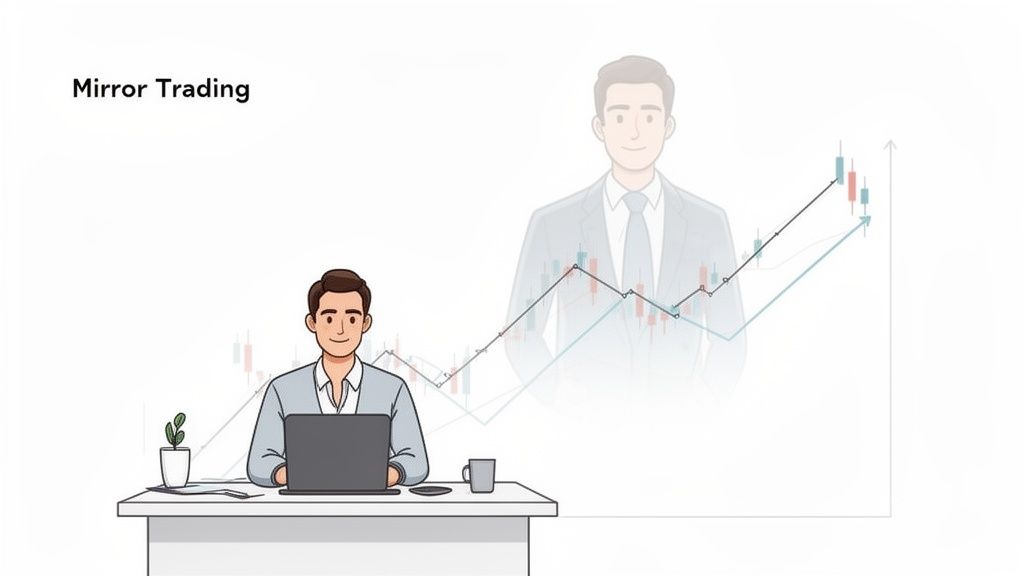
Ever heard the saying, "Success leaves clues?" In the world of trading, that’s not just a motivational quote—it's a literal strategy. That strategy is called mirror trading.
So, what is it? Put simply, mirror trading is a way to automatically copy the trades of a seasoned, profitable trader directly in your own account. You get to mirror their exact entry points, exit strategies, and even how they manage risk, all without having to lift a finger to place the trades yourself. It’s like having an expert co-pilot for your portfolio.

At its heart, mirror trading was created to give everyday investors a shortcut to the expertise of market pros. Instead of spending years buried in charts and financial reports, you can find a trader with a proven track record, connect your account, and let a platform copy their every move in real time.
This hands-off approach is a game-changer for beginners who are still learning the ropes, but it’s also a huge time-saver for experienced investors who want to diversify their strategies without adding more hours to their day.
The concept first took off in traditional markets like forex, but it has found a much more powerful application in cryptocurrency. The big difference? Radical transparency. In the old world, you had to trust a trader's self-reported performance. In crypto, you can verify everything on the public ledger.
You can dissect every single transaction a wallet has ever made, calculate its true profit and loss (PnL), and see its win rate with your own eyes. If you want to dive deeper into this concept, we break it all down in our guide on what is copy trading in crypto.
This leap from blindly trusting a resume to verifying irrefutable on-chain data is what makes mirror trading in crypto so compelling. It puts the power back in your hands, allowing you to make decisions based on cold, hard facts.
To really get a feel for how this works, it helps to know the moving parts. The mirror trading ecosystem can be broken down into a few core components, each with a clear job to do.
ComponentWhat It IsHow It Works in CryptoThe Strategy ProviderAn experienced trader whose performance and strategies are available to be copied.A high-performing crypto wallet with a verified 80% win rate on Solana.The Mirror TraderAn investor who allocates capital to automatically follow the provider's trades.You set aside 1 ETH to automatically buy and sell the same tokens as the provider.The Connecting PlatformThe technology that links the provider and follower, executing the trades.A tool like Wallet Finder that monitors a wallet's trades and sends you real-time alerts.Automated ExecutionTrades are opened and closed in the follower's account without manual input.When the provider sells a token, your connected account automatically sells it too.
As the table shows, it's a straightforward system where technology connects a skilled trader's actions with your capital, automating the entire process. This simple but powerful setup is what allows anyone to tap into expert strategies.
Mirror trading isn’t some flash-in-the-pan crypto trend; it's a battle-tested strategy that’s been honed over decades. Its roots stretch back to the chaotic trading floors of traditional finance, long before anyone had ever heard of a blockchain.
The idea was simple but powerful: break down the walls between professional traders and everyday investors. It was about giving anyone a shot at using strategies that were once locked away in the ivory towers of the financial elite, leveling the playing field in a big way.
The concept really took off in the early 2000s, especially in the forex and stock markets. For the first time, novice traders could automatically copy the exact moves of seasoned pros in real time, no finance degree or hours of screen time required.
Fast forward to today, and that same idea has found a natural home in crypto, where market volatility makes lightning-fast decisions essential. It's clearly caught on—a recent survey found that over 60% of retail crypto investors have tried copy or mirror trading at least once. The low barrier to entry and hands-off appeal are hard to ignore. You can dig into more data on these trends over at Zignaly's crypto trading report.
But this isn't just a simple change of scenery. The shift to crypto represents a massive upgrade to how the whole strategy works. In the old world, you had to trust a platform’s curated list of "top traders." You were basically taking their word for it, with little way to verify the claims yourself.
The real game-changer in crypto is transparency. On the blockchain, every single transaction is out there for the world to see. This jump from blind faith to verifiable proof is what makes modern mirror trading so potent.
Now, instead of just following a username on a centralized exchange, you can mirror the on-chain activity of any wallet. This throws the doors wide open. You're no longer stuck with the traders a platform wants you to see; you can go out and find your own hidden gems by digging into the public ledger.
This move from a "black box" system to a transparent, on-chain model is the biggest leap forward in mirror trading’s history. The core idea is the same, but the execution is infinitely more powerful and trustworthy.
Here’s a quick breakdown of how things have changed:
This new frontier gives you a crystal-clear window into what the "smart money" is doing. With tools that crunch all this on-chain data, anyone can spot wallets making consistently smart moves and instantly replicate their strategies. It’s all about turning raw, public data into actionable intelligence.
To really get what mirror trading is all about, you have to peek behind the curtain at the mechanics. The core idea is simple, but it has grown from a clunky, platform-dependent model into a transparent, on-chain workflow that puts you firmly in the driver's seat.
The old-school way was straightforward: you'd find a centralized platform, scroll through a list of their approved traders, and just click a "copy" button. From there, the platform handled everything, automatically mimicking every single trade in your account. While it was easy, you were stuck inside their walled garden, forced to trust their performance data without any way to verify it.
The explosion of decentralized finance (DeFi) has completely flipped this script, shifting the power from the platforms to individual traders. Instead of relying on some curated list of "gurus," you can now use the public blockchain itself as your hunting ground. This on-chain model is built entirely on transparency and verifiable data, giving you a massive upgrade in control.

This evolution shows how the core idea of mirror trading has adapted, moving from the closed-off systems of Forex to the wide-open, transparent ledger of crypto.
Here is an actionable, step-by-step process that places hard data at the center of your decisions:
The key takeaway here is that on-chain data takes all the guesswork out of the equation. You're not just blindly following a username on a forum; you're replicating the verified, public actions of a wallet with a proven history of success.
This method really gives you the best of both worlds. You tap into the insights of a top-tier trader while keeping 100% control over your own capital and decisions. It’s a proactive, data-driven approach that truly defines what mirror trading means in today's crypto markets.
Every time you mirror a trade, you pay a tax that nobody talks about. It's not a fee charged by a platform. It's not a commission. It's the cost of being second. The wallet you're following executes its trade first. Your alert arrives some number of seconds or minutes later. You execute after that. Every second of that gap costs you a fraction of a percent on your fill price, and across dozens or hundreds of mirrored trades, those fractions compound into a meaningful drag on your returns.
The latency gap isn't a bug in mirror trading. It's a structural feature of how the system works. The wallet makes a decision and executes instantly in its own account. The information about that trade then has to travel through several stages before it reaches you: the blockchain needs to confirm the transaction, whatever monitoring system is watching that wallet needs to detect the new transaction, the alert needs to be generated and delivered to your device, and then you need to read it and decide to act. Each stage adds time. The total pipeline from wallet execution to your execution might be anywhere from fifteen seconds to several minutes depending on the chain, the monitoring tool, and your own reaction speed.
The cost of latency depends entirely on the asset you're mirroring and the market conditions at the time. On liquid large-cap assets during normal trading hours, the price movement in thirty seconds to two minutes is usually small — a fraction of a percent. The latency tax exists but it's modest. On a low-cap token during a pump, thirty seconds can be the difference between entering at the wallet's price and entering at a price that's already twenty percent higher. The latency tax in that scenario is enormous.
This is why the assets you choose to mirror matter as much as the wallets you choose to mirror. If you're following a wallet that primarily trades large-cap tokens on chains with fast confirmation times, your latency gap stays small and manageable. If you're following a wallet that specializes in sniping new token launches on Solana — where the entire opportunity might play out in under a minute — your latency gap is likely too large to capture meaningful value from those specific trades.
You can't eliminate latency entirely, but you can minimize it at several points in the pipeline. The first and most impactful lever is choosing a monitoring tool with the fastest detection speed. Some tools detect new transactions within a few seconds of blockchain confirmation. Others have polling intervals of thirty seconds or more. That difference compounds across every single trade you mirror.
The second lever is your own reaction speed. Having the exchange app already open on the correct trading pair, knowing your position size in advance, and being ready to execute the moment the alert arrives shaves seconds off your end of the pipeline. Those seconds matter on fast-moving assets.
The third lever is chain selection. Blockchains with faster confirmation times — Solana at sub-second finality versus Ethereum at twelve-second block times — create smaller latency windows for the same monitoring speed. If a wallet you're interested in operates across multiple chains, prioritizing their activity on faster chains gives you a structural advantage in closing the latency gap.
The honest truth is that some mirror trading opportunities are simply not viable given your latency. A wallet that makes its money sniping tokens in the first five seconds of a launch is not a wallet you can profitably mirror unless you have infrastructure-level speed. Recognizing which opportunities your latency makes impossible and which it merely makes slightly less profitable is a critical part of building a mirror trading strategy that actually works in practice.
No trading strategy is a magic bullet. Mirror trading offers compelling advantages but also comes with real risks. Understanding both sides is critical before you put capital on the line.
The appeal is obvious: instant access to expert strategies, automation that removes emotional decision-making, and easy diversification across multiple assets and blockchains.
BenefitActionable AdvantageReal-World ImpactExpert AccessSkip the long learning curve by leveraging strategies from proven traders.Top platforms report users mirroring the best 10% of traders see 18-22% annualized returns.Time EfficiencyAutomate your trading so you don't have to watch the charts 24/7.Frees up time to focus on research and finding new opportunities.Emotional DisciplineRemove fear and greed from your decisions by following a pre-set strategy.Helps avoid common pitfalls like panic selling or FOMO buying.DiversificationEasily follow multiple traders across different niches (e.g., Solana memecoins, DeFi).Data shows mirroring 5-7 providers can cut portfolio drawdown by over 50%.
If you want to dig into the numbers, Benzinga offers a full breakdown of these stats.
But those rewards don't come for free. The single biggest mistake people make is blindly following a trader without doing any of their own homework. A hot streak is great until it isn’t, and past performance never guarantees future results.
A winning strategy has a shelf life. When too many people start copying a successful trader, the strategy's effectiveness can get diluted—a phenomenon known as "alpha decay." In crypto, it’s been observed that over 70% of heavily mirrored strategies see their profitability sliced in half within a few months as the market catches on and adapts.
Beyond a strategy going stale, you're up against two other major risks:
At the end of the day, mirror trading is a powerful tool, not a "set it and forget it" money printer. It demands that you put in the work upfront to research who you're following, keep an eye on their performance, and truly understand the risks. It’s meant to supplement your strategy—not replace it entirely.
The article above mentions alpha decay in passing — "over 70% of heavily mirrored strategies see their profitability sliced in half within a few months." That statistic is accurate and alarming, but it's presented without any explanation of how or why it happens, which means you can't actually do anything about it. Alpha decay isn't a mystery. It follows a predictable pattern driven by a specific mechanism, and understanding that mechanism is the difference between mirror trading that compounds returns and mirror trading that gradually bleeds them away.
Alpha decay happens because a successful wallet's edge is finite. The edge exists because the wallet identified something the rest of the market hasn't fully acted on yet — an undervalued token, a pattern in DeFi liquidity, a specific chain where opportunities are concentrated. When you mirror that wallet and make the same trades, you're partially capturing that edge. When a hundred other people mirror the same wallet and make the same trades, everyone's collective buying and selling activity closes the pricing gap the edge was built on. The opportunity that made the wallet profitable gets consumed by the volume of people trying to profit from it.
Alpha decay doesn't happen linearly. It follows a curve that starts slow and accelerates, which means the early days of mirroring a newly discovered wallet are disproportionately profitable compared to the months that follow.
When a wallet first gains attention and starts accumulating followers, its edge is still mostly intact. The follower volume is small enough that their collective trades don't meaningfully move prices on the assets the wallet trades. Returns during this window closely track the wallet's own returns. This is the golden window — the period where mirror trading delivers close to its full potential value.
As follower volume grows, the decay curve steepens. More people buying the same tokens ahead of the wallet's moves pushes entry prices up. More people selling when the wallet sells floods the order book and pushes exit prices down. The wallet itself might still be profitable — it's the first one in and the first one out — but the followers who are executing seconds or minutes later are getting progressively worse fills. Returns for followers start diverging downward from the wallet's actual returns.
By the time a wallet becomes widely known — appearing on leaderboards, getting discussed in Telegram groups, being featured in blog posts — the decay is usually well advanced. The wallet's historical performance looks spectacular because it was built during the period before heavy mirroring compressed the edge. Your future returns following that wallet will look nothing like its past returns, because you're entering after the golden window has closed.
The early warning signs of alpha decay are visible in the data if you know what to look for, and catching them before your returns collapse is far more valuable than understanding decay in theory.
The first signal is shrinking profit margins on the wallet's trades. If you're tracking the wallet's entry and exit prices over time and the spread between buy price and sell price is consistently narrowing — the wallet is still profitable but making less per trade than it used to — decay is actively compressing the edge. This narrowing happens because other followers are buying alongside the wallet, pushing entry prices up, and selling alongside the wallet, pushing exit prices down.
The second signal is increasing time-to-profit. If trades that used to hit take-profit levels in hours are now taking days, and some that used to win quickly are now grinding sideways before eventually resolving, the market is absorbing the wallet's trades more slowly. This means more competition for the same positions, which is decay manifesting as extended holding periods.
The third signal is your own returns diverging from the wallet's returns. If the wallet reports a great month but your actual account performance following that wallet is significantly worse, the gap is your cost of being a follower in a decayed strategy. Track this divergence religiously. A ten percent gap between wallet performance and your performance is manageable. A thirty percent gap means the edge has eroded to the point where following that wallet is barely worth the effort.
When you detect these signals, the right move is reducing your allocation to that wallet rather than abandoning it entirely. Decay is usually gradual, not binary. You can dial back from full allocation to half, monitor for another two weeks, and decide whether the remaining returns justify the capital. Complete abandonment should be reserved for wallets where the decay signals are so severe that the strategy has fundamentally changed, which brings us to the next section.

Let's move from theory to action. You can’t just follow any wallet on a hot streak; you need a solid process to tell the difference between consistently profitable traders and those who just got lucky. It's all about digging into the right performance metrics that paint a full picture of a trader’s skill, strategy, and risk management.
When vetting a potential wallet, looking at a single metric like total profit is a classic rookie mistake. A massive gain could easily be the result of one lucky, high-risk bet. What you really need is to analyze a mix of metrics that show consistency and smart thinking.
Use this actionable checklist to systematically evaluate any wallet. This process helps you make data-driven decisions, not emotional ones. For a more detailed breakdown, check out our guide on the 5 steps for screening profitable wallets.
The goal isn’t to find a trader who never loses. The goal is to find one whose strategy you understand and whose risk management aligns with your own.
Ultimately, this methodical vetting process is what separates successful mirror traders from the rest of the pack. It transforms mirror trading from a gamble into a calculated strategy built on verifiable, on-chain data.
Here's a problem that only surfaces once you start making real money mirror trading, and nobody discusses it until you've already hit it. The wallet you're mirroring might manage fifty thousand dollars. When you're mirroring with five thousand dollars, your trades are small enough that they don't meaningfully move the price on any asset the wallet trades. Everything works as expected. Your returns track the wallet's returns reasonably closely.
Now imagine you've grown your account to five hundred thousand dollars and you're still mirroring the same wallet. When that wallet buys a token with two million dollars in daily volume, your proportional buy order is suddenly large enough to move the price against you. You're not entering at the same price the wallet entered at — you're entering at a significantly worse price because your own order pushed the market up before it filled. The wallet made money on that trade. You might have broken even or lost money on the exact same trade, purely because your capital was too large relative to the asset's liquidity.
This is capital scaling destruction, and it silently eats returns as mirror trading accounts grow. The wallet's strategy was designed and executed at a specific capital size. It works at that size because the wallet's trades don't move markets. It stops working at larger sizes because follower trades do move markets, especially on the smaller-cap tokens where most mirror trading alpha actually lives.
The first indicator that capital scaling is affecting you is a widening gap between the wallet's reported returns and your actual account returns, even when you're executing quickly and catching most trades. If the wallet reports plus fifteen percent for the month and your account shows plus eight percent following the same trades, the missing seven percent is likely capital scaling and latency combined.
The fix requires either reducing your position sizes relative to what the wallet is doing, or rotating toward wallets that trade assets with enough liquidity to absorb your capital without meaningful price impact. A wallet that trades tokens with fifty million dollars or more in daily volume can handle much larger follower capital than a wallet that trades tokens with two million dollars in daily volume.
Some mirror traders solve this by splitting their capital across multiple wallets rather than concentrating it behind a single leader. Five wallets each getting one hundred thousand dollars creates much less price impact per trade than one wallet getting five hundred thousand dollars, even if all five wallets occasionally trade overlapping assets. The diversification across leaders also reduces the alpha decay and rotation risk discussed elsewhere in this guide.
The math to run periodically is simple: compare your position size on each trade to the token's average daily volume over the last twenty-four hours. If your position size is more than two to three percent of daily volume, you're in territory where your own trades are likely moving the price against you. Scale down until you're below that threshold, and accept that some wallets simply can't be mirrored profitably at your current capital size.
Any time there’s an opportunity to make money in trading, you can be sure scams and pitfalls are lurking nearby. Mirror trading is a powerful way to tap into expert strategies, but your greatest asset will always be a healthy dose of caution.
The history of trading is unfortunately filled with cautionary tales. One of the darkest chapters involved Mirror Trading International (MTI), a massive South African Ponzi scheme that operated from 2019 to 2020. MTI promised impossible returns of 200-400% a year, ultimately defrauding over 200,000 investors worldwide out of $1.7 billion. In reality, no trading ever happened. You can read more about how these financial schemes operate on amlwatcher.com.
This is where the transparency of on-chain mirror trading really shines. Unlike shady, closed-off platforms where you just have to take their word for it, the blockchain provides a public, unchangeable record of every single transaction. Scams like MTI thrive in secrecy, but they can't hide on a public ledger.
To keep yourself safe, always be on the lookout for these classic warning signs:
The best defense against scams is demanding proof you can actually verify. In the world of crypto, that means demanding to see the on-chain data. If you can't see the trades on a block explorer, the profits probably aren't real.
This verifiable nature is what makes all the difference. For a deeper dive into common crypto dangers, it's worth reading our guide on how to avoid DeFi wallet scams. By always prioritizing verifiable data and staying skeptical, you can navigate the market with confidence and keep your assets safe.
Sticking with a wallet through a temporary cold streak builds patience and lets you capture the full cycle of a strategy that works. Sticking with a wallet through genuine strategy decay destroys capital slowly and consistently. The problem is that from the inside, a cold streak and strategy decay look almost identical in the short term. Both show losing trades. Both make you doubt whether the wallet is still worth following. The difference only becomes clear over a specific timeframe with specific data — and most mirror traders don't have a system for making that distinction, so they either quit too early and miss recoveries or quit too late and absorb months of unnecessary losses.
Building a rotation decision framework — a set of specific conditions that trigger either "stay and wait" or "reduce and reassess" — is one of the most valuable things you can do for your mirror trading returns. It removes the emotional guesswork and replaces it with a repeatable process.
Temporary underperformance has specific characteristics that distinguish it from permanent edge loss. The first is that the losses are concentrated in a specific market condition rather than spread across all conditions. If a wallet that normally profits on altcoin breakouts suddenly has a bad stretch during a sideways market where breakouts aren't happening, that's environmental, not strategic. The wallet's edge hasn't disappeared — the market just isn't creating the setups the strategy needs right now. When the market returns to trending conditions, the wallet's returns should recover.
The second signal that says "stay" is that the wallet's trade selection hasn't changed. The wallet is still picking the same types of tokens, still entering at similar valuation levels, still using similar position sizing. It's just not working right now because the market is punishing that particular approach temporarily. Compare the wallet's current trade selection to its trades during its profitable periods. If they look structurally similar, the strategy is the same and the underperformance is likely cyclical.
The third signal is that the wallet's drawdown stays within historical norms. Every strategy has periods of drawdown — stretches where it loses money before recovering. If you've been following this wallet for a while, you have data on how deep its typical drawdowns go and how long they last. A current drawdown that's within that historical range is a normal cycle. A drawdown that exceeds the historical maximum by a significant margin is a different situation entirely.
Strategy decay — the point where a wallet's edge has genuinely eroded — shows different characteristics. The first is that the wallet starts trading assets or strategies it hasn't historically used. If a wallet that made its money on Solana DeFi tokens suddenly starts buying Ethereum memecoins, it's either pivoting its strategy or thrashing in search of new alpha because the old approach stopped working. Either way, you have no track record for this new approach and your confidence in the wallet's ability to execute it should be low.
The second signal is that losses are happening across all market conditions, not just during specific regimes. If the wallet is losing money during trending markets, sideways markets, and volatile markets simultaneously, the underlying strategy has likely broken down. This isn't a cold streak in one regime — it's a fundamental failure that spans regimes.
The third signal is that the wallet's drawdown has exceeded its historical maximum and kept going. Once a drawdown surpasses the worst the wallet has ever experienced and continues deepening, you're in uncharted territory. The historical data no longer tells you when or whether a recovery will happen. At this point, the rational move is reducing your allocation to that wallet regardless of whether you believe the strategy might eventually recover. Capital preservation takes priority over waiting for a bounce that might never come.
Rather than making rotation decisions emotionally in the moment, set a fixed review cadence. Every two weeks, sit down with your mirror trading performance data and run through three questions. Is the wallet's drawdown within its historical range? Has the wallet's trade selection stayed consistent with its historically profitable approach? Is the gap between the wallet's reported returns and my actual returns widening or narrowing?
If all three answers point to "normal temporary underperformance," maintain your current allocation and continue. If one or two answers raise flags, reduce your allocation by half and set another review in one week. If all three point to genuine strategy decay, exit the position and reallocate that capital to a wallet that's currently in its golden window — recently discovered, limited follower base, edge still intact.
This rotation framework isn't about chasing the hottest wallet at every moment. It's about systematically managing the lifecycle of each mirroring relationship so you're always allocated toward wallets where the probability of future returns is highest based on actual evidence, not hope or habit.
Let's clear up a few things. When people first hear about mirror trading, the same questions tend to pop up. Here are some quick, straightforward answers to get you started.
You'll often see these terms used interchangeably, and for the most part, that's fine in today's crypto world.
Technically, they used to mean slightly different things. Mirror trading was about copying an entire strategy, while copy trading was more focused on copying individual trades. Now, the lines have blurred so much that both terms pretty much mean the same thing: replicating another trader's moves.
Three to five is the sweet spot for most mirror traders, and the reasoning behind that number isn't arbitrary. Fewer than three means a single wallet's bad stretch can crater your entire portfolio — you have no buffer against one leader having a bad month. More than seven or eight means you're spreading attention so thin that you can't properly monitor each wallet's performance, can't detect decay signals early enough, and can't make informed rotation decisions when they're needed.
The ideal number also depends on your capital relative to each wallet's typical trade size. If you're mirroring with a hundred thousand dollars total and splitting it five ways, each wallet gets twenty thousand. If one of those wallets trades tokens with only five million in daily volume, your twenty-thousand-dollar positions might be large enough to create capital scaling issues on some of their trades. In that case, either mirror fewer wallets with more capital each and accept the concentration risk, or mirror more wallets with less capital each and accept the monitoring overhead. There's no perfect answer — only the right tradeoff for your specific situation.
Yes, and doing so is actually one of the better ways to build genuine diversification in your mirror trading portfolio. Different blockchains have different market dynamics, different types of opportunities, and different competitive landscapes. A wallet dominating on Solana memecoins is operating in an entirely different market than a wallet finding alpha in Ethereum DeFi or Base token launches. Following wallets across two or three chains means your returns aren't all tied to one chain's health or one chain's market cycle.
The practical consideration is monitoring complexity. Each chain requires different tools or tool configurations to track wallet activity, and alert latencies can vary significantly between chains. Solana's sub-second finality means alerts on Solana wallets can arrive faster than alerts on Ethereum wallets with twelve-second block times. Factor this latency difference into which wallets you follow on which chains — and accept that some chains simply offer better mirror trading conditions than others based on their speed and liquidity characteristics.
This is the scenario nobody wants to think about until it happens. A wallet you've been successfully mirroring for weeks gets hit — either through a rug pull on a token they're holding, a protocol exploit that wipes out a position, or a catastrophic trade that loses most of their capital in a single move. If you mirrored that trade, you're hit too.
The key distinction is whether you were still in the trade when it happened or whether you had already exited. If you caught the alert and executed before the exploit or rug, you're holding the same toxic position. If your latency gap meant the alert arrived after the damage was done, you might have avoided it entirely — or you might have bought into it at the worst possible moment depending on exact timing.
The protective measure is position sizing, not prediction. You cannot reliably predict which specific trades will be the catastrophic ones. What you can control is how much damage any single trade can do to your overall portfolio. If you're mirroring five wallets and sizing each position so that the worst possible outcome on any single trade costs you no more than two to three percent of your total capital, a single wallet getting rekt is a painful but survivable event. If you're all-in behind one wallet with no position size discipline, one bad trade ends your mirror trading career.
This is one of the best parts—you don't need a huge bankroll. The barrier to entry is incredibly low.
You can get started with a very small amount to test the waters and see how a trader's strategy performs in the real world. A golden rule always applies here: only invest what you're genuinely comfortable losing, especially while you're still figuring things out.
Yes, absolutely. Let's be crystal clear: mirror trading is not a cheat code for guaranteed profits.
If the trader you're mirroring has a bad day or makes a losing trade, your portfolio will take the same hit. It’s a direct reflection of their performance, good or bad.
Remember, past performance never guarantees future results. This is why thorough research, ongoing monitoring, and personal risk management are non-negotiable.
Ready to turn on-chain data into actionable trading signals? Discover, analyze, and get real-time alerts on top-performing wallets with Wallet Finder.ai. Start your free trial today at https://www.walletfinder.ai.