What Is TVL in DeFi? A Guide

Wallet Finder

Blank calendar icon with grid of squares representing days.

December 8, 2025

In decentralized finance (DeFi), if you want to quickly gauge a protocol's health and scale, there’s one number you look at first: Total Value Locked (TVL).

Think of it like checking a bank's total deposits. It’s a straightforward metric that tells you how much capital the community has collectively entrusted to a specific DeFi application. A higher TVL often signals greater user trust, deeper liquidity, and more activity.

Decoding TVL: A Core DeFi Metric

So, what exactly is TVL? At its heart, it’s the total dollar value of all the crypto assets currently locked within a DeFi protocol's smart contracts.

These assets aren't just sitting there gathering dust. They're being put to work—staked to secure a network, deposited into a lending protocol, or used to provide liquidity for a trading pool. When you see a protocol with a $1 billion TVL, it means users have parked that much capital on the platform, signaling they believe it's secure and offers a valuable service.

The Building Blocks of TVL

To really get what TVL means, you need to understand what counts toward that final number. It’s a mix of different assets, all valued in real-time.

The main ingredients include:

  • Staked Assets: Tokens locked up by users to earn rewards or participate in network governance.
  • Lent Assets: Funds deposited into lending protocols like Aave or Compound to earn interest from borrowers.
  • Liquidity Pools: Pairs of tokens supplied to decentralized exchanges (DEXs) to enable smooth and efficient trading for other users.

Basically, if a crypto asset is committed to a protocol and can't be immediately withdrawn, it contributes to its TVL. This simple sum gives you a powerful snapshot of a platform’s financial footprint at any given moment.

Total Value Locked is more than just a number; it’s a measure of collective confidence. It reflects the willingness of thousands of users to commit their capital to a protocol, signaling its perceived utility and security in the market.

How TVL Is Calculated

The math behind TVL is actually pretty simple. You take the total amount of each token locked in a protocol, multiply it by its current market price, and then add it all together.

For example, imagine a lending platform holds 10,000 ETH (with ETH priced at $2,000) and $5 million in USDC stablecoins. The TVL would be (10,000 ETH * $2,000/ETH) + $5,000,000 USDC, which equals $25 million. You can learn more about how different assets contribute to TVL on CoinMarketCap.

To make it even clearer, here’s a quick breakdown of the core concepts.

TVL At a Glance

This table breaks down the essential components of Total Value Locked into simple terms.

ConceptSimple ExplanationExample
Locked AssetsAll crypto tokens (ETH, SOL, USDC) deposited by users.A user deposits 10 ETH into a lending protocol.
Current Market PriceThe real-time USD value of each locked asset.The price of ETH is $3,500 at the time of deposit.
Total ValueThe sum of the USD value of all locked assets.The protocol's total TVL is the sum of all deposits.

Understanding these three pieces is all you need to grasp how TVL works. It’s a dynamic figure that changes constantly with both new deposits and the fluctuating prices of the underlying assets.

How DeFi Protocols Calculate TVL

Okay, so you get the "what" of TVL. Now, let's pull back the curtain and see how this number actually gets calculated. At its heart, the math for a single DeFi protocol is pretty simple—think of it like tallying up the total value of a diverse stock portfolio.

First, you identify every single crypto asset locked up in the protocol's smart contracts. This could be anything from majors like ETH and SOL to stablecoins like USDC and DAI. You take the total amount of each asset and multiply it by its current market price.

Add all those individual dollar values together, and voilà—you get the protocol's Total Value Locked. It’s a real-time snapshot of all the capital users have trusted it with.

A Step-by-Step Calculation Example

Let's make this real. Imagine a decentralized lending protocol where users have deposited three different assets.

Here’s how the TVL math would break down:

  1. Count Up the Assets:

    • 5,000 ETH is locked for lending.
    • 10,000,000 USDC is sitting as collateral.
    • 50,000 LINK has been supplied to a crypto liquidity pool.
  2. Grab the Current Prices:

    • ETH is trading at $3,500.
    • USDC holds its peg at $1.00.
    • LINK is priced at $18.
  3. Do the Math and Sum It Up:

    • ETH Value: 5,000 ETH * $3,500 = $17,500,000
    • USDC Value: 10,000,000 USDC * $1.00 = $10,000,000
    • LINK Value: 50,000 LINK * $18 = $900,000
    • Total TVL = $28,400,000
  4. That simple arithmetic is exactly how every protocol’s TVL gets figured out.

    The Role of Price Oracles and Aggregators

    This whole calculation hinges on one thing: accurate, live price data. DeFi protocols can't just guess the price of ETH; they rely on services called price oracles. Think of platforms like Chainlink or Pyth as the data feeds that pipe reliable market prices directly into smart contracts.

    Without trustworthy price oracles, TVL calculations would be a mess—inaccurate and easy to manipulate. These services are the unsung heroes making sure the data we use to judge a protocol's health is actually correct.

    Now, while each protocol can calculate its own TVL, most of us get our data from massive aggregators. Platforms like DeFiLlama are constantly running these calculations for thousands of protocols across dozens of blockchains, giving us a bird's-eye view of the entire ecosystem.

    The flow is simple: users deposit assets, and those assets immediately contribute to the protocol's TVL.
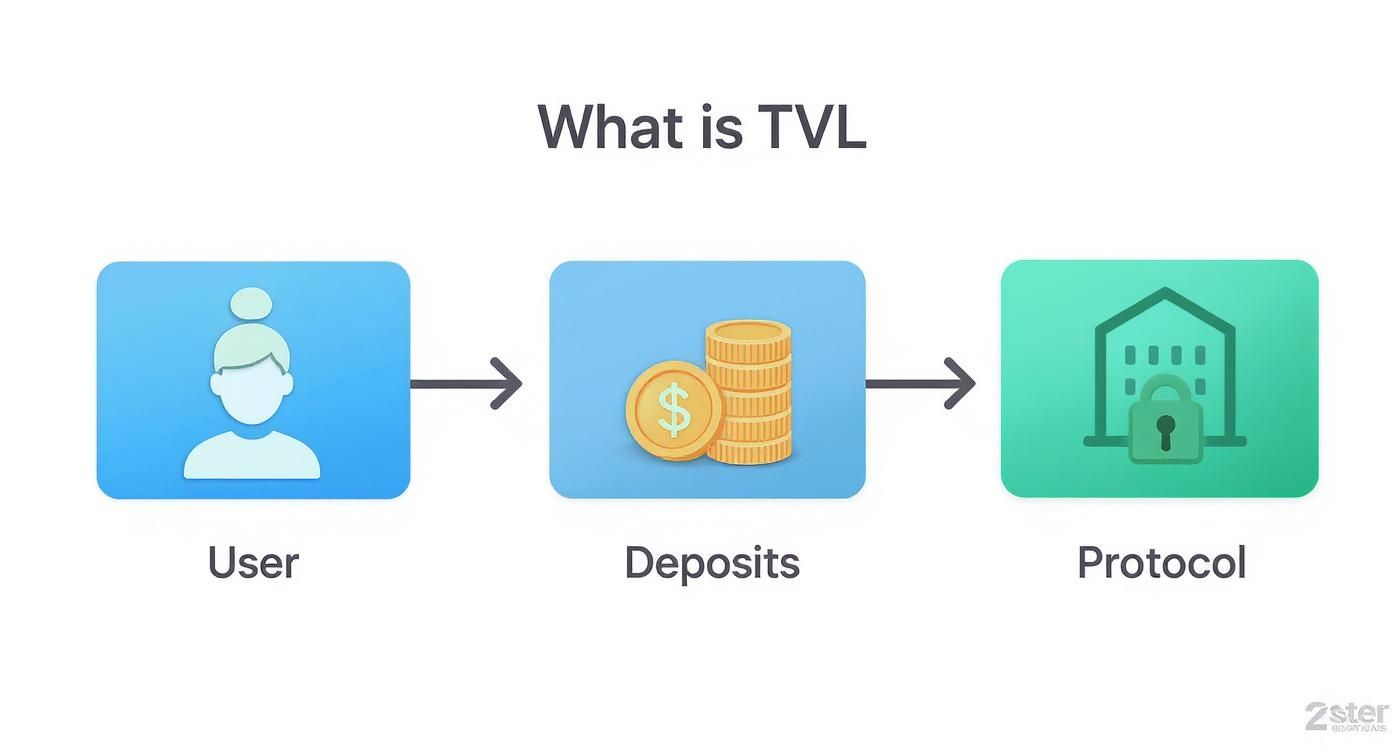
    A diagram illustrating the flow of a user making deposits into a decentralized protocol, explaining TVL.

    This diagram shows the journey from your wallet right into the protocol's shared pool of capital.

    From Protocol TVL to Blockchain TVL

    So how do we get the TVL for an entire blockchain, like Ethereum or Base? It's the same logic, just on a much bigger scale. Data aggregators simply add up the TVLs of every single DeFi protocol running on that chain.

    For example, Ethereum's TVL is the sum of all the assets locked in Uniswap, Aave, Lido, MakerDAO, and the hundreds of other apps built on its network. This chain-level TVL is a powerful gauge of a blockchain's overall health and its dominance in the DeFi world.

    Because TVL is tied directly to asset prices and user activity, it's constantly changing. It goes up and down as people deposit or withdraw funds and as token prices fluctuate, creating a living, breathing measure of capital flow across DeFi.

    Reading the Signals Behind TVL Changes

    A detailed line graph illustrating two data trends with an upward trajectory and specific marked points.

    A protocol's Total Value Locked isn't just a static number on a dashboard; it's the living, breathing pulse of market sentiment and user activity. Learning to read its ups and downs is like learning to read a story unfolding in real-time on the blockchain.

    Every fluctuation tells you something about the collective belief of thousands of users. A steady climb or a sudden nosedive offers powerful clues about a project's health, its appeal to the market, and how secure people think it is.

    What a Rising TVL Tells You

    When a protocol's TVL is climbing, it's usually great news. Think of it as a vote of confidence from the market. This upward momentum can be sparked by a few different things, each telling a slightly different story about the protocol's success.

    A sustained rise in TVL is often the sign of a project hitting its stride and building a loyal community.

    Here are the most common drivers behind a TVL increase:

    • Growing User Trust: More people are depositing their hard-earned assets, which signals that they see the protocol as secure and dependable. This kind of organic growth is the healthiest you can get.
    • Attractive Yields: The protocol might be offering juicy returns on staking, lending, or liquidity pools, pulling in capital from yield farmers hunting for the best profits.
    • New Feature Launches: Dropping a popular new product, like an innovative liquidity pool or a unique borrowing mechanic, can trigger a fresh wave of deposits.
    • Positive Market Sentiment: During a bull run, the price of crypto assets goes up. This naturally inflates the dollar value of the tokens locked in a protocol, boosting its TVL without a single new deposit.

    Understanding a Declining TVL

    On the flip side, a falling TVL can be a major red flag that deserves a closer look. But just like a rising TVL, a drop can happen for many reasons—some are harmless market cycles, while others point to serious, project-specific problems.

    The key is to figure out the why behind the drop. Is it part of a broader market downturn dragging everyone down, or is capital specifically fleeing this project?

    A declining TVL isn't always a catastrophe, but a sharp, isolated drop is a clear signal to investigate further. It could be an early warning of underlying problems that the broader market hasn't noticed yet.

    Common reasons for a drop in TVL include:

    • Security Concerns: Rumors or news of a hack, an exploit, or a potential vulnerability will cause a mass exodus as users rush to pull their funds to safety.
    • Decreasing Yields: When juicy incentive programs end or returns start to shrink, yield farmers pack up their capital and move on to the next protocol offering better rewards.
    • Wider Market Downturn: In a bear market, asset prices fall across the board. This lowers the overall TVL even if the number of users and deposited tokens stays the same.
    • Competitor Success: A rival project—new or old—might launch a more compelling feature that siphons liquidity away from the established protocol.

    Sustainable Growth vs. Temporary Spikes

    A critical skill for any on-chain analyst is telling the difference between real, sustainable growth and a temporary, incentive-fueled spike. A protocol can easily launch a liquidity mining program with massive short-term rewards, causing its TVL to shoot for the moon.

    But this "mercenary capital," as it's often called, usually vanishes the second the rewards dry up. True, sustainable growth is slower and steadier. It's built on a protocol’s genuine utility, a strong community, and a product people want to use even without insane short-term incentives.

    TVL is a vital sign for the health, liquidity, and adoption of DeFi protocols and entire blockchain ecosystems. High and steady TVL points to a robust platform with a strong user base, while sudden drops can warn of a crisis of confidence. You can discover more about how TVL reflects protocol health on GoMining's blog.

    By looking at where the capital is coming from and how long it sticks around, you can make a much better call on whether a project is building something that will last or just enjoying its fifteen minutes of fame.

    Comparing TVL Across Blockchain Ecosystems

    Cartoon illustration comparing the Total Value Locked (TVL) for Solana, Ethereum, and other cryptocurrencies.

    Total Value Locked is a powerful lens for sizing up the DeFi landscape, but its true magic appears when you start comparing it across different blockchains. Not all TVL is the same. The story behind the numbers reveals the unique strengths, priorities, and user bases of competing chains.

    A high TVL on one network might come from lending markets, while another might be dominated by decentralized exchanges. Digging into why the capital is there tells you everything.

    For a long time, Ethereum has been the undisputed heavyweight champion of DeFi. Its first-mover advantage and massive developer community created a network effect that was impossible to ignore, sucking in billions of dollars in capital. This early lead cemented its role as the foundational layer for many of DeFi’s most important protocols.

    Ethereum Versus the Competition

    While Ethereum still wears the crown, the crypto world is anything but a monopoly. A whole host of competitors—often called "alt-L1s" (alternative Layer 1s)—have jumped into the ring, each with its own trade-offs. Blockchains like Solana, Base, and Avalanche have pulled in significant TVL by offering lower fees and faster speeds, making them perfect for high-frequency trading and apps that everyday users can actually afford to use.

    As of early 2025, Ethereum remains the dominant force, with a TVL topping $60 billion. This reflects its deep roots and the sheer variety of protocols built on its network.

    But look elsewhere, and you see a different picture. Cardano, for example, held around $500 million in TVL at the start of 2025. That's a huge difference, and it highlights just how much ecosystems can vary in maturity and user trust. You can find more TVL distribution data on Bitcoin.com Markets.

    This divergence shows that different chains are building their own unique identities. One might become the go-to spot for decentralized perpetuals trading, while another carves out a niche in NFT marketplaces or liquid staking. By analyzing what is driving the TVL on each chain, you get a clear sense of its core purpose and where the real action is.

    TVL Snapshot Across Major Blockchains

    To put this all into perspective, let's look at a quick comparison. This table gives a high-level view of how capital is distributed and what kind of activities are popular across a few major networks.

    BlockchainApproximate TVLTop Protocol by TVLPrimary Use Case
    EthereumHighLido (Liquid Staking)Liquid staking, lending, DEXs
    SolanaMediumMarinade (Liquid Staking)High-speed trading, DeFi apps
    BaseGrowingAerodrome (DEX)SocialFi, DEXs, new projects
    AvalancheMediumAave (Lending)Enterprise DeFi, gaming

    This comparison makes one thing crystal clear: while the total TVL number is a good starting point, the composition of that TVL is far more revealing.

    A chain’s real value isn't just about how much money it holds, but what users are actively doing with that money. To truly answer "what is tvl" for any ecosystem, you have to look past the total and understand the apps and user behaviors that give the number its meaning.

    Why TVL Can Be a Misleading Metric

    While Total Value Locked is a great starting point for sizing up a DeFi protocol, treating it as the only measure of health is a classic rookie mistake. It's a big, impressive number, but it has some serious blind spots and can be shockingly easy to game. Relying on TVL alone is like judging a company's success just by the cash in its bank account—you're completely ignoring its profits, debts, or whether its business model even makes sense.

    To really get the story, you have to look past the flashy TVL figure. A high number can create a false sense of security, hiding huge risks that could put your funds on the line. Understanding these limitations is the first step to becoming a sharper on-chain analyst.

    The Double Counting Problem

    One of the biggest illusions in TVL, especially when you zoom out to the entire blockchain level, is double-counting. This happens all the time in DeFi's "money lego" system, where the same asset gets counted over and over as it moves between different protocols.

    Here’s a simple example:

    1. You deposit 10 ETH into a liquid staking protocol like Lido. This 10 ETH now counts toward Lido's TVL.
    2. You receive stETH (staked ETH) in return.
    3. You then deposit that stETH as collateral in a lending protocol like Aave.
    4. The value of that stETH just got counted again in Aave’s TVL.

    The result is that your initial 10 ETH now looks like 20 ETH of value locked on-chain. This inflates the blockchain’s total TVL and gives you a distorted picture of how much unique capital is actually securing the ecosystem.

    How TVL Can Be Manipulated

    Shady actors can, and do, manipulate TVL to make their project look bigger and more trustworthy than it is. A common trick involves wash trading or using low-utility tokens created by the project’s own team to pump up the numbers.

    It usually plays out like this:

    1. Token Creation: A new, unknown protocol launches its own token.
    2. Liquidity Provision: The developers use their own funds to create a liquidity pool for this token on a DEX, which sets an initial price.
    3. Inflation: They then lock up a massive supply of their own token within their protocol. Since TVL is calculated by multiplying the token count by its price, the number skyrockets.

    This trick creates a massive TVL that fools investors into thinking there's real traction, even when very little legitimate, external capital is actually involved.

    TVL might show how much capital is parked in a protocol, but it says zero about whether its token will actually perform. You can have billions "locked," but that doesn't mean the token has any real value or won't dump to zero.

    What TVL Does Not Tell You

    At its core, TVL is a measure of capital accumulation, not a scorecard for performance or sustainability. A huge TVL tells you nothing about the fundamentals.

    Think about all the critical pieces of the puzzle it leaves out:

    • Profitability: A protocol can have billions in TVL but generate almost no real revenue for its treasury or token holders.
    • Security: A high TVL just makes a protocol a juicier target for hackers. It's not a badge of honor guaranteeing audited, battle-tested smart contracts.
    • User Activity: It can't tell the difference between a few whales depositing huge sums and a vibrant community of thousands of genuinely active users.

    In fact, recent studies have busted the myth that high TVL leads to strong token returns, finding no real correlation. This just hammers home the point: you have to pair TVL with other, smarter metrics. For a more complete toolkit, our guide on the top metrics for liquidity pool performance is a great next step. TVL is just one piece of a much larger puzzle.

    How to Use TVL in Your Crypto Research

    Knowing what Total Value Locked means is one thing, but actually using it to make smarter trades is a whole different ballgame. It's time to turn that raw data into actionable intelligence. When you know what to look for, TVL becomes a powerful lens for spotting genuine opportunities and sidestepping potential risks.

    Instead of just glancing at the big headline number, you can use TVL to size up competing protocols, get a read on market sentiment, and even find assets that might be mispriced. The trick is to stop being a passive observer and start actively digging into the data. That means using tools like DeFiLlama not just to see a number, but to understand the story behind it.

    Finding Promising Protocols with TVL Growth

    One of the most straightforward ways to leverage TVL is to hunt for projects with strong, consistent growth. A protocol whose TVL is on a steady upward climb is a clear sign that it’s earning the trust of users and capturing market share. That kind of organic growth is infinitely more telling than a sudden, one-off spike.

    Here’s a simple workflow you can use to start finding these gems:

    1. Head to an Aggregator like DeFiLlama: Open up the main dashboard to get that 30,000-foot view of the entire DeFi space.
    2. Filter by Chain: Zero in on the ecosystem you’re interested in—whether that's Ethereum, Solana, Base, or something else entirely.
    3. Sort by TVL Change: Look for protocols showing solid TVL growth over the last 7-day and 30-day periods. This immediately filters out the short-term noise and helps you focus on projects with real momentum.
    4. Dig Into the Chart: Once a protocol catches your eye, click on it and study its historical TVL chart. Is the growth steady and consistent, or was it just one massive deposit? Smooth, steady inflows are the signal you’re looking for.

    Following this process helps you quickly build a shortlist of protocols that are gaining legitimate traction. It's a fundamental first step in any solid on-chain analysis strategy.

    Using the TVL-to-Market Cap Ratio

    Ready to level up? A more advanced technique is to compare a project's TVL to its market capitalization. This simple ratio can be a fantastic tool for spotting potentially undervalued or overvalued assets. It all boils down to one question: how much capital is locked in the protocol versus what the market thinks the entire project is worth?

    The formula is dead simple: Market Cap / TVL.

    • A ratio below 1.0: This could be a flashing sign that the project is undervalued. Its market cap is smaller than the capital it secures, suggesting there might be serious room for growth if the market wakes up and reprices it.
    • A ratio above 1.0: This might mean the project is overvalued, or that the market has incredibly high expectations for its future growth. The token's valuation is running ahead of the actual capital locked in its ecosystem.

    This ratio isn't a magic bullet, but it's an incredibly powerful filter. A low ratio should immediately make you ask why. Does the protocol have terrible tokenomics? Is it generating zero revenue? Or is it a hidden gem that the market has completely overlooked?

    Monitoring and Setting Alerts

    To truly get ahead of the curve, you need a system. Manually checking dashboards every day just isn’t going to cut it. The smart move is to build a simple workflow to monitor the protocols you care about.

    This is where platforms like Wallet Finder.ai come into play. While it’s not a direct TVL alert system, you can track the on-chain movements of smart money wallets that interact with a protocol—giving you a powerful early signal.

    When you see top traders start depositing huge sums into a protocol, that's a massive vote of confidence that often comes right before a big jump in TVL. By setting up a watchlist of key wallets or protocols, you can get real-time notifications and react instantly to significant capital flows.

    Got Questions About TVL? We've Got Answers.

    As you get more comfortable with Total Value Locked, a few common questions always pop up. Let's run through them to sharpen your understanding and make sure you’re using the metric like a pro.

    TVL vs. Market Cap: What’s the Real Difference?

    It’s easy to mix these two up, but they tell completely different stories.

    MetricWhat It MeasuresWhat It Represents
    Market CapTotal value of all circulating tokens (Price x Supply).Market sentiment, speculation, and future growth potential.
    TVLTotal value of assets locked inside a protocol's smart contracts.User trust, liquidity, and current platform utility.

    A project can have a sky-high market cap fueled by hype but a tiny TVL, which is a red flag suggesting nobody's actually using the thing. The flip side is also true, making the TVL-to-Market Cap ratio a powerful gut check for analysts.

    Is a High TVL a Guarantee of Safety?

    Absolutely not. Let's be crystal clear on this: a high TVL indicates user trust and deep liquidity, but it is not a security guarantee. If anything, it just paints a bigger target on the protocol's back for hackers.

    DeFi's history is littered with the ghosts of protocols that had billions in TVL before a single smart contract bug led to a catastrophic exploit.

    Always pair TVL analysis with your own digging. Check for security audits, look into the team's reputation, and understand how the protocol is built. A high TVL means it's popular, not invincible.

    Bottom line: never deposit your funds into a DeFi protocol based on its TVL alone. Do your own homework, every single time.

    How Do I Track the TVL of a New Project?

    For this, you'll want to use an on-chain data aggregator, which is the industry-standard tool. It’s pretty straightforward.

    1. Pick Your Platform: Head over to a trusted site like DeFiLlama. It’s the go-to for tracking TVL across nearly every chain and protocol imaginable.
    2. Find the Project: Just type the protocol's name into the search bar.
    3. Dig into the Data: You’ll get a dashboard showing its current TVL, historical charts, and where it stacks up against others in its ecosystem.

    This is the exact method pros use to watch capital move around DeFi in real-time.


    Want to see where smart money is heading before it gets locked up and reflected in TVL charts? With Wallet Finder.ai, you can track the top wallets in real-time, get instant alerts on their trades, and spot opportunities before the crowd catches on. Start your 7-day trial and turn raw on-chain data into your competitive edge at https://www.walletfinder.ai.

Copy Winning Trades Instantly

4.9 Rating based reviews on

Product of the Day Badge

"I've tried the beta version of Walletfinder.ai extensively and I was blown away by how you can filter through the data, and the massive profitable wallets available in the filter presets, unbelievably valuable for any trader or copy trader. This is unfair advantage."

Portrait of a man with short dark hair and beard wearing a dark t-shirt, smiling softly against a plain white background.

Pablo Massa

Experienced DeFi Trader