Coin Market Cap ADA Explained for Traders
Decode the Coin Market Cap ADA page. Learn what ADA's market cap means, how to read the data, and combine it with on-chain wallet tracking for smarter trades.

April 22, 2026
Wallet Finder

April 22, 2026

You search a token name, skim a few results, see the word staking, and your brain fills in the rest. Yield. Validators. Lockups. APR math. That reflex is common in crypto, and it’s exactly why traders get trapped by bad assumptions before they even reach the wallet-analysis stage.
aero staking inc is a useful case study because the name sounds native to DeFi, but the actual company has nothing to do with blockchain. It’s an aerospace tooling manufacturer. That mismatch is more than a funny search error. It shows how easily surface-level research can point you toward the wrong conclusion, especially when a project name sounds familiar, technical, or adjacent to crypto language.
A junior trader usually thinks due diligence starts on-chain. It doesn’t. It starts with a simpler question.
Are you even researching the right thing?
A trader sees “Aero Staking Inc” and assumes it might be a new protocol, a validator service, or some aviation-themed DeFi project. The name has the right ingredients. “Aero” sounds futuristic. “Staking” sounds native to crypto. “Inc” makes it look official.
Then the search results get weird.
One documented issue is that Aero Staking Inc’s aerospace specialization doesn’t come through clearly in search, and some results even describe it as serving “inline, roller, and skateboard enthusiasts”, which creates confusion for both aerospace buyers and crypto users trying to identify what the company does, as noted on the Aero Staking FAQ discussion of search confusion.
That’s the kind of moment where sloppy research turns expensive.
Crypto attracts branding games. Some are deliberate. Some are just lazy. Either way, the market doesn’t care why you got confused. If you misidentify the entity behind a name, every downstream step gets corrupted:
Practical rule: Before you analyze token flows, verify that the name, company, product, and domain all belong to the same entity.
The aero staking inc example isn’t just about one company name. It exposes a broader due diligence failure mode. Traders often search for confirmation, not identity. They want the fast answer, not the correct one.
That habit is dangerous in crypto because naming overlap is common. A protocol can sound like an exchange. A token can sound like a real business. A brand can borrow language from a different industry and still look plausible long enough to fool a rushed investor.
If you want to stay out of low-quality setups, treat off-chain verification as your first filter, not your last.
Aero Staking Inc belongs to the aerospace tooling field. It builds precision equipment used to install, remove, and test bearings in aircraft and related systems.

That distinction matters because a fast search can mislead a trader. The word "staking" pulls your attention toward DeFi, but the company itself operates in manufacturing. According to Aerospace Defense Review’s company profile of Aero Staking, Inc., its history traces back to a World War II Polish munitions factory that was later repurposed for aircraft parts production. The same profile describes a long operating history in aerospace bearing tools.
The simplest way to verify identity is to look at what the company sells and who buys it.
Aero Staking makes tools for bearing installation, bearing removal, and bearing testing. Its product line includes tri-roller machines, anvil tools, cutters, extractors, proof load testers, and torque breakaway tools. Those are shop-floor products for aerospace production and maintenance teams, not financial products for token holders.
If you're newer to this terminology, compare the research process to reading a token dashboard. In crypto, you would check token supply, validator design, or protocol fees. Here, the equivalent clues are product catalogs, engineering terms, customer types, and certification language. The company passes the identity test for an industrial manufacturer, not a blockchain project.
You can also compare the language around its business with a plain-English guide to how staking works in DeFi. The gap is immediate. One side talks about bearings, retention tools, and maintenance environments. The other talks about locking digital assets into a protocol.
In aerospace, staking refers to a physical retention method. A tool applies force so a bearing stays secured under stress, vibration, and strict performance requirements. That use of the word sits much closer to fastening and machining than to yield generation or validator participation.
This is the kind of detail rushed investors skip.
A legitimate company with a real website and real products can still be irrelevant to your trade. That is the lesson here. Off-chain due diligence is not just about asking whether an entity exists. It is about asking whether the entity you found matches the thesis you are building.
A careful analyst checks four things before going any further: the domain, the product language, the industry context, and the customer base. In Aero Staking Inc's case, those signals point to aerospace manufacturers, subcontractors, end users, and MRO facilities. That is a clean identity match for an industrial toolmaker. It is not a crypto protocol wearing a technical-sounding name.
The confusion starts with one word: staking. But in practice, aerospace staking and crypto staking have almost nothing in common.
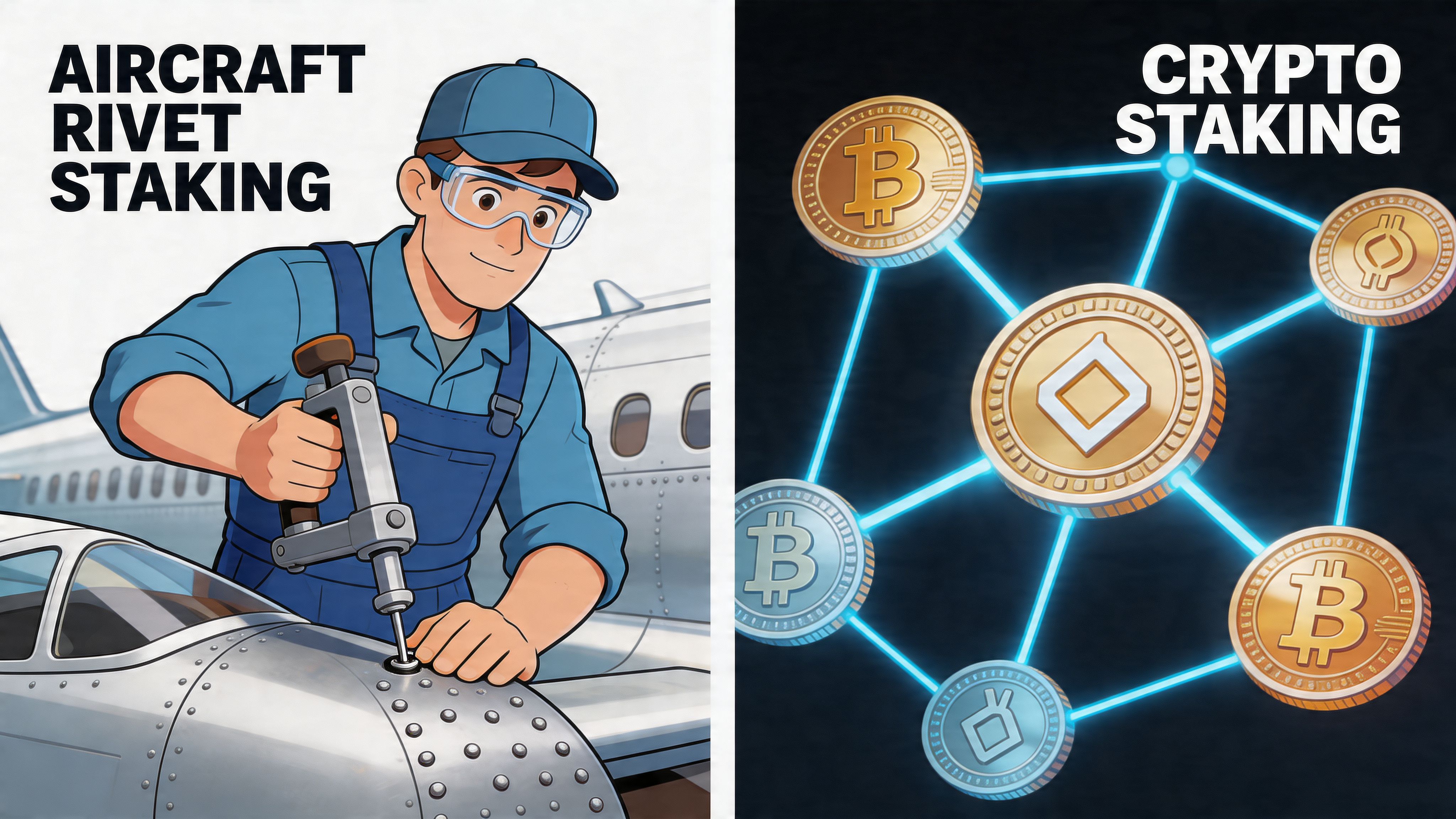
Aero Staking Inc specializes in Tri-Roller Swaging Tools (AST-series) used to install MS14103 bearings by applying controlled radial force and deforming the outer race into V-grooves, which creates a mechanical lock for high-vibration environments like turbine engines, according to the Aero Staking specifications page for cutting tools and cutters.
That same source states that these tools operate with ±0.001 inches tolerance, reduce installation time by 40% compared to other methods, support proof load capacities over 5,000 lbs, and achieve 99.5% first-pass success in production settings.
This is manufacturing language, not protocol language.
If you’re new to aerospace terms, think of it this way. The tool doesn’t “stake tokens.” It physically shapes metal so a bearing stays locked in place under stress and vibration. It’s closer to precision fastening than anything in finance.
Crypto staking means locking assets into a blockchain or protocol process. You’re supporting validation, governance, security, or some reward mechanism. No one is deforming a metal race into a groove. No proof load machine is pressing against a component. The “stake” is economic, not mechanical.
If you want a cleaner primer on the DeFi meaning of the term, this guide on staking in DeFi gives the blockchain-side context.
| Term | Aerospace meaning | Crypto meaning |
|---|---|---|
| Staking | A mechanical process used to secure bearings or components | Locking digital assets into a protocol or network mechanism |
| Primary object | Physical parts and tooling | Tokens and smart contracts |
| Success criteria | Precision, retention, compliance, repeatability | Security, yield, participation, incentive alignment |
| Failure mode | Improper installation or component movement | Slashing, smart contract risk, token dilution, illiquidity |
| Evidence | Engineering specs, tool tolerances, test procedures | On-chain activity, contract code, wallet behavior |
The problem isn’t just vocabulary. It’s pattern matching.
A junior trader sees “AST-series,” “testing,” “compliance,” and “integrity,” then unconsciously maps those words into crypto ideas like audits, validator health, and staking infrastructure. That’s a mistake. The words sound technical in both domains, but they refer to different systems.
Use context clues to reset your interpretation:
The smartest traders don’t just ask, “Is this legit?” They ask, “Is this even the same category of thing I thought it was?”
That question saves money.
Once you’ve seen how easy it is to misread a name like aero staking inc, the next step is building a repeatable process. A good framework protects you from confusion before it turns into conviction.

One useful lesson from the Aero Staking case is that publicly available information lacks details on competitive environment, pricing, lead times, specific geographic market share, customer testimonials, and supply chain performance, which makes those areas important due diligence targets when evaluating any business, as noted on the Aero Staking contact-page research summary.
That point applies well beyond aerospace.
Before you evaluate upside, verify the basic object in front of you.
Ask:
A lot of bad research starts with skipping those basics. Traders jump straight to token charts because the chart is easy to parse. Identity work is slower, but it filters out nonsense fast.
The next layer is whether the project functions as described.
Look for evidence in several buckets:
Here’s where the aero staking inc example helps. Information gaps aren’t automatic disqualifiers, but they are a signal to investigate harder. If pricing, lead times, customer proof, or market position remain fuzzy, you don’t fill the gap with optimism. You mark it as unresolved.
Field note: Missing information isn’t the same as fraud. But in investing, unanswered questions should lower your confidence until evidence raises it again.
| Check Point | What to Look For | Red Flag Example |
|---|---|---|
| Name verification | Exact project name, official domain, consistent branding across channels | Search results point to unrelated businesses or mixed industries |
| Entity check | Registered company, foundation, or documented operator structure | No identifiable operator behind the project |
| Team review | Public profiles, prior work, relevant technical or market experience | Anonymous team with no verifiable history |
| Product validation | Live product, usable interface, code references, documentation | Landing page only, no working product |
| Narrative consistency | Whitepaper, website, and community all describe the same thing | Different channels describe different missions |
| Market analysis | Clear competitors and a reason the project stands out | “No competitors” claim or vague category definition |
| Token design | Supply logic, unlocks, utility, treasury purpose | Overly complex tokenomics with unclear beneficiaries |
| Community quality | Questions get answered, discussion is specific, admins are coherent | Engagement is mostly hype, giveaways, and price talk |
| Legal and compliance posture | Terms, disclosures, jurisdictional clarity where relevant | No legal pages, no risk disclosures, no responsible operator named |
Don’t do your research in a random order. Use a sequence.
Check names, domains, and entity records first.
Read the homepage and docs with one goal. Confirm what the project actually is in plain English.
Search for contradictions. If the website says one thing and community chatter says another, stop and resolve the mismatch.
List the unanswered questions. Good analysts write them down instead of hand-waving them away.
Only after that should you move to deeper technical and on-chain verification.
That process sounds basic. It is. Basic work done consistently beats clever work done late.
Red flags often show up before the smart contract does. The branding tells on the project if you know how to read it.
The aero staking inc case shows one version of this. A name can sound crypto-native while pointing to a totally different industry. That doesn’t mean Aero Staking itself is deceptive. It means your interpretation can be, especially if you move too fast.
Real engineering companies usually talk in concrete terms. Product names. Test procedures. Compliance standards. Specific use environments.
For example, Aero Staking’s testing tools are described as critical because bearing failure contributes to 8% of in-flight incidents, and those tools apply forces up to 10,000 lbs while cutting inspection cycles from 2 hours to 20 minutes, according to the Aero Staking testing specifications summary.
That’s what substance looks like. You can agree or disagree with a business case, but you’re not left guessing what the tools are for.
A lot of weak crypto projects do the opposite. They use technical-sounding language without tying it to specific operations, users, or verifiable outputs.
For a practical checklist on early scam signals, this piece on how to run a rug check in crypto is worth reviewing.
If branding creates confusion and documentation doesn’t resolve it quickly, treat that as a warning. Clear projects reduce ambiguity. Weak projects often depend on it.
Don’t ask whether the project looks exciting. Ask whether it survives boring questions.
What does it do?
Who runs it?
Why does the token need to exist?
What can you verify today without trusting the marketing?
That discipline won’t make every trade a winner. It will keep you out of many avoidable mistakes.
The Aero Staking Inc mix-up shows why on-chain analysis comes second, not first.
If a trader types “aero staking” into search, sees a familiar-sounding name, and jumps straight to wallet activity, the whole process starts on the wrong foundation. It is like checking the foot traffic inside a building before confirming you have the right address. Clean charts and active wallets mean little if the entity behind the name is unrelated to crypto.

Once you have verified the project off-chain, confirmed the correct token, and matched official contract addresses, on-chain tools become far more useful. A platform for tracking wallet behavior and token flows helps you test whether market activity supports the story the project is telling.
Start with a simple rule. First identify the project. Then study the wallets connected to it.
That sequence matters because wallet data is evidence, not context. Context comes from the company, protocol docs, team disclosures, contract addresses, and product claims you verified earlier.
With that groundwork in place, examine a few questions:
A good process feels almost boring. That is a strength.
Start by mapping the wallet universe around the token. Separate what you know from what you suspect. Treasury wallets, founder-associated wallets, liquidity wallets, early accumulators, and repeat high-conviction buyers each play a different role. If you skip this step, every address looks equally important, which leads to weak conclusions.
Next, check concentration. A token can appear healthy because volume looks active and social sentiment is positive, yet still be fragile under the surface. If a small cluster of wallets controls too much supply, one coordinated exit can change price behavior fast. That does not always kill the trade. It does change position sizing, time horizon, and your tolerance for volatility.
Then study behavior over time.
A static wallet snapshot is like a single frame from a surveillance camera. You need the sequence. When did strong wallets enter? Did they buy gradually or chase one candle? Are they still holding, trimming, or rotating out? Do insider-linked wallets behave differently from outside participants? Those timing patterns often reveal more than a holder list alone.
Strong wallet analysis comes from repeated behavior across credible addresses, not from attaching too much meaning to one famous wallet.
Say you find a project that claims to be building DeFi infrastructure. You already checked the legal entity, website, team pages, documentation, token ticker, and official contract address. Now the on-chain work begins.
At that stage, you are not asking, “Is this name interesting?” You are asking sharper questions. Is the contract being used in a believable way? Are treasury movements consistent with stated goals? Are experienced participants accumulating, providing liquidity, or leaving? Do token flows support the growth story, or do they point to distribution dressed up as momentum?
That loop is where junior traders often improve the most. Many can read a narrative. Fewer can test it against wallet behavior.
The Aero Staking Inc example is useful because the mistake is so easy to make. The name sounds crypto-adjacent. Search results can blur categories. A trader in a hurry can attach a token thesis to the wrong entity before doing even basic verification.
Using an on-chain tool after you clear that confusion gives you something much more reliable than social proof. You can inspect whether capital is behaving with conviction, whether wallet clusters create hidden risk, and whether the market structure matches the project’s public image.
That is the core lesson here. Off-chain research tells you what you are looking at. On-chain research helps you judge how participants with money at risk are acting around it.
Keep this checklist simple:
Crypto punishes rushed pattern-matching. A name that sounds right is not evidence. A wallet dashboard is not a substitute for identification. Put those pieces in the right order, and tools like Wallet Finder.ai become far more effective.
The aero staking inc case is useful precisely because it’s so ordinary. A name sounds crypto-related. Search results are messy. Assumptions pile up. That’s how bad research usually begins. Not with a dramatic scam, but with a small identity error nobody bothered to fix.
The actual company behind the name is an aerospace tooling manufacturer with a serious engineering background. That fact matters less than the lesson it teaches. You can’t evaluate an investment if you haven’t correctly identified the entity, category, and evidence trail first.
Strong due diligence has two parts. First, do the off-chain work. Verify the name, company, team, product, and claims. Second, do the on-chain work. Check wallet behavior, distribution, treasury movement, and actual participation. One without the other leaves gaps.
Your edge in crypto often comes from refusing to be rushed. Clarity before conviction beats excitement before evidence.
If you build that habit, you’ll avoid more than name confusion. You’ll avoid a large share of the avoidable losses that hit traders who chase narratives before verifying reality.
If you want a faster way to turn on-chain activity into something actionable, Wallet Finder.ai helps you track profitable wallets, study token flows, monitor smart money behavior, and verify whether market actions support a project’s story before you commit capital.