Chainlink Staking Rewards: A Trader's Guide for 2026

Wallet Finder

Blank calendar icon with grid of squares representing days.

June 6, 2026

Most advice on Chainlink staking gets one thing wrong. It treats the quoted reward rate like a deposit account yield. That's not how this works.

If you stake LINK because you saw a headline APY and assumed that's what will hit your wallet over the next few months, you're already using the wrong model. Chainlink staking rewards depend on mechanics that many guides skip: reward distribution design, lock behavior, ramp-up timing, cooldown constraints, and your own actions after staking.

For a trader, that gap matters more than the marketing line. Your realized return isn't just about the annualized number. It's about whether your LINK stays locked while price moves, whether you reset your own reward timing, and whether the position still makes sense against your alternative uses of capital. If you want a broader grounding in how staking rewards differ across networks, this guide to staking rewards by blockchain is a useful companion.

What Chainlink Staking Rewards Are Really Worth

Headline APR is the wrong number to anchor to if you trade around positions.

What matters is realized return over your actual holding period, after you account for reward vesting, cooldown friction, and the chance that you change the position before rewards fully mature. Chainlink's official Staking v0.2 overview explains the mechanics at a high level, and those mechanics are exactly why two wallets can face very different outcomes even if both entered at the same advertised rate. For a broader benchmark on how these trade-offs show up across networks, this guide to staking rewards by blockchain is a useful comparison.

The main gap is simple. Quoted APR assumes time and behavior you may not give the position.

Many YouTube explainers and staking roundup posts focus on the displayed annual rate because it is easy to compare across tokens. That shortcut breaks down with Chainlink staking. If you stake LINK, add more later, or start planning an exit before rewards have fully ramped, your wallet-level return can land well below the headline figure.

Why the advertised rate can overstate your P&L

A passive holder who plans to leave LINK staked through the full cycle can use the quoted rate as a rough baseline. An active trader cannot.

Your actual outcome depends on a few practical questions:

  • How long will you keep the position live? Annualized yield means less if you may rotate out on the next major move.
  • Will you top up the same staking address later? Chainlink documentation notes that wallet actions can affect how rewards accrue and when they become fully available.
  • Can you tolerate the exit friction? Cooldown and unbonding mechanics matter if volatility spikes and you need capital elsewhere.

That last point is where a lot of P&L gets misread. A staking position is not only a yield line item. It is also a liquidity decision.

What the rewards are actually worth

Chainlink staking rewards are worth more to investors who already intended to hold LINK and can accept reduced flexibility. They are worth less to traders who value fast redeployment, trade around catalysts, or scale in and out frequently.

The clean way to judge the position is to compare expected realized staking return against the opportunity cost of having LINK tied up under Chainlink's staking rules. If the spread is small, the headline APR is mostly noise. If the spread is wide enough to cover liquidity risk and execution constraints, staking can make sense.

How Chainlink Staking Generates Rewards

Chainlink staking isn't just passive yield. It's economic backing for oracle performance.

The simplest analogy is a security deposit. Stakers lock LINK to help support honest, reliable oracle services. In return, they earn rewards through the staking system. That framing matters because it explains why rewards exist at all. You're not just collecting emissions in a vacuum. You're taking part in a security model.
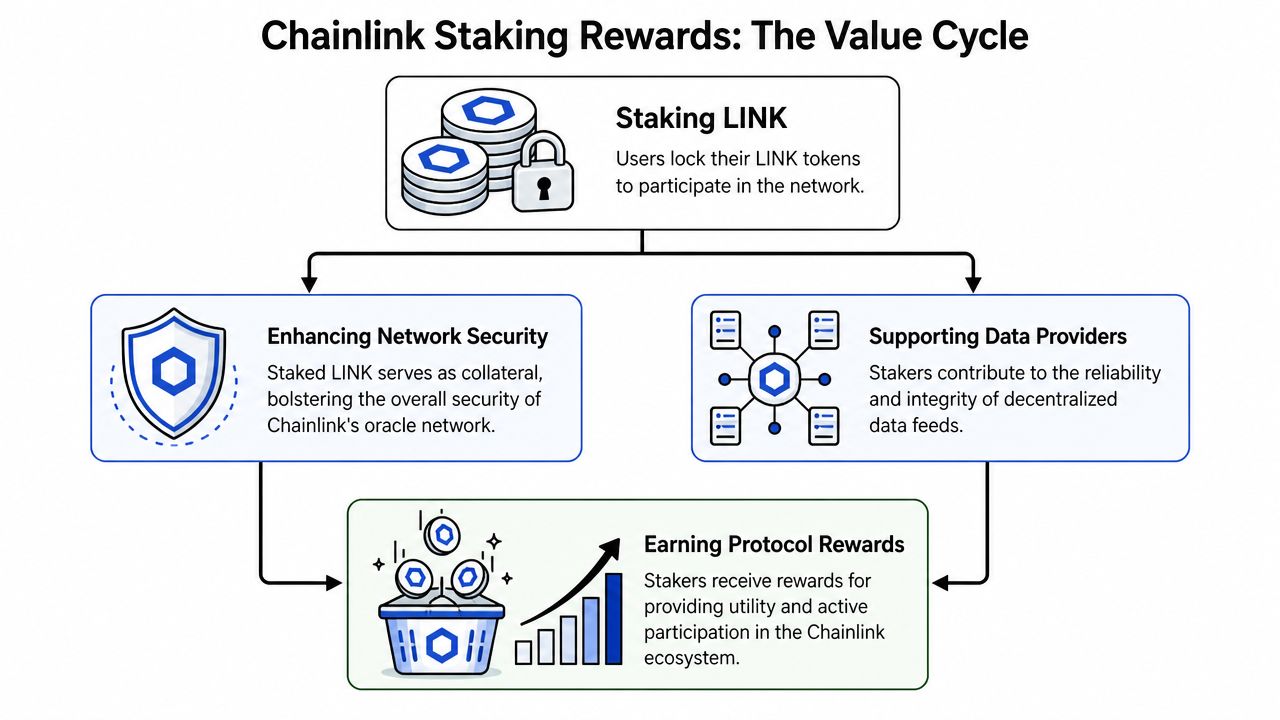
A diagram illustrating the Chainlink staking value cycle from locking tokens to earning protocol rewards.

The basic value cycle

At a high level, the process looks like this:

  1. You lock LINK into the staking system.
  2. That stake strengthens network security by adding economic weight behind oracle reliability.
  3. The protocol distributes rewards to participants in line with staking mechanics.

This is why staking LINK should be judged differently from farming a transient incentive program. The position ties your capital to a network service role, not just to short-term token distribution.

Community stakers and node operators

Chainlink separates participation into distinct pools with different roles. The key distinction is between community stakers and node operator stakers.

Community stakers are the closer fit for most token holders. They stake LINK to participate in network security and receive staking rewards under the protocol's rules. Node operators play the operational role inside the oracle network and have a different reward profile.

That distinction matters because your reward stream isn't isolated from the broader staking structure. Community staking may look simple from the front end, but the system is built around role-based incentives underneath.

What experienced traders usually miss

A lot of market participants still evaluate chainlink staking rewards like this:

  • quoted annualized rate
  • expected token payout
  • done

That shortcut misses the important part. Mechanics drive realized outcomes. The protocol design determines how rewards accrue, when they become economically meaningful, and what trade-offs you accept to earn them.

Treat Chainlink staking like a portfolio sleeve with its own liquidity terms, not like idle cash earning a fixed return.

What tends to work and what doesn't

Here's the practical split:

  • Works well for conviction holders: If LINK is part of a longer-duration thesis and you don't expect to rotate fast, staking can align with that view.
  • Works poorly for tactical traders: If you regularly move inventory around events, staking adds friction.
  • Works best when monitored: Reward conditions and participation dynamics aren't static, so a one-time decision is rarely enough.
  • Fails when treated as guaranteed yield: The protocol structure is more nuanced than that, and your own wallet behavior can change the payoff path.

How to Estimate Your Real Staking APR

The quoted APY is the least useful number in the model if you trade around it like cash yield. Real return depends on how long your LINK stays staked, whether rewards are still ramping, and whether your own wallet actions reset part of the reward path.

Chainlink documents the reward structure in practical terms on its staking concepts and FAQs page. For community stakers, the headline base rate is not the number to underwrite blindly because part of community rewards is redirected to node operator stakers, and some rewards mature over time instead of becoming fully usable from day one.

Start with the benchmark that matches your wallet

Use the effective community reward rate as your anchor, not the advertised top-line figure. Then adjust that number for your expected holding period.

That matters because annualized rates compress a lot of friction into one clean number. If you stake for a shorter window, add to the same address later, or start an exit process before rewards have fully matured, your realized APR will usually come in below the rate used in promos and dashboards.

If you want a quick refresher on how quoted annual rates can diverge from what you earn, this APR vs APY calculator guide helps frame the math.

What actually moves your realized return

ComponentWhat it means in practiceImpact on Your APR
Effective community rateCommunity stakers do not keep the full headline reward stream.Your real starting benchmark is lower than the advertised base rate.
Variable distributionRewards depend on protocol parameters and pool conditions, not a fixed personal payout.Your return can drift from the number you first modeled.
Reward ramp-upA portion of rewards matures over time instead of behaving like fully earned yield immediately.Shorter staking periods tend to realize less than the annualized quote suggests.
Wallet top-upsAdding LINK to an address that is already staking can affect the reward ramp for locked rewards.Active position management can reduce near-term yield.
Exit timingThe moment you decide to unstake matters, not just the day you entered.Poor timing can leave part of the expected annualized return unrealized.

A more useful estimation method

Start with the effective community rate. Then haircut it based on your likely behavior, not your ideal behavior.

For a passive holder who expects to leave the position alone for a long stretch, the gap between advertised and realized return can be modest. For an active trader, that gap is usually wider. The common mistake is modeling a full-year rate on a position that will probably be adjusted, partially exited, or rotated if market structure changes.

I use a simple three-question filter:

  1. How long will this wallet realistically stay untouched?
    If the honest answer is "until the next major move in LINK," use a lower working APR than the posted rate.

  2. Will you add to the same staking address later?
    If yes, account for the chance that reward ramp mechanics reduce what you expected to earn in the near term.

  3. What is your likely exit path?
    If you may need liquidity on short notice, the posted annualized rate is only part of the trade. The timing friction changes the actual economics.

Market estimates are references, not your return

Third-party staking trackers are useful for context, but they do not tell you what your wallet will earn. Staking Rewards' Chainlink page provides a market view of estimated staking yield, and P2P.org's Chainlink staking guide also describes the reward model as dynamic rather than fixed. Those estimates are fine for benchmarking. They are weak inputs for position sizing unless you also model ramp-up and wallet behavior.

Practical rule: build your estimate from the effective community rate, trim it for the early staking period, and assume any wallet changes make your realized APR worse, not better.

That approach is less flattering than the headline APY. It is also closer to what hits your P&L.

Understanding Slashing and Other Staking Risks

Advertised staking yield gets too much attention because the ugly part sits in the fine print. For Chainlink stakers, the bigger question is simple: what can reduce your token count, trap your liquidity, or turn a decent-looking APR into a bad trade?

The first risk is slashing. If the staking system penalizes behavior tied to oracle performance or security conditions, principal is part of the risk budget. That matters because this is not a pure savings product. You are accepting protocol risk in exchange for rewards.

An infographic detailing four primary risks associated with Chainlink staking, including slashing penalties, vulnerabilities, and market volatility.

Liquidity risk usually hits P&L before slashing does

For active traders, the bigger day-to-day risk is often liquidity friction. Chainlink staking includes a cooldown and unstaking process, and the protocol has been described by Chainlink as still operating in beta. The practical takeaway is straightforward. You may not be able to exit on your preferred timeline.

That changes the trade materially.

A posted APY can look fine on a dashboard and still lose to holding liquid LINK if the market moves during your cooldown window. This is the gap many staking guides skip. Realized return depends on whether you can act when price, basis, or hedge conditions change.

The risk stack traders tend to underprice

Smart contract risk

Staking contracts can fail, behave unexpectedly, or expose users to implementation risk even when the broader protocol thesis remains intact. If you stake, you accept contract-level exposure on top of LINK price exposure.

Market risk during restricted exits

Rewards are paid in LINK. Your portfolio is still marked to market in LINK. If price drops while you are waiting through staking workflow constraints, the extra tokens may not offset the drawdown.

Opportunity cost

This one sounds boring and costs real money. Capital tied up in staking cannot be redeployed quickly into perp hedges, spot rotations, or collateral transfers when the market gives you a better setup.

Parameter risk

Staking terms matter more than many holders assume. Cooldowns, pool capacity, reward changes, and other design choices shape realized returns. If those mechanics change your flexibility, they also change the true value of the yield.

How to assess principal risk without overcomplicating it

Use two separate tests:

  • Token-count risk: Can staking reduce the number of LINK you hold under adverse protocol conditions? Yes. Slashing exists for a reason.
  • Portfolio-value risk: Can staking still underperform liquid spot even if your LINK balance rises? Yes. Price moves, cooldown delays, and missed trades can easily outweigh earned rewards.

I treat Chainlink staking as paid exposure to protocol and liquidity constraints. Traders who ignore that usually compare the reward rate to zero and call it yield. The actual comparison is staking versus keeping LINK fully usable.

Good staking decisions come from pricing the exit friction and downside path first, then deciding whether the reward is high enough to justify it.

Developing a Strategy for Chainlink Staking

A good Chainlink staking strategy starts with one uncomfortable question. Is this a yield decision, or a portfolio structure decision?

If it's only about squeezing extra LINK out of a passive balance, you'll probably overallocate. If it's a portfolio decision, you'll think about liquidity, optionality, and conviction first.

A focused investor strategizing Chainlink staking rewards with charts and tokens on a workspace desk.

Split your LINK by job, not by habit

Most traders do better when they divide holdings into functional buckets:

  • Core position: LINK you already intend to hold through noise and don't need for fast rotation.
  • Trading inventory: LINK you may sell, hedge, or rebalance on short notice.
  • Reserve liquidity: Tokens kept flexible for collateral, tactical entries, or market dislocation.

Staking usually belongs in the first bucket only. When traders stake from the second bucket, they create self-inflicted liquidity problems.

Match staking size to your behavior

A few practical filters help:

  • If you trade around catalysts often, keep more LINK liquid.
  • If your Chainlink thesis is long duration, staking can fit better because you're already accepting time exposure.
  • If you're unsure whether you'll need the position, err on the side of under-staking. Regret from idle spot is usually cheaper than regret from trapped capital.

When staking tends to make sense

Staking is usually more defensible when your thesis already looks like this:

  1. You want exposure to LINK regardless of short-term noise.
  2. You don't need immediate portfolio flexibility.
  3. You're willing to monitor protocol conditions instead of treating the position as static.

That last point matters. Chainlink staking rewards may sit in a familiar range for long stretches, but your realized outcome still depends on timing and behavior.

A trader should stake only the portion of LINK they're comfortable not treating like trading inventory.

What usually doesn't work

The weakest staking setups tend to share the same traits:

  • Staking because the rate “looks decent” without a holding-period plan.
  • Adding to the same staking address casually and changing the reward path.
  • Ignoring cooldown implications until the market becomes volatile.
  • Comparing staking returns only against cash yield instead of against the returns from keeping capital liquid.

If you frame staking as a strategic lock on a conviction position, the trade-off becomes clearer. If you frame it as free yield, you'll almost always underprice the cost.

How to Monitor Staking with Wallet Finder

The edge in chainlink staking rewards isn't only in earning them. It's in watching how capital moves around the staking system.

Independent market trackers have shown Chainlink rewards in the 4% to 5% range, with Coinbase listing an estimated reward rate of 4.75% and StakingRewards reporting a weighted average reward rate of approximately 4.75%. That variability is exactly why passive observation isn't enough. You need monitoring, not just a bookmarked dashboard.

Screenshot from https://www.walletfinder.ai

What smart traders watch

The useful signals usually aren't the obvious ones. The reward estimate itself matters, but wallet behavior around staking contracts can matter more.

Traders who monitor staking activity closely often look for:

  • Large stake movements: Big inflows can signal rising commitment to staking despite opportunity cost.
  • Large unstake or exit behavior: Outflows can reflect changing risk appetite or a need for liquidity.
  • Repeated actions from known strong wallets: Behavior clusters are often more informative than isolated transactions.
  • Timing around market volatility: Capital moving into or out of staking near major market shifts can reveal how knowledgeable participants are positioning.

For that workflow, an on-chain tracker such as Wallet Finder's crypto wallet tracker can help translate wallet activity into something you can act on faster.

A practical workflow

Here's a straightforward approach a disciplined trader might use:

  1. Track the relevant staking-related contract activity so large position changes don't go unnoticed.
  2. Build a watchlist of serious wallets that have shown disciplined positioning elsewhere in DeFi.
  3. Compare wallet actions with your own staking assumptions. If strong wallets are reducing locked exposure while you're considering increasing yours, pause and reassess.
  4. Use alerts rather than manual checking. Monitoring only works if it's timely.

One useful walkthrough of this style of monitoring is below.

Why monitoring improves decision quality

Monitoring doesn't magically predict rewards. It does something more practical. It helps you avoid making a staking decision in isolation.

A static staking page tells you the posted conditions. On-chain flow tells you how actual participants are behaving under those conditions. That difference matters when you're deciding whether to keep LINK locked, stay liquid, or change sizing.

Common Questions About Chainlink Staking

Is Chainlink staking a fixed APY product

No. Chainlink has described the reward model as variable rather than fixed. That means you should treat quoted rates as benchmarks, not guarantees.

What should community stakers use as the baseline rate

The practical baseline is the effective community-staker rate rather than the headline floor, because community rewards are adjusted by the delegation mechanism described earlier.

Can short-term stakers earn less than the quoted annualized rate suggests

Yes. That's one of the most important realities. Reward ramp-up, wallet actions, and exit timing can make realized returns over the first months look different from the annualized benchmark.

Does adding more LINK to an already-staking address matter

Yes. Chainlink's documentation says that adding more LINK to an already-staking address can reset the ramp-up period for locked rewards. For active allocators, that's a key operational detail.

Is staked LINK immediately liquid if market conditions change

No. Staking involves liquidity constraints, and Chainlink has described a cooldown period in v0.2. If flexibility matters to your strategy, assume staking reduces it.

Can you lose principal

Staking always carries real risk. The relevant forms include security-model risk, smart contract risk, and market risk while your capital is less flexible. The right question isn't whether staking is safe in a generic sense. It's whether the reward compensates you for the constraints and exposures you're taking on.


If you want to go beyond posted APRs and watch how serious wallets position around Chainlink and other DeFi opportunities, Wallet Finder.ai gives you a faster way to track profitable wallets, monitor on-chain moves, and turn raw blockchain activity into tradable signals.