APR vs APY Calculator: Your Crypto Guide

Wallet Finder

Blank calendar icon with grid of squares representing days.

February 28, 2026

The real difference between APR and APY boils down to one crucial thing: compounding.

APR (Annual Percentage Rate) is the simple, flat interest rate you earn or pay over a year. Think of it as the sticker price. APY (Annual Percentage Yield), on the other hand, is the actual rate you get after factoring in the magic of compounding. For anyone serious about crypto, especially in DeFi, understanding this distinction is non-negotiable for calculating real returns.

APR vs APY: What Crypto Investors Need to Know

When you're navigating the world of decentralized finance (DeFi), you'll see APR and APY everywhere. Getting them mixed up is a rookie mistake that can lead to costly errors and missed gains. While they sound alike, one tells you the advertised rate, and the other reveals your true earning potential.

An APR vs APY calculator is the essential tool that bridges this gap. It translates a simple rate into the effective yield you can actually expect. This is especially vital in crypto, where compounding can happen daily or even multiple times a day, dramatically amplifying your returns.
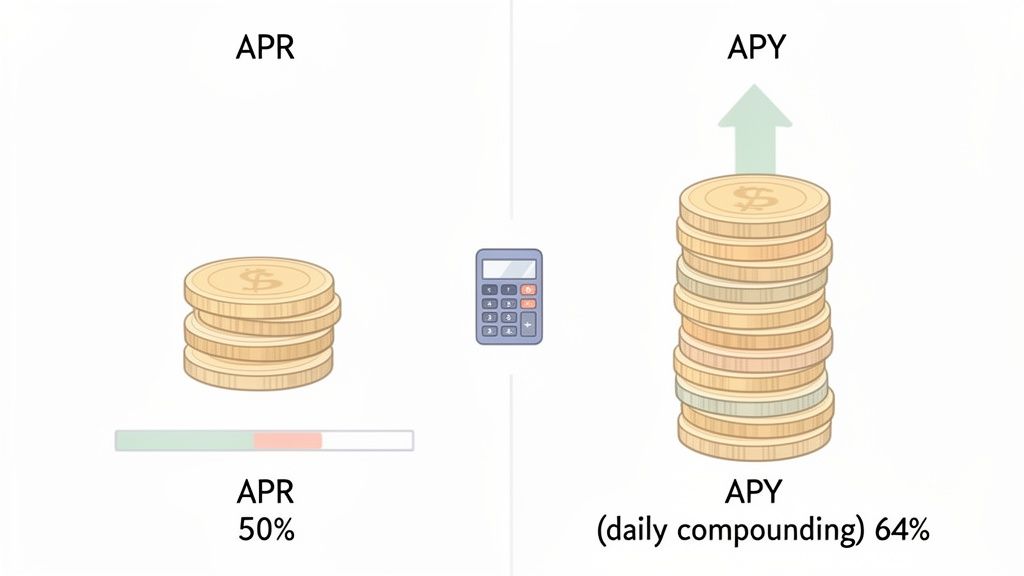
An image comparing APR (50%) and APY (daily compounding, 64%) with stacks of coins and a calculator.

Unpacking APR and APY

Let's break these down into simple, actionable terms.

APR (Annual Percentage Rate) represents the yearly interest on your money without any frills. It's a straightforward number that ignores the effect of compounding within that year.

  • Think of it as simple interest. If you stake $1,000 in a pool with a 50% APR, you'll earn $500 over one year—if you don't touch the rewards.
  • Best for borrowing. When you take out a loan, a lower APR is always better. It reflects the pure cost of borrowing before any compounding kicks in.

APY (Annual Percentage Yield), however, shows you the total interest you'll earn in a year, including the effects of compounding. Compounding simply means you're earning interest not just on your initial principal, but also on the interest that has already piled up.

Key Takeaway: APY shows the true growth of your investment. Because it accounts for interest earning its own interest, APY will always be equal to or higher than the APR.

This is where the real gains are made. A 50% APR might not seem that different from a 60% APY at first, but the compounded growth over time can be massive. For a deeper dive, you can learn more about what APY in crypto means and how it’s calculated.

APR vs APY: A Quick Comparison

This table helps you understand the fundamental differences between Annual Percentage Rate and Annual Percentage Yield at a glance, so you know which metric to focus on.

MetricAPR (Annual Percentage Rate)APY (Annual Percentage Yield)
Calculation BasisSimple interest; does not include compounding.Compound interest; includes interest earned on interest.
Primary Use CaseBest for understanding the cost of borrowing money.Best for understanding the return on investments and savings.
ComplexitySimple and straightforward to calculate.More complex, as it depends on compounding frequency.
Investor FocusFocus on APR when you owe money (loans, credit cards).Focus on APY when you are earning money (staking, yield farming).

For active DeFi traders using platforms like Wallet Finder.ai, internalizing this table is non-negotiable. It gives you the clarity to accurately compare yield farming opportunities and analyze the true PnL of top wallets you might be tracking.

How to Calculate Your Real Crypto Returns

To make money in crypto, you first have to understand the math behind it. Accurately forecasting your profits and making sense of the returns advertised on DeFi platforms comes down to knowing the difference between APR and APY. These two formulas are what turn those abstract percentages into real-world return projections.

While APR is just a simple interest rate, APY accounts for the powerful effect of compounding. Grasping this distinction is the secret to seeing the true growth potential of your crypto assets. Let's break down the formulas you need to know.

The Simple APR Formula

Calculating the Annual Percentage Rate (APR) is straightforward. Because it doesn’t factor in compounding, it’s simply the periodic interest rate multiplied by the number of periods in a year.

Formula: APR = Periodic Rate × Number of Periods in a Year

  • Periodic Rate: This is the interest you earn over a specific period, like daily or monthly.
  • Number of Periods: This is just how many of those periods fit into one year.

Let’s say you find a DeFi protocol offering a 0.1% daily interest rate. To find the APR, you’d multiply that daily rate by the number of days in a year.

  • Calculation: 0.1% (daily rate) × 365 days = 36.5% APR

This number shows your simple annual return if you don't reinvest your earnings. But since most DeFi protocols let you compound, that brings us to the metric that really matters for investors: APY.

The APY Formula: The Engine of True Yield

The Annual Percentage Yield (APY) shows you the actual return you can expect on an investment by including compound interest. The APY formula is your go-to tool, essentially acting as an apr vs apy calculator to reveal how your earnings can really pick up speed over time.

Formula: APY = (1 + r/n)^n - 1

Let's unpack what each part of this critical equation means:

  • r (The Rate): This is your APR, but written as a decimal. So, a 30% APR becomes 0.30.
  • n (Number of Periods): This is the number of times your investment compounds each year. This is the variable that has the biggest impact on your final return.

The magic of this formula is all in the 'n'. The more often your crypto compounds—whether it's daily, hourly, or even more frequently—the higher your APY will be compared to the base APR.

Key Insight: The APY formula proves that how often you compound is just as important as how much interest you earn. Frequent compounding is what drives that exponential growth you see in DeFi.

Putting the APY Formula into Practice

Let's run the numbers with a real-world crypto scenario. Imagine a new staking pool on Solana is advertising a 30% APR with daily compounding. What's the actual yield?

  • r = 0.30 (for the 30% APR)
  • n = 365 (since it compounds daily)

Now, we just pop these values into the formula:

  1. Divide the rate by the periods: 0.30 / 365 = 0.0008219
  2. Add 1: 1 + 0.0008219 = 1.0008219
  3. Raise to the power of n: 1.0008219 ^ 365 = 1.3498
  4. Subtract 1 and turn it into a percentage: 1.3498 - 1 = 0.3498, which gives you 34.98% APY.

See that? The advertised 30% APR actually becomes a much more attractive 35% APY just from compounding daily. This isn't just a math exercise; it's a fundamental skill for forecasting profits and is exactly how smart traders on platforms like Wallet Finder.ai vet new opportunities.

How Compounding Frequency Shapes Your Gains

The secret ingredient separating modest returns from massive ones is compounding frequency. This concept—how often your interest earns interest—is the powerful "n" variable in the APY formula. Its impact on your portfolio can be dramatic, turning a simple APR into a much more significant real-world return.

Getting a grip on this isn't just theory; it's a core skill for any serious investor. The more frequently an investment compounds, the faster your principal grows. It’s a snowball effect that accelerates your gains over time, which is exactly why APY is the more critical metric for evaluating earning opportunities.

This simple visualization breaks down how the interest rate (r) and the number of compounding periods (n) work together to calculate your final APY.

Illustration of Annual Percentage Yield (APY) calculation, showing effective APY increase with compounding frequency.

As you can see, APY isn't a static number. It’s the dynamic result of both the base rate and how often it’s compounded, highlighting why more frequent periods always lead to higher effective yields.

The Exponential Power of More Frequent Compounding

Let's make this tangible. Imagine a fixed 10% APR. By itself, this number tells you very little about your actual earnings. The real story unfolds when we apply different compounding frequencies, and the difference between compounding once a year versus 365 times a year is substantial.

To illustrate, think about traditional finance. You're eyeing a high-yield savings account or a CD, and the bank quotes you a 5% APR. If it's compounded monthly, a quick run through an APR vs APY calculator shows it jumps to about 5.12% APY. This difference became especially stark during the rate spikes of 2022-2023 when competitive one-year CD APYs peaked. You can dig into more of these historical CD rate fluctuations on Bankrate.com.

The table below shows exactly how a 10% APR blossoms into different APYs as compounding becomes more frequent.

How a 10% APR Changes With Compounding Frequency

This table shows how Annual Percentage Yield (APY) increases as the number of compounding periods grows, even when the APR remains fixed at 10%.

Compounding FrequencyPeriods Per Year (n)Resulting APY
Annually110.00%
Quarterly410.38%
Monthly1210.47%
Daily36510.52%

As you can see, even with the same 10% APR, daily compounding yields a noticeably higher return than annual compounding. While a 0.52% difference might seem small, it adds up significantly on larger sums or over longer timeframes.

Why This Matters for DeFi Traders and Analysts

In DeFi, this effect is amplified. Unlike traditional banking where monthly compounding is common, many crypto protocols compound daily, hourly, or even per block. This aggressive schedule is a primary driver of the high yields you see in yield farming and staking.

For traders using tools like Wallet Finder.ai, understanding compounding frequency is critical for two key reasons:

  1. Accurate Opportunity Assessment: You can properly vet and compare different DeFi opportunities. A protocol offering a 70% APR with weekly compounding might actually be less profitable than one offering a 65% APR with daily compounding.
  2. Strategy Analysis: It helps you analyze whether a top wallet's profitability is driven by a high base rate or just aggressive compounding. This allows for smarter strategy replication and risk assessment, as highly compounded returns can sometimes mask underlying asset volatility.

Key Insight: When you analyze a top wallet's PnL on Wallet Finder.ai, don't just look at the final return. Dig deeper to see if the gains come from a sustainable high APR or from an aggressive, potentially riskier, compounding schedule.

This distinction is vital. A strategy based on a solid base rate is often more sustainable than one that relies purely on hyper-compounding, which can be subject to protocol changes or market volatility. By using an APR vs APY calculator to normalize returns, you can make more informed decisions about which strategies are worth replicating and which carry hidden risks.

Ultimately, mastering this concept helps you see beyond the advertised rates to understand the true mechanics of wealth generation in DeFi.

A Practical Guide to Using an APR to APY Calculator

Turning financial theory into actual profit starts with getting your hands dirty. An APR vs APY calculator is a non-negotiable tool for any DeFi investor, but truly understanding what goes on behind the scenes is what solidifies your knowledge. Let's walk through a real-world scenario to see how to translate an advertised rate into the yield you'll actually pocket.

Imagine you've stumbled upon a new liquidity pool on an up-and-coming blockchain. It's flashing a very attractive 60% APR, and the protocol's docs confirm that rewards compound daily. To properly size this up against other opportunities, you need to find its APY.

Manual APR to APY Conversion: A DeFi Example

Before you jump to an online tool, let's crunch the numbers by hand using the formula we covered: APY = (1 + r/n)^n - 1. Going through this process helps you internalize just how much compounding frequency can juice a simple rate into a powerful yield.

Here are the variables for our situation:

  • APR: 60%
  • Compounding Frequency: Daily

Now, let's plug these into the formula, step-by-step.

  1. Define Your Variables:

    • r (Rate): Convert the APR to a decimal. A 60% APR becomes 0.60.
    • n (Number of Periods): Since compounding is daily, there are 365 periods in a year.
  2. Calculate the Periodic Rate:

    • Divide the annual rate (r) by the number of compounding periods (n).
    • 0.60 / 365 = 0.0016438
    • This tiny number is the percentage you earn each day.
  3. Add 1 and Compound:

    • Add 1 to your daily rate: 1 + 0.0016438 = 1.0016438.
    • Now, raise this result to the power of 'n' (365): (1.0016438) ^ 365 = 1.8219.
  4. Finalize the APY:

    • Subtract 1 from the result: 1.8219 - 1 = 0.8219.
    • Finally, convert this decimal back into a percentage by multiplying by 100.
  5. The final APY comes out to 82.19%. That means the advertised 60% APR is actually delivering a much higher real-world return, all thanks to the magic of daily compounding.

    Using an APR vs APY Calculator for Instant Results

    While doing the math yourself is a great learning exercise, speed and accuracy are everything in the fast-paced world of DeFi. This is where an online or embedded APR vs APY calculator becomes your best friend.

    Let's use the same scenario to see just how much faster it is.

    Input for the Calculator:

    • APR: 60%
    • Compounding Periods: 365 (for daily)

    The calculator instantly runs the exact same calculation we just did manually, spitting out the immediate result: 82.19% APY.

    Pro Tip: Bookmark a reliable APR to APY calculator. When you're digging into new DeFi projects or tracking wallets on a platform like Wallet Finder.ai, you can instantly convert any advertised APR into its true APY. This lets you make quick, accurate comparisons between different yield opportunities on the fly.

    Mastering this simple two-step process—finding the APR and compounding frequency, then plugging them into a calculator—is a fundamental skill. It lets you vet opportunities in seconds, cut through the marketing hype, and focus on the numbers that actually grow your portfolio. For users of Wallet Finder.ai, this means you can instantly translate any advertised rate into the real-world yield you can expect, making your profit projections and trading decisions that much sharper.

    Actionable Strategies for DeFi Yield Farming

    Knowing the math behind APR and APY is one thing. Actually using that knowledge to turn a profit is a whole different ball game. This is where your understanding becomes a real edge in decentralized finance. With the right approach, you can vet opportunities more effectively, analyze top traders, and make smarter decisions to protect and grow your capital.

    The core principle is simple but incredibly powerful: always use the right metric for the job. APY reveals your true earning potential, while APR shows the real cost of borrowing. Getting this right is the first step toward building a profitable on-chain strategy.

    Vet Opportunities with Precision

    Heads up: not all high yields are created equal. The first step in effective yield farming is to look past the flashy headline APR and zero in on protocols that offer both transparency and frequent compounding. A protocol's willingness to clearly state its compounding schedule is often a good sign.

    When you're sizing up a new farm or staking pool, ask these critical questions:

    • Is Compounding Automatic or Manual? Auto-compounding means the protocol reinvests your earnings for you, ensuring you capture the full power of APY without lifting a finger. Manual compounding forces you to claim and restake rewards yourself, which eats into profits with gas fees and relies on you remembering to do it.
    • How Frequent is the Compounding? As we’ve seen, daily compounding is worlds away from weekly or monthly. The more frequent the compounding, the higher your real APY.
    • Is the APR Sustainable? Be skeptical of astronomical APRs, especially on brand-new protocols. These are often just temporary "promotional" rates designed to lure in initial liquidity and can plummet once the farm gets going.

    By prioritizing pools with transparent, frequent, and automatic compounding, you're setting yourself up for much more predictable and passive returns.

    Analyze Top Wallets on Wallet Finder.ai

    One of the smartest ways to find an edge is to study what profitable traders are actually doing. Tools like Wallet Finder.ai let you track the PnL of top wallets, but just glancing at the surface can be misleading. A sharp analyst uses their knowledge of APR and APY to dig deeper.

    When you spot a wallet with impressive gains, don't just see the profit. Ask how they got there.

    A key takeaway for every investor: 'When you invest, compare APY. When you borrow, compare APR.' This simple rule ensures you are always evaluating opportunities and obligations from the correct financial perspective, maximizing gains and minimizing costs.

    This volatility highlights the danger of focusing only on APR—for instance, a standard 4% APR compounded quarterly becomes 4.06% APY, but if compounded annually, it stays at just 4%, costing long-term holders. In DeFi, where Wallet Finder.ai tracks Solana memecoin flips with 100%+ APRs, daily compounding on certain protocols can inflate that into a 150%+ APY, amplifying the win streaks for top wallets. This is a stark contrast to traditional markets, where historical stock data shows the S&P 500 returning 11.62% annualized over 50 years, and yet many investors miss out by sticking to "safe" assets. You can see how these rates have evolved by checking out historical CD rates on NerdWallet.com.

    A Framework for Comparing Opportunities

    Let's say you're looking at two promising yield farming opportunities. They both advertise a similar APR, but they're on different blockchains and involve completely different assets. How do you decide?

    Here’s a simple framework to guide your decision. Let's compare two hypothetical farms:

    • Opportunity A: A memecoin staking pool on Solana offering a 120% APR, compounded daily.
    • Opportunity B: A stablecoin liquidity farm on Base offering a 30% APR, compounded daily.

    At first glance, the 120% APR looks like a no-brainer. But a smart investor always analyzes the risk-adjusted return.

    1. Calculate the True APY: Use an apr vs apy calculator to convert both. The 120% APR explodes to roughly 231% APY, while the 30% APR becomes a solid 35% APY.
    2. Assess the Asset Risk: That memecoin is extremely volatile. Its price could crash to zero tomorrow, wiping out your incredible APY gains and your principal. The stablecoin farm, on the other hand, has minimal price risk, making its 35% APY a much more reliable return.
    3. Consider Protocol and Chain Risk: Solana is a more established chain, but the specific memecoin protocol might be new and unaudited. Base is a newer chain, but a farm built around blue-chip stablecoins may be more secure.

    For an investor who wants to preserve their capital, the stablecoin farm's 35% APY is the clear winner, even with its lower headline number. For a degen chasing high-risk, high-reward plays, the memecoin might be tempting, but they have to accept the massive underlying risk. You can sharpen your ability to make these calls by exploring our detailed guide on staking in DeFi and its associated risks.

    Common DeFi Yield Traps to Avoid

    A massive APY can be a siren's call for crypto investors, but it often hides serious risks. Knowing how to use an apr vs apy calculator is a great start, but spotting the traps that can wipe out your gains is how you protect your capital.

    Let's dig into the hidden dangers that can turn a promising yield farm into a financial black hole. Moving beyond just chasing the highest number to finding the highest risk-adjusted and sustainable yield is what separates novice investors from seasoned pros.

    A 'High APY' sign stands on a cracked pedestal, surrounded by warning signs like impermanent loss and price volatility.

    The Illusion of High APY

    A jaw-dropping APY is the oldest marketing trick in the DeFi playbook. While it looks great on the surface, that number can be incredibly misleading if you don't understand the mechanics and risks involved. What you see is almost never what you get.

    The most common trap is the disconnect between the advertised APY and the actual return you'll see. Most APY figures are calculated assuming the token's price stays perfectly stable. In the wild west of crypto, that's a fantasy, leading to massive gaps between expected and real returns.

    The Dangers of Impermanent Loss

    Impermanent loss (IL) is easily one of the most misunderstood—and dangerous—risks in DeFi, especially for liquidity providers. It’s the loss you face when the value of your tokens in a liquidity pool drops compared to what they'd be worth if you just held them in your wallet. Even a crazy-high APY can get completely wiped out by IL if the token prices diverge.

    Keep these points about impermanent loss in mind:

    • It’s a silent portfolio killer. Many LPs get laser-focused on the yield they're earning, only to realize later that their initial investment is worth less than when they started.
    • High volatility is your enemy. The risk of IL is at its peak in pools with highly volatile assets, like a brand-new memecoin paired with ETH.
    • APY vs. IL is the real math. Your actual profit is the yield you earn from fees and rewards minus the value you lose from impermanent loss.

    A sky-high APY means nothing if impermanent loss erodes your principal. Before jumping into any liquidity pool, you must weigh the expected yield against the potential for IL. To get a better handle on this, check out our guide where you can learn more about an impermanent loss calculator and how to assess your risk.

    Smart Contract and Protocol-Level Risks

    Even if you nail the token price predictions and impermanent loss is a non-issue, you’re still exposed to tech risks. The protocol with the highest yield could be a ticking time bomb if its smart contracts aren't locked down. A single bug can mean a total loss of your funds.

    Before you deposit a single dollar, always vet the protocol’s security:

    • Audits: Has the protocol been audited by reputable security firms? A lack of audits is a massive red flag.
    • Team Reputation: Is the team anonymous, or are they public and respected in the space?
    • Unsustainable APR: Be extremely cautious of protocols offering insane APRs funded by inflationary token rewards. These "promotional" rates are just a tactic to attract quick liquidity but often collapse as sell pressure on the token mounts, leaving latecomers holding worthless bags.

    Your Questions About APR and APY Answered

    Even when you feel like you have a handle on the basics, applying APR and APY concepts out in the wild always brings up new questions. Let's tackle some of the most common ones I hear, so you can navigate DeFi yields with more confidence.

    Can APY Ever Be Lower Than APR?

    Nope, APY can never be lower than APR. Think of it this way: at the absolute minimum, APY will match the APR. This only happens if your interest is compounded just once per year.

    The second compounding kicks in more often—whether it's monthly, weekly, or even daily—the APY will always climb higher than the APR. That’s because APY is designed to include the extra earnings you get from your previously paid interest, a detail the simpler APR metric completely overlooks. The more frequently it compounds, the bigger that difference gets.

    Why Do Some Protocols Only Show APR?

    You’ll definitely run into protocols that only list an APR, and it’s usually for a couple of strategic reasons.

    • Manual Compounding: If a platform requires you to physically click a button to claim and restake your rewards, the final APY is up to you. It depends entirely on how often you decide to compound. Advertising a specific APY would be misleading since every user’s outcome will be different based on their own actions.
    • Perceived Transparency: Let's be honest, a massive APY can sometimes look "too good to be true," scaring off more seasoned or cautious investors. Showing a more grounded APR can feel more transparent and trustworthy, even if the potential APY is huge for those who compound diligently.

    Key Insight: When you only see an APR, take it as your cue to do some quick math. Your first move should be to plug the numbers into an apr vs apy calculator to see what you could actually earn based on the compounding schedule.

    How Do I Find a Protocol's Compounding Frequency?

    Finding out how often a protocol compounds your earnings is a critical piece of due diligence before you put any capital in.

    1. Check the UI and Docs: The best projects are upfront about it and state the compounding frequency right on the staking page. If it’s not there, your next stop should be the official documentation or "litepaper."
    2. Ask the Community: If the official docs are vague, jump into the project’s Discord or Telegram. Community managers or experienced users can usually give you a straight answer pretty quickly.
    3. Inspect the Contract: For the more technical folks, the smart contract is the ultimate source of truth. Using a block explorer, you can dig into the contract's code and find the functions that control exactly when rewards are distributed.

    What Is a Good APY in Crypto?

    There’s no magic number here—a "good" APY is completely relative and depends on the asset's risk profile.

    Here’s a rough guide to put things in perspective:

    • Stablecoins (USDC, USDT): Anything in the 5% to 20% APY range is generally considered strong for a relatively low-risk asset.
    • Major Blue-Chips (ETH, SOL): Yields between 5% and 50% are common. Here, you're balancing the potential for the asset's price to go up with the risks of staking.
    • High-Risk Assets (New Tokens, Memecoins): APYs can shoot into the hundreds or even thousands of percent. But be warned: this massive potential return is always tied to extreme risk, like the token price crashing, smart contract hacks, or impermanent loss.

    Always weigh the shiny APY against the asset's volatility and the security of the protocol it's on.


    Ready to stop guessing and start analyzing? Wallet Finder.ai helps you discover profitable wallets and mirror winning DeFi strategies in real time. Find your edge and act ahead of the market by tracking smart money movements. Start your 7-day free trial at Wallet Finder.ai.