What Is APY in Crypto? A Simple Guide

Wallet Finder

Blank calendar icon with grid of squares representing days.

January 1, 2026

When you start exploring ways to make your crypto work for you, one acronym pops up everywhere: APY. So, what is APY in crypto? Think of it as the real return you can expect on your digital assets over a year, because it accounts for the powerful effect of compounding interest. It's the key metric for comparing staking, lending, or yield farming opportunities in DeFi.

The Power of Compounding Crypto Growth

Imagine a snowball rolling downhill. It doesn't just get bigger—it picks up more snow faster and faster as it grows. That's compounding in a nutshell. Your earnings start generating their own earnings, creating a feedback loop of accelerated growth. This isn't a new concept; it's the foundation of wealth-building in traditional finance, too.

What’s different in crypto is the speed. A traditional bank might compound your interest monthly. A DeFi protocol, on the other hand, could compound your earnings daily, hourly, or even with every new block added to the blockchain—which is about every 12 seconds on Ethereum. You can see how crypto returns stack up against historical market data on platforms like CoinMarketCap. This rapid compounding is how a seemingly modest interest rate can balloon into an impressive annual yield.

Why APY Matters More Than APR

This is where it’s super important to know the difference between APY and its simpler cousin, APR (Annual Percentage Rate). APR is just a flat rate. If a platform offers a 10% APR, you’ll earn exactly 10% on your initial capital over the year. Simple.

But a 10% APY that compounds daily will always result in a higher return because the interest you earn each day gets added back to your principal, and you start earning interest on that too.

The core takeaway is this: APY provides a more accurate picture of your potential earnings because it reflects the real-world impact of your returns generating more returns.

Getting this distinction right is the first step to properly comparing different yield opportunities across the crypto world. When you see a high APY, you know a big chunk of that projected return is coming from the protocol automatically reinvesting your profits for you. It puts your growth on autopilot, maximizing your potential without you having to lift a finger.

The Real Difference Between APY and APR

It's easy to glance at APY and APR and think they're just two ways of saying the same thing. But that common mix-up can be a costly one, especially in DeFi. The two metrics are fundamentally different, and knowing how they work is critical for figuring out what you’ll actually earn.

The entire difference boils down to one powerful concept: compounding.

APY vs APR: A Quick Comparison

Before we dive deep, let's get a high-level view of what separates these two core metrics. The main takeaway is that APY gives you a much truer picture of your potential earnings because it accounts for growth on your growth.

FeatureAPR (Annual Percentage Rate)APY (Annual Percentage Yield)
CalculationSimple InterestCompounding Interest
CompoundingExcludes the effect of compoundingIncludes the effect of compounding
Real-world ReturnDoesn't show the true annual returnShows the true annual return
Use CaseOften used for borrowing (loans, credit cards)Often used for earning (savings, staking)

Simply put, while both are annualized rates, APY will always be higher than APR for the same base rate, as long as interest is compounded more than once a year.

How Compounding Makes APY the King

Let's break this down with a practical example.

Annual Percentage Rate (APR) is the straightforward, no-frills interest rate you earn on your principal investment each year. If a staking pool offers 10% APR on your $1,000 deposit, you'll walk away with exactly $100 in profit after one year. Clean and simple. Your earnings don't start earning anything themselves.

Annual Percentage Yield (APY), on the other hand, is the metric that shows you what you really get. It includes the magic of compounding interest. APY calculates the return you earn not just on your initial capital, but also on the accumulated interest that gets added back to your principal over and over again.

Imagine you have two protocols to choose from. Both offer a 10% rate on a $1,000 investment.

  • Protocol A (10% APR): Your return is a flat $100 for the year. Your total ends up at $1,100. Easy.
  • Protocol B (10% APY, compounded daily): Every single day, a tiny bit of interest is calculated and added back into your investment pile. The next day, you earn interest on that slightly larger amount. It might seem small, but those daily boosts add up. By the end of the year, your total would actually be $1,105.16.

Sure, an extra $5 might not sound like much, but that gap gets exponentially wider with larger investments, higher rates, and longer time horizons.

The key takeaway is simple: For the same stated interest rate, an investment calculated with APY will always yield a higher return than one calculated with APR because your earnings start working for you.

This chart shows it perfectly. Look at how an initial investment grows with simple interest versus the accelerating curve you get from compounding APY.
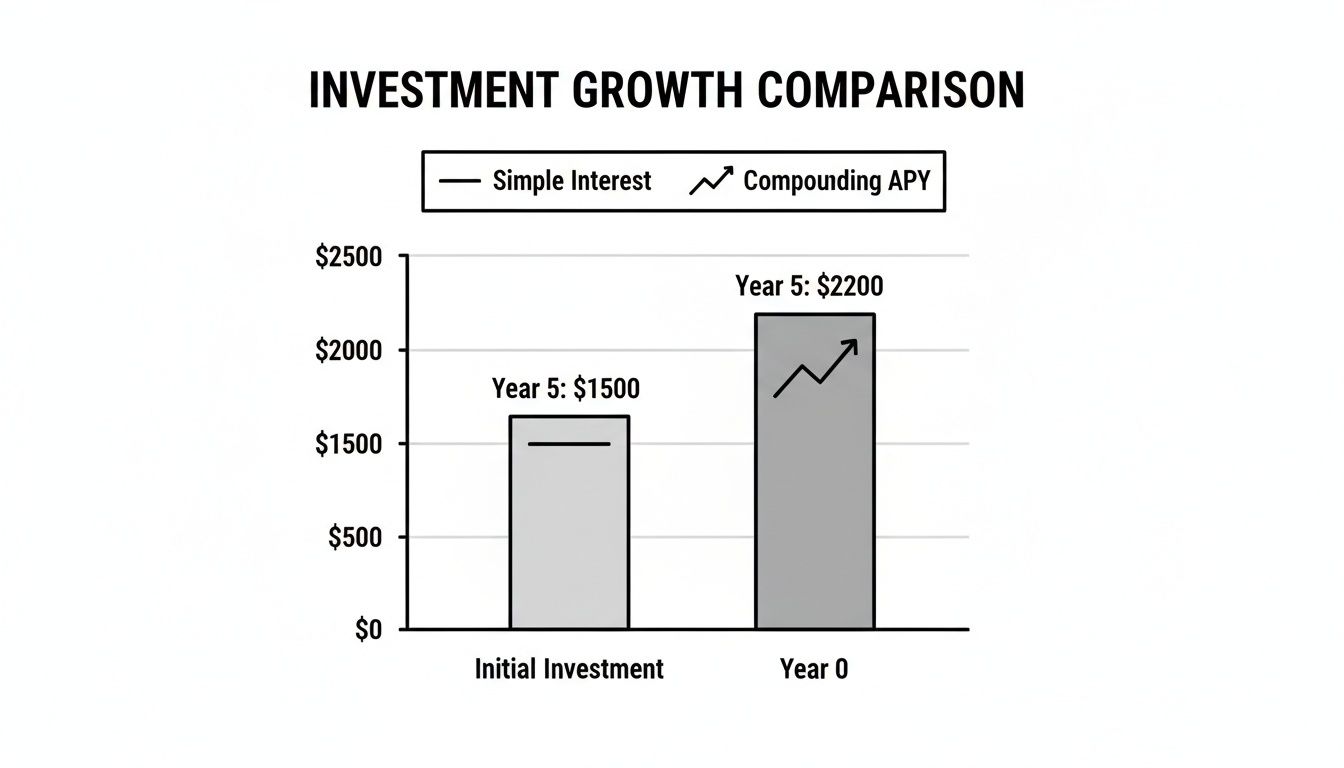
Bar chart comparing investment growth: simple interest reaches $1500, while compounding APY reaches $2200 in five years.

As you can see, the space between those two lines just keeps growing. That’s the power of compounding in action. When you're evaluating crypto opportunities, always hunt for the APY to understand the real potential of your investment.

Where Does Crypto Yield Actually Come From?

Those eye-popping APY figures you see in crypto aren't just pulled out of thin air. They might seem too good to be true, but every single yield opportunity is backed by real economic activity happening on-chain. Getting a handle on where this yield comes from is the first step to understanding what you’re actually putting your money into.

At its core, the APY you earn from a DeFi platform is a reward. You're being compensated for providing something of value to the network, and this usually happens in one of three main ways. Each method is a critical gear in the decentralized machine, and you get paid for helping keep it running.

Three icons illustrating cryptocurrency concepts: Staking (shield), Lending (hand with coin), and Liquidity (coins over liquid).

1. Staking: Securing the Network

One of the most foundational ways to earn in crypto is through staking. This is the lifeblood of Proof-of-Stake (PoS) blockchains like Ethereum, Solana, and Cardano. When you stake your tokens, you’re locking them up to help verify transactions and secure the entire network.

  • Your Role: You become a validator or, more commonly, delegate your tokens to a professional validator who does the technical work.
  • Source of Yield: Rewards come from the blockchain's own token issuance (a form of controlled inflation) and sometimes a cut of the network's transaction fees.
  • The Trade-Off: Your funds are temporarily illiquid because they're locked up, but you're being paid to contribute directly to the network's security and stability.

Staking is what keeps a PoS network decentralized and strong. As a result, its APY is often seen as one of the most straightforward and fundamental forms of crypto yield.

2. Lending: Providing Capital

Another huge source of crypto yield is lending. DeFi platforms like Aave and Compound essentially act as decentralized money markets. You can deposit your crypto into a lending pool, and it becomes available for other users to borrow.

  • Your Role: You act as a lender by depositing your idle crypto assets into a pool.
  • Source of Yield: You earn interest paid by borrowers.
  • The Trade-Off: Your APY depends on supply and demand. If many people want to borrow an asset but few are lending, the interest rate—and your APY—will shoot up to attract more deposits.

3. Liquidity Provisioning: Powering Trades

Finally, many of the most attractive APYs come from being a liquidity provider (LP) on a decentralized exchange (DEX) like Uniswap or PancakeSwap. Instead of using old-school order books, DEXs use "automated market makers" (AMMs) that are powered by pools of tokens supplied by users like you.

  • Your Role: You deposit a pair of tokens (like ETH and USDC) into a liquidity pool.
  • Source of Yield: You earn a percentage of the trading fees every single time someone uses your pool to swap between the two assets.
  • The Trade-Off: You are exposed to a unique risk called impermanent loss (more on that below).

If you want to go deeper, you can learn more about how crypto liquidity pools work and the mechanics that drive them. They are a cornerstone of the DeFi ecosystem.

Unpacking the Hidden Risks of High APY

A massive, triple-digit APY looks incredible on paper, but in crypto, it’s almost never a free lunch. When you see a number that seems too good to be true, it’s usually a sign that you're being compensated for taking on serious, often hidden, risks. Understanding what is APY in crypto means digging deeper than the advertised rate.

The goal isn't to scare you away from high-yield opportunities. It's to give you a clear framework for making smart, risk-aware decisions. Let's pull back the curtain on the most common risks hiding behind those big APY numbers.

Illustrations showing impermanent loss, smart contract risk, and inflationary rewards in cryptocurrency.

Risk 1: Impermanent Loss

If you're providing liquidity, impermanent loss is one of the trickiest concepts to wrap your head around. It happens when the price of the tokens you deposited into a pool changes relative to each other. The bigger the price split between the two assets, the more "loss" you'll see compared to if you had just held them in your wallet.

When you eventually withdraw your funds, you could end up with less of the asset that performed well and more of the stable one. That difference in value is impermanent loss. It only becomes permanent when you cash out.

Risk 2: Smart Contract Bugs

Every DeFi protocol is built on smart contracts—basically just lines of code running on the blockchain. While this code is what makes trustless finance possible, it can also have bugs, flaws, or exploits that hackers can target. A single vulnerability could be enough for a bad actor to drain every last dollar from a protocol.

Don't assume that only new, obscure projects are at risk. Billions have been lost to smart contract hacks, even on well-known platforms. This is why you should always check if a protocol has been audited by reputable security firms. You can learn more about these threats by reading up on smart contract security risks in liquidity pools.

Risk 3: Token Inflation

Many DeFi protocols lure users in with insane APYs by paying them out in the protocol’s own native token. This reward mechanism, called token emissions, is really just a form of planned inflation. The project mints new tokens from thin air to reward you for participating.

The risk is basic supply and demand. If the protocol is constantly printing new tokens, it puts massive and continuous selling pressure on the price. Unless there's enough new demand to soak up all that new supply, the token's value is almost guaranteed to go down. This can create a brutal cycle:

  1. You earn a huge yield paid out in the protocol's token.
  2. The token's price plummets because of the constant emissions.
  3. Your "high APY" ends up being worth far less in real dollar terms than you expected.

An APY that comes entirely from inflationary rewards is often a ticking time bomb. Your real return could easily turn negative if the token's price crashes faster than you're earning it.

How to Find and Vet High-Yield Opportunities

Now that you understand the risks, the next step is putting that knowledge to work to find good opportunities and sidestep the duds. Here is an actionable checklist for vetting any high-APY opportunity:

Actionable Checklist for Vetting Crypto APY

  • ✅ Check the Source of Yield: Is the APY from real usage (trading fees, lending interest) or just inflationary token rewards? Sustainable yield comes from economic activity.
  • ✅ Verify Security Audits: Has the protocol been audited by reputable security firms like CertiK, Trail of Bits, or OpenZeppelin? No audit is a major red flag.
  • ✅ Analyze Total Value Locked (TVL): Is the TVL high and growing? A rising TVL shows community trust. A rapidly falling TVL means users are fleeing for a reason.
  • ✅ Evaluate the Team: Is the team behind the protocol public and experienced? Anonymous teams can disappear without a trace.
  • ✅ Assess Tokenomics: If rewards are paid in a native token, what is its inflation rate? Is there a clear use case or value accrual mechanism for the token beyond farming?
  • ✅ "Follow the Smart Money": Use on-chain tools to see if experienced, profitable wallets are using the protocol. This is a powerful signal of trust.

Following the Smart Money

While metrics like TVL give you a bird's-eye view, a sharper strategy is to see where the seasoned DeFi pros are putting their own capital. By keeping an eye on the wallets of top traders, you can see:

  • Which new protocols they’re jumping into: This is how you find gems before they become mainstream.
  • How they manage their risk: Watch when they start taking profits or decide to exit a position completely.
  • What kind of yields they're actually after: See what APY ranges are enough to attract serious, well-informed capital.

This whole approach shifts your focus from chasing advertised numbers to following proven strategies. It’s a data-first way of thinking, based on what successful people are doing, not just what a protocol is promising.

Using On-Chain Tools for an Edge

Trying to track top wallets by hand is nearly impossible. That's where tools like Wallet Finder.ai come in, designed specifically to do the heavy lifting for you. They pull together all the on-chain data to show you exactly where the most successful traders are moving their funds, giving you actionable signals based on what's happening in real-time.

This level of analysis can uncover powerful trends. For instance, Wallet Finder.ai users who monitor winning wallet strategies often see top-tier traders rotating into new opportunities offering 25%+ APY right before those rates start to come down. The game has gotten so sophisticated that you can now even calculate risk-adjusted returns by looking at a protocol's historical performance.

By combining foundational metrics with the laser-focused insights you get from wallet tracking, you can build a repeatable process for vetting opportunities. This turns the question of "what is APY in crypto" into a practical strategy for finding legitimate high-yield chances. You can dive deeper with our guide to finding high APY crypto staking opportunities.

Common Questions About APY in Crypto

Even after getting the hang of the mechanics, a few questions always pop up when you're dealing with APY in crypto. Let's tackle the most common ones head-on to clear up any lingering confusion.

Can Crypto APY Change Over Time?

Yes, and you should expect it to. Unlike the fixed rates you might see at a bank, most crypto APYs are variable. They’re living numbers that can shift dramatically based on what’s happening in the market.

Several things can send an APY swinging, sometimes from one day to the next:

  • Token Price: If your rewards are paid out in a project's native token, the dollar value of your APY will go up and down with that token's price. A 50% drop in the token's value effectively cuts your real APY in half.
  • Network Activity: On a decentralized exchange, more trading means more fees are collected. For liquidity providers, this is great news—it directly boosts their APY.
  • Total Capital: Think of it like splitting a pizza. As more people join a staking pool or lending protocol, the same pool of rewards has to be divided among more participants. This almost always pushes the individual APY down.
  • Protocol Changes: The team behind a project can always tweak the rules, like adjusting reward emissions, which directly changes the APY.

Because of this constant flux, you can't just "set it and forget it." You've got to keep an eye on your positions.

Is a Higher APY Always Better?

Definitely not. In fact, an absurdly high APY should be treated like a flashing red light—a signal to dig deeper, not ape in blindly. It's usually a sign that you’re being compensated for taking on a massive amount of risk.

An extremely high APY can be a red flag for issues like unsustainable token inflation, a new and unaudited protocol, or risky underlying assets. The highest numbers often come from projects where the risk of losing your entire principal is also the greatest.

Always weigh the shiny APY against the real risks we covered earlier. Grinding out a sustainable 5-15% APY from a battle-tested protocol is often a much smarter play than chasing a speculative 1,000% APY on a project that launched yesterday.

How Often Does Crypto APY Compound?

This varies all over the place; there's no single standard. What you'll find, though, is that it's almost always much faster than in traditional finance. Forget annual compounding. In crypto, it's common to see rates that compound daily, hourly, or even per block—which can mean every few seconds on some chains. The more frequent the compounding, the greater the effect on your total yield.


Ready to move from theory to action? Stop guessing and start tracking. With Wallet Finder.ai, you can see where the most successful DeFi traders are putting their capital, identify high-yield opportunities backed by real on-chain data, and mirror winning strategies in real time.

Discover Top Performing Wallets with Wallet Finder.ai