DeFi Diversification Tool: Build a Resilient Portfolio 2026
Discover the ultimate DeFi diversification tool. Go beyond asset count; analyze correlation & risk with Wallet Finder.ai for a resilient portfolio in 2026.

May 29, 2026
Wallet Finder

May 29, 2026

Your wallet probably looks diversified on the surface. You hold an L1, a few DeFi governance tokens, a memecoin basket, an LP position, maybe an RWA token for “balance.” Then risk comes off across crypto and nearly everything drops together.
That's the problem. In DeFi, owning more tickers often just means you've spread the same risk across more wrappers.
A useful diversification tool isn't a magic dashboard that says “safe” or “unsafe.” It's a way to inspect correlation, concentration, protocol risk, and liquidity before the market forces you to learn what your portfolio really is.
A lot of traders build what looks like a broad book, then discover they were long one trade the whole time.
You can hold ETH, three ETH-beta governance tokens, two Solana memecoins, an L2 token, and a yield position that ultimately depends on the same risk-on flow. On paper, that's many positions. In practice, it's one regime bet with extra tabs open.
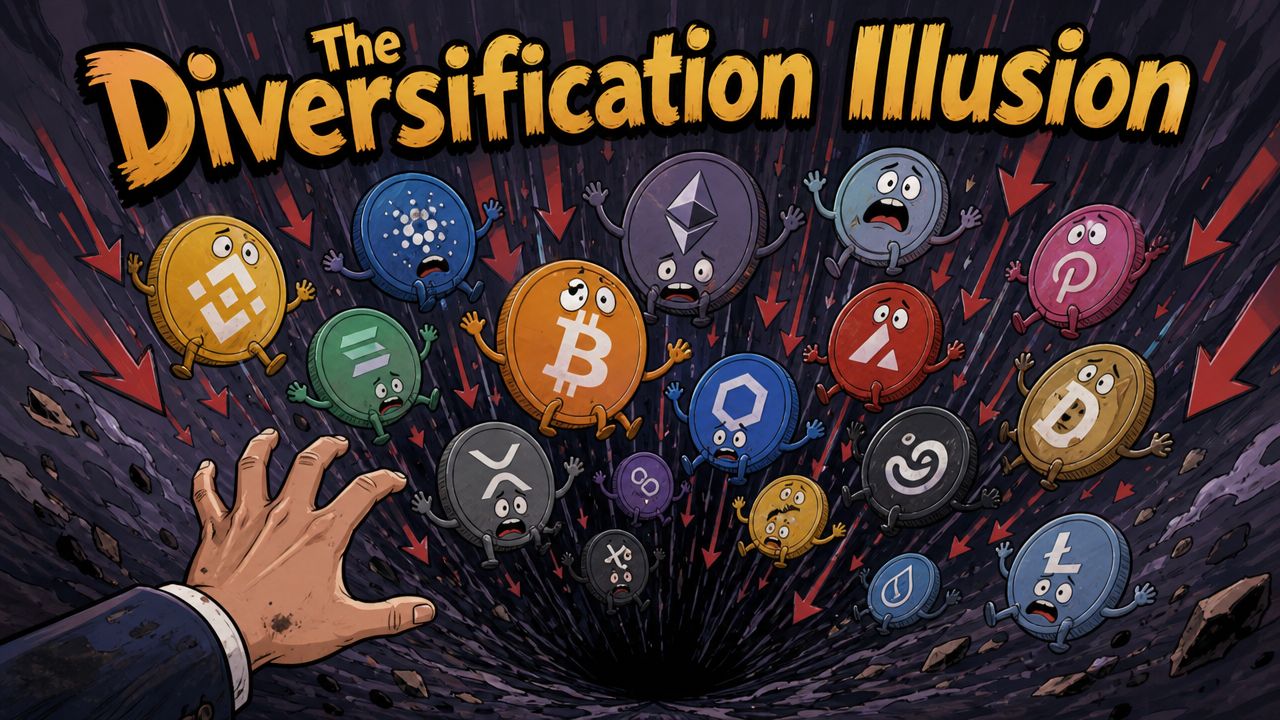
That's why “more coins” is a weak portfolio rule. It ignores what matters when the tape turns. A memecoin, a farm token, and an L2 governance token can all behave like amplified versions of the same market sentiment.
Recent institutional commentary argues for moving beyond simple stock and bond mixes to include alternatives. That same piece says such portfolios have shown the potential to achieve Sharpe ratios close to 1.0 and improve drawdowns over 20+ years, while focusing more on inflation hedges, tail-risk control, and total-portfolio design (Interactive Brokers on defensive alternatives). The lesson maps well to DeFi. If you want resilience, you need exposures that fail differently, not just more exposures.
A trader thinks they've diversified because they split capital across:
Practical rule: If several positions depend on the same liquidity conditions, the same user base, or the same chain health, treat them as related risk.
If you trade LPs, this matters even more. A lot of “hedged” LP books still hide directional exposure and correlation risk. That's where a deeper review helps, especially if you've been thinking about how diversification can reduce impermanent loss risks.
A real diversification tool starts with one blunt question: what survives when your main thesis is wrong?
Real DeFi diversification is about how positions behave relative to each other, not how many line items sit in your wallet.
The cleanest way to think about it is a basketball roster. Five centers don't make a complete team. They just give you five versions of the same strength and the same weakness. A DeFi portfolio built from assets that all rely on the same market mood has the same flaw.
The core benefit of diversification is reducing unsystematic risk by combining assets that move differently. But that benefit weakens when correlations rise during stress, which means the key test isn't asset count. It's how your positions co-move when everything sells off together (Saxo on diversification and correlation under stress).
You can own:
That isn't broad exposure. It's clustered exposure.
A smarter question is: what role does each position play?
A practical DeFi book often has different jobs assigned to different positions:
| Role | What it does | Typical DeFi examples |
|---|---|---|
| Core beta | Captures broad market upside | Large-cap majors |
| Defensive ballast | Holds up better when speculation cools | Stablecoin strategies, select lower-beta exposures |
| Asymmetric risk | Targets breakout upside with controlled sizing | Memecoins, early narrative tokens |
| Cash-like optionality | Preserves flexibility for new setups | Dry powder in stable assets |
That framework forces discipline. Instead of asking whether a token is interesting, you ask whether it adds a new behavior to the portfolio.
Diversification only counts if the assets diversify when conditions get ugly, not when the timeline is euphoric.
A useful DeFi diversification tool helps you inspect several layers at once:
If you want a practical framework for deciding those buckets, this allocation strategy guide is a useful companion.
The short version is simple. A diversified DeFi portfolio doesn't own everything. It owns a small set of exposures that react differently for clear reasons.
If you want to evaluate a portfolio like a practitioner, track four things: correlation, concentration, exposure, and rebalancing cadence. Without those, “diversified” is just a vibe.

Correlation asks whether assets move differently.
In DeFi terms, ETH, a fresh Solana memecoin, and an RWA token may look unrelated. Sometimes they are. But if all three mainly respond to broad crypto risk appetite, then the diversification benefit is weaker than it appears.
What works is comparing behavior across market regimes, not just calm periods. If two assets look independent only when everything is green, that's weak diversification.
Use this checklist:
Concentration is the fastest way to blow up a “diversified” book.
Most traders check single-token concentration and stop there. That misses the bigger issue. You can be diversified by ticker and highly concentrated by narrative, chain, or protocol family.
Common hidden concentration points include:
Hidden risk: When one narrative drives most of your unrealized gains, your portfolio is usually less diversified than your token list suggests.
Exposure is broader than position size. It includes what can hurt you indirectly.
For example, an LP might look neutral at first glance, but your real exposure can include directional token risk, impermanent loss, smart contract risk, bridge risk, and exit liquidity risk. A restaking or yield strategy may add counterparty and protocol dependency that doesn't show up in a simple wallet balance view.
A practical way to audit exposure is to map each position to these buckets:
| Exposure layer | What to inspect |
|---|---|
| Market exposure | Broad beta to crypto risk-on and risk-off moves |
| Protocol exposure | Reliance on one app, governance system, or smart contract set |
| Chain exposure | Dependency on one chain's activity and stability |
| Liquidity exposure | Ability to reduce size without severe slippage |
Rebalancing is where good portfolio construction usually breaks down. Traders either never rebalance, or they touch the book every time the feed gets noisy.
A useful cadence is event-driven, not compulsive. Rebalance when the portfolio drifts from its intended role mix, when one narrative becomes too dominant, or when a position's risk profile changes.
Good practice usually looks like this:
A good diversification tool helps you see those four metrics quickly. It doesn't replace judgment. It sharpens it.
Most traders don't need one tool. They need a small stack where each tool does a specific job well.
Some tools show balances cleanly but miss wallet behavior. Others are strong at wallet discovery but weak at allocation review. Some automate portfolio maintenance but don't help you judge whether the underlying exposures are distinct.
Here's a practical comparison:
| Tool Type | Primary Function | Key Strength | Best For |
|---|---|---|---|
| Portfolio analytics platforms | Aggregate holdings and classify positions | Fast view of allocation, token mix, and chain mix | Traders who need a dashboard of current exposure |
| On-chain wallet trackers | Inspect wallet histories, entries, exits, and realized behavior | Reveals whether gains come from repeatable process or one lucky trade | Copy traders and researchers studying specialist wallets |
| Automated rebalancers | Adjust portfolio weights based on preset rules | Enforces discipline when markets move fast | Traders with a defined framework who want fewer manual decisions |
| Multi-chain dashboards | Pull positions from several ecosystems into one view | Good for avoiding blind spots across chains | Users active across Ethereum, Solana, Base, and similar ecosystems |
Portfolio analytics platforms work well for snapshot analysis. They're useful when you want to know whether your wallet is too heavy in one chain or one token family. They're less useful when you need to understand how a position was built and whether the wallet owner has process.
On-chain wallet trackers help with behavioral diversification. That matters if you copy trade or source ideas from smart money. A wallet that trades only one narrative isn't the same as a wallet that rotates cleanly across unrelated setups. For that use case, this overview of DeFi portfolio tracker options is a practical starting point.
Automated rebalancers are powerful if your rules are already good. They are dangerous if your rules are lazy. Automation can preserve discipline, but it can also industrialize bad portfolio design.
Multi-chain dashboards solve a different problem. They reduce operational blindness. If your exposure lives across several chains, you need one place to verify where risk is sitting.
A tool stack is only useful if each part answers a different question. Don't buy five dashboards that all show the same wallet balance.
Wallet-level analysis sits in a different category from standard portfolio tracking.
It's not just about what a wallet owns today. It's about:
That's where a diversification tool becomes an edge, not just an organizer. You stop looking only at your own positions and start studying how strong wallets distribute risk across markets.
If you use wallet tracking as a diversification tool, the goal isn't to copy every profitable address you find. It's to understand what kind of risk each wallet is taking, then build a watchlist with complementary strengths.
Start with the wallet discovery layer.

Use Discover Wallets to search for traders by behavior, not just headline returns.
A practical screen looks for wallets that appear strong in different ways:
That gives you a research basket, not a hero wallet.
The mistake is chasing the top PnL line without context. A wallet can look elite because one outsized trade dominates the history. That's not diversified skill. That's concentrated luck until proven otherwise.
Once you click into a wallet, ignore the temptation to judge it by total value or one recent win. Look at its PnL, trade history, and where gains originated.
Ask these questions:
Are profits broad or narrow?
If most success traces back to one token or one narrative, the wallet may not be a good model for resilient exposure.
Does the wallet operate across chains or just one lane?
Cross-chain activity can add breadth, but only if the strategies are different.
How does it size positions?
A wallet that repeatedly survives usually has some internal risk structure, even if it isn't obvious at first.
What does it do in weaker conditions?
The most useful wallets often show selectivity, not constant activity.
Don't confuse visible PnL with transferable process. Your edge comes from identifying which wallet behavior can survive outside one hot regime.
Wallet-level analysis proves valuable. You can often tell when an apparently diversified wallet is still fragile.
Watch for patterns like:
A good review often ends with fewer wallets on your list, not more.
Here's a quick product walk-through if you want to see the workflow in action:
The strongest use of Wallet Finder.ai is building a watchlist of complementary wallets instead of mirroring one address wholesale.
That can look like:
| Wallet role | What you want from it |
|---|---|
| Core allocator | Exposure to steadier, larger-cap positioning |
| Narrative scout | Early reads on new sectors |
| Tactical trader | Cleaner entry and exit timing |
| Ecosystem specialist | Coverage in a chain where you lack native feel |
That structure matters because you're diversifying your idea flow, not just your token holdings.
Wallet Finder.ai fits the on-chain wallet tracker category. It lets users inspect wallet histories, trades, tokens, and PnL, then build watchlists and alerts across major ecosystems. Used this way, it becomes less of a copy-trading shortcut and more of a research layer for avoiding concentration in both positions and information sources.
Diversification in DeFi works when you treat it like risk engineering. It fails when you treat it like collecting ticker symbols.
The point isn't to remove risk. It's to avoid taking the same risk five different ways without realizing it.
Run this once before you add another position:
If those answers feel uncomfortable, your diversification tool isn't another token. It's better analysis.
Use an event-driven approach, not a fixed habit. Rebalance when a position grows far beyond its intended role, when your portfolio becomes too concentrated in one theme, or when a protocol's risk changes. Small drift usually isn't worth paying to fix.
Sometimes, yes. That's the trade-off. Real diversification usually sacrifices some top-end outcome in exchange for a better chance of staying solvent and adaptable. The practical fix is to isolate high-upside bets in a clearly sized speculative sleeve instead of letting them dominate the whole book.
Spread risk across different protocol designs, chains, and custody assumptions. Avoid stacking too much capital into positions that share the same technical or governance failure points. Price diversification helps, but operational diversification matters just as much in DeFi.
If you want to turn diversification from a slogan into a repeatable research process, Wallet Finder.ai is useful for studying wallet behavior, checking where PnL really came from, and building watchlists across different trading styles instead of copying a single concentrated bet.