Chainlink Staking Rewards: A Trader's Guide for 2026
Explore our guide on Chainlink staking rewards. Learn how they work, the real APR to expect, risks like slashing, and how to monitor staking activity on-chain.

June 6, 2026
Wallet Finder

June 6, 2026

You bought a coin with a clean breakout, decent volume, and a story everyone on X seemed to agree on. For a while, it worked. Then the market turned while you were away from the screen. By the time you checked again, the green trade had become a red one, and the hardest part wasn't the loss. It was knowing you had time to prevent it.
That's where stop loss crypto trading stops feeling like theory and starts feeling necessary. A stop loss isn't there to make you look smart. It's there to keep one bad decision, or one bad hour, from damaging your account far more than it should.
Good traders don't always avoid losses. They avoid uncontrolled losses. That difference is most of the game.
Most newer traders remember one position more clearly than all the winners.
It's usually the one that was up nicely, then round-tripped because there was no exit plan. An altcoin breaks out, momentum builds, the candles look strong, and selling feels premature. You tell yourself you'll close it manually if price weakens. Then a sharp market-wide flush hits, liquidity disappears, and the chart falls much faster than your decision-making does.
That kind of trade leaves a mark because it exposes two things at once. First, crypto can move violently even when your original idea wasn't crazy. Second, hesitation gets expensive.
A stop loss solves a very specific problem. It handles the decision you're worst at making in real time: accepting that the trade is invalid before the loss gets emotionally hard to take.
Losses hurt less when they're planned. Unplanned losses damage both capital and judgment.
The traders who stay around long enough to improve usually learn one habit early. They define the risk before they enter, not after the chart turns ugly.
That doesn't mean every stop will save you perfectly. It won't. Slippage is real, fast markets are messy, and low-liquidity coins can behave badly. But having a stop is still better than negotiating with yourself while a candle is collapsing.
If you've ever watched a good trade become a painful lesson, you already understand why this matters. The stop loss isn't the advanced part of trading. It's the adult part.
A crypto stop loss is a conditional exit order. When price hits your trigger, the exchange activates the order automatically. On many venues, that order typically converts into a market order, which means it's built to prioritize execution certainty over exact fill price, and it can be used for both longs and shorts, as explained in Kraken's stop-loss order guide.
Consider a fire escape in a building. You don't install it because you expect disaster every day. You install it because when things go wrong, speed matters more than elegance.
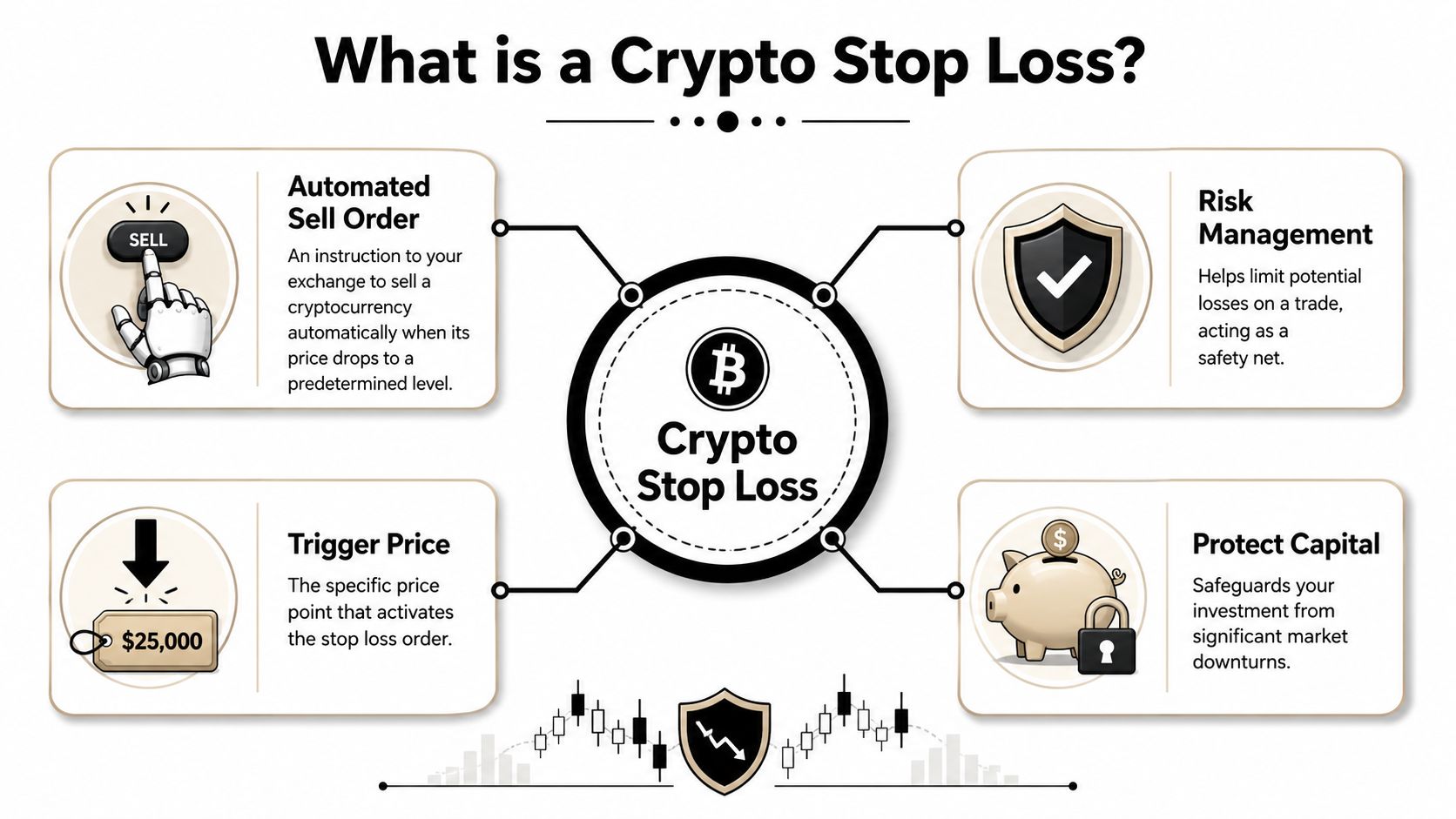
A stop loss does not predict the market. It does something more practical. It draws a line where your trade thesis is no longer valid.
That matters in crypto because volatility punishes indecision. If you trade manually without a predefined exit, you're forcing yourself to make a calm decision during the least calm part of the trade.
Here's the simplest way to frame it:
If you can't answer the third question before entry, you don't really have a trade plan. You have a hope plan.
Beginners often get confused. Your stop price is the trigger, not a promise.
If the market reaches that level, the exchange tries to get you out. In calm conditions, the fill may be close. In chaotic conditions, the fill may be worse. That's normal behavior for a tool designed to get you out first and optimize later.
Practical rule: Treat a stop loss as a damage-control tool, not a precision instrument.
If you want to get more comfortable with order mechanics before using stops, it helps to review how crypto limit orders work in practice. Limit logic and stop logic solve different problems, and mixing them up causes a lot of avoidable mistakes.
Usually for emotional reasons, not technical ones.
That last point sounds reasonable, and sometimes it is. But “giving it room” only makes sense if the room is defined in advance. Otherwise the trade just keeps borrowing more of your capital and attention.
A stop loss is not bearish. It's disciplined. In crypto, that distinction matters.
Once you accept that you need an exit plan, the next question is which tool fits the job. Many traders make the first serious mistake at this point. They choose an order type because it sounds safer, not because it matches the market they're trading.
On major exchanges, stop-loss and stop-limit orders are standard risk controls. A stop-loss becomes a market order when triggered, which prioritizes execution. A stop-limit adds a second price condition and may not fill if the market moves too fast. Exchange education also repeats a broader portfolio rule: don't risk more than 2% of total capital per trade, as outlined in Crypto.com's guide to stop-loss and take-profit levels.
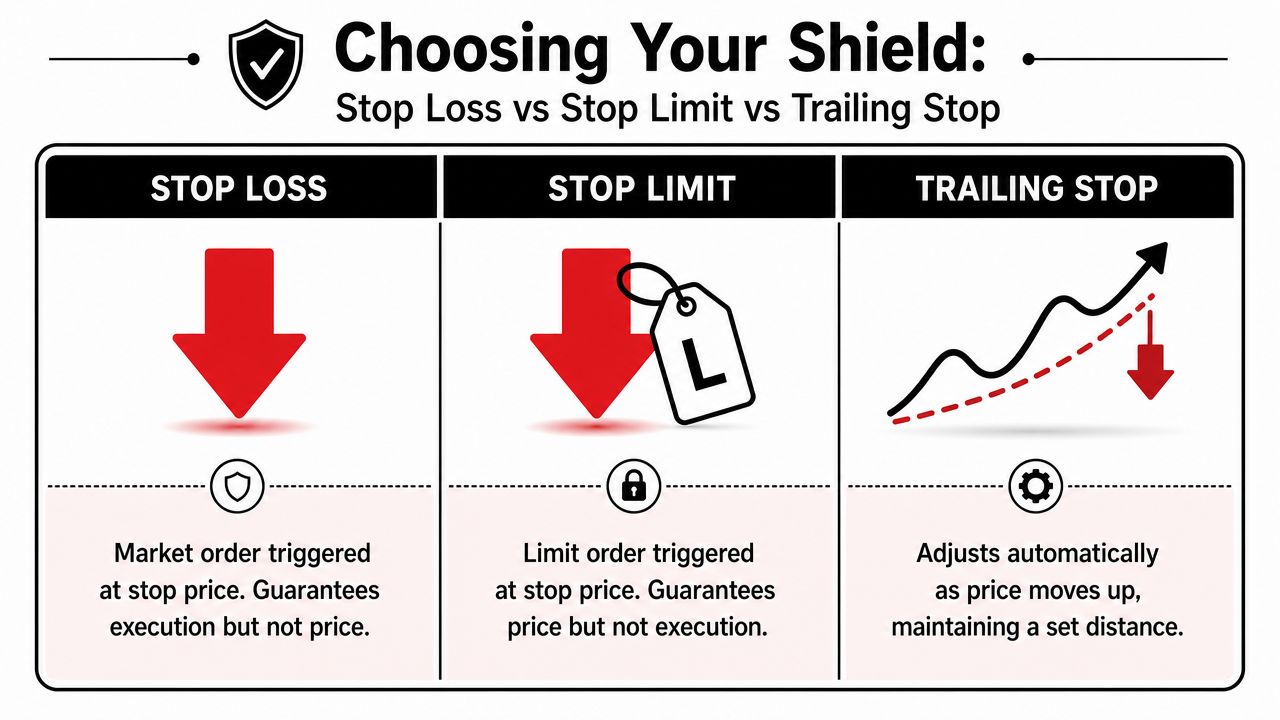
A plain stop loss is the blunt instrument. It's there to get you out.
A stop limit adds control over price, but that control comes at a cost. In a fast drop, your order can trigger and still sit there unfilled while price keeps moving away.
A trailing stop is different. It follows price as the market moves in your favor, then triggers if price reverses by your chosen distance. Traders like it because it can protect gains without constant manual updates. The catch is simple: in choppy crypto markets, a trailing stop can get shaken out repeatedly.
| Order Type | How It Works | Best For | Key Risk |
|---|---|---|---|
| Stop Loss | Triggers an exit order when price hits your stop level, with execution prioritized over exact price | Fast markets, high-conviction risk control, traders who care more about getting out than perfect precision | Slippage |
| Stop Limit | Triggers a limit order after the stop is reached | More controlled conditions where price discipline matters and liquidity is decent | No fill during sharp moves |
| Trailing Stop | Moves with price as the trade goes your way, then exits on reversal | Trend trades where you want to lock in gains without setting a static exit | Noise can trigger premature exits |
Use a plain stop loss when the market is moving fast and your first priority is survival. This is often the right choice for volatile majors and breakout trades where a failed move can unwind quickly.
Use a stop limit when the book is stable enough that price discipline has a real chance of helping. It's better suited to calmer conditions than panic candles.
Use a trailing stop when you're already in profit and want a rules-based way to stay in trend while protecting some upside. It can work well on cleaner moves. It tends to work badly on erratic charts.
A stop loss says, “Get me out.” A stop limit says, “Get me out, but only on my terms.” In crypto, the market doesn't always care about your terms.
They pick stop-limit orders on assets that don't trade cleanly.
That feels smart because nobody likes the idea of a sloppy fill. But execution risk is usually more dangerous than price discomfort. An unfilled protective order is worse than an imperfect exit.
They also overuse trailing stops on coins that whipsaw all day. That can turn a strong directional idea into a sequence of small frustrating exits.
A better approach is to match the order to the environment:
Order type isn't a minor setting. It changes how your risk behaves when the market stops being cooperative.
The biggest misconception in stop loss crypto trading is that having a stop means you're protected in every scenario. You're not. You're better protected than a trader with no exit rule, but the market can still punish sloppy placement and bad market selection.
That matters most in thin, wick-heavy pairs.

A practical trading guide points out that in illiquid crypto markets, especially some altcoins, stop-losses can fail because of stop hunts and manipulation. For those pairs, a closing-price stop or time-based exit can work better than a simple price trigger because they're less vulnerable to temporary wicks, as discussed in this analysis of crypto stop-loss placement.
Slippage happens when your stop triggers but the actual fill lands worse than expected. This is common during fast selloffs.
Wicks create false invalidation. Price tags your level, runs the stops, then snaps back.
Clustered stops get hunted. If too many traders place exits at the obvious round number or just under the same visible level, that zone becomes a target.
None of this means stops are useless. It means naive stops are expensive.
Stops fail most often when traders copy textbook placement into markets that don't trade like textbooks.
Low-liquidity tokens can print ugly candles with very little real consensus behind them. One burst of aggressive selling, one pocket of thin bids, or one opportunistic bot can shove price through a common stop area and reverse it just as fast.
That's one reason serious traders pay attention to execution quality, not just chart levels.
If you trade on-chain or through decentralized venues, it also helps to understand transaction-level risks around order flow and execution. A practical complement is learning the basics of MEV protection for crypto traders, because bad fills aren't only a chart problem.
A resilient stop setup usually changes with the asset:
| Market Type | Common Problem | Better Response |
|---|---|---|
| Major liquid coin | Fast directional selloff | Use a straightforward stop where execution matters most |
| Mid-cap altcoin | Wick through support then recover | Place the stop beyond obvious liquidity pockets or use close-only invalidation |
| Thin meme coin | Repeated stop hunts | Reduce size, widen the logic, or skip the trade entirely |
| Choppy range | Constant noise around your level | Time-based exits or structure-based stops often work better than tight triggers |
Sometimes the right fix isn't a different stop. It's a smaller position.
And sometimes the right fix is not trading the asset at all. Newer traders resist that answer because it feels passive. In reality, passing on a coin that trades badly is a risk-management decision just as real as placing a stop.
A good stop isn't picked after entry. It's designed alongside the trade.
That means your stop distance, position size, and expected reward need to agree with each other. A commonly cited benchmark in crypto is to place stops between 3% and 10%, with many traders trying to stay below 10% unless volatility justifies more room. Some guidance narrows the range to 3% to 8%, while volatile low-cap or meme coins may require 10% to 15% stops. The same framework pairs stop placement with risking no more than 2% of total capital per trade and often looks for a 2:1 to 5:1 reward-to-risk ratio, as summarized in Flipster's discussion of crypto stop-loss percentages.
![]()
Before you even think about the order ticket, answer three practical questions:
That third question is where a lot of traders break the process. They decide size first because they're excited about the coin, then squeeze the stop around the position. That's backwards.
Your stop tells you how far the market can move against the idea. Your account size tells you how much money that distance is allowed to represent. If the position becomes too small to bother with after you calculate it properly, that's valuable information. The trade may not be worth taking.
For traders who want a quick way to think through that relationship, a crypto position sizing calculator can help turn stop distance into a position size that fits your account.
A fixed-percentage stop is simple. It works best when the asset is liquid, the setup is straightforward, and you need consistency.
A structure-based stop is placed where the chart itself says the idea breaks. That might be below support, below a reclaim level, or beyond the part of the pattern that invalidates your thesis.
Each has trade-offs.
The best stop is the one that matches the reason for the trade. If the setup is structural, the invalidation should be structural too.
A resilient stop plan usually includes more than one number on a chart.
Consider this checklist before entry:
Many generic articles stop at “put it below support.” Real trading starts after that sentence.
If you trade DeFi tokens, memes, or early rotation plays, chart levels alone can be too generic. On-chain behavior can add context.
Watching wallet behavior helps answer questions that candles don't fully answer on their own:
That doesn't mean you can see every stop placement. Most of the time you can't. What you can do is study how skilled participants behave around similar setups. Their entries, partial exits, speed of de-risking, and willingness to cut losers all give clues about where risk really changes.
A trader who tracks on-chain winners usually develops better stop logic for one reason. They stop thinking only in chart drawings and start thinking in behavior.
Here's a simple way to build a stop decision before you enter:
| Step | What You Check | Why It Matters |
|---|---|---|
| Define setup | Breakout, pullback, range reclaim, momentum continuation | The stop should match the setup type |
| Mark invalidation | The level or behavior that proves the idea wrong | This keeps the stop logical, not emotional |
| Measure stop distance | Percentage or structure distance from entry | This determines whether the trade is practical |
| Size the trade | Adjust size so account risk stays controlled | This prevents one loss from dominating your account |
| Review liquidity | Depth, spread, wick behavior, speed of moves | This affects whether the stop can execute cleanly |
| Plan the exit style | Hard stop, close-only stop, or time-based exit | Different assets need different protection |
Some traders also stage their protection. They may use a harder disaster stop on exchange, then manage a closer mental or close-based invalidation manually. That approach requires discipline. If you don't trust yourself to execute it, use the cleaner rule.
A short walkthrough can make the process easier to visualize:
What works:
What usually fails:
A resilient stop loss strategy doesn't try to eliminate losing trades. It makes sure losses stay ordinary.
The traders who last in crypto aren't the ones who avoid every bad trade. They're the ones who keep bad trades small enough that they can keep playing the next good hand.
That's the primary function of stop loss crypto trading. It turns risk from a surprise into a choice.
A lot of beginners think the key leap is finding better entries. Better entries help, of course. But most accounts aren't wrecked by mediocre entries alone. They're wrecked by oversized positions, vague invalidation, and the refusal to exit when the trade has already broken.
Risk management works best when it's automatic, not heroic.
That means:
The stop loss is only one tool, but it forces the right discipline. It asks you to define your idea clearly, accept uncertainty, and cap the damage when the market disagrees.
The goal isn't to never get stopped out. The goal is to make getting stopped out normal, affordable, and unemotional.
If you build that habit, you trade differently. You stop chasing certainty. You start managing probabilities.
That shift separates gambling from professional behavior. Not because pros always win, but because they stay solvent long enough for skill to matter.
If you want a sharper view of how strong on-chain traders manage entries, exits, and position behavior in real time, Wallet Finder.ai is built for that job. It helps you track profitable wallets across major ecosystems, review complete trading histories, and study how better traders size, scale, and de-risk positions so your own stop decisions come from evidence instead of guesswork.