Chain Trade Size Chart: Spot Smart Money Moves
Master the on-chain trade size chart to analyze market structure and copy trade with precision. Learn to build and read charts with Wallet Finder.ai.

May 24, 2026
Wallet Finder

May 24, 2026

You spot a clean setup on a token you've been stalking for days. The narrative is strong, the chart is tight, and the move starts exactly where you expected. Then a fast flush hits, your stop slips, and the position is so large that one trade does real damage.
That sequence is common in crypto because the idea can be right while the sizing is still wrong. A trader can read momentum well, catch the theme early, and still lose money because the position was too big for the account, too levered for the volatility, or too exposed to correlated holdings elsewhere in the portfolio.
That's why a position sizing calculator matters. It's not a side tool for neat freaks. It's the control that turns “I like this trade” into “I know exactly how much I'm willing to lose if I'm wrong.”
A lot of traders learn risk the expensive way. They don't blow up because they can't read a chart. They blow up because they size the trade based on conviction instead of damage tolerance.
Crypto makes this worse. A token can trade cleanly for hours, then a sudden liquidity pocket opens and price jumps through levels that looked safe a minute earlier. In spot, that can mean a loss larger than planned. In margin-based perps, it can mean the trade never gets a second chance.
The pattern is familiar:
The painful part is that the market doesn't care that your thesis later proved correct. If the position was too large, you're out anyway.
Good analysis can survive a bad trade. Bad sizing can't survive normal volatility.
A professional trader doesn't ask only, “Will this go up?” The first question is, “If this fails, what does that cost me?”
That shift changes everything. It forces discipline before the order goes live. It also keeps a single mistake from hijacking the rest of the week.
In crypto and DeFi, that matters even more because trade conditions aren't stable. Slippage changes. Liquidity changes. Correlations snap tighter when the market turns risk-off. The setup might be strong, but if the size ignores those realities, the trade is still fragile.
Position sizing is the part of trading that keeps you in the game long enough for your edge to matter.
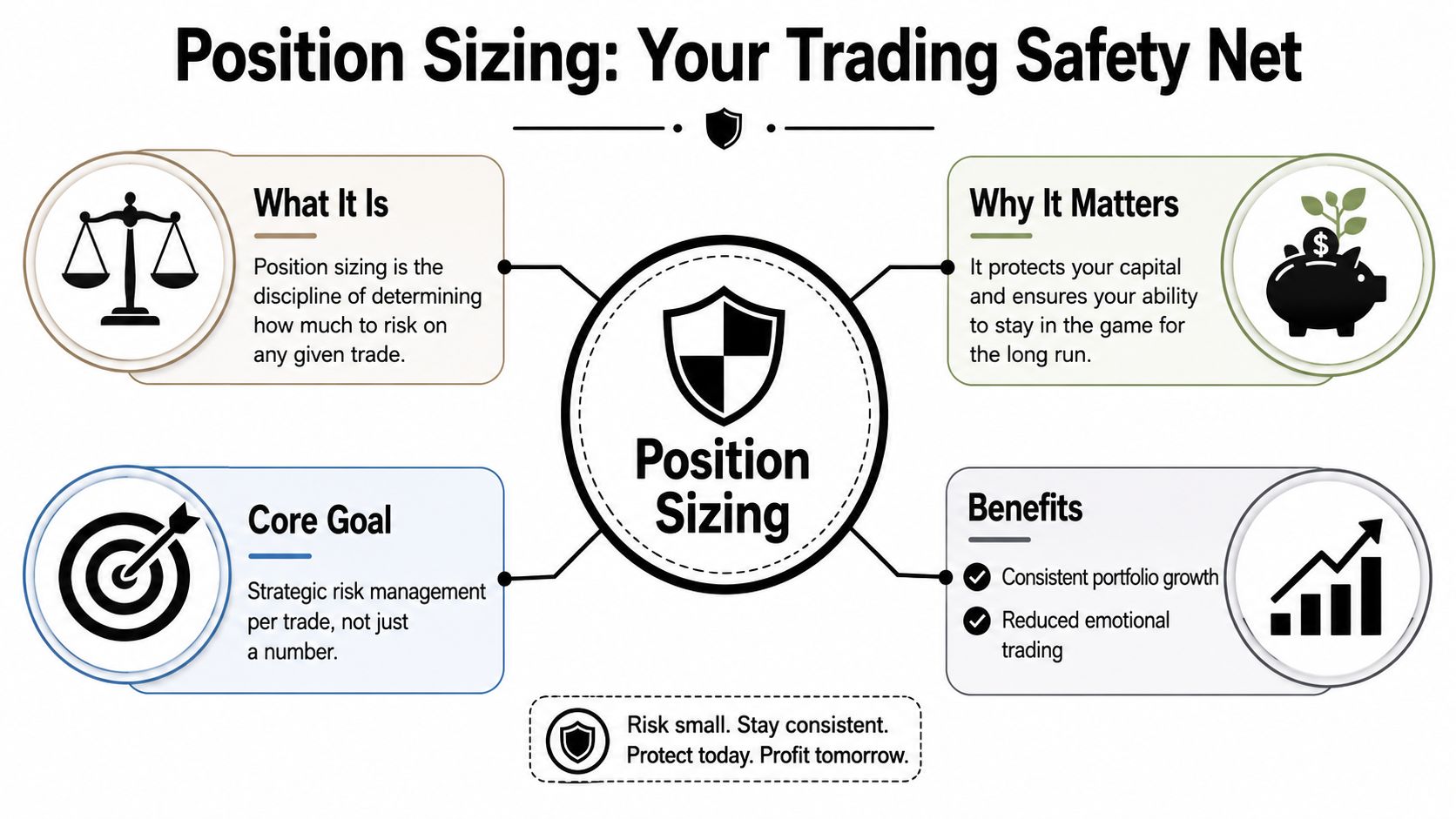
Position sizing is the process of deciding how large a trade should be based on how much of your account you're willing to risk if the stop loss gets hit. That's the key idea. The trade starts with acceptable loss, not with desired profit.
A position sizing calculator became standard because oversized trades can wreck performance even when entry logic is correct, and many trading references recommend limiting risk per trade to about 1% to 2% of total capital as a baseline for repeatable risk budgeting, as noted by Infinity Algo's overview of position sizing calculators.
A poker pro doesn't shove a huge share of their bankroll into one hand because it looks good. A casino doesn't remove table limits because a player feels confident. Risk limits exist so one bad outcome doesn't end the game.
Trading works the same way. Your edge plays out over a series of trades, not one prediction. If one position can cripple the account, you're not managing risk. You're gambling with better vocabulary.
A position sizing calculator turns a broad rule into an executable order.
It answers three practical questions:
| Question | Why it matters | What it controls |
|---|---|---|
| How much can I lose on this trade? | Defines acceptable damage | Dollar risk |
| Where is the trade wrong? | Sets your invalidation point | Stop loss |
| How many units can I hold? | Converts risk into order size | Shares, lots, or coins |
That's why the calculator isn't just math. It's pre-commitment. You decide the loss before the market can pressure you into improvising.
Crypto traders often think first in token units. “I'll buy some SOL.” “I want exposure to ETH.” That mindset is fine for narrative investing, but it's weak for active trading.
A professional framing is different:
Practical rule: If your first thought is coin quantity instead of account risk, you're building the trade backward.
That's the line between structured trading and impulsive exposure.
The standard formula is simple, and that's part of its power. Across trading education, the core method is Position Size = (Account Size × Risk %) ÷ (Entry Price − Stop Loss), with a common professional baseline of risking 1% to 2% of capital per trade, as shown by Capital Companion's position calculator explanation.
Each part has a job:
Once you know the dollar amount you're willing to lose, and you know how much you lose per coin if the stop gets hit, the position size becomes straightforward.
Here's the logic in sequence:
The formula is simple. Execution isn't.
Most mistakes come from one of these:
That last point matters a lot in crypto. The facility to amplify capital can make a small account control a larger notional position, but your risk still needs to be anchored to the account, not the exchange's maximum amplification setting.
For crypto trades with amplified exposure, the sizing logic still starts with the same risk budget. The difference is that you must also check whether the notional size you want creates a liquidation profile that's too tight for the planned stop.
That means there are really two filters:
| Filter | Question |
|---|---|
| Risk filter | Does the stop-out loss stay within my account risk limit? |
| Leverage filter | Can this position survive normal volatility without getting forced out early? |
If the first passes but the second fails, the trade is still too big.
A useful habit is to pair position sizing with reward planning. If you want a tighter process for that side of the trade, this guide on how to calculate risk reward ratio is a good companion.
The calculator tells you what you can carry. It doesn't tell you whether the trade deserves to be taken.
That judgment still sits with the trader.
Let's make this concrete with a simple spot-style crypto example and then translate the logic to margin trading. The point isn't to memorize one setup. It's to build a repeatable workflow you can run before every order.

A good walkthrough helps because crypto traders often jump too quickly from “I want SOL exposure” to clicking buy. Slow that down. Define the risk first.
| Parameter | Value | Notes |
|---|---|---|
| Account size | $25,000 | Trading capital used for sizing |
| Risk per trade | 2% | Within the commonly presented professional baseline |
| Maximum loss | $500 | Derived from account size and risk percentage |
| Entry price | Example input | Must be defined before sizing |
| Stop loss | Example input | Must reflect invalidation, not comfort |
| Stop distance | Example input | Entry price minus stop loss |
| Position size | Depends on stop distance | Calculated from risk budget ÷ per-unit risk |
The standardized sequence is straightforward. If a trader has a $25,000 account and risks 2%, the maximum loss on one trade is $500. If the distance between entry and stop loss is $5 per share, the position size is 100 shares, as shown by Capital Companion's practical example.
That same structure works in crypto. Replace “shares” with coin quantity or token units. The underlying logic doesn't change.
For another simple example, a $50,000 portfolio risking 1% implies a $500 maximum loss, and with a $10 per-unit risk the calculator returns 50 units, which Infinity Algo uses to illustrate cross-market sizing.
Set the account-level loss limit
Decide the maximum dollar loss you'll tolerate on this one trade. Don't skip this step. It's the anchor for everything else.
Choose an actual invalidation level
Your stop should mark where the trade idea is wrong. In crypto, that often means below a key low, range support, or a level that would break structure.
Add slippage awareness
Thin books and fast moves can push fills beyond the exact stop price. In practice, many traders widen their planning assumptions for volatile assets so the actual loss doesn't exceed the intended loss.
Convert stop distance into per-unit risk
Measure the difference between entry and stop. That's your loss per coin if the stop triggers.
Divide risk budget by per-unit risk
This gives the number of units you can trade while keeping the loss inside your plan.
Check notional size against margin requirements
On perps, ensure the margin and liquidation profile still make sense.
Here's the practical point. If your stop needs to be wider because SOL is moving sharply, your position size must get smaller. That's not a flaw in the setup. That's the market telling you the trade needs more breathing room.
Not all crypto assets should be sized the same way. A strong position sizing calculator has to respect the fact that BTC, ETH, and SOL trade in different units and can move differently intraday. The same principle used in FX calculators applies here: the sizing tool must normalize unit-specific risk so a given account risk maps correctly to trade volume, as discussed in Myfxbook's position size calculator notes.
That prevents a common crypto mistake: treating a “small-looking” coin quantity as low risk when the stop distance and volatility say otherwise.
Watch this if you want a visual walkthrough of the process in action:
Copy trading sounds simple. Find a strong wallet, mirror the buys, and ride the same moves. In practice, the easiest part is copying the transaction. The hard part is copying it without importing risks that don't fit your own account.
That's where many traders get blindsided. They copy positions, but they don't copy context.

A wallet you follow might be trading with a very different bankroll, a different time horizon, and a much higher tolerance for drawdown than you have. If you mirror size naively, you can end up overexposed fast.
Three common mistakes show up again and again:
This is the blind spot most single-trade calculators don't solve. A calculator can tell you how much to buy on one token. It usually won't tell you that your “diversified” basket is really one crowded macro bet.
A major gap in sizing tools is portfolio-level risk. Work discussed by TradersPost notes that crypto asset correlations can rise sharply during stress, which means a calculator using only single-trade entry and stop-loss can understate real drawdown risk across multiple correlated positions, as explained in TradersPost's review of position sizing algorithms.
That matters in copy trading because you might think you're following several independent wallets while they're all expressing variations of the same view.
If three copied traders are long different tokens in the same ecosystem, you may have one oversized thesis wearing three different tickers.
If you're learning the basics first, this primer on copy trading for beginners is useful. The key is to treat copied trades as signals, not commands.
Use a checklist before mirroring anything:
| Check | What to ask |
|---|---|
| Account fit | Is this size reasonable for my equity? |
| Strategy fit | Is this trader scalping, swinging, or rotating narratives faster than I can follow? |
| Correlation fit | Does this add a new exposure or pile onto an existing one? |
| Liquidity fit | Can I enter and exit without ugly slippage? |
Blind copying feels efficient. Risk-adjusted copying is slower, but it's real trading.
Manual calculation is fine when you're placing a few careful trades a week. It gets harder when you track multiple wallets, several ecosystems, and a stream of on-chain moves that need quick triage. The weak point isn't the formula. The weak point is workflow friction.
That's where automation helps. Instead of hunting manually for active wallets and then rebuilding every trade context from scratch, traders can monitor wallet behavior, compare sizing patterns, and decide whether a trade even deserves deeper review.
A useful process usually works like this:
That shift matters. You're no longer trying to become the other wallet. You're using wallet activity as input for your own execution process.
Tools that surface on-chain histories and wallet behavior can reduce a lot of the research lag that hurts copy traders. They help you identify recurring patterns, such as whether a wallet tends to enter in one shot, ladder in over time, or rotate out quickly after momentum fades.

If you want to build that monitoring layer into your process, this guide to choosing a wallet tracker app is a practical starting point.
The edge isn't that automation replaces judgment. It doesn't. The edge is that it saves attention for the decisions that matter most: whether the signal is worth taking, how much correlated exposure you already carry, and where your stop makes sense in current market conditions.
A position sizing calculator isn't advanced. It's foundational.
The traders who last in crypto usually aren't the ones with perfect prediction. They're the ones who make sure a bad trade stays small enough that the next good trade still matters. That's why sizing belongs at the front of the process, before amplified exposure, before conviction, and before any copy trade goes live.
The durable approach is simple:
The habits that hurt traders are predictable:
The best traders don't use risk rules to limit upside. They use risk rules to stay solvent long enough to capture it.
Make that your default. Before your next trade, run the numbers. If you follow other wallets, translate their signal into a size that fits your own account and your own risk budget.
Wallet Finder.ai helps crypto traders turn on-chain activity into actionable research. You can use Wallet Finder.ai to discover profitable wallets, study how strong traders build and exit positions, track smart money across ecosystems, and set alerts that give you time to run your own position sizing process before copying a move.