Copy Trading for Beginners: Your On-Chain Starter Guide

Wallet Finder

Blank calendar icon with grid of squares representing days.

May 10, 2026

As of Q1 2025, DeFi held about $156 billion in total value locked, according to DefiLlama. That matters because copy trading is shifting with the market. Beginners used to start on centralized exchanges, where trader rankings, execution, and custody all sat inside one app. More of that activity now starts on-chain, where anyone can inspect wallet behavior directly and decide what to mirror from their own wallet.

That shift changes the job.

On a CEX, the platform does a lot of the work for you. On-chain, you handle wallet setup, approvals, execution, slippage, and gas. You also get a level of transparency centralized copy trading rarely gives you. You can study entries, exits, position sizing, and trading cadence before risking capital. If you want to get better at reading that behavior, Wallet Finder.ai's guide to on-chain wallet analysis and trader behavior is a useful place to start.

The upside is real, especially in fast-moving DeFi sectors like memecoins where good wallets often spot momentum before a CEX listing puts the trade on everyone's radar. The downside is just as real. Transactions are irreversible, fees can erase small edges, and copying a wallet without understanding its style usually ends with late entries and poor sizing.

Treat on-chain copy trading as a risk management exercise first. Wallet Finder.ai can help you find wallets worth tracking and act on them faster, but the beginner edge comes from filtering hard, sizing small, and accepting that you do not need to mirror every trade to make progress.

What Is On-Chain Copy Trading

Roughly speaking, copy trading used to mean picking a ranked trader inside a centralized exchange and letting the platform handle the rest. On-chain copy trading changes that model. You mirror the actions of public wallets from your own wallet, with every entry, exit, size change, and transfer visible on the blockchain.

That shift matters because the source of truth changes. On a CEX, you mostly see a profile, a return chart, and whatever the platform chooses to show. On-chain, you can inspect actual behavior. You can see whether a wallet buys early, scales in, takes partial profits, rotates fast between pairs, or apes into every trending token. For a beginner, that transparency is the primary advantage.
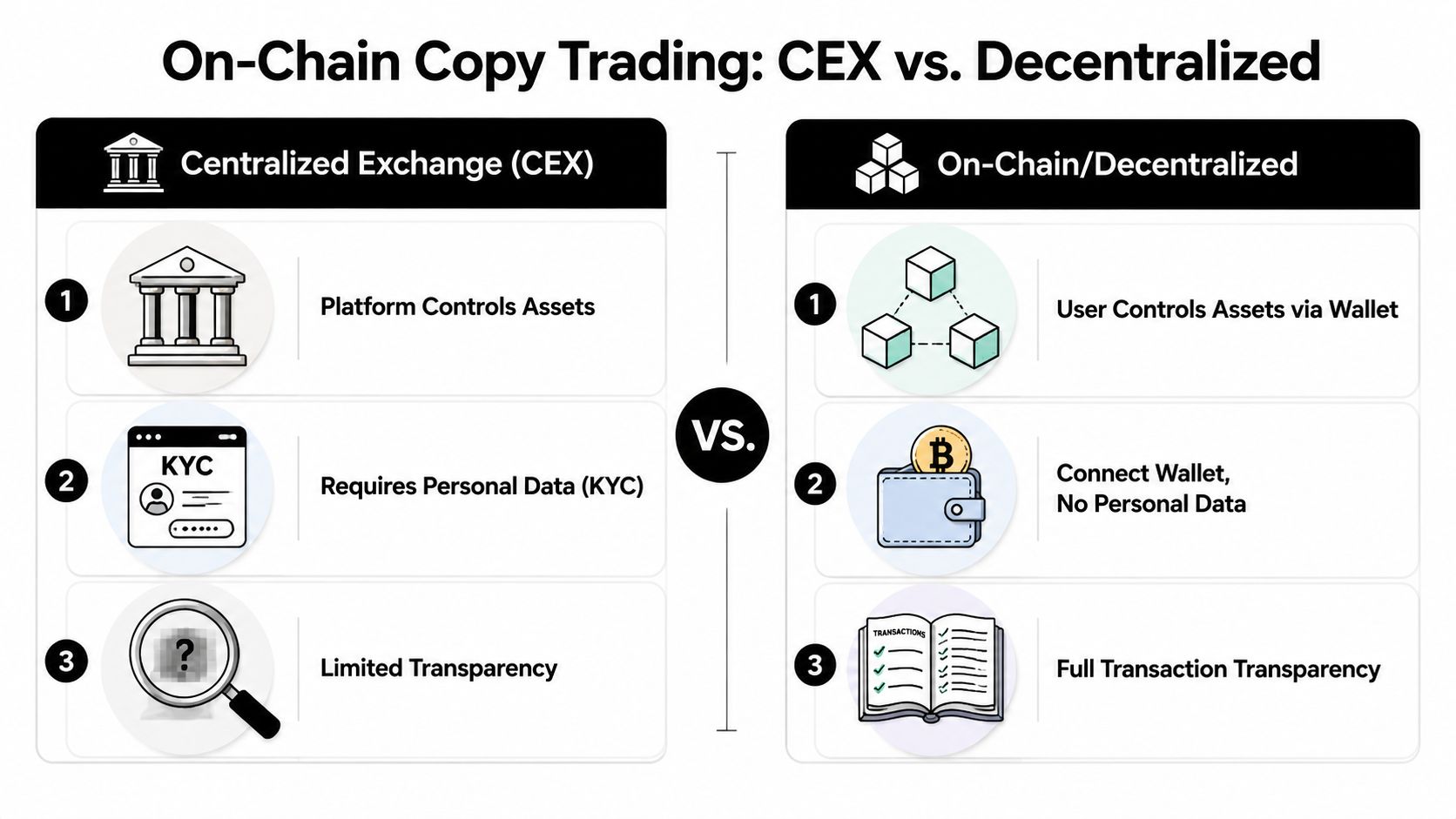
A comparison chart showing the differences between centralized exchanges and decentralized on-chain copy trading platforms.

What changed from CEX to wallet mirroring

The mechanics are very different.

A centralized platform usually bundles custody, execution, and trader discovery into one interface. On-chain wallet mirroring splits those jobs back up. You keep custody in your own wallet, choose what to copy, approve transactions, and deal with slippage, gas, and liquidity yourself.

That gives you more control, but also more ways to make expensive mistakes.

Three differences matter right away:

  • You keep custody: Funds stay in your wallet instead of sitting inside a copy trading account on an exchange.
  • You get raw behavior, not a polished profile: Wallet history is public, so you can review actual trades instead of relying on leaderboard marketing.
  • Execution risk is yours: If you copy late, buy into thin liquidity, or approve the wrong token, there is no support ticket that reverses the trade.

This is why on-chain copy trading attracts DeFi traders who care about early flow, especially in memecoins and fast-moving small caps. Wallets often move before a token gets broad attention. The catch is that beginners usually see the trade after the first move, not before it.

Why beginners need a different mindset on-chain

CEX copy trading can feel passive. On-chain copy trading is not passive at all. It is closer to supervised mirroring. You watch skilled wallets, filter for setups you understand, and execute with your own rules.

That distinction saves money.

A profitable wallet can still be a bad wallet to copy if its style depends on speed, private group access, tiny market caps, or sizing that does not fit your bankroll. I have seen beginners copy a wallet that made money overall, then lose on the same trades because they entered later, paid higher fees, and used worse size.

Practical rule: Mirror behavior you can explain. Skip behavior you cannot execute cleanly.

The risk profile is also different from centralized platforms. Gas fees can turn a small win into a net loss. Slippage can wreck entries in volatile pairs. Transactions are irreversible, so one bad approval or rushed swap can do permanent damage. Those are normal parts of trading on-chain, not edge cases.

Before you mirror any wallet, learn how to read one. A basic framework for on-chain wallet analysis and trader behavior will help you separate repeatable traders from wallets that just caught one hot cycle.

Wallet Finder.ai fits into that process as the execution layer for beginners. You use it to identify wallets worth following, monitor what they do, and decide which trades are worth copying. The goal is not to clone every move. The goal is to copy selectively, with smaller size and tighter risk than the wallet you are watching.

How to Find Profitable Wallets to Mirror

A wallet that turned a small account into a large one can still be a terrible wallet for a beginner to copy.

That happens all the time in the shift from CEX copy trading to on-chain wallet mirroring. On a centralized platform, fills are usually standardized and execution is hidden behind the exchange. On-chain, you inherit the actual conditions of the trade. Entry timing, liquidity, gas, and token quality all matter. So the job is not finding the wallet with the biggest recent gain. The job is finding a wallet whose edge still works when you copy it from your own wallet.

Start with a short metric stack. I use ROI, maximum drawdown, win rate, profit factor, and track record length. A useful summary of those red flags appears in this guide to copy trading metrics and red flags. The practical point is simple. Read the metrics together.

The five metrics that matter

Beginners usually overvalue ROI because it is the easiest number to sort by. That is how people end up mirroring a wallet that hit one memecoin early and never repeated it.

  • ROI: Treat it as a starting point, not a verdict. Good returns matter, but returns created by one outlier trade are less useful than steady gains across many trades.
  • Maximum drawdown: This tells you how much pain the wallet took on the way to those returns. If a wallet regularly drops hard before recovering, many beginners will exit at the worst possible time.
  • Win rate: High win rate looks safe, but it often hides weak risk discipline. A wallet can win on many small trades and still get crushed by a few oversized losses.
  • Profit factor: This shows whether total gains outweigh total losses. It helps separate disciplined traders from wallets that look good only because they churn a lot of small wins.
  • Track record length: Longevity matters. A wallet that stayed profitable across different market conditions is easier to trust than one that appeared during one hot cycle.

A beginner-friendly wallet is usually less flashy than the leaderboard suggests.

What to check beyond the headline numbers

Metrics narrow the list. Trade behavior decides whether a wallet belongs on it.

Inside Wallet Finder.ai, I want to see a repeatable pattern I can execute. If a wallet buys tiny caps seconds after liquidity appears, that may be profitable for the original trader and unusable for a beginner. If it trades liquid pairs, scales in with some patience, and exits in pieces, that is far easier to mirror with smaller size.

Review these points before you follow anything:

  1. Style consistency
    The wallet should have a recognizable approach. A trader who sticks to a lane is easier to study and easier to copy than one who jumps between random narratives.

  2. Entry quality
    Check whether the wallet buys strength, buys pullbacks, or enters before attention arrives. You are looking for behavior you can repeat without needing perfect speed.

  3. Exit discipline
    Good wallets often take partial profits and cut weak trades before they get out of hand. Bad wallets let winners round-trip or keep averaging into bad positions.

  4. Position sizing
    Size tells you a lot about risk control. If a wallet makes aggressive all-in bets, the PnL may look exciting but the path is hard for a beginner to survive.

  5. Recent activity
    Old performance is less useful if the current behavior changed. A wallet that used to trade swing setups may now be chasing fast memecoin rotations you cannot follow cleanly.

Many centralized exchange copy traders get caught off guard at this stage. On-chain, the strategy itself matters more than the top-line return because your copy will rarely match the original fill quality.

A simple beginner filter

Use conservative filters first. You can widen them later after you have a feel for how your execution compares to the wallet you are tracking.

FilterSettingWhy it matters
ROIPositive across many trades, not one spikeFilters out one-hit wallets
Maximum drawdownReasonable relative to total returnReduces the odds of copying a wallet with painful swings
Win rateReviewed alongside profit factorStops you from trusting a misleading hit rate
Profit factorClearly positiveConfirms the wallet keeps more than it gives back
Track record lengthLong enough to cover multiple periodsGives you more evidence than a short hot streak
Position size patternConsistent, not recklessHelps you mirror with smaller size and clearer rules
Market focusTokens and chains you understandImproves your odds of getting acceptable execution
Recent behaviorSimilar to its older profitable behaviorHelps avoid wallets that changed style

A structured screen beats instinct. If you want a practical workflow, use this checklist for screening profitable wallets step by step.

One last rule. Do not try to mirror the most entertaining wallet. Mirror the one you can follow without chasing, oversizing, or buying tokens you do not understand.

Create Watchlists and Set Real-Time Alerts

A wallet can look excellent in historical data and still be a bad wallet to mirror today. Maybe it changed style. Maybe it started trading faster. Maybe it moved into tokens you don't want to touch. That's why the watchlist stage matters.

Before you copy anything, observe it in real time. Build a short list of wallets that passed your filters, then track how they behave over several sessions. You're looking for confirmation that the current behavior matches the historical profile you liked.

What belongs on a watchlist

Don't build a giant list. That creates noise. A small watchlist is easier to monitor and easier to learn from.

Good watchlist candidates usually share these traits:

  • Clear style: The wallet trades in a way you can recognize quickly.
  • Usable speed: The trades are frequent enough to learn from, but not so fast that every alert becomes impossible to act on.
  • Understandable market focus: If the wallet trades ecosystems or token categories you already follow, your execution improves.
  • Recent coherence: The current trades still look like the older profitable trades.

A watchlist isn't a hall of fame. It's a working set of wallets you're willing to study.

Screenshot from https://www.walletfinder.ai/#alerts-feature-screenshot

Alerts are your execution bridge

Once you have a shortlist, alerts turn research into timing. You don't want to stare at a block explorer all day waiting for one wallet to move. You want clean notifications when tracked wallets buy, sell, or swap.

That's where a tracker like Wallet Finder.ai fits naturally. It lets users discover wallets, build watchlists, and receive real-time notifications when tracked wallets act. For a beginner, that's useful because it shortens the gap between seeing a trade and deciding whether it's one worth mirroring.

The practical setup is simple:

  1. Track only wallets you've already reviewed
    Alerts for random wallets create impulse trades.

  2. Choose event types that matter
    Buy and swap alerts are usually the first ones to monitor. Sell alerts matter later when you're studying exits.

  3. Send alerts where you'll see them fast
    Telegram and push notifications work better than checking manually.

  4. Tag wallets by style
    Group them mentally as momentum, early rotation, or high-volatility speculation. That keeps context attached to the alert.

If an alert arrives and you don't know the wallet's style, you're not ready to copy the trade.

Real-time alerts are only useful if they reduce hesitation without removing judgment. Set them so they support a decision. Don't set them so they pressure you into acting.

For traders who want notifications routed directly to their phone, this overview of push notification alerts shows how to make the monitoring side more efficient.

Execute Trades and Manage Your Risk

Slippage, gas, and timing decide whether a copied trade works for you. On a CEX, copy trading often feels buffered. On-chain, every buy is your transaction, your fill, and your mistake if you chase too late.

A cartoon worker wearing a safety helmet balances coins on a scale against a protective shield icon.

Start smaller than you want to

Beginners usually size too large on their first few mirrored trades because they trust the wallet more than they trust their own execution. That is backwards. Your first risk is not only whether the wallet is profitable. It is whether you can copy that wallet without getting poor entries, overpaying on fees, or freezing on the exit.

A practical starting point is still conservative. As noted in this beginner guide to copy trading capital and expectations, many beginners start with small allocations, and a useful risk rule is keeping exposure to any single copied trader to a limited share of investable assets rather than concentrating in one strategy. On-chain, that caution matters even more because swaps are irreversible and execution quality varies from trade to trade.

If you are using Wallet Finder.ai to mirror wallet activity, treat your first batch of trades as live practice. Size them small enough that one bad fill does not affect your week.

Copy the setup, not the exact wallet behavior

Wallet mirroring is not literal duplication. The tracked wallet may have entered minutes earlier, used a private RPC, accepted higher volatility, or bought before liquidity thinned out. Your job is to decide whether the setup still makes sense at the price you can obtain.

Check these four things before you copy:

  • Liquidity: Thin pools can turn a good alert into a bad trade.
  • Slippage: A memecoin entry with loose slippage settings can become expensive fast.
  • Gas cost: Small positions can get eaten by network fees, especially on busy chains.
  • Distance from the wallet's entry: If the token already moved hard, the edge may be gone.

This is the biggest shift for traders coming from CEX copy systems. There is no clean "follow" button that guarantees matching execution. You are running your own risk book.

Use a first-trade process you can repeat

A beginner does not need a complex system. A repeatable one works better.

I use a simple process for new wallets:

  1. Start with a test size
    Make the first copied trade small enough to expose execution problems without causing real damage.

  2. Set the invalidation before entry
    Decide in advance what would make the trade wrong. That could be a fast dump after entry, a failed breakout, or the wallet exiting.

  3. Avoid instant chasing
    If the alert arrives after a sharp move, skip it. Late entries are one of the fastest ways to turn a strong wallet into weak results.

  4. Scale only after clean execution
    Increase size only after you have seen that you can enter, manage, and exit this wallet's style properly.

That process sounds simple because it is. Simple rules survive volatile sessions better than emotional ones.

Risk management matters more than wallet selection

A good wallet can still produce a bad trade in your account. The usual reasons are late entry, oversized positions, and weak exits. Beginners often spend too much time hunting for elite wallets and too little time deciding how much they are willing to lose on one copied position.

Set limits before you need them. For example, decide your maximum size per trade, your maximum exposure to one wallet, and the point where you stop copying that wallet after a change in behavior. If a wallet starts rotating into thinner memecoins than usual, that is a strategy change. Do not keep copying it out of habit.

Manual exits are part of DeFi trading. There is no platform-level protection that fixes a bad decision after your swap confirms.

Set expectations that fit on-chain reality

The fastest way to blow up a beginner account is to expect social-media returns from delayed on-chain entries. Memecoin alpha exists, but it comes with failed launches, bad liquidity, MEV, and sudden reversals. You do not need to catch every winner. You need to avoid the trades that were only attractive for the original wallet because they got there first.

That is why disciplined position sizing beats excitement. Missing a trade costs nothing. Forcing one often costs gas, slippage, and principal.

A short visual walkthrough can help if you haven't executed these flows before:

Risk lens: Copy only the trades you can still justify at your price, with your size, and with a clear exit plan.

Track Your Performance and Refine Your Strategy

Most beginners judge themselves by one question. Did I make money this week? That's too crude to be useful.

A copied trade can make money for the wrong reason. You might enter late, overpay on slippage, and still profit because the token kept running. If you log that as a successful repeatable trade, you'll learn the wrong lesson.

Review your own execution, not just the wallet's result

Your review process should split every copied trade into two parts:

  • Signal quality: Was the wallet's move worth copying?
  • Execution quality: Did you enter and exit well enough to capture the edge?

That distinction is where improvement happens. A wallet may remain worth tracking even if your copied result was poor, especially if your delay or sizing hurt the outcome. The opposite is also true. Sometimes a weak signal still works because the market bails you out.

Screenshot from https://www.walletfinder.ai/#portfolio-analytics-screenshot

A weekly review that actually helps

Keep this simple. Complexity causes people to stop reviewing altogether.

At the end of each week, check:

Review pointWhat to ask
Wallet qualityDid the wallets on my list still trade the same way I approved?
Entry timingWas I entering too late after alerts?
Exit disciplineDid I follow my pre-planned exit, or improvise emotionally?
Cost dragDid fees, slippage, or rushed execution damage otherwise good setups?
Watchlist healthWhich wallets should stay, pause, or be removed?

Write short notes next to each trade. A sentence is enough. Over time, patterns show up fast. You'll notice that some wallets are good to study but bad to mirror. Others might look boring but produce cleaner, easier entries.

Good review habits turn copy trading from imitation into skill-building.

How strategy refinement should look

Refining doesn't mean changing everything every few days. It means making small, evidence-based adjustments.

Typical useful changes include:

  1. Remove wallets that changed character
    A wallet that starts overtrading or rotating into unfamiliar markets often stops fitting a beginner strategy.

  2. Keep the wallets you understand best
    Familiarity improves execution. That matters on-chain.

  3. Reduce complexity before adding size
    It's better to mirror fewer wallets well than many wallets badly.

That review cycle is what separates casual copying from disciplined trading.

Security Legal and Tax Best Practices

On-chain copy trading exposes you to two different risks at once. Market risk is obvious. Operational risk is what catches people off guard.

The first rule is essential and simple. No tracking tool should ever need your private key or seed phrase. If a site, bot, or person asks for them, stop immediately.

Security rules that should never be optional

Use a separate wallet for copy trading activity. Keep it as a dedicated hot wallet with limited funds, not as the place where you store your long-term holdings. If you make a mistake, sign a bad approval, or interact with a sketchy token, the damage stays contained.

A practical security checklist:

  • Use a dedicated hot wallet: Keep only the funds you actively need for copy trades.
  • Review approvals carefully: Fast-moving tokens and rushed swaps are where sloppy approvals happen.
  • Double-check token contracts: Fake tickers and lookalike tokens are common enough to treat every trade as suspicious until verified.
  • Avoid blind clicking from alerts: An alert is a prompt to investigate, not an instruction to sign.
  • Keep your wallet environment clean: Separate routine trading from experiments.

Legal and tax reality

Copy trading itself is often discussed as a trading method rather than a special legal category, but your obligations depend on where you live and how local rules treat crypto activity. That's why broad claims here aren't useful.

The practical view is straightforward:

  • Check your local rules before trading: Jurisdiction matters.
  • Assume your activity may be reportable: On-chain doesn't mean invisible for compliance purposes.
  • Keep records from day one: Exportable histories, wallet activity logs, and notes on entries and exits save time later.
  • Talk to a qualified tax professional if needed: Especially if you trade frequently or across multiple chains.

What good recordkeeping looks like

You don't need a complicated system. You do need a consistent one.

Track these basics for each copied trade:

  1. Which wallet you mirrored
  2. Why you took the trade
  3. Your entry and exit
  4. Any execution issue you noticed
  5. The result and what you learned

That record becomes your defense against fuzzy memory and impulsive decision-making. It also makes tax reporting less painful when the time comes.

Copy Trading FAQ

QuestionAnswer
How much money do I need to start?The technical minimum can be low on some platforms, but a beginner usually does better starting with a budget that allows diversification and small test positions. More important than the raw amount is keeping any single mirrored wallet to a conservative share of your investable assets.
Can I lose all the money I use for on-chain copy trading?Yes. On-chain trades are exposed to market moves, execution mistakes, poor liquidity, and bad token selection. That's why small sizing, selective wallet tracking, and manual exit discipline matter so much.
Is on-chain copy trading passive?No. It can reduce research time, but it still requires monitoring, filtering, and review. Beginners who treat it as fully passive usually copy too late or keep following wallets after the edge is gone.
Is it legal?It depends on your jurisdiction and the way local rules apply to crypto trading and taxable activity. Check local requirements before you start.
How much time does it take each week?Enough to review alerts, manage positions, and audit your watchlist. It's less demanding than full-time discretionary trading, but it still needs regular attention.
What's the biggest beginner mistake?Chasing wallets with eye-catching gains instead of studying consistency and execution quality. Most losses start with copying a result instead of understanding a process.
Should I mirror every trade from a wallet I like?No. Even strong wallets produce trades that won't fit your timing, risk tolerance, or market focus. Selectivity improves results.
What should I do if a tracked wallet changes behavior?Pause it from your active copy list and observe. If the style change continues, remove it. A wallet that no longer trades the way you researched is a new strategy, not the old one.

If you want a cleaner workflow for on-chain copy trading, Wallet Finder.ai is built for the research side of the job: finding active wallets, reviewing trading history, building watchlists, and tracking wallet activity in real time so you can decide what's worth mirroring from your own wallet.