Buy the Dip Crypto: Master Smart Entry Strategies
Buy the dip crypto - Master buy the dip crypto without getting burned. Learn step-by-step signals, optimal entry timing, risk management, & how to mirror smart

May 9, 2026
Wallet Finder

May 9, 2026

MOG is trading around $0.00000016, with recent data clustering around $1.567e-7 to $1.632e-7, and its market cap is around $63.5M based on current exchange-tracked snapshots and circulating supply. That puts mog crypto price in the familiar memecoin zone where one viral move can change the chart fast, but the bigger edge usually comes from reading wallet behavior before the crowd notices.
If you're checking MOG right now, you're probably in one of two camps. You're either wondering whether this is a dead bounce after a brutal drawdown, or you're trying to figure out whether smart traders are positioning again.
Both are fair questions. Price alone won't answer them.
For a token like MOG, the chart matters, but the chart is late. By the time retail sees a clean breakout, the best wallets have often already built positions. The traders who do well in these names usually combine basic market structure with wallet flow, exchange activity, and support-resistance discipline.
You open the MOG chart after a quiet weekend, see a small green candle, and the move looks meaningless at first glance. On MOG, that kind of print can still turn into a fast percentage move if a few active wallets start bidding size on-chain before the wider market notices.
What matters right now is not whether MOG looks cheap on a screenshot. What matters is whether fresh demand is showing up in the places that usually matter for this token: Uniswap flow, wallet concentration, and repeat buying from addresses that have traded memecoin rotations well before.
MOG still trades like a reflexive meme asset. Price can move hard without any change in long-term fundamentals because the actual drivers are attention, liquidity access, and how aggressively larger holders choose to add or sell. That is why I treat the headline price as a starting point, not the signal itself.
A useful MOG read starts with execution quality. If buyers are stepping in, I want to see that happen through repeated on-chain buys from the same wallets or clusters of related wallets, not just one exchange-led pop that fades within hours.
Use a MOG-specific checklist:
The edge in MOG comes from following the wallets that can shift short-term price. If a few proven traders start accumulating into weak sentiment, that is actionable. If price rises while those wallets stay flat or reduce exposure, the move is much easier to fade.
Practical rule: Do not trade MOG because the chart looks active. Trade it when you can identify the buyers, confirm where they are buying, and see that they are still holding after the first spike.
That framing keeps you out of a lot of bad entries. It also puts the focus where it belongs: on the wallets and flows that move MOG first, not the hype that shows up later.
A trader who pulled up MOG in late 2023 saw a tiny memecoin with very little structure. By December 2024, that same chart had printed an all-time high at $0.000004022 after trading around $4.61e-8 in December 2023. The move from obscurity to full breakout is the part of the MOG story that matters.
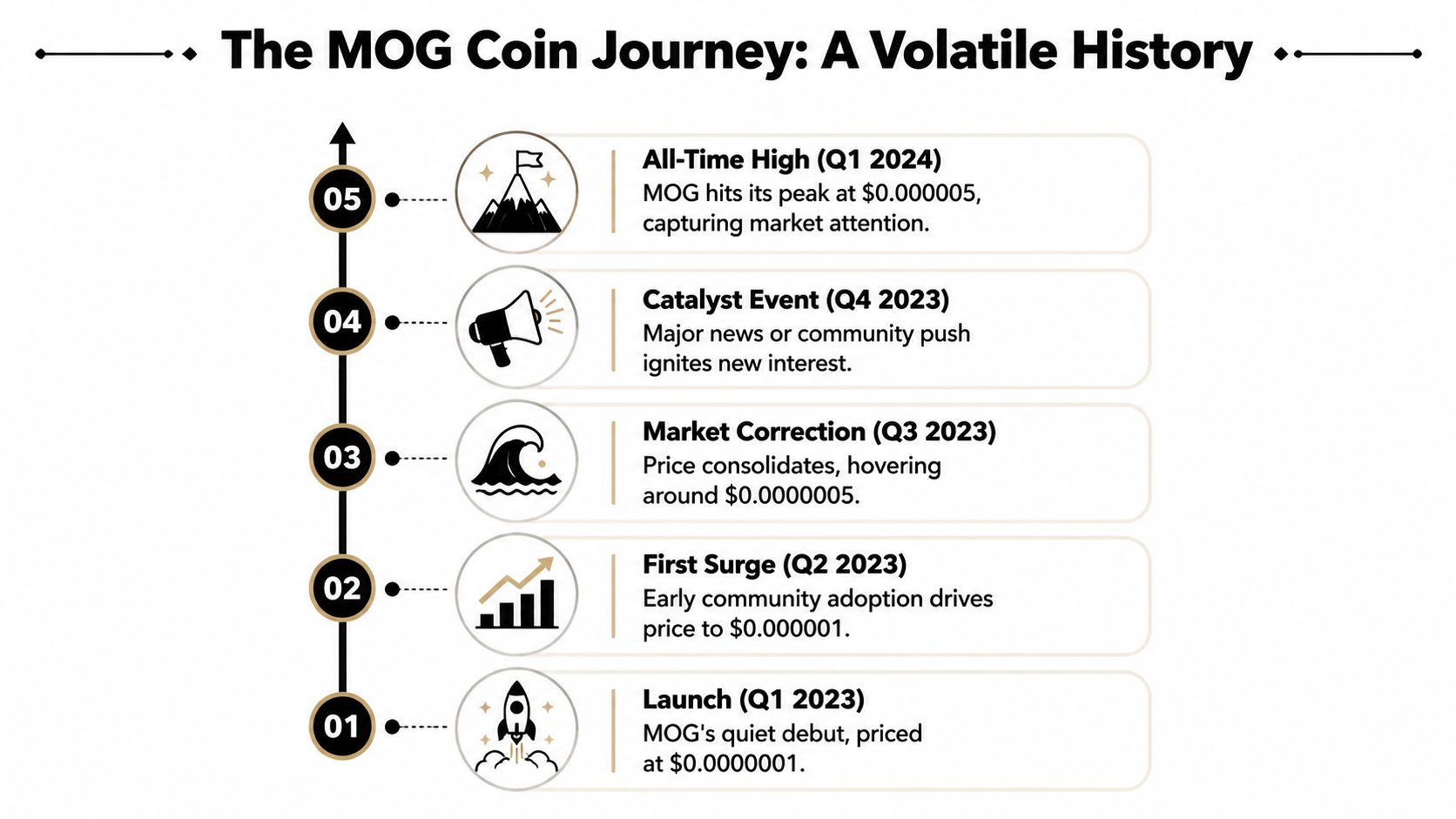
MOG launched in July 2023. Early trading was thin, price discovery was messy, and the token behaved like many new meme assets do before broader attention arrives. Then the market found a narrative. Listings, social traction, and meme rotation pulled more liquidity into the chart and turned MOG from a niche trade into a name momentum desks had to watch.
The key phase came in 2024.
MOG did not grind higher in a clean trend. It repriced in bursts. Strong upside days changed market perception fast, and that matters historically because meme traders usually respond to acceleration, not valuation. Once MOG showed it could produce outsized daily moves, it earned a place on more watchlists and stayed there.
That is the useful read on its history. MOG's breakout was not built on slow, orderly demand. It was built on attention spikes, expanding participation, and repeated momentum waves that fed on each other.
The same record also shows why the chart needs more than surface-level analysis. A token can make a huge run and still trade with violent air pockets between impulse legs. For MOG, that means the historical chart is less useful as a "belief" story and more useful as a map of how fast sentiment can reprice the market in both directions.
A few patterns stand out:
That last point is where traders usually miss the edge. The chart tells you when MOG already moved. Wallet behavior helps explain who moved it. In practice, the historical record matters most when it is paired with wallet tracking, holder rotation, and repeated buying from experienced meme traders. That is how you separate a nostalgic retest story from a setup that has real sponsorship behind it.
MOG's history is worth studying for one reason. It shows the token can go from ignored to crowded very quickly, and that kind of transition usually starts in wallets before it becomes obvious on the chart.
A workable MOG setup usually appears before the chart looks clean. The edge comes from reading how the risk profile, trend damage, and wallet participation fit together.
That matters more here than repeating headline figures from the price section.
The most useful combination is MOG's small-cap profile paired with a chart that still sits well below its long-term trend marker. Coinlore's MOG trend page shows the token trading 49.8% below its 200-day EMA, a reminder that any upside trade is still a counter-trend attempt until that gap starts closing materially, based on Coinlore's MOG forecast and trend data.
For traders, that creates a specific type of opportunity. Small meme assets can reprice fast when attention returns, but the same structure also fails fast if buyers cannot hold higher levels. In practice, this is a high-risk, high-reward reversal environment, not a clean trend-following market.
A trader does not need six metrics with equal importance. MOG is easier to frame with three questions:
That last point is where many retail traders lose time. They watch candles first and wallets second. For MOG, the order should often be reversed.
The same chart can mean two different trades.
If MOG is still under the 200-day EMA, but wallet accumulation and bid-side volume start improving, the better plan is usually a tactical trade with tight invalidation. If price reclaims higher levels and strong wallets keep adding, the trade can shift from a bounce setup into a momentum continuation.
If those pieces do not line up, standing aside is a position too.
One practical habit helps here. Set alerts around trend levels and breakout zones before MOG starts moving, then pair them with wallet tracking so price strength has a sponsor behind it. A simple crypto price alert workflow helps catch the level. Wallet behavior helps judge whether the move is worth taking.
Market lens: MOG is attractive when the chart is damaged but sponsorship starts improving. That is usually where asymmetric meme trades begin.
There are two practical ways to buy MOG. Use a centralized exchange if you want speed and simpler order entry. Use a decentralized exchange if you want self-custody and direct wallet control.

For most traders, this is the cleaner starting point.
Create and verify your account
Use a major exchange that lists MOG, such as Kraken or KuCoin. Complete verification before you need to act on a move.
Fund the account
Deposit stablecoins or fiat, depending on what the exchange supports for your region.
Find the MOG market
Search the token ticker and check that you're on the correct pair.
Choose your order type
Market orders are faster, but limit orders give you better control in volatile names.
Set a post-entry plan immediately
Don't buy first and think later. Decide where you'd add, reduce, or exit before the order fills.
This route usually works best for traders who care about execution simplicity and don't want to manage swaps manually.
Use this route if self-custody matters more to you than convenience.
| Method | Works well for | Main advantage | Main drawback |
|---|---|---|---|
| CEX | Newer traders and active order managers | Faster execution and easier alerts | You rely on exchange custody |
| DEX | Self-custody users and on-chain natives | Direct wallet ownership | More manual steps and swap friction |
Most traders wait too long to do this. If MOG is on your watchlist, alerts should already be live.
Set alerts in three layers:
If you want a cleaner process for notification setup, this guide on how crypto price alerts work is a useful operational reference.
What doesn't work is staring at the chart all day. Good traders build alert systems so they can react with a plan instead of improvising under pressure.
Most MOG price content stops at chart patterns. That's incomplete. In memecoins, wallet behavior often matters more than the visible chart because the traders who move these markets don't wait for confirmation candles.
On-chain analysis highlighted by MEXC notes a gap in typical MOG prediction coverage. It found that top MOG wallets tracked through tools like Wallet Finder.ai posted 300-500% PnL in the last year by accumulating on dips below $0.00000015 and exiting near hype peaks, as covered in MEXC's MOG market analysis.

That isn't a promise you can copy mechanically. It is evidence that wallet-level behavior can produce a clearer edge than headline sentiment.
A wallet tracker helps you answer practical questions that a normal chart can't:
Not every whale is smart money. Some big wallets are early holders with poor timing. Others are active traders with repeatable entry discipline.
Use a process, not intuition.
Find the token first Start from the token view so you're looking at wallets that trade MOG, not random profitable wallets from unrelated sectors.
Sort for quality, not just size
Balance PnL, win rate, and recent activity. A wallet that made one lucky MOG trade isn't the same as a wallet with repeatable exits.
Open the full trade history
The edge is in behavior. Look at whether the wallet scales in over time, buys after flushes, or trims into euphoric spikes.
Check concentration risk
If a wallet goes too large relative to normal conditions, that's useful context. Aggressive sizing can signal conviction, but it can also create exit risk.
Build a watchlist
The goal isn't to copy every transaction. The goal is to know when several credible wallets start behaving the same way.
For traders who want a deeper framework, this explainer on smart money crypto tracking gives a solid base for evaluating wallet quality.
Execution note: The best signal usually isn't one wallet buying MOG. It's a cluster of capable wallets entering the same zone within a short period.
Many traders get sloppy at this juncture. They see a profitable wallet buy and jump in without context.
Before acting, check:
Later in your research flow, video walkthroughs can help you speed up this process without missing details.
What works with MOG is following disciplined wallet behavior at meaningful levels. What doesn't work is copying random large buys with no idea whether the buyer is entering, averaging, hedging, or preparing to distribute.
You log in after a sharp MOG bounce and price looks tempting. The better question is not who bought first. It is whether the underlying on-chain metrics support continuation or warn that the move is running into supply.
A forecast only matters if it can be checked against live market behavior. Traders Union's daily and weekly MOG outlook cites a near-term projection of $0.000000175 within four weeks, along with a "Strong Buy" signal and RSI(14) at 65.886. For traders, that forecast is only useful if on-chain metrics confirm that holders are not sending size into likely sell venues and ownership is not becoming more fragile as price rises.
Net exchange flow measures whether more MOG is moving onto exchanges or off them over a given period. This is a supply metric, not a wallet-quality metric.
A positive net flow usually raises the chance of near-term sell pressure, especially after a fast upside move. A negative net flow often supports price better because fewer tokens are sitting where they can be sold immediately. In practice, I treat this as a pressure gauge. If MOG is reclaiming a level while exchange inflows stay muted, the move has a better base than a bounce fueled only by social momentum.
Holder distribution shows how much supply sits with small, mid-sized, and large holders. For MOG, this matters because concentrated ownership can distort price discovery fast.
Watch the change, not just the snapshot:
This metric helps answer a simple trading question. Is the market broadening, or is it becoming easier for a few holders to move price?
Active addresses and daily transfer count help separate real participation from a dead-cat bounce. If price rises while address activity and transfers stay flat, the move is often thinner than it looks. If both expand with price, market interest is usually broadening.
That does not guarantee continuation. It does tell you that more participants are engaging with the token, which tends to matter more for MOG than isolated chart breakouts.
If you want a clearer framework for reading metrics like these, this guide to crypto on-chain analysis covers the core signals in a practical way.
Older coins moving after long inactivity can change the tone of a market. Dormant supply waking up into strength often deserves respect because long-held tokens can become fresh overhead supply.
For MOG, I pay close attention when older holdings begin moving during a rally but price stops expanding. That combination can mark distribution from patient holders into late buyers, even when the chart still looks constructive.
The cleanest MOG setups tend to show agreement across measurable conditions, not just one attractive print.
| Metric | Constructive read | Caution read |
|---|---|---|
| Net exchange flow | Outflows or stable exchange balances during consolidation | Rising inflows during weak or stalled price action |
| Holder distribution | Supply broadens across mid-sized holders | Large-holder concentration rises too fast |
| Active addresses | Participation expands with price and volume | Price rises while usage stays flat |
| Dormancy | Older supply remains quiet during breakout attempts | Long-idle tokens begin moving into strength |
That is the distinction that matters here. The previous section focused on which wallets deserve attention. This section is about which measurable conditions make a MOG move stronger, weaker, or more fragile before you put risk on.
MOG is still the kind of asset that can move hard and fast. That's the attraction, and it's also the trap. Traders who treat mog crypto price as just another chart usually end up entering too late, sizing too large, or holding through conditions they never properly assessed.
A better approach is narrower and more disciplined. Start with the current market context. Respect the long-term weakness while the chart remains below key macro trend markers. Use support and resistance to plan entries. Then do the part most traders skip. Check who is active on-chain.
That's where the edge tends to show up in memecoins. Price tells you what already happened. Wallet behavior often tells you what skilled traders are trying to do next.
The practical lesson isn't that every smart-money move should be copied. It isn't. The lesson is that wallet activity gives you timing, context, and intent that ordinary chart reading often misses.
If you're going to trade MOG in 2026, keep the process tight. Wait for defined zones. Use alerts. Track wallet clusters instead of isolated prints. Reduce size when structure is unclear. Press only when technicals and on-chain behavior line up.
If you want to turn that process into something repeatable, Wallet Finder.ai helps you track profitable wallets, monitor trades across major chains, and spot smart-money behavior before it becomes obvious on the chart. For MOG and other fast-moving meme coins, that kind of visibility can make the difference between chasing moves and preparing for them.