Recovery Factor Calculation for Smart Traders
Master the recovery factor calculation to measure a strategy's resilience. Learn the formula, see DeFi examples, and find top wallets with Wallet Finder.ai.

June 20, 2026


Wallet Finder
February 5, 2026
The best cryptocurrency portfolio tracker isn't just about adding up your balances. It’s a tool that gives you deep on-chain analytics, accurate DeFi PnL, and real-time alerts on what the smart money is doing. The old guard of tracking tools just can't keep up anymore—they were never built for the chaos of yield farming, NFT flipping, and multi-chain trading. You need actionable insights, not just a static list of numbers.
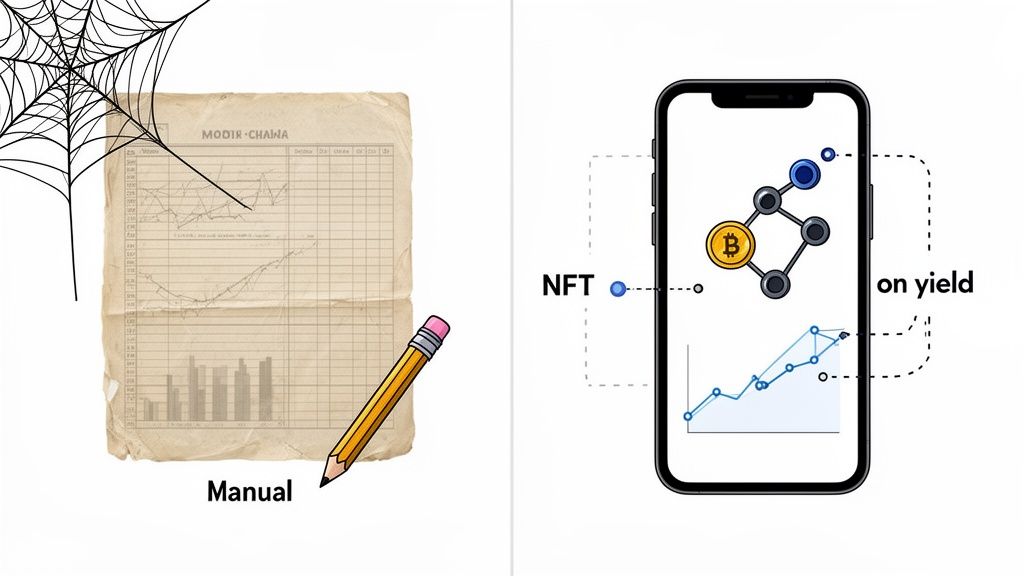
Remember when you could just hold some Bitcoin and Ether in one wallet and track it on a spreadsheet? Those days are long gone. The crypto world has exploded into a massive ecosystem of decentralized finance (DeFi), NFTs, and dozens of different blockchains. This evolution has left most traditional portfolio trackers in the dust.
Most of the older tools and manual methods just weren't built for this. They typically lean on basic exchange APIs, which means they're completely blind to what’s happening on-chain.
The cracks in these old systems start to show the minute you dive into modern crypto strategies. They just fall apart when trying to handle a few critical things:
The core problem is simple: traditional trackers show you what you hold, but they can't tell you why its value is changing or what the smart money is doing next. They give you a static snapshot in a market that never stops moving.
This hunger for deeper, real-time tracking is only getting more intense as the market matures. Take 2025, for example, when Bitcoin's market dominance shot past 60% and institutional ETF inflows topped $115 billion. Being able to see those market shifts as they happened was critical. Even with all that institutional money pouring in, major assets still saw huge corrections, proving how vital it is to have trackers that can monitor HODLer sentiment and dominance shifts on the fly. You can read more about these kinds of 2026 crypto market predictions on youhodler.com.
At the end of the day, a modern crypto investor needs more than a glorified balance sheet. You need a command center that turns raw blockchain data into clear trading signals, helping you spot opportunities and manage risk across the entire Web3 world.
Picking the right crypto portfolio tracker isn't just about finding a pretty dashboard anymore. In today's on-chain world, you need a powerful set of features that can actually keep up with the chaos. A modern tracker has to be an analytical engine, not just a simple balance aggregator.
To make the right call, you need a solid framework for evaluation. The criteria below cut through the marketing fluff and get straight to the non-negotiable features you need to succeed in DeFi, memecoin trading, and multi-chain investing.
The first, most basic test is a tracker's reach. The crypto world isn't just about Ethereum now; huge amounts of action are happening on networks like Solana, Base, Arbitrum, and others. Any top-tier tracker worth its salt has to offer comprehensive support across all the major and up-and-coming chains you're active on.
But just supporting the chain isn't enough. The platform also needs deep integrations with the specific DeFi protocols you're using. That means it has to correctly identify and track assets you have tied up in:
If a tracker only shows the native token of a protocol sitting in your wallet but misses all your complex positions within it, it’s giving you a dangerously incomplete picture of your portfolio.
This is where most basic trackers fall flat on their face. Calculating your true PnL in DeFi is an incredibly messy business. A proper cryptocurrency portfolio tracker must be able to dig through complex transaction histories to give you a precise picture of how you're really doing.
The gold standard for any tracker is its ability to calculate your PnL on a per-wallet, per-token, and even per-trade basis. Without that level of detail, you're flying blind, unable to separate your winning strategies from the ones that are bleeding you dry.
Think about it: if you're providing liquidity for a new memecoin on Base, the tracker needs to account for the initial swap fee, the value of the LP tokens you got, any farming rewards you earned, and the final value when you pulled out—including slippage and gas fees. Anything less is just a wild guess.
Finally, the best tools do more than just report what happened; they turn raw data into signals you can act on. This is where robust on-chain analytics and customizable, real-time alerts come in. These are the features that separate a passive dashboard from an active trading weapon.
To help you compare your options, here’s a quick checklist of the capabilities that truly matter.
When you're comparing different trackers, it's easy to get lost in a long list of features. This table cuts through the noise and highlights the absolute must-haves for any serious trader today.
A solid tracker that ticks all these boxes gives you a serious edge in the market.
Ultimately, the goal is to find a platform that doesn't just track your existing assets but actively helps you find new ones. To dig deeper into this, you can learn more about how a sophisticated crypto wallet tracker can uncover alpha. This proactive ability to hunt for opportunities is what really defines a modern portfolio management tool.
Picking the right crypto portfolio tracker isn't about ticking boxes on a feature list. The real test is how these tools handle the messy, fast-paced situations traders deal with every day. So, let's put four of the top platforms—Wallet Finder.ai, Zapper, DeBank, and CoinStats—through a couple of real-world scenarios.
Instead of just giving you a generic list of pros and cons, we're going to see where each platform really shines and where it stumbles. This is the only way to see the small differences that can give you a genuine edge.
Let's say you're running a multi-step yield farming strategy on Arbitrum. You’ve supplied ETH to a lending protocol, borrowed a stablecoin against it, and then used that stablecoin to provide liquidity in a DEX pool. How does each tracker handle this web of transactions?
For serious DeFi users, the game-changer isn't just seeing what you hold, but understanding the performance of the strategy as a whole. Tools that can accurately link a chain of transactions give you a far more honest picture of your real returns.
Alright, let's switch to something faster and more speculative: finding the next breakout memecoin on a chain like Base before everyone else piles in. The goal is to spot which tokens "smart money" is quietly accumulating.
Wallet Finder.ai was literally built for this. Its Discover Tokens feature lets you screen for new tokens based on criteria like how many smart money wallets are buying, recent spikes in volume, and holder distribution. You can see which top traders are getting in and set up instant alerts to copy their moves, giving you a massive timing advantage.
DeBank has a social feed and wallet activity streams that can help here. You can follow big-name wallets and see what they're buying in real-time. But it’s a manual process—you have to do a lot of digging yourself, and it doesn't have the kind of focused filtering and alerting tools designed for proactive hunting.
Zapper and CoinStats are reactive in this scenario. They are fantastic for tracking a memecoin after you’ve bought it, but they don’t have any features to help you find new opportunities based on smart money flow. You’d have to discover the token somewhere else first, then add it to your dashboard.
The infographic below gives you a simple checklist for what truly matters when you're sizing up these tools.
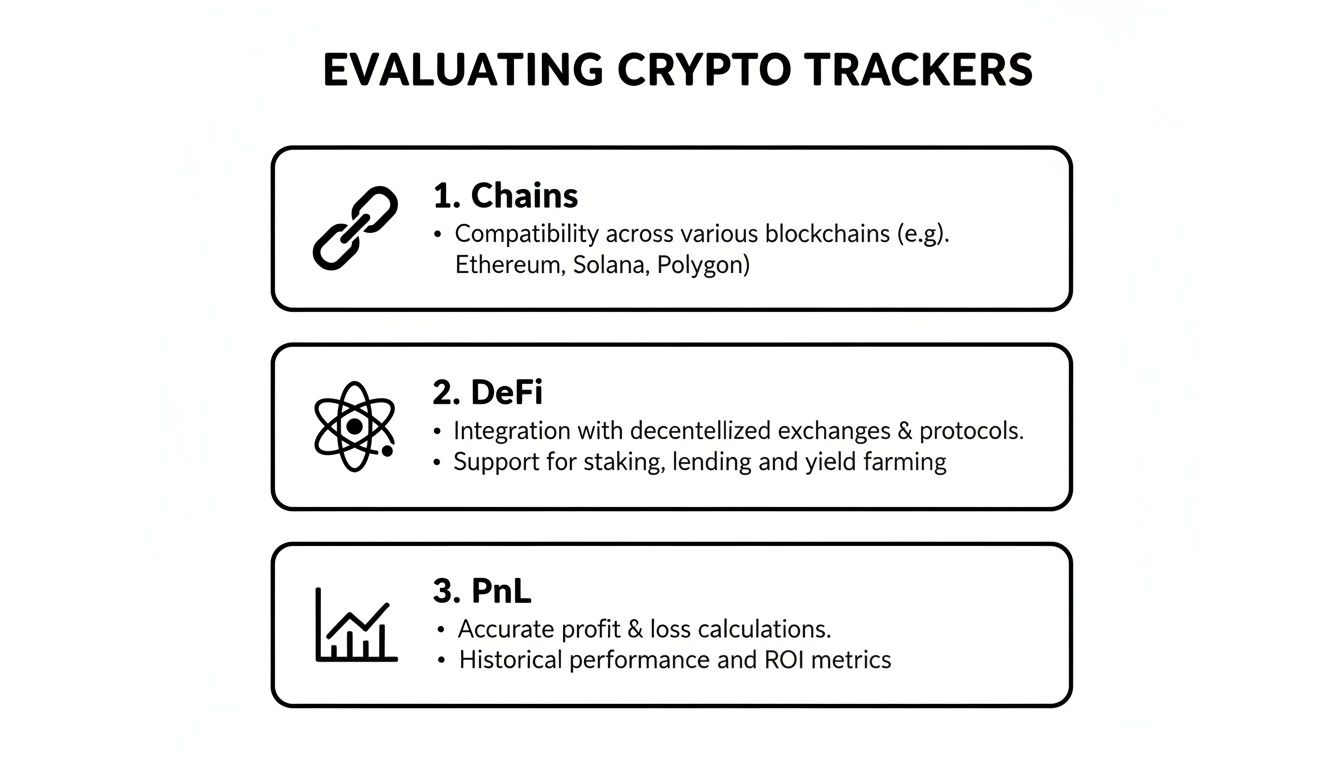
As the visual shows, top-tier performance boils down to deep chain support, spot-on DeFi analysis, and precise PnL calculations.
To lay it all out clearly, let's compare these platforms across the features that matter most to active traders and on-chain analysts. This table cuts through the marketing noise to show you exactly what each tool delivers.
This breakdown makes it clear that while all four are great tools, they are built for very different people with very different goals.
Ultimately, the best cryptocurrency portfolio tracker is the one that fits your strategy and goals. There's no single right answer.
While many of these platforms offer free versions, you might also want to compare some of the best free portfolio trackers on the market today.
While most portfolio trackers give you a rearview mirror look at your assets, Wallet Finder.ai is more like a powerful set of binoculars, helping you spot opportunities on the horizon. It’s built on a completely different philosophy. The goal isn't just to track what you already own, but to actively discover what you should own next by dissecting the moves of top-performing traders.
This section isn't just another feature list. We're going to dive into a hands-on, practical walkthrough of exactly how to turn raw on-chain data into profitable trading signals using Wallet Finder.ai’s specialized tools. The focus here is on action, not just passive observation.
Let’s kick things off with a common goal for DeFi traders: finding a consistently winning wallet on a hot chain like Solana and mirroring their strategy. Doing this manually is an absolute grind, but Wallet Finder.ai was engineered to make it incredibly efficient.
Imagine you want to find a trader who has been consistently banking profits on Solana memecoins. Here’s how you can turn that idea into a real, actionable strategy.
This isn't just a high-level summary. You get to see their exact realized gains, how long they held each coin, and which tokens generated the most profit. This level of detail helps you understand their strategy, not just their final numbers.
The real power of a true on-chain intelligence tool is its ability to move you from analysis to action seamlessly. It’s one thing to find a profitable wallet; it's another to be instantly notified the second they make their next move.
Once you’ve identified a trader whose strategy you like, the next step is crucial. With a single click, you can add their wallet to your watchlist and set up instant Telegram alerts. The moment they buy, sell, or swap a token, you get a notification. This allows you to mirror their trade in near real-time, transforming the best cryptocurrency portfolio tracker from a simple dashboard into a proactive trading engine.
Another powerful way to use the platform is to discover new tokens before they hit the mainstream. Too many traders chase pumps, but the real alpha is found by getting in before the pump even starts. This is where the 'Discover Tokens' feature becomes a game-changer.
Let's say you're hunting for the next potential breakout token on the Base network. You want to find something that the smartest traders are quietly accumulating before it starts trending everywhere.
This approach completely flips the script on token discovery. Instead of relying on hype and social media noise, you're making data-driven decisions based on the actions of proven winners. It’s a systematic way to front-run market sentiment.
The key difference in these scenarios is the focus on actionable intelligence. While other tools might just show you that a wallet bought a token, Wallet Finder.ai gives you the context you need to actually make a decision.
Ultimately, this platform is designed for a specific type of user: the proactive trader who wants to use on-chain data as a competitive edge. It’s less about managing a static portfolio and more about dynamically finding and executing on new opportunities. For traders looking to do more than just track, it stands out as the best cryptocurrency portfolio tracker for generating alpha.
Let’s be real: there’s no single “best” crypto portfolio tracker. Anyone who tells you otherwise is selling something. The right tool is the one that fits your trading strategy, risk tolerance, and goals like a glove. A platform built for a long-term, passive investor will feel clunky and useless to a hardcore DeFi degen, and vice versa.
Choosing the right tracker starts with an honest look at what you’re actually doing on-chain. Are you carefully managing a portfolio of blue-chip assets for the long haul? Or are you hunting for the next 100x memecoin on Base? Your answer completely changes which features go from being a "nice-to-have" to an absolute necessity.
If you live and breathe decentralized finance, your main goal is simple: find an edge. Your strategy is all about discovering new opportunities, shadowing the moves of winning wallets, and moving faster than everyone else. A basic dashboard that just shows your net worth isn't going to cut it.
This is where a tool like Wallet Finder.ai becomes your command center. Its whole purpose is to support this high-speed, aggressive trading style.
For the active DeFi trader, a portfolio tracker should be an offensive weapon, not just a defensive accounting tool. Its value is measured in the new alpha it helps you find, not just how accurately it calculates your net worth.
On the flip side, if your game plan is more about long-term holding (HODLing) and passive investing, your needs are completely different. You aren't chasing daily trades; you're focused on the big picture and the steady growth of your portfolio over time. For you, simplicity and clarity are king.
A tool like CoinStats or a basic plan on Zapper is often a much better match. Your ideal tracker needs to nail these points:
For the HODLer, the best tool is one you can set up once and check in on periodically for a reliable snapshot, without being overwhelmed by on-chain data you don't need.
This type of trader is a bit of a hybrid. You’re always exploring new ecosystems, jumping from Solana and Base to Arbitrum and beyond. You might not be a frantic copy trader, but you’re actively using new DeFi protocols and always looking for the next big trend across different chains.
Your biggest headache is fragmentation—assets scattered everywhere. The perfect tracker for you needs exceptional multi-chain support. This is where a platform like DeBank often stands out, offering a surprisingly comprehensive view of assets spread across countless dApps. The key is finding a tool that correctly identifies and values those obscure LP positions, staked assets, and borrowed funds, no matter what chain they're on. Your goal is a single dashboard that brings order to the chaos of a multi-chain strategy.
Even the sharpest crypto portfolio trackers can bring up some valid questions. After all, you’re handing over access to your financial data, even if it's just read-only access. It’s smart to be cautious.
Let's walk through some of the most common concerns traders have before they commit to a platform. Getting these answers straight is key to using any tracking tool safely and effectively.
This is always question number one, and for good reason. Security is everything. Reputable trackers build their platforms on a multi-layered defense system, starting with a strict "read-only" policy.
What this means is when you connect a wallet address or an exchange API key, the platform can only view your balances and transaction history. It cannot execute trades, process withdrawals, or move your funds. Period.
The golden rule of crypto security applies here: A legitimate portfolio tracker will never ask for your private keys or seed phrases. If any tool asks for them, it's a massive red flag. Close the tab and don't look back.
On top of that, the best platforms add extra layers of protection, like:
These features are designed to give you a clear window into your assets without ever handing over the keys.
Absolutely. A good portfolio tracker can be a massive headache-saver come tax season. While they aren't tax software themselves, they are absolutely essential for gathering and organizing the data you need.
Think about it: a solid tracker automatically logs every single buy, sell, swap, and airdrop you make across all your connected accounts. This gives you a complete, chronological transaction history—the bedrock of any accurate tax report. Some can even generate reports that calculate your capital gains and losses, which you can then pass along to your accountant or upload to a crypto tax service.
Just remember their limits. The wild world of DeFi—with things like yield farming and liquidity pools—can sometimes stump automated systems. It's always a good idea to double-check the data and run it by a tax professional to make sure you’re fully compliant.
This is a great question because the answer gets right to the heart of data accuracy and what kind of insights a tool can actually provide. The two methods work in completely different ways.
For a truly complete picture of your crypto life, you need a tracker that excels at both. API tracking handles your centralized exchange moves, while on-chain tracking makes sure you don't miss a single bit of the decentralized action. The best cryptocurrency portfolio tracker will merge both data streams into one clean, unified dashboard so you can see everything in one place.
Ready to turn on-chain data into actionable trading signals? Wallet Finder.ai is built for traders who want to discover and mirror the moves of top-performing wallets in real time.

A premier DeFi analytics platform empowering traders to discover and analyze profitable blockchain wallets, trades and tokens.