
The 10 Best DeFi Staking Platforms for 2026
Discover the best DeFi staking platform for maximizing yield in 2026. In-depth reviews of Lido, Jito, ether.fi & more on security, APY, and fees.
With over $120 billion+ in DeFi TVL tied to Ethereum alone in 2026 rankings, staking platform choice isn't a side decision anymore. It shapes your liquidity, your downside in a de-peg, your smart contract exposure, and whether your capital can still work elsewhere after you stake.
That’s why chasing headline APY is a bad way to pick the best defi staking platform. The better question is simpler. What token do you want back after staking, how easy is it to exit, where can that token be used in DeFi, and what extra risks are layered on top?
A plain ETH staking position and a liquid restaking position may both look attractive on the surface, but they behave very differently when markets get stressed. The same goes for Solana. Native staking, liquid staking, and MEV-enhanced staking are different products with different failure points.
The platforms below are the ones I’d shortlist in 2026. Some are safer defaults. Some are better for active DeFi users. A few are only worth touching if you understand restaking risk and can monitor your position on-chain.
Practical rule: If you can’t explain how the staking token earns yield, how you exit it, and where it might lose parity, you’re not ready to size the position.
1. Lido
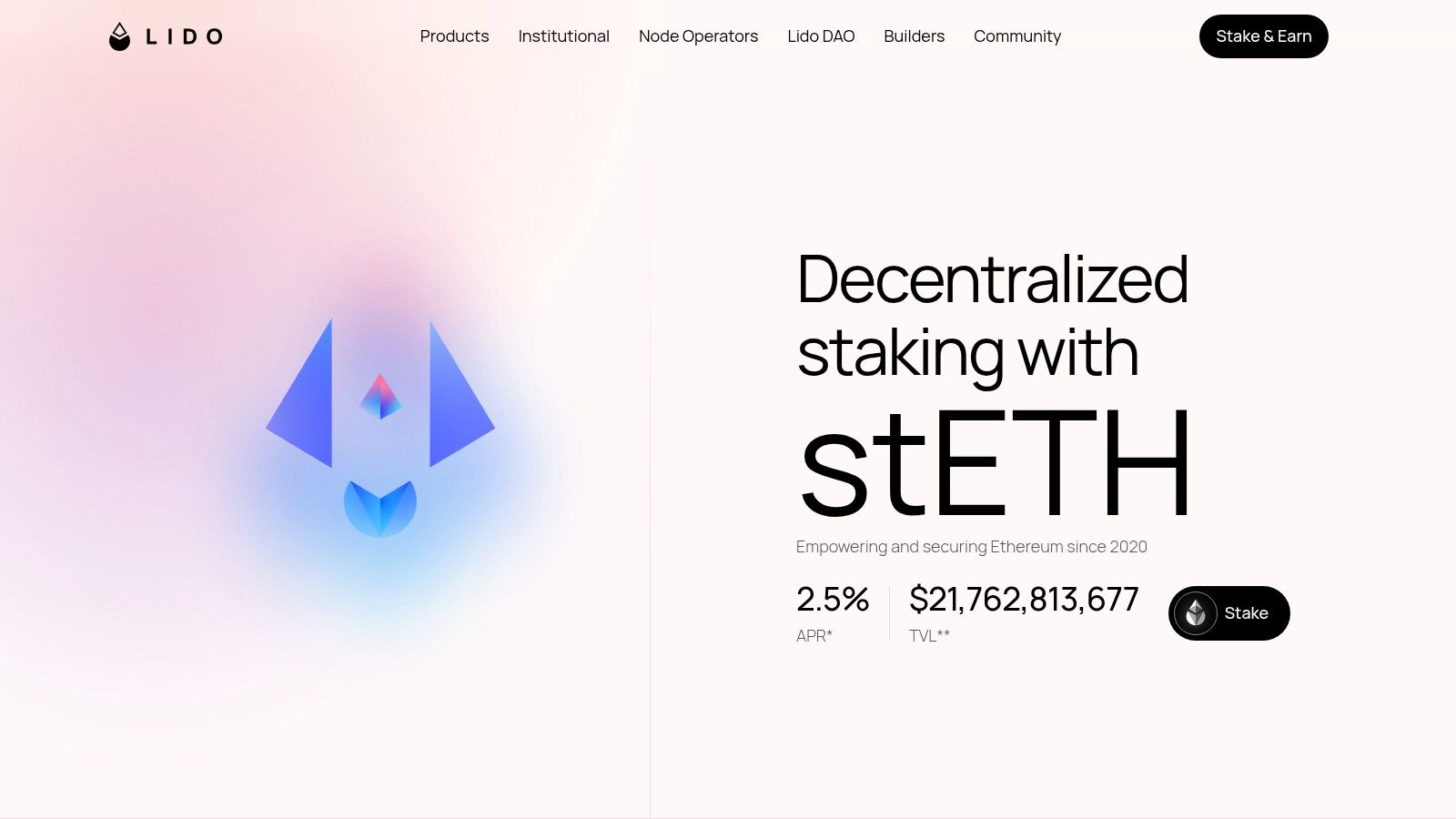
Lido is still the default answer for most ETH users because it solves the biggest staking problem cleanly. You stake ETH, receive a liquid token back, and can keep using that position across DeFi instead of locking capital in place.
As of recent 2026 data, Lido commands over 28% market share in Ethereum liquid staking with about $25 billion in TVL through stETH. That matters in practice because liquidity depth is often more important than a small APY edge. If you need to unwind, hedge, borrow, or rotate into another trade, deep liquidity usually beats exotic yield.
Why Lido works
Lido’s strength is composability. stETH is everywhere that matters in Ethereum DeFi, and wstETH is often the cleaner choice if you want a wrapped format for integrations and accounting. The protocol is non-custodial, DAO-governed, and supported by a decentralized validator set.
For active users, that opens up more than passive staking:
- Borrowing flexibility: stETH and wstETH are easier to use as collateral across major DeFi venues.
- Cleaner portfolio management: wrapped exposure can be simpler to track if you’re moving between chains or vaults.
- Better copy-trading visibility: if you want to study how strong wallets deploy liquid staking positions, Wallet Finder’s guide to staking in DeFi is a useful starting point.
The trade-off
Lido is the blue-chip option, but blue-chip doesn’t mean risk-free. Large market share creates concentration concerns, and Lido also takes a protocol fee from rewards. If your priority is maximum decentralization or minimizing protocol-level concentration, you may prefer a smaller alternative.
Lido is best when you want the most liquid ETH staking token, not when you want the most ideologically decentralized setup.
2. Rocket Pool

Rocket Pool appeals to a different kind of staker. If Lido is the liquidity-first option, Rocket Pool is the decentralization-first one. That difference shows up in both culture and structure.
Its liquid staking token, rETH, doesn’t rebase. Instead, rewards accrue through exchange-rate appreciation relative to ETH. That’s a cleaner model for some DeFi users, especially if they dislike rebasing tokens and prefer a token whose value drifts upward rather than whose balance changes.
Where Rocket Pool stands out
Rocket Pool is one of the few options I’d point to when someone says, “I want liquid staking, but I also care about permissionless node operation.” That design choice matters. It supports a broader operator base and avoids pushing everything toward a smaller set of dominant validators.
Earlier institutional staking comparisons in the research set frame Rocket Pool at around a smaller share than Lido, and that gap is visible in liquidity too. You usually feel it most when size matters. Large exits, collateral routing, and DEX pricing can be less forgiving than on stETH-heavy markets.
- Best fit: users who value decentralization design over absolute liquidity depth
- Works well for: long-term ETH holders who don’t need the deepest secondary markets
- Less ideal for: traders who constantly lever, hedge, or rotate large positions
What can go wrong
rETH pricing in DeFi can diverge from the simple “ETH plus rewards” mental model if market conditions get messy. That doesn’t automatically make it unsafe, but it does mean you should watch secondary market liquidity instead of assuming smooth exits.
Rocket Pool also isn’t the easiest path if you’re trying to mint at scale during capacity constraints. Pool-side limits can affect the user experience more than people expect.
3. ether.fi

ether.fi is where the conversation shifts from staking to stacked risk. You’re not just collecting ETH staking rewards. You’re stepping into liquid restaking, which can add more yield but also adds more places for something to break.
That’s the appeal. It automates restaking exposure in a way that feels simple from the front end. You stake, receive eETH or weETH, and get an asset that can still move through DeFi while targeting layered rewards.
Why traders like it
For capital-efficient ETH users, ether.fi is easier to justify than a plain staking position. The token formats are built for composability, and the protocol has become a common choice for users who want both ETH staking exposure and restaking upside in one place.
The underserved angle is what top wallets are doing with those tokens after minting them. The broader category has seen strong growth, and one verified market snapshot notes that Ether.fi’s liquid restaking surge in 2025 to 2026 pushed yields to 19%+ APY equivalents in that context. That kind of headline draws traders in fast, but it doesn’t tell you when smart money is entering, rotating out, or using the token as collateral.
That’s where a tool-driven approach matters. If you’re comparing headline returns, this roundup of high APY crypto staking options is useful context. But the edge is tracking wallets that size into eETH or weETH before broader flows follow.
What doesn’t work
Restaking isn’t a free upgrade on standard ETH staking. It adds AVS-layer and smart contract risk on top of validator risk. If you can’t monitor those layers, ether.fi can quickly become “too complicated to own well.”
Use it if you want yield with active oversight. Skip it if you want something you can forget about.
4. StakeWise v3
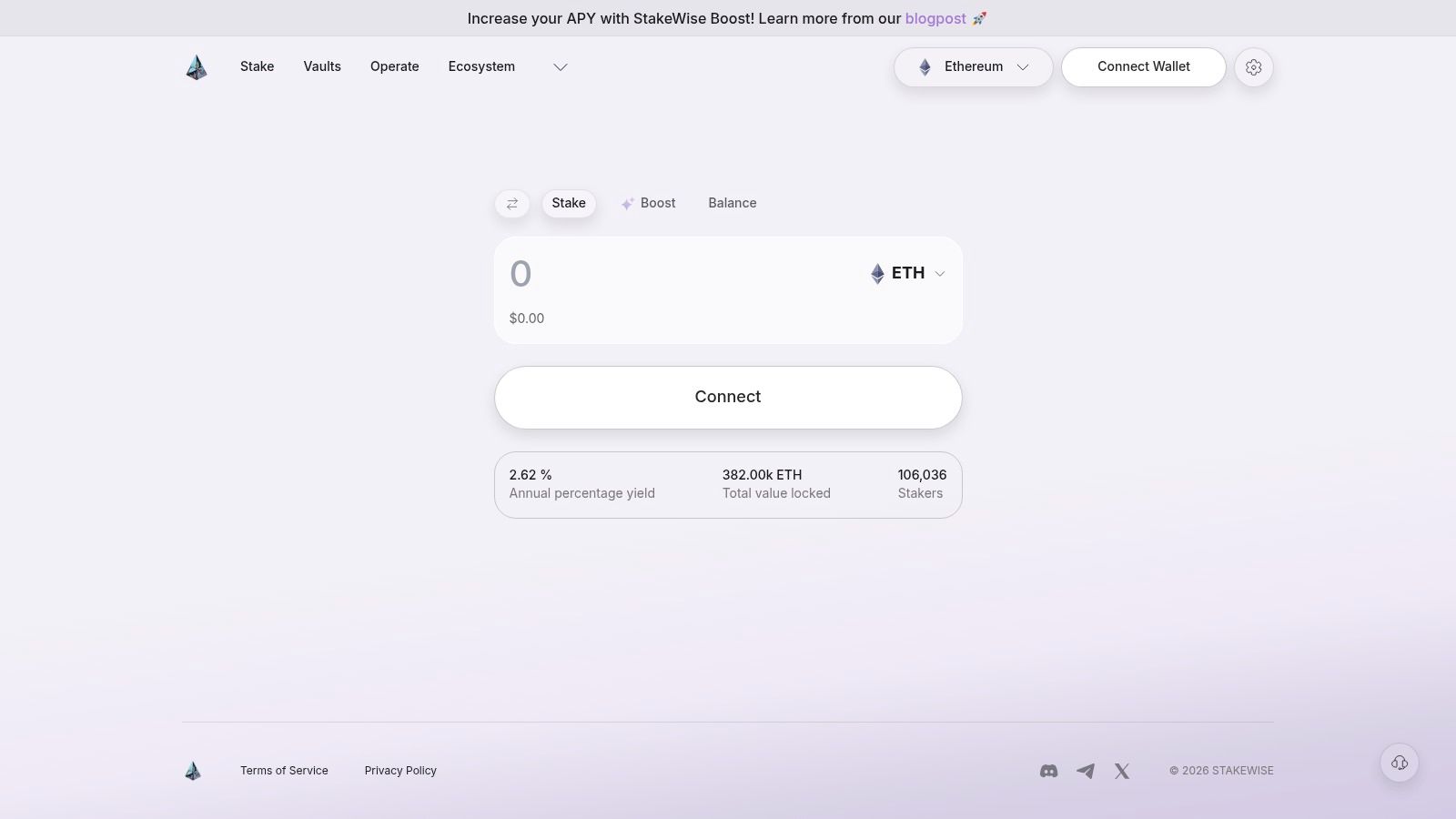
StakeWise v3 is one of the better choices for users who don’t want a one-size-fits-all staking product. Its vault model gives you more control over operator selection and risk exposure than most mainstream ETH staking interfaces.
That control is the reason to use it. If you care who runs validators, how vaults are structured, and how your liquid staking token gets deployed, StakeWise is more flexible than the larger “deposit and forget” options.
Why it earns a place on the list
osETH gives you a liquid token to work with, while the vault structure lets you be more selective about where your exposure sits. That’s useful for users who don’t want all operator risk abstracted away into a single protocol-level package.
This setup tends to fit three kinds of users:
- Hands-on allocators: people who compare vaults instead of accepting the default route
- Risk splitters: users who want to spread validator or operator exposure
- DeFi tinkerers: people who care about where osETH can be deployed after minting
The main drawback
The trade-off is obvious once you use it. More choice means more work. You need to evaluate vaults, operator quality, and osETH liquidity rather than relying on one giant market to absorb every decision.
That also means thinner liquidity can matter more here than on the biggest ETH liquid staking tokens. StakeWise is strongest when you value control and customization. It’s weaker if your top priority is the deepest market and the easiest path in and out.
If you won’t spend time comparing vaults, StakeWise loses a lot of its advantage.
5. Frax Ether
Frax Ether is a good reminder that token design matters. A lot of users buy the wrong asset in this ecosystem because they assume every staking token earns yield the same way.
With Frax, that assumption gets expensive. frxETH is the utility side. sfrxETH is the yield-bearing side. If you don’t understand that distinction before clicking through the app, you can end up holding the wrong instrument for your goal.
Why some users prefer it
Frax has always been better than average at building products that connect with a broader DeFi stack. That ecosystem effect helps here too. If you already use Frax-related markets or strategies, frxETH and sfrxETH can fit naturally into a larger portfolio.
The reward routing is also clearer than many users expect once they read through the mechanics. You can identify where staking rewards are meant to accrue and which token is supposed to capture them.
The actual trade-off
The structure is elegant, but not beginner-friendly. Only sfrxETH earns staking yield, and that trips people up constantly. The protocol also takes a cut of rewards. Verified product notes in the brief describe that fee split as 8% to treasury and 2% to insurance, 10% total. That doesn’t make the product unattractive, but it does reduce gross rewards before they hit your wallet.
- Good use case: you already operate inside the Frax ecosystem and understand the token split
- Bad use case: you want the simplest possible ETH staking position
- Biggest mistake: holding frxETH and expecting it to behave like the yield-bearing side
Frax Ether makes more sense for users who read docs carefully than for users who just chase the best defi staking platform by homepage yield.
6. Stader ETHx
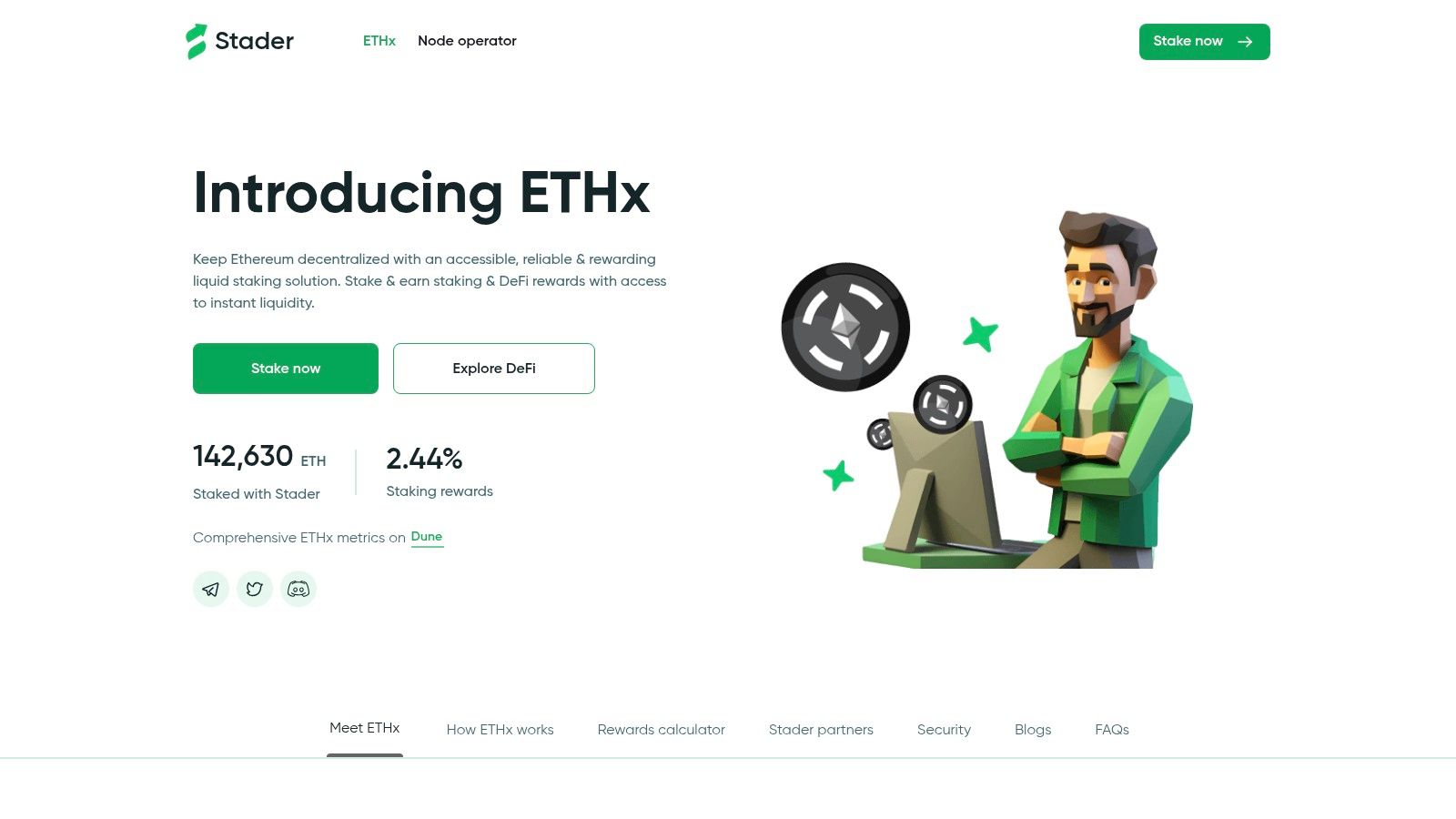
Stader ETHx stands out because it doesn’t approach staking as an Ethereum-only problem. It has broader multi-chain experience, and that shows in the product positioning, docs, and operator model.
If you’re a user who moves across ecosystems instead of living entirely on Ethereum, Stader’s approach can feel more natural than some ETH-native liquid staking products. The protocol leans into a multi-operator architecture and a decentralization story that includes both professional operators and smaller participants.
Where ETHx fits
ETHx isn’t the token I’d default to for maximum DeFi liquidity. It is a token I’d consider when decentralization and operator breadth matter more than being on the most crowded trade.
That distinction is important. The largest ETH liquid staking markets have stronger routing, more collateral support, and easier exits. Smaller markets can still be good products, but they demand more attention from the user.
Best use cases
- Cross-ecosystem users: people who already use Stader products outside Ethereum
- Decentralization-minded allocators: users who want alternatives to the biggest LST pools
- Institutional-style evaluators: people who care about architecture, audits, and operator design
The downside is practical rather than theoretical. ETHx liquidity is smaller than the deepest ETH LST markets, so trade execution and collateral availability can be less convenient. That won’t matter to every user, but it matters a lot if you actively rebalance.
Stader is a solid choice for thoughtful staking. It’s not the easiest choice for aggressive DeFi routing.
7. Marinade Finance

Marinade Finance is one of the cleanest ways to get liquid staking exposure on Solana. Stake SOL, receive mSOL, and keep that asset usable inside the Solana ecosystem instead of waiting through a standard unstake path.
For users who want a long-running Solana native option, Marinade still deserves serious attention. It’s especially useful if your strategy involves staking but you still want flexibility for lending, LP positions, or later rotation into other Solana trades.
Why mSOL still matters
Jito gets more attention from traders because of the MEV angle, but Marinade remains attractive for users who want straightforward liquid staking without adding another narrative layer on top. mSOL works well for portfolio builders who want broad Solana DeFi utility without centering the whole position around MEV capture.
There’s also a practical education benefit here. If you’re still deciding between pure staking exposure and active DeFi deployment, this breakdown of staking vs yield farming helps clarify what you’re signing up for once you move beyond a simple stake-and-hold setup.
What to watch
Marinade offers both instant and delayed unstake paths. That sounds minor until you need to exit quickly. The instant route is convenient but comes with a fee. The delayed route is cheaper but requires waiting on epoch timing.
On Solana, unstake mechanics matter almost as much as yield. Fast chains make users assume exits are always instant. They aren’t.
Marinade is a better fit for disciplined allocators than for traders who constantly need immediate liquidity under pressure.
8. Jito Network
Jito Network is the strongest Solana staking option for users who care about total reward potential and understand where that extra yield comes from. It combines liquid staking with MEV-aware infrastructure, and that changes both the upside and the risk profile.
Verified market data notes that Jito had over 14.5 million SOL staked across 204 validators as of December 2024, with more than 8% APY tied to MEV-enhanced staking through JitoSOL. That’s enough to make it impossible to ignore if you’re active on Solana.
Why Jito is different
Jito isn’t just “another liquid staking token.” The value proposition is that stakers share in MEV-related rewards that plain staking doesn’t capture the same way. For some users, that’s a meaningful edge. For others, it’s one more moving part that they’d rather not underwrite.
Its validator breadth also matters. A large validator set supports resilience and keeps the product from being only a single-yield wrapper with a marketing story attached.
- Best for: active Solana users and performance-focused stakers
- Strong use case: traders who want liquid staking plus MEV-linked upside
- Not ideal for: users who want the simplest possible staking return stream
What can frustrate users
MEV-linked rewards introduce variability. Your effective return can drift with network conditions and bundle activity, so the experience won’t always feel as predictable as a simpler staking product.
The unstake path also matters here. Direct exits can include a fee, while delayed exits follow standard waiting periods. If you use Jito, accept that you’re choosing a more dynamic reward engine, not a passive set-it-and-forget-it product.
9. BENQI Liquid Staking
BENQI Liquid Staking is the easiest Avalanche pick on this list because it’s ecosystem-native and simple to understand. Stake AVAX, receive sAVAX, and keep that position usable across Avalanche DeFi.
That simplicity matters more than people think. On smaller ecosystems, the best product often isn’t the one with the most ambitious architecture. It’s the one with enough adoption, decent integrations, and a UI that doesn’t punish normal users for showing up.
Where BENQI wins
BENQI makes sense for AVAX holders who want to keep capital productive without introducing unnecessary complexity. If you already use Avalanche lending or LP strategies, sAVAX is the natural first stop.
The product is especially approachable for users who are newer to liquid staking outside Ethereum and Solana. The app flow is clear, and the token behavior is straightforward.
The limitation
The ceiling is ecosystem size. BENQI can be the right Avalanche platform and still not offer the same cross-chain liquidity profile you’d get from the largest ETH staking tokens. That’s not a flaw in the product as much as a reality of where the token lives.
Keep expectations aligned with the chain:
- Strongest for: Avalanche-native users
- Less compelling for: cross-chain traders who want deep secondary liquidity everywhere
- Main risk to monitor: validator performance and the practical depth of sAVAX markets
BENQI is one of the few entries here where “good enough and easy to use” is a real advantage.
10. Puffer Finance

Puffer Finance is another Ethereum liquid restaking option, but it has a different appeal from ether.fi. The pitch leans harder into validator tooling, permissionless participation, and slash-protection-oriented design claims.
That makes it more interesting to technically engaged users than to casual stakers. If you care about validator infrastructure and protocol architecture, Puffer gives you more reason to dig in. If you just want easy ETH yield, it may feel like too much product for the job.
Why advanced users pay attention
pufETH gives exposure to restaked ETH yield while the broader platform focuses on validator participation and technical safeguards. That combination stands out in a category where many users focus only on front-end APY and ignore the system beneath it.
Puffer also benefits from clear technical documentation and published audits. That doesn’t remove risk, but it does make the protocol easier to evaluate on its own terms.
The practical trade-off
This is still restaking. So the biggest downside remains the same. You’re adding AVS and smart contract layers on top of regular ETH staking exposure. Liquidity and integration depth also aren’t as mature as older Ethereum liquid staking markets.
Use Puffer if you’re comfortable underwriting protocol design. Don’t use it just because “restaking” sounds like upgraded staking.
For advanced users, that trade can be worth it. For everyone else, simpler ETH staking products are often the better call.
Top 10 DeFi Staking Platforms Comparison
| Protocol | Core Features | UX & Trust | Value & Fees | 👥 Target Audience | ✨ / 🏆 Unique Selling Point |
|---|---|---|---|---|---|
| Lido (stETH / wstETH) | stETH & wstETH, deepest LST liquidity, DAO-governed | ★★★★★, audited, broad DeFi integrations | 💰 Competitive yields, 10% protocol fee on rewards | 👥 DeFi traders, LPs, composability users | ✨ Broadest integrations & liquidity, 🏆 market leader |
| Rocket Pool (rETH) | rETH + permissionless node minipools, decentralization-first | ★★★★, strong docs, permissionless nodes | 💰 Variable net yield (operator commissions), DEX price variance | 👥 Decentralization-focused users & node operators | ✨ Permissionless node ops & clear mint/burn |
| ether.fi (eETH / weETH) | Auto restaking via EigenLayer, eETH/weETH shares model | ★★★★, growing integrations & transparency | 💰 Restaking + staking yields, protocol fee reduces net | 👥 Yield-seekers, builders wanting LRT composability | ✨ Automatic EigenLayer restaking for higher gross yields |
| StakeWise v3 (osETH) | Vault-based, pick-your-operator, Boost DeFi routes | ★★★★, granular operator transparency | 💰 Customizable risk/reward; vault/DAO fees vary | 👥 Users wanting operator control & fine risk tuning | ✨ Vault selection + Boost integrations for custom exposure |
| Frax Ether (frxETH / sfrxETH) | Split-token: frxETH (utility) & sfrxETH (yield-bearing) | ★★★★, integrated into Frax ecosystem | 💰 sfrxETH earns staking rewards, ~10% protocol fee total | 👥 Frax users, DeFi LPs & lenders | ✨ Split-token design for utility vs yield |
| Stader ETHx | Multi-operator, multi-chain LSTs (ETH + chains) | ★★★★, audits & multi-chain docs | 💰 Cross-chain exposure; protocol fees (~~10% common) | 👥 Multi-chain users, institutional & retail | ✨ Multi-chain LST architecture & operator mix |
| Marinade Finance (mSOL) | mSOL accrues rewards, validator diversification, instant unstake | ★★★★★ native Solana protocol, audited | 💰 SOL-native yields; instant-unstake fee vs epoch wait | 👥 Solana stakers & DeFi users | ✨ Instant Unstake option, strong Solana composability, 🏆 |
| Jito Network (jitoSOL) | MEV-enabled validators, jitoSOL for Solana DeFi | ★★★★, active tooling & disclosures | 💰 Potential MEV upside; direct unstake ≈0.1% fee | 👥 Yield-maximizers on Solana | ✨ MEV revenue sharing to boost net rewards |
| BENQI (sAVAX) | sAVAX native LST, Avalanche integrations | ★★★, clear UI & docs | 💰 AVAX staking yield; smaller cross-chain liquidity | 👥 Avalanche users, beginners | ✨ Ecosystem-native LST with simple UX |
| Puffer Finance (pufETH) | EigenLayer restaking, anti-slash claims, permissionless validators | ★★★, published audits & docs | 💰 Restaking yields with added AVS risk; early liquidity | 👥 Restaking enthusiasts & validators | ✨ Permissionless restaking tooling & slash-protection focus |
Start tracking smart money today
Join thousands of traders using WalletFinder.ai to find profitable wallets and copy their trades.
Start Free Trial →

