CoinMarketCap Yield Farming: A Trader's Guide for 2026
Master CoinMarketCap yield farming. Our guide explains how to find, vet, and analyze pools, interpret APY/risk, and use on-chain tools to mirror top traders.

April 23, 2026
Wallet Finder

April 23, 2026

You’re probably doing the same thing most DeFi traders do when yield gets interesting again. You open CoinMarketCap, sort by eye-popping returns, click a few pools, and try to work out whether any of them are real opportunities or just temporary emissions wrapped in good marketing.
That instinct is fine. The mistake is stopping there.
coinmarketcap yield farming is useful, but only as a discovery layer. It helps you spot categories, tokens, and protocols worth investigating. It does not tell you whether a pool is durable, whether rewards can be dumped, whether smart money is already rotating out, or whether the token you’ll be paid in is collapsing.
The traders who survive in yield farming don’t chase the biggest number on a dashboard. They build a workflow. They use CoinMarketCap to scan, then they switch to protocol docs, block explorers, on-chain activity, and wallet tracking to confirm whether the setup is worth the risk.
Yield farming is the practice of putting crypto assets to work inside DeFi protocols so those assets generate returns. In plain terms, you’re renting out your crypto to a market structure that needs liquidity, lending capital, or both.
Sometimes you deposit a single asset into a lending market. Sometimes you provide a token pair into a DEX pool. In return, the protocol may pay you from trading fees, lending interest, token incentives, or a combination of all three. That’s the attractive part. The ugly part is that your return can change fast, and the headline rate rarely tells the full story.
For newer traders, CoinMarketCap is the obvious starting point because it gives you a familiar interface and broad market coverage. It’s the crypto equivalent of opening a map before you start driving. You can see projects, token categories, and farming-related assets without needing to jump immediately into five different DeFi dashboards.
CoinMarketCap is good at a few things:
That’s useful when the market gets noisy and you need a first filter.
What it isn’t good at is giving you a tradable edge on its own. It doesn’t replace reading reward mechanics, checking release pressure, reviewing contract behavior, or watching wallet flows. If you want a practical base before getting more advanced, this breakdown of yield farming crypto basics is a good companion to keep the terminology straight.
Practical rule: Use CoinMarketCap to find candidates, not to approve positions.
A lot of traders approach yield farming like a savings product. That’s the wrong frame. It behaves more like an active strategy with hidden variables. Your real return depends on entry timing, token volatility, liquidity conditions, and whether the incentives keep attracting sticky capital or just short-term mercenaries.
Start with CoinMarketCap because it’s accessible. Leave it quickly once a pool looks interesting. That’s where the actual work begins.
CoinMarketCap became a major entry point for DeFi research because yield farming helped drive DeFi from $500 million to $10 billion in market capitalization in 2020, a 20x increase, during the period many traders call DeFi Summer, and Compound’s liquidity mining launch in June 2020 helped pull billions in value into DeFi platforms almost overnight, according to CoinMarketCap Academy’s overview of yield farming.
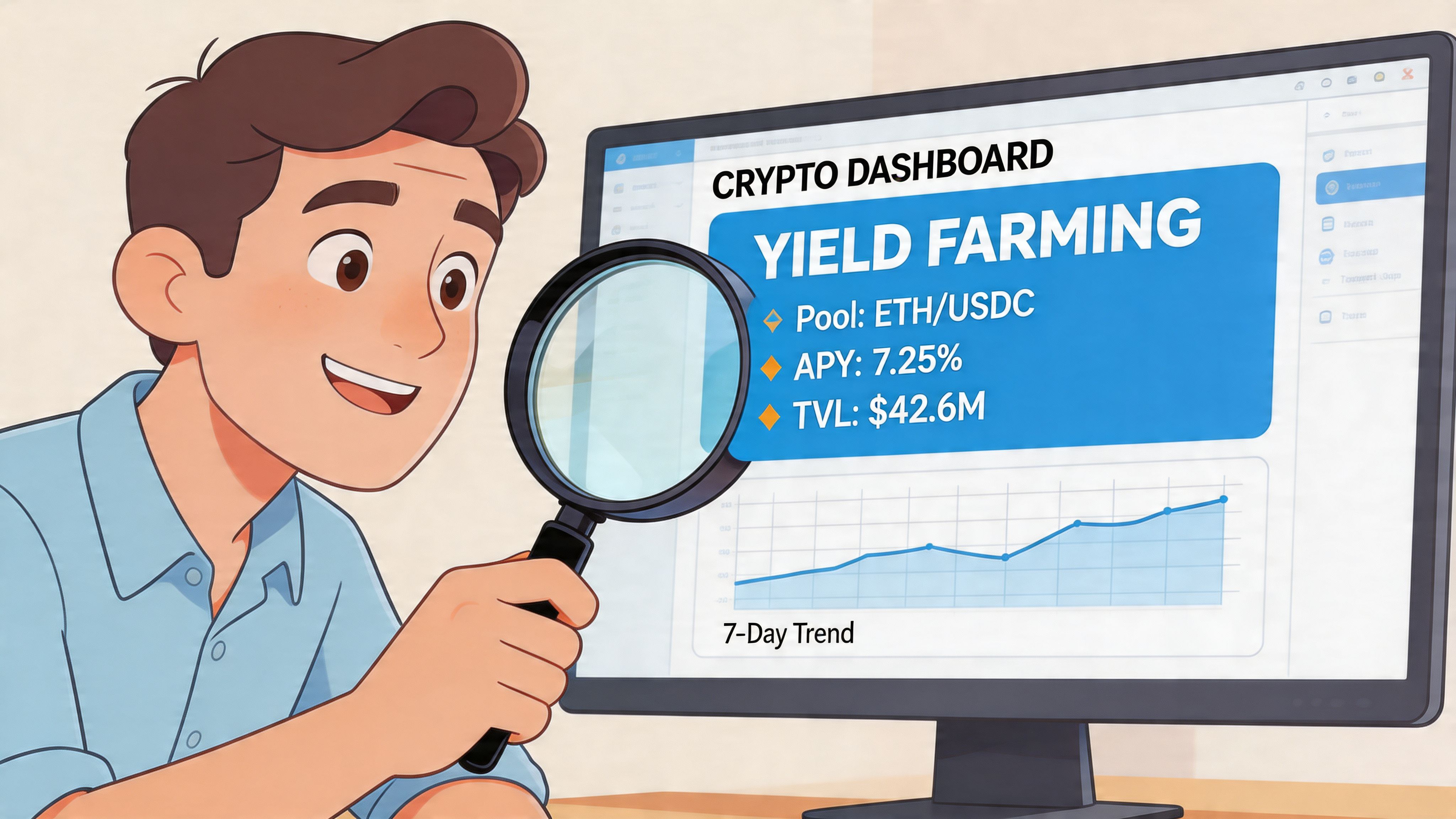
That history matters because it explains why dashboards built around farming data became so popular. Traders wanted one place to compare opportunities without opening every protocol manually. CMC filled that role for a broad audience.
When you land on a CoinMarketCap yield-related page, the first job is to separate discovery metrics from decision metrics.
Discovery metrics help you notice something. Decision metrics help you size a position. CMC gives you more of the first than the second.
Key dashboard elements usually include:
If you’re rusty on rate terminology, a quick refresher on what APY means in crypto helps because many traders still confuse nominal rewards with compounded outcomes.
An APY number on CMC is not a promise. It’s a snapshot generated from current inputs.
That means three things:
A practical way to read APY is to ask what component is driving it. If the return is mostly from protocol emissions, you need to inspect the reward token before you inspect the pool. If the return is mostly from real fees, the setup may be sturdier, though never risk-free.
Here’s a simple lens:
| Dashboard item | What it tells you | What it doesn’t tell you |
|---|---|---|
| APY | Current quoted return profile | Whether rewards hold value |
| Chain | Where the strategy lives | Whether liquidity is deep enough to exit cleanly |
| Token page | Market context and category placement | Whether insiders or top wallets are rotating out |
| Price chart | Recent market behavior | Whether farming economics still make sense after incentives change |
A short visual walkthrough helps if you want to compare interface behavior while you read:
CoinMarketCap is an aggregator. That’s both its advantage and its weakness.
It pulls together data from many places so you can scan quickly. But aggregated yield data can lag, miss protocol-specific nuances, or flatten distinctions that matter a lot in practice. A pool may look healthy on a broad dashboard while the actual reward contract has changed, emissions have weakened, or exits have become crowded.
Don’t confuse clean presentation with verified edge. Aggregators summarize. Traders verify.
This is why experienced DeFi traders rarely execute straight from a public dashboard. They use it to spot candidates, then go to the protocol, the contract, and the wallets that are interacting with it.
What works
What doesn’t
Use the dashboard like a scanner. The mistake is treating it like a final verdict.
The most expensive sentence in DeFi is, “the APY looked worth it.”

That number can be real and still be misleading. A pool can quote strong yield while your underlying position bleeds through token repricing, emissions dilution, thin liquidity, or contract risk. The professional habit is to break yield into its actual moving parts.
If you provide liquidity to a pair and one asset moves sharply against the other, your pool share gets rebalanced. That means you may end up holding more of the weaker asset and less of the stronger one compared with holding both tokens outside the pool.
This is the classic impermanent loss problem. It matters most when the pool contains volatile assets, especially if the token used for incentives is the one traders are dumping into every rally.
A useful mental model is a seesaw. The more one side jumps, the more the balance changes under you. Fees and rewards can offset that, but they don’t erase it automatically.
The reward token itself often determines whether the farm is investable. Historical data for FARM illustrates the point. On January 30, 2026, FARM traded between $0.03412 and $0.03415, after dropping from $0.0359 the prior day, and the same source notes that yield farming assets can swing double-digits daily, as shown on CoinMarketCap’s YieldFarming Index page.
That kind of price behavior changes how you should think about emissions. If you’re being paid in something that’s hard to hold through volatility, then your real strategy may be “farm and sell quickly,” not “compound and stay.”
High APY paid in a weak token is often just a scheduled transfer of risk from the protocol to the farmer.
Before depositing into any farm, check these points:
For a more formal approach, this guide to building a liquidity pool risk scoring framework is useful when you want to turn instinct into a repeatable process.
| Risk type | What happens in practice | Why traders miss it |
|---|---|---|
| Impermanent loss | Pool rebalancing leaves you worse off than holding | APY screens don’t model your alternative outcome |
| Smart contract risk | A bug or exploit threatens deposits | Public dashboards don’t audit code for you |
| Protocol risk | Governance, admin controls, or incentive design fail | Traders focus on returns before permissions |
| Liquidity risk | You can’t exit efficiently when conditions change | “Available” yield looks tradable until everyone leaves |
Some setups can still be worth taking. The point isn’t to avoid all risk. The point is to match the type of yield to the type of risk you’re being asked to absorb.
A practical sequence looks like this:
That last step matters most. Many farms fail not because the idea was terrible, but because the trader sized them like stable carry when the payoff profile was venture-like.
CoinMarketCap is broad. That’s why traders like it. But broad tools usually trade precision for convenience, and yield farming is one of the worst places to rely on convenience alone.
The better approach is to match each tool to the job you need done. CoinMarketCap helps with discovery. Other platforms help with protocol TVL context, portfolio inspection, and LP-specific pain points like impermanent loss tracking.

Here’s the practical comparison:
| Aggregator | Primary Use Case | Data Granularity | Unique Feature |
|---|---|---|---|
| CoinMarketCap | Broad discovery and market orientation | Medium | Familiar token-centric interface tied to wider market data |
| DeFi Llama | Protocol-level DeFi research | High for ecosystem mapping | Strong TVL and protocol tracking context |
| Zapper | Wallet and portfolio visibility | High for user positions | Useful for seeing what a wallet holds across DeFi |
| APY.vision | LP position analysis | High for liquidity providers | Focuses on LP performance and impermanent loss behavior |
If your question is, “What yield-related sectors or tokens are active?” CoinMarketCap is a clean first stop.
If your question is, “Is this protocol attracting and retaining capital?” DeFi Llama usually gives a more direct answer.
If your question is, “What’s happening inside my positions or another wallet’s DeFi footprint?” Zapper becomes more practical.
If your question is, “Am I earning enough to justify LP exposure?” APY.vision is more specialized than a general market aggregator.
The edge comes from using a generalist tool first and a specialist tool second, not from forcing one dashboard to do everything.
Traders often try to make CoinMarketCap behave like a due diligence terminal. It isn’t one.
Use CMC to build a shortlist. Then move to specialist tools based on the exact uncertainty you need to resolve. If the uncertainty is protocol traction, use protocol data. If the uncertainty is wallet behavior, use wallet tools. If the uncertainty is LP math, use LP analytics.
That sounds obvious, but it changes results because it stops you from making decisions off incomplete screens.
Most yield farming mistakes happen between “that pool looks interesting” and “I deposited.” The fix is a workflow that forces confirmation before capital moves.
Use CoinMarketCap to scan for names, sectors, and yield-related tokens that are drawing attention. Don’t optimize for the highest displayed return. Optimize for interesting anomalies.
Examples of useful anomalies:
At this point, you are not picking a farm. You are creating a research queue.
Once a candidate enters the queue, try to kill it quickly. At this point, most traders should be more aggressive.
Use a short screen:
If the answer to any of those is weak, move on.
Leave the aggregator. Go to the actual protocol.
Read the pool details, token mechanics, reward terms, lock conditions, and any documentation tied to the strategy. Then open the block explorer and inspect the core contracts involved. You are looking for practical signs, not legal comfort.
Check for things like:
| Verification point | Why it matters |
|---|---|
| Reward token contract activity | Shows whether emissions and transfers look active or distorted |
| Pool contract interactions | Reveals whether the farm is actually being used |
| Recent transaction patterns | Helps spot whether deposits are organic or clustered |
| Admin-related events | Flags control risk and possible operational centralization |
The reason this step matters is simple. A clean front end can hide ugly contract behavior. The chain can’t.
A protocol can look valid and still be a poor trade. You need to know who is using it, and how they behave after entering.
At this stage, skilled traders switch from dashboard analysis to wallet analysis.
Questions that matter:
Behavior is often more informative than advertised economics. A farm that looks average on paper can be attractive if competent wallets keep interacting with it in a repeatable pattern. A flashy farm can be toxic if the best wallets only use it for short extraction cycles.
Watch what profitable wallets do after entry. That’s where the strategy is, not in the headline APY.
Before you deposit anything, define the full trade.
That includes:
A lot of yield farming underperforms because traders make only the entry decision. They never decide what to do with rewards, when to stop compounding, or what kind of wallet flow would invalidate the thesis.
After entering, the work changes but doesn’t end.
Monitor:
This is the difference between passive farming and active yield trading. Once the position is open, your job is to determine whether the original reason for entering is still true.
If the answer changes, don’t defend the farm. Exit it.
Most public yield dashboards show the same information to everyone. That means the actual edge comes from finding where better traders are already allocating and understanding their behavior before the crowd notices.
That’s where wallet tracking becomes useful. Instead of guessing which pools are smart money favorites, you inspect the wallets that repeatedly position well and look for their DeFi patterns.

A practical process starts with the protocol or token you already found during discovery. Search for that asset or related activity in a wallet analytics platform and identify wallets that have interacted with it in meaningful size and with consistent timing.
With Wallet Finder.ai, traders can inspect wallet histories, compare behavior across chains, filter for stronger performance patterns, and set alerts when tracked wallets buy, swap, or sell. Used correctly, that helps answer the question CoinMarketCap cannot answer: who is acting on this opportunity, and what do they do next?
Not every active wallet is worth following. Volume alone is not enough.
Focus on wallets that show:
A good wallet to monitor often looks boring at first glance. It enters with purpose, manages rewards logically, and exits without drama.
Here’s a clean way to use wallet tracking after coinmarketcap yield farming discovery:
That last part matters because timing is the whole game. A wallet’s historical profitability is useful, but the actionable value comes from getting notified when behavior changes in real time.
Public APYs tell you what a protocol wants you to notice. Wallet flows tell you what experienced participants are actually doing.
What works
What doesn’t
The point of wallet tracking isn’t to outsource judgment. It’s to reduce informational delay. When skilled wallets rotate, stake, harvest, or exit, that behavior gives you a stronger signal than a static aggregator page ever will.
CoinMarketCap is a useful place to start. It gives you a broad view of the market, helps you discover yield-related tokens and protocols, and makes early screening fast.
But that’s all it should be. A start.
Profitable yield farming comes from stacking layers of confirmation. First, find the opportunity. Then test the reward source, the pair structure, the contract exposure, the liquidity, and the wallet behavior around it. The advertised APY is only one input, and often not the most important one.
The sharper way to approach coinmarketcap yield farming is simple. Treat public dashboards as signal discovery, treat protocol research as truth checking, and treat on-chain wallet behavior as execution intelligence.
That’s the playbook traders use when they want something better than lucky entries. They don’t chase the brightest number on the screen. They follow capital, verify incentives, and react when experienced wallets change course.
If you adopt that process, you’ll make fewer lazy deposits, avoid more fragile farms, and spend your time where there’s actual edge.
If you want to move from passive browsing to active on-chain intelligence, try Wallet Finder.ai to track profitable wallets, study their DeFi activity, and get real-time alerts when the wallets you follow rotate into or out of the setups you’re watching.