Yield Farming Crypto: A Complete Guide

Wallet Finder

Blank calendar icon with grid of squares representing days.

April 3, 2026

Imagine your crypto isn't just sitting idle in a wallet. What if it could be out there working for you, earning a salary just like an employee? That’s the entire idea behind yield farming crypto. It's a way to put your digital assets to work to generate even more crypto.

You’re essentially lending or staking your funds in various decentralized finance (DeFi) protocols, and in return, you earn rewards.

What Is Yield Farming And How Does It Work
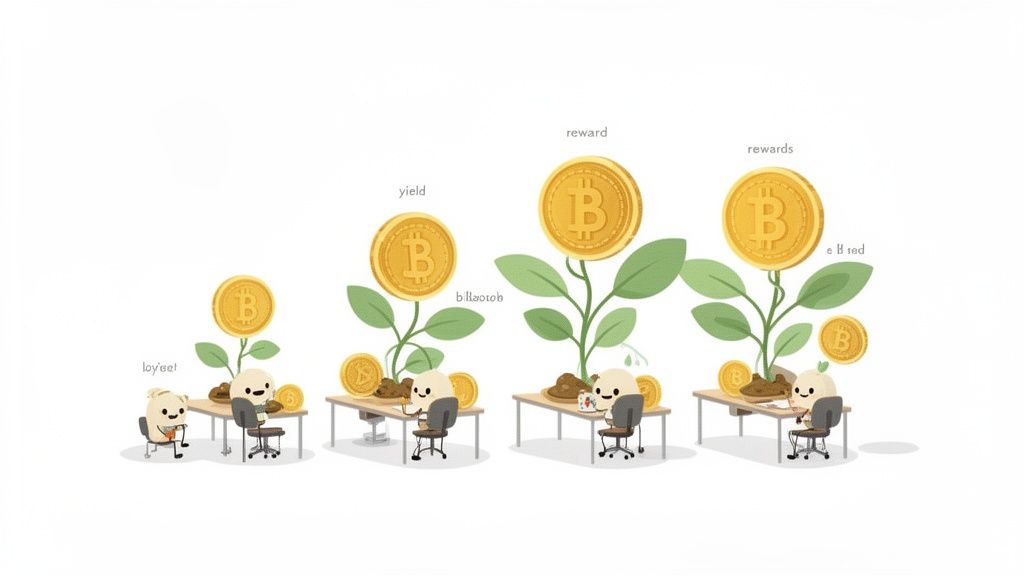
Cartoon illustration showing four stages of cryptocurrency yield farming with Bitcoin plants and characters.

Yield farming is all about strategically putting your crypto to work to squeeze out the highest possible returns. Think of it like a high-yield savings account, but instead of dealing with a traditional bank, you're interacting with a financial system built entirely on the blockchain.

When you start yield farming, you take on the role of a liquidity provider. Your job is to supply your crypto assets to a DeFi protocol. These platforms require massive pools of assets, known as liquidity pools, to operate smoothly. If you want to dive deeper, you can learn all about how these pools power DeFi in our comprehensive guide.

The Core Mechanism

The whole process runs on smart contracts—basically, self-executing code on a blockchain that automatically manages all the funds. When you deposit your crypto, it gets pooled together with assets from thousands of other users. This collective pot of money is then used to enable activities like decentralized trading or lending money to borrowers.

So what's in it for you? For providing this crucial liquidity, the protocol rewards you. These rewards, or your "yield," typically come in a few different flavors:

  • Trading Fees: You get a cut of the fees generated from trades happening within the pool.
  • Interest: Borrowers pay interest on loans taken from the pool, and a portion of that goes to you.
  • Token Rewards: Many protocols issue their own new tokens as an extra incentive for you to participate.

This reward system gives users a powerful reason to supply their capital, which in turn makes the entire DeFi ecosystem more liquid and efficient for everyone.

Yield farming isn't just a way to earn passive income. It's the engine that provides the liquidity needed for decentralized exchanges, lending platforms, and other DeFi apps to function.

The Birth of the Farming Frenzy

So, how did this all start? The concept of yield farming absolutely exploded back in the "DeFi Summer" of 2020. The catalyst was Compound Finance, a lending protocol that started giving out its COMP governance token to users. This one move shot the total value locked (TVL) in DeFi from around $1 billion to over $10 billion in a matter of months.

Early farmers who jumped in were reporting insane triple-digit APYs, sometimes over 100-300%, because they were earning COMP tokens on top of the regular interest for both lending and borrowing.

Yield Farming Core Components

To really get a grip on how yield farming works, it helps to break down the key players involved. Each piece has a specific job to do.

ComponentRole In The EcosystemAnalogy
Liquidity Provider (You)Lends or stakes crypto assets to a protocol.You're the depositor at a high-yield savings account.
Liquidity PoolA smart contract holding the collective funds.This is the bank's vault where all the deposits are stored.
DeFi ProtocolThe platform facilitating transactions (e.g., Aave).This is the bank itself, setting the rules and interest rates.
Rewards (Yield)Interest, fees, or new tokens paid to you.These are the interest payments you earn from the bank.

As you can see, every element is connected. As a liquidity provider, you're the foundation that allows the DeFi protocol to offer its services, and your reward is a slice of the value that activity creates.

Exploring Common Yield Farming Strategies

Illustrates key components of crypto yield farming: lending, liquidity provision, and an aggregator vault.

Yield farming isn’t just one thing. When you dive into yield farming crypto, you'll find a whole range of strategies, from simple, lower-risk plays to incredibly complex setups. The first step is to get familiar with the common approaches so you can build a strategy that actually fits your goals.

Think of these strategies as the fundamental building blocks of almost all yield generation in DeFi. Once you get a handle on the core three, you'll start to see how the pros combine and stack them to chase those head-turning returns.

Let's break down the main ways farmers put their capital to work.

Lending and Borrowing

The most straightforward way to start farming is through lending. At its core, it’s just like a high-yield savings account, but built for the crypto world. You take your assets, like the stablecoin USDC or a major like ETH, and deposit them into a decentralized money market.

Protocols like Aave or Compound are the banks in this new financial system. They pool your funds with other lenders and let borrowers access that capital. For providing your assets, you earn a variable interest rate paid out by the borrowers.

This method is a go-to starting point for a few reasons:

  • Simple: It’s usually a single-asset deposit, so you don't have to worry about pairing different tokens.
  • Lower Risk: By lending stablecoins, you sidestep the wild price swings of other crypto assets.
  • The Bedrock: Lending is what makes DeFi tick. The yield you earn here is often seen as the baseline "risk-free" rate that all other, riskier yields are measured against.

This is the perfect strategy for beginners or anyone who wants a predictable, hands-off yield. The returns, typically in the 3% to 15% APY range for stablecoins, are driven by the simple economics of supply and demand.

Liquidity Mining

If you're ready for a bit more action, liquidity mining is the next step up. This is the strategy that powers decentralized exchanges (DEXs) like Uniswap. Instead of just lending out a single asset, you provide a pair of them—say, an equal value of ETH and USDC—to what’s called a liquidity pool.

When you do this, you become a liquidity provider (LP). Your deposited crypto allows other traders to swap between ETH and USDC smoothly. For every trade that happens in your pool, the protocol charges a tiny fee, and you get your cut.

Real-World Scenario: Let's say you put $1,000 of ETH and $1,000 of USDC into a Uniswap V3 pool. You now own a piece of that pool. If the pool handles $1 million in trades that day and collects $3,000 in fees, you’ll earn a slice of those fees based on how much of the pool you own.

On top of earning trading fees, many protocols sweeten the deal by giving out their own governance tokens as an extra reward. This is the "mining" part of liquidity mining, and it can seriously boost your overall APY. The trade-off? You’re exposed to impermanent loss, a risk we’ll unpack in detail later.

Yield Aggregators and Vaults

Trying to manage several yield farming positions yourself can get old fast. It's a constant cycle of checking rates, claiming rewards, and reinvesting—all while paying gas fees for every single transaction. This is where yield aggregators, or vaults, become a farmer's best friend. Think of them as a robo-advisor for your crypto yield.

Platforms like Yearn Finance or Beefy Finance automate the entire farming process. You just deposit your assets into a "vault," and the smart contracts behind it take care of everything:

  1. Finding the Best Yield: The vault’s strategy is always on the hunt, automatically moving funds across different DeFi protocols to capture the highest possible returns for your asset.
  2. Auto-Compounding: Instead of you manually claiming rewards and paying gas fees to reinvest them, the vault does it for everyone in the pool at once, saving a ton of money.

By pooling everyone's funds together, vaults make it possible to compound returns frequently, which is how a decent Annual Percentage Rate (APR) gets supercharged into a fantastic Annual Percentage Yield (APY). This is the ideal "set and forget" strategy for anyone who wants to maximize their returns through the magic of compounding without all the manual work.

Understanding The Real Risks Of Yield Farming

Those triple-digit APYs you see in yield farming crypto look incredible, right? But let's be real—that isn't free money. Those sky-high returns are your compensation for stepping into one of the riskiest arenas in DeFi.

Ignoring the dangers is the fastest way to get your capital wiped out. High yields are a sign of high risk, so before you dive in, you need a no-nonsense guide to the four biggest threats you'll face.

Smart Contract Risk and Rug Pulls

Every DeFi protocol runs on smart contracts, which are just lines of code that handle everyone's money automatically. But what happens if that code has a mistake? Hackers live for these moments. A single bug can let them drain millions from a protocol in minutes. We've seen it happen time and time again.

Even worse are rug pulls. This is a flat-out scam where developers create a convincing-looking project, attract a flood of cash from eager yield farmers, and then simply vanish with the funds. These are most common with new, unaudited protocols that pop up overnight with unbelievable APYs.

How to stay safe:

  • Stick to Audited Protocols: Only put your money into platforms audited by well-known security firms.
  • Look at the TVL: Projects with a high Total Value Locked (TVL) and a solid history are generally safer bets.
  • Be a Skeptic: If a brand-new farm promises returns that seem too good to be true, they probably are.

Impermanent Loss Explained

This is one of the trickiest and most misunderstood risks for anyone providing liquidity. Impermanent loss is that sinking feeling you get when you realize you would have made more money by simply holding your tokens instead of farming with them.

It happens when the prices of the two tokens in your liquidity pair drift apart. The pool’s algorithm automatically rebalances your position to maintain a 50/50 value split, which means you end up with more of the token that went down in price and less of the one that went up.

Simple Example: You deposit 1 ETH (worth $3,000) and 3,000 USDC into a liquidity pool for a total of $6,000. If ETH rockets to $6,000, arbitrage traders will buy the cheaper ETH from the pool. When you go to withdraw, you might only get back 0.707 ETH and 4,242 USDC. That's worth $8,484. Sounds great, but if you had just held, you'd have $9,000 ($6,000 in ETH + $3,000 in USDC). The $516 difference is your impermanent loss. You can play with the numbers yourself in our guide to calculating impermanent loss.

While the trading fees you earn as a liquidity provider can help cover this loss, it's a major factor to watch, especially when the market gets choppy.

The Danger of Sky-High APYs

Let’s talk about those APYs that grab all the headlines. While yield farming can throw up insane numbers like 100-1,000%+ on some pairs, research shows these farms rarely deliver on their promises.

One study analyzing DeFi's peak bull run found that as more people piled into these high-yield farms, the actual payouts dropped off a cliff. On top of that, farmers were getting hammered by other risks, with impermanent loss alone sometimes eating away up to 50% of their initial capital in volatile pairs.

Liquidation Risk in Leveraged Farming

Some advanced farmers take things a step further. They use their deposited assets as collateral to borrow more funds, then re-invest that borrowed capital into the farm. This is called leveraged farming, and while it can magnify your gains, it also introduces liquidation risk.

If the market takes a nosedive and the value of your collateral falls below a certain point, the protocol will automatically sell off your assets to repay the loan. A flash crash can cause a domino effect of liquidations, completely wiping out a farmer's position in an instant. This is the deep end of the pool—only experienced farmers who are constantly managing their positions should even consider it.

Yield Farming Risk And Reward Comparison

Every yield farming strategy offers a different balance of potential returns and associated dangers. Knowing the trade-offs is crucial before you commit any capital.

StrategyTypical APY Range (Annual)Primary Risks
Stablecoin LP5-20%Smart contract risk, de-pegging risk
Volatile Pair LP20-150%+Impermanent loss, smart contract risk, volatility
Lending/Borrowing2-15%Smart contract risk, platform insolvency
Leveraged Farming50-1000%+Liquidation risk, impermanent loss, smart contract risk

As you can see, the path to higher APYs is paved with greater risk. Stablecoin strategies are the most conservative, whereas leveraged farming carries the potential for both massive gains and total loss. Choosing the right strategy depends entirely on your risk tolerance and how actively you plan to manage your positions.

How To Find And Copy Profitable Crypto Wallets

Want to fast-track your yield farming crypto journey? The quickest way to get up to speed is to watch the pros. Forget the guesswork—you can break down the proven strategies of elite traders who consistently rake in profits. Modern on-chain analytics tools turn the blockchain's endless stream of data into a playbook you can actually use.

This whole process is about finding the top-performing wallets, figuring out their game plan, and even mirroring their moves as they happen. You're swapping blind speculation for decisions backed by solid data.

Discovering Top-Performing Wallets

First things first, you need to identify the "smart money." These are the wallets with a track record of success. You can't just follow a random address and hope for the best; you have to filter for the metrics that separate the truly skilled from the merely lucky. Using a platform like Wallet Finder.ai lets you screen for wallets based on criteria that actually matter.

Here are the key stats to zero in on:

  • Total Profit (PnL): This one's a no-brainer. Look for wallets with a solid, consistent history of realized gains.
  • Win Rate: This tells you the percentage of trades that end up in the green. A high win rate (over 60-70%) is a strong sign of a disciplined and effective strategy.
  • Average Return Per Trade: Is the wallet hitting massive home runs, or is it grinding out smaller, more consistent wins? This metric tells you.
  • Wallet Age & Consistency: A wallet that's been profitable over a long stretch is way more credible than one that just got lucky on a single memecoin pump.

This dashboard immediately surfaces wallets with high PnL and win rates, giving you a curated list of top performers to analyze further.

Analyzing The Playbook Of A Target Wallet

Once you've zeroed in on a promising wallet, it's time to play detective. The goal is to reverse-engineer its strategy by digging into its complete transaction history. This isn't just about what they bought; it’s about how and why they trade.

As you sift through the data, ask yourself these questions:

  1. What protocols are they using? Are they sticking to blue-chip platforms like Aave and Uniswap, or are they jumping on new protocols on emerging chains?
  2. What asset pairs are they farming? Do they prefer low-risk stablecoin pairs, or are they chasing higher yields with more volatile assets?
  3. How long are they holding positions? Do they jump in and out quickly, or are they in it for the long haul, compounding rewards for weeks or months?
  4. How do they handle risk? Can you spot them taking profits at certain levels or bailing on farms when the APYs start to tank?

This kind of deep dive lays a wallet's entire playbook bare, offering insights that go way beyond surface-level numbers. It’s like getting a masterclass in profitable yield farming.

Flowchart illustrating the crypto risk process flow, detailing impermanent loss, smart contract vulnerabilities, and scams.

The top wallets consistently navigate these kinds of threats, often by diversifying across protocols and having clear exit plans—all of which you can see in their on-chain history.

Setting Up Real-Time Alerts To Copy Moves

Analysis is great, but in DeFi, timing is everything. A hot new farm can get swamped with liquidity in hours, sending those juicy APYs straight down. To jump on the same opportunities as the pros, you have to know what they're doing the second they do it.

This is where real-time alerts become your secret weapon. By setting up notifications for a wallet you're tracking, you get an instant message via Telegram or a push notification when they make a move.

You can set up alerts for all kinds of specific actions, including:

  • Entering a new liquidity pool
  • Swapping one token for another
  • Adding or removing liquidity from a farm they're already in
  • Minting a new token

These alerts transform your passive research into an active, real-time trading signal. Instead of finding out about a profitable move days after the fact, you're in the loop instantly.

Executing The Copy Farm And The Profit Gap

With real-time alerts ready to go, you can pull the trigger on the final step: copy farming. When an alert fires, you can quickly look at the transaction, decide if it fits your own risk profile, and then replicate the move in your own wallet. You can read more on how to track crypto wallets effectively to sharpen this part of your process.

Since yield farming blew up in 2020, it’s locked up trillions in cumulative volume, but the reality is most retail farmers barely break even after accounting for risk. For memecoin and DeFi traders on Wallet Finder.ai, the numbers show just how elite the top wallets are: the top 1% of performers pull in 200%+ annualized returns. They do it by hopping across chains (like Ethereum to Base), and we can see it all through real-time alerts on their buys and swaps, which often have 70% win rates and incredibly precise position sizing.

This data-first approach takes the guesswork and emotion out of yield farming. When you mirror the actions of proven winners, you dramatically stack the odds in your favor and turn the public ledger into your personal source of alpha.

Real-World Examples Of Winning Strategies

All the theory in the world doesn’t mean much until you see it in action. Let's put the concepts aside and look at how real farmers are making serious money on-chain. We’re going to dissect a few anonymized but realistic scenarios to see what a winning yield farming crypto strategy actually looks like.

These examples show that there are many ways to win in DeFi—it’s all about matching your strategy to your risk appetite.

The Early Rotator Strategy

Our first wallet, let’s call it "The Early Rotator," lives by one rule: get in early. This trader’s success is all about speed and a high tolerance for risk. Using on-chain tools, we watched this wallet pull around $150,000 in ETH from a mature, low-yield farm on the Ethereum mainnet.

Their destination? A brand-new, completely unaudited decentralized exchange launching on the Base network. This was a classic high-risk, high-reward play.

  • The Play: New protocols need liquidity, and they're willing to pay for it. They often launch with insane token rewards to attract the first wave of capital. In the first few hours, APYs can rocket past 1,000% before dropping off a cliff as more people pile in.
  • The Execution: The Early Rotator bridged their ETH to Base and jumped into a WETH/USDC liquidity pool in the first hour the farm went live. By being one of the first significant depositors, they soaked up the highest reward rates.
  • The Payoff: After farming for just 48 hours, they had a huge stack of the protocol's new governance token. Before the APY collapsed below 200% and the hype started to fade, they pulled everything. They sold the reward tokens for a clean profit of over $50,000 and rotated back into stable assets, ready to hunt for the next launch.

This strategy isn’t for the faint of heart and requires constant screen time, but it’s a perfect example of how speed creates incredible opportunities in DeFi.

The Low-Risk Compounder Method

Not every successful farmer is a degen. Our second example, "The Low-Risk Compounder," is a DeFi pro who plays the long game, prioritizing capital safety and steady growth over quick, risky flips. Their entire strategy is built on consistency and the magic of compounding.

This farmer sticks exclusively to battle-tested, blue-chip protocols like Curve and Convex Finance. Their portfolio is laser-focused on providing liquidity for correlated assets, mainly different versions of staked Ether like stETH/ETH.

By farming correlated pairs, the Low-Risk Compounder basically eliminates the risk of impermanent loss, since stETH and ETH prices rarely move far apart. Instead of worrying about volatility, they can focus entirely on squeezing out the most efficient yield possible.

Their process is disciplined and almost boring—which is exactly why it works so well:

  1. Deposit: They add ETH and stETH into a Curve liquidity pool.
  2. Stake: The resulting LP tokens are then staked in Convex Finance to earn boosted CRV and CVX rewards.
  3. Compound: On a regular schedule, they claim these rewards, swap them for more ETH, and loop it all back into their original liquidity position.

Following this method for 12 months, this wallet grew an initial $250,000 portfolio to over $325,000. A 30% APY might not sound as thrilling as a 10x, but it's a massive, relatively safe gain built on pure discipline and patience.

The Vigilant Risk Avoider

Our last example isn't about making a profit, but protecting one—a skill that's just as crucial. "The Risk Avoider" is a trader who uses on-chain alerts to stay one step ahead of trouble.

This trader had about $75,000 in a farm for a new, extremely volatile memecoin paired with SOL. The advertised APY was a juicy 800%, but the underlying risk was massive.

  • The Alert: The trader had set an alert on Wallet Finder.ai to track the activity of several top wallets in the same farm. Suddenly, an alert fired: one of the largest and most profitable wallets in the pool had just pulled its entire $1.2 million position.
  • The Action: This was a giant red flag. When you see the "smart money" running for the exit, you don’t ask questions. The Risk Avoider immediately followed their lead, withdrawing all liquidity and swapping back into the safety of USDC.
  • The Aftermath: Less than six hours later, the memecoin’s price crashed by over 90%. The farm’s liquidity was sucked dry, and anyone who stayed in the pool lost almost everything. By simply copying a top wallet’s exit, The Risk Avoider sidestepped a catastrophic loss. This proves that sometimes, knowing when to get out is far more profitable than knowing when to get in.

Defensive Best Practices For Long-Term Success

Let's be real: chasing the highest APY is a rookie move and a surefire way to get rekt. In yield farming crypto, the real winners aren't the ones hitting a single moonshot. They're the ones who stick around long enough to let their wins compound.

This calls for a complete mindset shift—from a degen gambler to a savvy, defensive investor. Surviving and, more importantly, thriving in this space is all about protecting your capital, not just chasing flashy, unsustainable returns. The best farmers are masters of risk management. These practices are your playbook for building a portfolio that lasts.

Start Small And Test Everything

Never, ever ape into a new protocol with your entire bag. The golden rule of defensive farming is to start small. Dip your toes in the water with an amount you’re genuinely okay with losing. Think of it as tuition for your on-chain education.

This initial small deposit lets you walk through the entire process on your own terms. You’ll connect your wallet, deposit funds, stake tokens, claim rewards, and eventually withdraw. You get a feel for the UI, see the real gas fees, and observe how the protocol actually performs, all without risking your main stack.

Think of it as a trial run. If the protocol is solid and works like it should, you can slowly add more capital. If you hit weird bugs, hidden fees, or other red flags, you’ve paid a small price for a massive lesson.

Diversify Your Capital And Strategies

Putting all your crypto into one farm is the on-chain equivalent of betting your life savings on a single lottery ticket. It’s a recipe for disaster. Real resilience is built through diversification. You need to spread your capital across different layers to protect yourself from any single point of failure.

A smart, diversified approach looks something like this:

  • Across Protocols: Don't just stick to one DEX. Split your funds between battle-tested giants like Aave and Curve, and maybe allocate a small piece to newer, high-potential projects you've thoroughly vetted.
  • Across Blockchains: Ethereum gas fees can obliterate your profits. Get comfortable on Layer 2s like Base and Arbitrum or even alternative L1s like Solana to cut down on costs and tap into different ecosystems.
  • Across Strategy Types: Mix it up. Combine a base layer of low-risk stablecoin lending with some higher-risk, higher-reward liquidity mining for volatile pairs. This creates a blended, more stable return that aligns with your risk tolerance.

This strategy ensures that a hack on one protocol or a sudden dip on one chain doesn’t send your entire portfolio to zero.

Vet Your Protocols Thoroughly

Not all DeFi protocols are built the same. Before you even think about depositing a single token, you have to do your homework. Making sure a platform has solid fundamentals is the most critical step in managing your risk.

Here’s what you should be looking for:

  • Public Audits: Has the protocol been audited by well-known security firms? An audit isn't a magical shield against hacks, but it's a clear sign the team cares about security.
  • High Total Value Locked (TVL): A high TVL (think over $100 million) is a strong social signal. It means other serious investors trust the platform with a lot of money.
  • Strong Community Reputation: Dive into the project’s Discord and Twitter. Is the community active and helpful, or is it a ghost town full of angry users? The vibe tells you a lot.

Finally, you need to understand the tokenomics of the rewards you’re farming and—this is crucial—have an exit plan before you enter. Know your profit targets and your stop-loss levels in advance. This ensures your decisions are driven by a clear strategy, not by fear or greed.

Frequently Asked Questions About Yield Farming

Alright, we’ve covered a lot of ground. But even with all the details, you probably still have a few questions rolling around in your head. Let's tackle some of the most common ones so you can get started with confidence.

How Much Money Do I Need to Start Yield Farming?

Technically, you can start with as little as $100. The real question is, should you? On networks like Ethereum, the answer is probably no—gas fees would eat your lunch before you even placed your order.

Here’s a more realistic breakdown:

  • On Ethereum, you'll want at least $500-$1,000 to make the high transaction costs worth it. Anything less and you're just farming for the validators, not yourself.
  • On Layer 2s like Base or Arbitrum, the game changes. Gas fees are a tiny fraction of Ethereum's, so starting with a smaller stack is perfectly viable.

What Is the Difference Between Yield Farming and Staking?

People often use these terms interchangeably, but they are fundamentally different. One is about securing the network, and the other is about providing fuel for the apps running on it.

The simplest way to think about it is that staking secures the blockchain itself, while yield farming provides liquidity for the applications built on top of that blockchain.

Staking is pretty straightforward. You lock up a single crypto asset (like ETH or SOL) to help validate transactions and keep a Proof-of-Stake network secure. The network's code defines your rewards.

Yield farming is the broader, more active strategy. It's about putting your assets to work in DeFi protocols—supplying liquidity to an exchange, lending out assets, and constantly moving your capital to chase the best returns from fees and token incentives.

Is Yield Farming Crypto Still Profitable Today?

Yes, but the gold rush is over. Gone are the days of throwing money at a blue-chip protocol and watching a guaranteed 1,000% APY roll in. The market is smarter, faster, and way more competitive now.

Profitability in 2026 isn't about passive income; it's about active strategy. The farmers who are still crushing it are the ones who:

  • Get in early on new, legitimate protocols before they hit the mainstream.
  • Master risk management, especially tricky concepts like impermanent loss.
  • Use on-chain analytics to see what the market is doing, not just guess.

It's less about luck and more about having a data-driven edge.


Ready to stop guessing and start copying the strategies of top-performing crypto wallets? Wallet Finder.ai gives you the on-chain data and real-time alerts you need to find and mirror the moves of elite yield farmers. Start your 7-day free trial today.