7 Best Meme Coin Trading Tools for 2026
Discover the 7 best meme coins trading platforms and tools for 2026. Get actionable insights, find winning wallets, and trade smarter on CEXs and DEXs.

February 20, 2026
Wallet Finder

January 22, 2026

When you're figuring out where to put your crypto to work, the staking vs yield farming debate is one of the first you'll encounter. Here’s the simplest way to think about it: staking is like earning interest in a high-yield savings account—it's generally stable, predictable, and lower-risk. Yield farming is like active, high-risk, high-reward investing. You're chasing much bigger returns, but that comes with a lot more complexity and danger.

While both staking and yield farming let you generate passive income from your crypto, they come from completely different worlds and are built for different types of investors. Getting a handle on their origins helps explain why their risk and reward profiles are so distinct.
Staking is the engine that powers Proof-of-Stake (PoS) blockchains like Ethereum, Solana, and Cardano. When you "stake," you're locking up a network's native token to help secure the entire blockchain.
Your locked coins are used by validators to confirm transactions and add new blocks to the chain. The network thanks you for this service by rewarding you with more of that same token. It’s a straightforward deal, perfect for long-term believers in a project who want a low-maintenance way to grow their holdings.
Yield farming exploded onto the scene during the legendary "DeFi Summer" of 2020. This strategy isn't about securing a network; it's all about providing liquidity to decentralized applications (dApps), especially decentralized exchanges (DEXs).
You deposit a pair of tokens into a liquidity pool, which allows other people to trade between those two assets. In return, you get a cut of the trading fees and, often, bonus reward tokens from the protocol itself. This is a much more hands-on process that brings with it way more complexity, risk, and—if you play your cards right—potential reward.
For years, staking has been the reliable choice for steady returns. Ethereum staking, for example, typically offers a predictable 2.02% to 3.5% APY, and Solana stakers can expect somewhere between 5.1% and 9.39%.
Yield farming is a different beast entirely. It drew in hordes of "farmers" with APYs that could shoot past 100%, sometimes even hitting 250% in popular pools. If you're curious about what drives these numbers, you can find a detailed guide on these return differences and the factors behind them.
To give you a clearer picture, here's a high-level breakdown of how these two strategies stack up against each other.
This table makes the core trade-offs obvious. Staking offers simplicity and relative safety, while yield farming opens the door to much higher returns at the cost of significantly more risk and complexity.
To really get the difference between staking and yield farming, you have to look under the hood. They both generate returns, sure, but the engines driving them are worlds apart. Staking is a core part of keeping a blockchain secure, while yield farming is a financial strategy built on top of the DeFi ecosystem.
Staking is all about the Proof-of-Stake (PoS) consensus model. Think of a PoS blockchain like a digital country that needs governors to approve its laws (which are transactions). When you lock up your tokens, you're basically casting a vote for trustworthy governors, called validators, to keep the network running smoothly.
These validators do the heavy lifting: processing transactions and adding new blocks to the chain. Your staked capital is their security deposit, making sure they play by the rules. If a validator acts maliciously, they can get hit with a penalty called slashing, losing some of their—and your—staked funds.
You’ve got two main ways to get into staking, and each requires a different level of commitment. Getting a handle on these roles is a big part of understanding staking in DeFi.
There's also a newer, more flexible approach called liquid staking. Here, you get a derivative token (like stETH for staked ETH) that represents your locked-up assets. You can then take that token and use it elsewhere in DeFi, effectively blending the security of staking with the agility of yield farming.
Yield farming happens in the world of decentralized applications (dApps), especially Decentralized Exchanges (DEXs). Instead of securing a blockchain network, you’re providing liquidity to make trading possible. The magic ingredient here is the Automated Market Maker (AMM).
An AMM is just a smart contract that takes the place of a traditional order book. It holds pools of token pairs—say, an ETH/USDC pool. When someone wants to swap their ETH for USDC, they trade against this pool, not another person. As a yield farmer, your job is to be the one who supplies the tokens that fill up these pools.
By providing a token pair to a liquidity pool, you become a market maker. You are essentially setting up a small, automated currency exchange booth and earning a commission on every transaction that passes through it.
So where does the "yield" come from? You typically earn returns from two places:
The whole process is much more hands-on than staking. Yield farmers are constantly moving their capital between different pools and protocols to chase the best returns—a tactic known as "crop rotation." In the fast-moving world of DeFi, this kind of active management is key to maximizing your gains.
When you're weighing staking against yield farming, it really boils down to the classic risk-versus-reward trade-off. Think of staking as the slow and steady path—it's more predictable and feels a lot like earning interest at a bank. Yield farming, on the other hand, is the high-stakes, high-reward game where massive returns are possible, but they come tangled in a complex web of very real risks.
The most glaring difference is the potential return. Staking rewards are generally modest and reliable, typically landing in the 3% to 10% APY range. These rewards are paid out in the network's native token and come directly from the blockchain protocol for helping to secure the network.
Yield farming is in a completely different ballpark. APYs can swing wildly, often soaring above 100% and sometimes much, much higher. These returns aren't just from one source; they're a mix of trading fees earned from the liquidity pool and, more importantly, bonus tokens the protocol doles out to attract more capital. It's this one-two punch that fuels its eye-popping returns.
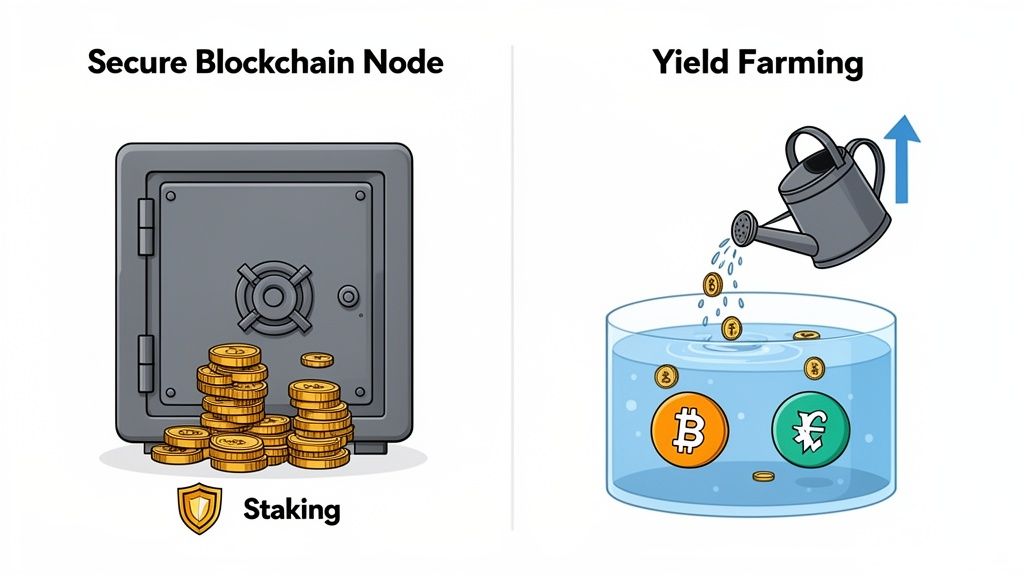
This infographic gives you a quick visual breakdown of how the two strategies stack up.

As you can see, staking is a straightforward deal: you lock up assets to help the network. Yield farming is a bit more involved, requiring you to provide liquidity to more sophisticated DeFi protocols.
Those massive APYs in yield farming look tempting, but they're directly tied to higher risk. If you don't get a handle on the specific threats, you could lose your shirt. While staking isn't entirely risk-free, its dangers are fewer and more well-understood compared to the minefield that yield farming can sometimes be.
Here’s the main thing to remember in DeFi: yield is just another word for risk. The higher the APY, the more risk you’re taking on, whether it's spelled out for you or buried deep in a smart contract.
The yield farming explosion back in mid-2020, kicked off by Compound Finance's COMP token launch, is a perfect example. DeFi's total value locked (TVL) rocketed from $1 billion to over $25 billion in just a few weeks. This was fueled by APYs ranging from 2.5% to 250%, making staking’s 5-15% returns look like pocket change.
But this frenzy also gave many their first brutal lesson in impermanent loss. A fivefold price shift between a token pair could slice 25% off a $2,000 deposit, often erasing any gains from fees and then some. You can get more of the backstory on how these strategies came to be by reading up on yield farming in DeFi.
To make a smart move, you need a clear picture of what could go wrong. The table below breaks down the main risks for both staking and yield farming, giving you a sense of their potential impact and how often they might crop up.
Here's a closer look at the specific risks you're exposed to with each strategy. Notice how yield farming introduces several layers of risk that simply don't exist in a standard staking setup.
This comparison makes it pretty clear: while both strategies are at the mercy of market swings, yield farming throws in extra, complex risks. Impermanent loss and smart contract bugs are the two big ones that yield farmers constantly have to watch out for. Staking, in contrast, offers a much simpler risk profile that hinges mainly on the staked asset's price and your validator's performance.
Figuring out whether to stake or yield farm isn't about finding the "best" option—it's about finding the best fit for you. The right move hinges on your personal goals, how much risk you’re comfortable with, and the amount of time you’re willing to put in. This decision is as much about your personality as it is about your portfolio.
To help you cut through the noise, we'll break down the key factors that should guide your choice. We’ll look at common investor profiles to help you see where you fit and build a strategy that actually works for your situation.
First, a little self-reflection is in order. Are you a long-term believer in a specific project, happy to accumulate more of its token over time? Or are you an active strategist, constantly hunting for the highest possible returns across the DeFi ecosystem? How you answer that single question is the biggest clue to whether staking or yield farming is your game.
Let’s explore two common crypto investor archetypes.
The Long-Term Believer: This person is fundamentally bullish on a blockchain like Ethereum or Solana. They plan to hold the native token for years, betting on its long-term appreciation. Staking is a natural fit here. It lets them compound their holdings by earning more of the token they already believe in, all while helping secure the network. It’s a low-maintenance, “set it and forget it” approach that aligns perfectly with a long-term vision.
The Active DeFi Strategist: This individual lives and breathes DeFi, always scanning for the next big opportunity. They understand the nuances of impermanent loss, aren't afraid of complexity, and are ready to move capital between different protocols to chase the highest yields. For this hands-on strategist, yield farming is the clear winner. It provides the dynamic, high-reward environment they thrive in, but it demands constant monitoring and a solid grasp of market mechanics.
Choosing between staking vs yield farming is like picking a vehicle. Staking is a reliable sedan for a long, steady road trip. Yield farming is a high-performance race car—exciting and incredibly fast, but it requires a skilled driver and constant attention to avoid a crash.
Knowing your investor profile points you in the right direction, but a few other factors will help you lock in your decision. Think about where you stand on each of these points, as they directly impact which strategy will feel right and ultimately be more profitable for you.
Risk Tolerance: How much can you stomach losing? With staking, the main risks are slashing penalties and the price volatility of the single asset you’re holding. Yield farming throws in extra layers of risk, including the notorious impermanent loss and the ever-present threat of smart contract exploits. If the idea of your initial capital shrinking due to complex market forces keeps you up at night, staking is your safer bet.
Time Commitment: How hands-on do you want to be? Staking is largely passive. Once you delegate your tokens to a trustworthy validator, you can pretty much just check in occasionally. Yield farming, on the other hand, requires active management—you’ll be monitoring APYs, rotating positions (or "crops"), and staying on top of protocol updates. It's less of a passive investment and more of a part-time gig.
Capital and Goals: Are you chasing steady, predictable growth or are you aiming for explosive, short-term gains? Staking offers a more consistent income stream, making it easier to forecast your returns over time. Yield farming returns are wildly variable and can vanish overnight as liquidity incentives change or dry up completely.
This table breaks it down into simple scenarios to help you make the final call.

Picking between staking and yield farming is just step one. The real magic happens when you know where and when to put your capital to work. Instead of just chasing the highest advertised APY, you can use on-chain data to follow the moves of consistently profitable traders—the so-called "smart money."
This is where the blockchain’s public ledger becomes your secret weapon. Every transaction, every wallet history, and every protocol interaction is out there in the open. By watching what the top-performing wallets are doing, you can spot high-conviction staking opportunities and find juicy yield farming pools before they get crowded. It’s all about turning raw data into a real strategy.
When you're looking for staking opportunities, your goal is to find wallets that are true believers in a network. I'm not talking about traders who jump from one hot token to the next. I'm talking about investors who've parked serious capital in a project for the long haul, signaling deep confidence in its future.
Here’s what to look for to identify these influential stakers:
Yield farming is a completely different beast; it demands a more agile approach. The most successful farmers are almost always the first ones in the pool, scooping up those insane initial APYs before the rewards get diluted. On-chain data lets you spot these "alpha" hunters by tracking their funds as they move between different DeFi protocols.
By analyzing dashboards like those in Wallet Finder.ai, you can quickly find wallets that consistently crush the market and then dig into exactly how they're doing it.
Following smart money in yield farming isn't about blind copy-trading. It's about seeing where capital is flowing. When you see a bunch of top-performing wallets suddenly pile into a new, obscure protocol, that's a massive signal that you might have just found the next big thing.
To find the best yield farmers to follow, keep an eye on these indicators:
Tools like Wallet Finder.ai are built specifically for this. They pull together all the on-chain data you need, letting you filter for wallets that fit your strategy—whether you’re after a long-term staker or a nimble yield farmer. You can even set up alerts to get notified the second a wallet you're tracking makes a move.
To go even deeper on this, check out our guide to on-chain data analysis for some more advanced tactics.
At the end of the day, whether you choose the steady income of staking or the fast-paced world of yield farming, using on-chain data gives you a serious edge. It lets you stop guessing and start making decisions based on what the most successful players in DeFi are actually doing.
Let's talk about the part of DeFi everyone loves to ignore: taxes. It's not glamorous, but figuring out the tax side of your staking and yield farming rewards is absolutely critical. Getting this wrong can turn a profitable strategy into a massive headache.
A quick heads-up: the rules are often murky and change depending on where you live. This isn't financial or tax advice, so please, chat with a professional who knows this stuff inside and out.
For the most part, staking rewards are seen as ordinary income. The taxable event usually hits the moment those rewards land in your wallet. The fair market value of the tokens on that day is what you'll likely report as income. Simple enough, right?
Yield farming, on the other hand, is a whole different beast. It’s not just one taxable event; it's a chain of them, and you need to track every single link.
Unlike the clean, predictable nature of staking rewards, yield farming creates a messy paper trail. Each move you make can trigger a tax obligation, turning a simple farming strategy into a major accounting challenge.
Here are a few common moments you’ll need to record for tax purposes:
Here’s the bottom line: nearly every click you make in DeFi could have a tax consequence. If you're serious about this game, keeping meticulous records isn't just a good idea—it's non-negotiable.
Taxes aren't the only thing that will chip away at your profits. Gas fees can be a silent killer, especially if you're actively managing yield farms on a network like Ethereum where every transaction costs a premium. While these fees might be deductible, you still have to track them, which adds another layer of bookkeeping to your plate.
Finally, don't forget the golden rule: diversify. Putting all your crypto into a single staking pool or the hottest new yield farm is asking for trouble. If that one platform gets hacked or fails, you could lose everything. A smart approach balances the steady reliability of staking with a few calculated, higher-risk yield farming bets. It's about building a resilient portfolio that can weather the inevitable storms of DeFi.
When you're weighing staking against yield farming, a few questions always seem to pop up. Let's clear the air on some of the most critical points so you can move forward with confidence.
Yes, it's possible, though it happens less often than with yield farming. The biggest risk is something called slashing. This is basically a penalty that gets triggered if the validator you've delegated your tokens to messes up—either by acting maliciously or having too much downtime. When that happens, a chunk of your staked tokens gets deducted as a fine.
Beyond that, you’re always exposed to the market. If the token you’re staking takes a nosedive in price, the dollar value of your investment will drop right along with it, even while you're earning more tokens. You can minimize the slashing risk by sticking with well-known, reputable validators.
Impermanent loss is a risk unique to providing liquidity in yield farming. It kicks in when the price ratio between the two tokens in your liquidity pool changes. If one token skyrockets while the other stays flat, the value of your share in the pool could end up being less than if you had just held those two tokens separately in your wallet.
Impermanent loss is the silent tax on liquidity providers. The more volatile the token pair, the greater the potential loss, which can sometimes outpace the fees and rewards you earn.
The easiest way to sidestep this is by sticking to liquidity pools with stable, less volatile assets. Think stablecoin pairs like USDC/DAI, where the price ratio is designed to stay constant.
For anyone just dipping their toes into DeFi, staking is the clear winner. It's way simpler to understand, carries a lower risk profile, and doesn't require the constant monitoring that yield farming does. It’s a great way to put your assets to work and support a network you believe in.
Yield farming is really for the more seasoned crowd. Its layers of complexity, combined with serious risks like impermanent loss and smart contract bugs, demand a much deeper understanding of how DeFi really works under the hood.
Ready to stop guessing and start copying the pros? Wallet Finder.ai gives you the on-chain intelligence to discover top-performing wallets, see their exact staking and yield farming strategies, and get real-time alerts on their next move. Find your alpha today.