Best Portfolio Trackers to Use

Wallet Finder

Blank calendar icon with grid of squares representing days.

January 1, 2026

Choosing the best crypto portfolio tracker depends entirely on your needs. For manual tracking, free tools like CoinGecko and CoinMarketCap are excellent starting points. But for traders seeking deep, on-chain intelligence to mirror profitable strategies, advanced platforms like Wallet Finder.ai offer a distinct advantage.

Ultimately, the choice is between a simple financial snapshot and real-time, actionable insights that guide your next move.

Why You Need a Crypto Portfolio Tracker
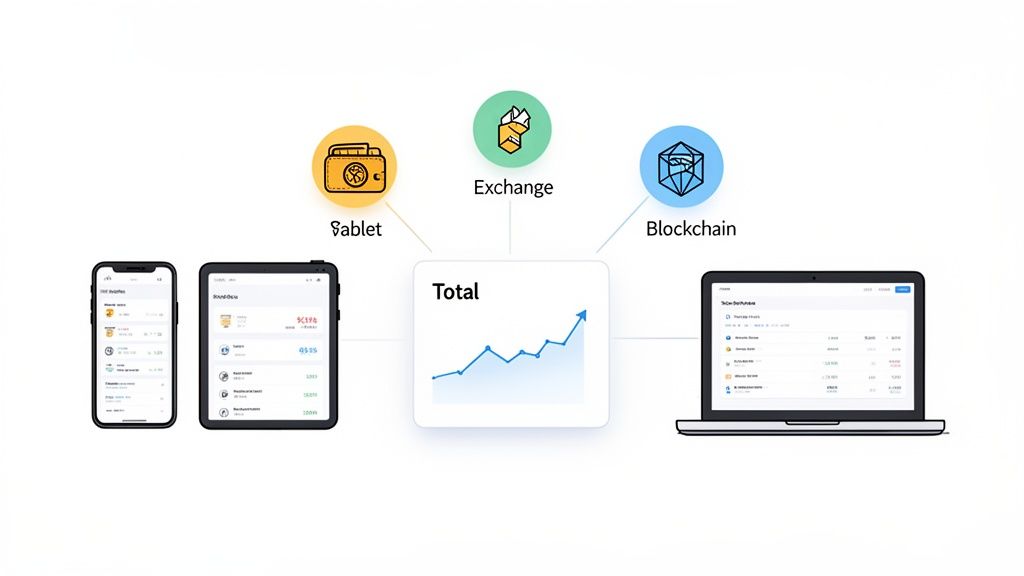
Digital portfolio management system connecting mobile, tablet, laptop with wallet, exchange, and blockchain services.

Let's be honest: keeping tabs on your crypto assets can get chaotic, fast. Your holdings are probably scattered across centralized exchanges, various DeFi protocols, and a handful of blockchain wallets. Trying to get a clear, accurate picture of your total net worth in that environment isn't just a hassle—it's nearly impossible.

This is where a crypto portfolio tracker becomes less of a nice-to-have and more of an essential part of your toolkit.

Think about the alternative for a second. You'd have to manually log into Binance, check your MetaMask on Ethereum, then hop over to your Phantom wallet on Solana, all while trying to calculate your total profit and loss. It's a recipe for headaches and errors. A portfolio tracker automates this whole mess.

A portfolio tracker is your financial command center. It pulls all your scattered crypto accounts into one clean, unified dashboard. This gives you a bird's-eye view of your investments, empowering you to make smart, data-driven decisions instead of just guessing.

Getting everything in one place is just the first step. The real magic is in the clarity these tools provide, turning a flood of raw data into a genuine strategic advantage. You can finally ditch the spreadsheets and start focusing on your strategy.

For a deeper dive, check out our complete guide to crypto tracking.

The Problem with Manual Tracking

Trying to track your portfolio in a spreadsheet seems like a good idea at first, but it quickly falls apart as your investments grow. You're stuck constantly updating prices by hand, and calculating complex metrics like unrealized gains or your cost basis for tax season becomes a total nightmare.

With the global crypto market cap soaring to $3.05 trillion, the complexity isn't going away. It only highlights how crucial a good tracker is for staying on top of things.

Beyond a Simple Balance Sheet

The best portfolio trackers do so much more than just list what you own. They're packed with powerful analytics that show you how your strategies are really performing.

Here’s what you gain:

  • A Unified View: See everything from your Coinbase account to your Ledger wallet, all in one spot.
  • Accurate P&L Analysis: Finally understand your true profit and loss after accounting for pesky fees and your full transaction history.
  • Performance Over Time: See how your portfolio has grown over days, months, or years to figure out what's actually working.
  • Simplified Tax Reporting: Many trackers can generate reports that take the headache out of filing crypto taxes.

Without a tool like this, you're essentially flying blind. You’re making critical decisions with incomplete information in a market that moves at the speed of light.

Comparing On-Chain and Off-Chain Trackers

An image showing the difference between off-chain (exchange, safe, API) and on-chain (blockchain, wallet) transactions.

Before you can pick the right portfolio tracker, you need to know where it gets its data. It really boils down to two main sources: off-chain and on-chain. Getting this one concept right is the key to finding a tool that actually fits your trading style instead of fighting against it.

Think of an off-chain tracker as your online banking portal. It connects to centralized places—in crypto, that means exchanges like Binance or Coinbase—using a secure API key. This lets the tracker pull your balance and trade history directly from the exchange's private records.

It's a reliable method and perfect if all your activity happens on centralized platforms. The big catch? It's completely blind to anything happening outside those exchanges.

Understanding Off-Chain Trackers

Off-chain trackers are masters of the centralized crypto world. Their main job is to pull together all your data from different exchanges and show it to you on one simple dashboard.

  • How They Work: You grant them "read-only" access with an API key, so they can see your data but can't touch your funds.
  • Best For: Traders who stick to buying, selling, and holding crypto on major centralized exchanges (CEXs).
  • Key Advantage: They are incredibly simple and give you a clean overview of your CEX trading activity.

If you mainly buy your assets on Kraken or KuCoin and leave them there, an off-chain tool gives you a perfect, no-fuss snapshot. It's a clean, walled-garden view of your portfolio.

But what about the wild world of DeFi, NFTs, and self-custody wallets? That’s where you need to look on-chain.

The Power of On-Chain Tracking

An on-chain tracker, on the other hand, is like a public investigator that reads the blockchain itself. Instead of logging into a private server, it scans the decentralized, public record of every single transaction ever made.

This means it sees everything—every swap on Uniswap, every NFT you minted on OpenSea, and every token you moved between your wallets. You get a complete, unfiltered picture of all public activity on chains like Ethereum, Solana, or Base. For a deeper look at this, our guide to on-chain data analysis shows how this raw information becomes a huge strategic advantage.

On-chain trackers give you the ground truth, straight from the source. They don't need to ask a third party for permission or data, offering a level of transparency that off-chain tools just can't match for decentralized finance.

This direct-from-the-blockchain approach is non-negotiable for anyone active in DeFi. It’s the only way to accurately track what’s in your MetaMask wallet, your staked tokens, or your liquidity pool positions.

Hybrid Models: The Best of Both Worlds

So, which one do you choose? The reality is, any serious crypto investor today needs a bit of both. The best portfolio trackers figured this out and evolved into a hybrid model.

Hybrid trackers merge the two approaches into one powerful tool. They use APIs to connect to your centralized exchange accounts and scan public blockchains for your wallet addresses. The result is a single, unified view of your entire crypto net worth, from the Bitcoin sitting on Coinbase to the meme coins you just bought on Base.

Why a Hybrid Tracker Wins

FeatureOff-Chain OnlyOn-Chain OnlyHybrid Model
CEX TradingExcellentNo visibilityExcellent
DeFi & NFTsNo visibilityExcellentExcellent
Portfolio ViewIncompleteIncompleteComplete
Best AudienceCEX TradersDeFi UsersAll Investors

At the end of the day, a hybrid tool makes sure no asset gets left behind. Whether you're a long-term HODLer on an exchange or a degen farmer exploring new DeFi protocols, a hybrid tracker gives you the 360-degree view you need to make smart moves.

What to Look For in a Great Portfolio Tracker

Picking the right portfolio tracker isn’t just about finding the one with the flashiest interface. The best tools are set apart by a specific set of features that directly impact your ability to make sharp, timely decisions. Think of this as your checklist for cutting through the marketing noise to find a tool that actually fits your trading style.

Not all features are created equal for every investor. A copy trader who needs to react in seconds will care most about instant alerts, while a long-term holder might put a higher premium on rock-solid security. Understanding these core components helps you find a tracker that truly works for you.

Comprehensive Data Coverage

The first question you should always ask is: "What can this tracker actually see?" Data coverage is all about the range of exchanges, wallets, and blockchains a tracker can plug into. If it can't see where your assets are, it's useless.

  • Exchanges: Does it connect to major centralized exchanges like Binance, Coinbase, and Kraken using an API?
  • Blockchains: How many chains does it support? Ethereum is a given, but the top-tier trackers also cover booming ecosystems like Solana, Base, Arbitrum, and Avalanche.
  • DeFi Protocols: Can it actually recognize and track assets you’ve staked in popular DeFi protocols like Aave, Uniswap, or Lido?

Without wide-ranging coverage, you’ll be stuck with a patchy, incomplete picture of your portfolio, which defeats the whole point. This is the foundation every other feature is built on.

Advanced P&L and Performance Analytics

Just knowing your portfolio's current dollar value is surface-level stuff. You need to understand how it got there. Deep profit and loss (P&L) analytics are what separate a simple balance checker from a serious trading tool. These are the metrics that show you if your strategies are actually working.

The best portfolio trackers don't just show you what you have; they show you how you got there. This includes realized gains from sold assets, unrealized profits on current holdings, and a detailed breakdown of your performance over time, net of all fees.

Look for tools that give you a complete historical P&L, showing your entry and exit points for every single trade. This is how you analyze your win rate, pinpoint your most profitable moves, and—just as importantly—learn from your mistakes.

For instance, CoinStats has become a giant in this space, with over 1 million users worldwide as of 2025, making it the #1 choice for traders with diverse assets. For DeFi copy traders and on-chain analysts, CoinStats provides advanced P&L metrics like total acquisition cost, unrealized P&L, and realized P&L, letting you get a precise read on performance. It's the kind of analysis you'd want when mirroring smart wallets on platforms like Wallet Finder.ai. You can see how top-tier trackers handle these metrics by checking out their platform insights.

Real-Time Customizable Alerts

The crypto market never sleeps, and it moves at lightning speed. A price swing that happens overnight can completely reshape your portfolio. This is why real-time, customizable alerts are a non-negotiable feature for any active trader.

The best tools go way beyond simple price pings. They let you set up notifications for specific on-chain events. For example, a copy trader can set an alert to get notified the second a wallet they’re tracking executes a trade. This flips the tracker from being a passive reporting tool into an active signal generator, giving you a real edge.

Security and Privacy Protections

In crypto, security is everything. When you're looking at a portfolio tracker, the most critical security question is simple: "Does it need my private keys?" The answer should always, always be no.

A legitimate tracker will never ask for your private keys or seed phrase. Period. Here’s a quick rundown of what to look for:

  • Non-Custodial: The tracker never actually takes control of your funds. You remain the sole owner of your assets, always.
  • Read-Only Access: When you connect an exchange via API, the key should be set to "read-only." This lets the tracker see your balance but gives it zero ability to execute trades or withdrawals.
  • No Private Keys Required: You connect wallets using your public address, not your private keys. This is the absolute gold standard for security, ensuring your keys never leave your possession.

Any platform that even hints at needing your private keys is a massive red flag. Walk away. Your portfolio's safety depends on keeping those keys locked down.

Powerful Integrations and Data Export

Finally, a great portfolio tracker shouldn’t be a walled garden. It needs to play nice with other tools. This could mean integrations with apps like Telegram for instant alerts or, crucially, the ability to export your entire transaction history as a CSV file.

Data export is especially important for two groups:

  1. Quantitative Researchers: They need to pull massive datasets for offline analysis, backtesting new strategies, or feeding into custom models.
  2. Tax Filers: Being able to export a clean, complete transaction history is a lifesaver when it comes to calculating capital gains and getting your tax reports in order.

Without these options, your data is effectively held hostage by the platform, limiting what you can do with it. Choosing a tracker with solid integration and export features ensures your data stays yours.

Before we move on, let's see how some of the top tools stack up against these key criteria.

Portfolio Tracker Feature Comparison

This table offers a side-by-side look at how leading portfolio trackers perform on the features we've just discussed. It's a quick way to gauge which platform might align best with your priorities, whether you're focused on data depth, security, or analytics.

FeatureWallet Finder.aiCoinStatsCoinGeckoDelta
Data CoverageHigh (focus on on-chain, major EVMs & Solana)Very High (500+ exchanges, wallets, chains)High (100+ exchanges, 15+ chains)High (300+ exchanges, 20+ chains)
Real-Time AlertsAdvanced (Custom on-chain events via Telegram)Advanced (Price, P&L, NFT, on-chain)Basic (Price alerts)Advanced (Price, portfolio value, market cap)
P&L and AnalyticsAdvanced (Wallet-specific P&L, win rate, ATH profit)Advanced (Realized/unrealized P&L, cost basis)Basic (Overall portfolio P&L)Advanced (Realized/unrealized P&L, fee tracking)
Security/PrivacyExcellent (Non-custodial, no private keys)Excellent (Read-only API, no private keys)Excellent (Read-only API, no private keys)Excellent (Read-only API, no private keys)
Multi-Chain SupportStrong (Ethereum, Solana, Base, Arbitrum, etc.)Excellent (Extensive cross-chain & L2 support)Good (Major chains supported)Very Good (Broad chain and L2 support)
IntegrationsGood (Telegram alerts, data export)Good (Tax software, data export)Limited (API access, no direct integrations)Good (Tax software, data export)
Data ExportabilityYes (CSV/Excel for wallets and trades)Yes (CSV for tax purposes)Yes (CSV for portfolio holdings)Yes (CSV/PDF reports)

As you can see, the "best" tracker really depends on what you need. For pure breadth of exchange connections, tools like CoinStats and Delta are hard to beat. But for deep, actionable on-chain analytics and alerts, a specialized tool like Wallet Finder.ai shines. Now, let's look at how to apply these features in the real world.

Actionable Workflows for Different Crypto Traders

Knowing what a top-tier portfolio tracker can do is one thing, but using it to gain a real edge is a whole different ballgame. The true power of these tools comes alive when you apply them to a specific strategy. Let's shift from theory to practice and look at some concrete workflows for different types of crypto traders.

Each workflow shows how to turn a firehose of raw data into profitable decisions, whether you're a beginner just trying to get organized or a seasoned pro hunting for alpha. These step-by-step guides will show you exactly how to squeeze value out of a powerful tracker.

The DeFi Copy Trader Workflow

For the DeFi copy trader, speed and accuracy are everything. The goal is simple: find the "smart money" wallets, figure out their strategy, and mirror their moves before the rest of the market catches on. An on-chain tracker is your primary weapon here.

Step-by-Step Guide:

  1. Discover Top Wallets: Use the discovery features to filter for wallets with a high P&L, a solid win rate (over 60% is a good place to start), or big recent gains. You're looking for consistency over a few weeks, not just a single lucky trade.
  2. Analyze Their History: Once you've got a promising wallet, go deep. Dig into its complete transaction history. What are its entry and exit points? How long does it hold tokens? This helps you see if its strategy actually fits your own risk tolerance.
  3. Set Up Instant Trade Alerts: This step is absolutely critical. You need to create custom alerts for your target wallets, probably through an integration like Telegram. The goal is to get notified the second a buy or sell happens so you can act on the signal immediately.
  4. Mirror and Monitor: When an alert hits your phone, you can quickly vet the trade and decide if you want to mirror it. From there, keep tracking the wallet's performance to make sure its strategy stays profitable over time.

This approach turns a portfolio tracker from a passive monitoring tool into an active, real-time alpha generation engine.

The Quant Researcher Workflow

Quantitative researchers and data-driven analysts need more than just a pretty dashboard. They need raw, granular data to build and backtest their models. For this crowd, the best portfolio trackers are essentially high-fidelity data pipelines.

The core job of a quant is to find patterns hidden in massive datasets. A tracker's ability to serve up clean, exportable on-chain data is the bedrock for uncovering market inefficiencies and building a unique strategic edge.

This process is less about real-time alerts and more about deep, offline analysis.

  • Filter and Segment: Start by creating specific groups of wallets based on metrics like total assets, P&L over the last 90 days, or how often they interact with new DeFi protocols.
  • Export Large Datasets: Use the tracker's export function to pull the complete trading histories of your filtered wallets into a CSV or Excel file. This is the raw material for your analysis.
  • Identify Patterns: In your own environment, like a Python script or other analytics software, you can start digging for recurring patterns. You might look for correlations between gas fee spikes and token buys, or spot wallets that consistently front-run major announcements.
  • Develop and Test Hypotheses: Use your findings to build trading hypotheses. For instance, "Wallets that buy a new token within the first hour of its Uniswap launch see an average return of 300%." You can then use the tracker to find new wallets that fit this successful profile.

The following visual guide breaks down the core evaluation process for finding the right tool.

This infographic outlines the essential steps in evaluating the best portfolio trackers, focusing on coverage, analytics, and security.

Process flow diagram showing three steps: Coverage, Analytics, and Security for evaluating trackers.

This process flow emphasizes that a tracker's value comes from its ability to cover all your assets, provide deep analytics, and maintain top-tier security.

The Beginner Investor Workflow

If you're new to crypto, the first challenge isn't finding alpha—it's just getting organized. With assets scattered across an exchange, a hot wallet like MetaMask, and maybe even a hardware wallet, just seeing your total net worth in one place is a huge win. For this, a hybrid tracker is perfect.

Getting a Unified View:

  1. Connect Exchange Accounts: First, link your centralized exchange accounts (like Coinbase or Binance) using a read-only API key. This is a totally secure process that lets the tracker see your balances without giving it any access to your funds.
  2. Add Wallet Addresses: Next, add the public addresses of your blockchain wallets. Just copy and paste your Ethereum or Solana address into the tracker. And remember, never share your private keys.
  3. Review Your Dashboard: Instantly, the tracker will pull all of your holdings into one unified dashboard. For the first time, you’ll see your entire crypto portfolio in a single, clean interface.
  4. Explore Basic Analytics: Now you can start exploring simple metrics, like your overall P&L and how your portfolio has performed over the last 30 days. This foundational view is the first step toward making smarter investment decisions.

This simple workflow solves the biggest headache for new investors by creating a single source of truth for all their holdings. For more on this, you can learn more about how to track DeFi portfolios across multiple wallets and get a complete picture of your assets.

How Wallet Finder.ai Unlocks On-Chain Alpha

While most portfolio trackers give you a clean, historical report card of your assets, a select few are built to do something much more powerful. They don’t just show you where you've been; they give you the tools to decide where you're going next. This is exactly where Wallet Finder.ai moves beyond simple tracking to become a genuine on-chain intelligence engine.

The whole platform is built on one core idea: the most profitable moves on the blockchain always leave a trail. By analyzing the wallets of top-performing traders—what many call "smart money"—you can spot opportunities and get in before they hit the mainstream. It’s less about watching your own balance and more about finding your next big win.

Discovering Smart Money Before the Crowd

The first step to finding alpha is knowing who to follow. You can't just pick a random address and hope for the best; you need to find traders with a proven, consistent track record of winning. This is what the 'Discover Wallets' feature was made for.

Instead of just feeding you a list of the biggest accounts, Wallet Finder.ai lets you slice and dice the data by the metrics that actually point to skill.

  • Filter by P&L: Pinpoint wallets that have generated the most profit over the last 7, 30, or 90 days.
  • Analyze Win Rate: Focus on traders with a high percentage of profitable trades. This shows a solid strategy, not just a single lucky moonshot.
  • Track Recent Gains: Spot the wallets that are crushing it right now, capitalizing on current market trends.

This lets you cut straight through the noise and zero in on that tiny fraction of traders who consistently beat the market. You’re not just looking for whales; you're looking for sharks.

The 'Discover Wallets' dashboard lets you filter for top-performing traders based on metrics like P&L and win rate.

This view gives you a clear, data-driven launchpad for finding wallets whose strategies are actually worth digging into.

Vet Traders with Deep-Dive Analytics

Finding a promising wallet is just step one. The real magic happens when you vet their strategy to make sure it matches your own risk appetite and goals. A huge P&L might look amazing, but if it came from one ridiculously risky "degen" play, you probably don't want to copy that approach.

Wallet Finder.ai lays out the complete, transparent trading history for any public wallet. This lets you put on your detective hat and pick apart a trader’s every move.

You can see not just what they bought, but when they bought it, how much they paid, and when they cashed out. That granular detail is the difference between blindly following and making a truly informed decision.

This level of detail is a hallmark of advanced on-chain tools. For instance, since its launch back in October 2017, Delta.app has become a top-tier portfolio tracker by offering professional traders and quants similarly deep insights. As the crypto ETF market ballooned to an estimated $179.16 billion in assets by 2025, tools that provide exhaustive historical analysis—much like Wallet Finder.ai's trading histories—became absolutely essential for serious investors. You can learn more about how top trackers deliver detailed insights on coinledger.io.

Gain a Crucial Edge with Instant Alerts

In the breakneck world of DeFi, a few minutes can mean the difference between getting in early and buying someone else's exit pump. Once you've found and vetted a handful of top-tier wallets, you need to be able to act on their moves the second they happen. This is where instant alerts become your secret weapon.

Wallet Finder.ai hooks directly into Telegram, sending you a notification the moment a wallet on your watchlist makes a trade.

Here’s how it works in practice:

  1. You add a top-performing Solana trader to your watchlist. You've done your homework and see they have a knack for sniffing out new meme coins right before they take off.
  2. The trader buys a new, low-cap token. Instantly, your phone buzzes with a Telegram alert showing the token, the amount purchased, and a direct link to the transaction.
  3. You vet the opportunity in seconds. You can quickly click through, check out the token, and see the trader’s entry point to decide if you want to follow their lead.

This simple workflow turns your tracker from a passive reporting tool into an active, real-time signal generator. It closes the gap between analysis and action, giving you the power to move with the same speed as the sharpest players in the market. You can see what this feels like for yourself with a no-risk, 7-day trial of Wallet Finder.ai and experience firsthand how it turns raw blockchain data into actionable opportunities.

Got Questions? We've Got Answers.

Jumping into the world of portfolio trackers can feel a bit like drinking from a firehose. You've got questions about security, taxes, and how to actually use these things to make better moves. Getting straight answers is key to picking the right tool and making it work for you.

Let's cut through the noise and tackle the questions that come up most often. We'll cover everything from keeping your assets safe to using trackers to level up your trading game.

What Is the Most Secure Type of Portfolio Tracker?

When it comes to security in crypto, there's one golden rule: never, ever share your private keys. The safest portfolio trackers are built with this rule at their core. They're what we call non-custodial, meaning they never ask for your keys or control over your funds.

A secure tracker works in a "read-only" mode. Think of it like this:

  • For On-Chain Wallets: You just give it your public wallet address—the same one you'd give someone to send you crypto. The tracker then looks up that address on the public blockchain to see your holdings, just like anyone could with a block explorer.
  • For Centralized Exchanges: You'll use an API key to connect your account. The critical step here is to set the permissions for that key to "read-only." This lets the tracker see your balances but gives it zero ability to make trades or withdrawals on your behalf.

The bottom line is that a trustworthy tool will give you a full picture of your portfolio without ever needing your seed phrase or private keys. If a platform asks for that stuff, it’s a massive red flag. Run, don't walk.

This "look but don't touch" approach ensures you're always the one in control of your assets, making it the only truly safe way to monitor your portfolio.

Can These Trackers Help Me with Crypto Taxes?

Yes, and honestly, this is one of their most valuable features. Anyone who's tried to manually calculate capital gains and losses from a year's worth of crypto trades knows it's a nightmare waiting to happen. The best trackers can turn that headache into a simple task.

Most top-tier platforms let you export your entire transaction history into a single CSV or Excel file. You can then upload this file directly into specialized crypto tax software or hand it over to your accountant. It’s that simple.

The export file contains everything needed for tax calculations:

  • The asset you traded
  • The exact date and time
  • The price you bought or sold at
  • How much you traded
  • Any transaction fees you paid

Having this clean, organized record saves you dozens of hours and gives you the proper documentation to file your taxes correctly. It's a game-changer.

How Do I Start Copy Trading Safely?

Copy trading sounds easy—just follow the smart money, right? But it's risky if you're just blindly mirroring trades without a plan. A powerful on-chain tracker like Wallet Finder.ai lets you copy trade with your brain, not just your gut. The key is to vet wallets thoroughly before you follow them.

Here’s a simple workflow to get started on the right foot:

  1. Find and Filter: Use the discovery tools to find wallets with a solid history. Don't just chase the biggest profit number. Look for a high win rate (over 65% is a good benchmark), steady gains over time, and a trading style that you're comfortable with.
  2. Do Your Homework: Before you copy a single trade, dig into the wallet's history. Check out their past entry and exit points, how long they typically hold tokens, and what their biggest wins and losses look like. You need to understand the strategy you're about to follow.
  3. Set Up Real-Time Alerts: Found a few wallets you like? Add them to a watchlist and turn on instant trade alerts (usually through Telegram). This way, you get a notification the second they make a move, giving you time to decide if it's right for you.
  4. Mirror, Don't Mimic: When an alert hits your phone, don't just ape in. Take a minute to do your own quick check on the token and what the market is doing. It's always smart to start with smaller positions until you're confident in the trader you're following.

This process transforms copy trading from a gamble into a calculated, risk-managed strategy. You're using the tracker to make informed decisions, not just to find someone to follow.


Ready to stop guessing and start making data-driven moves? Wallet Finder.ai gives you the on-chain intelligence to discover top traders, analyze their strategies, and get real-time alerts so you never miss an opportunity. Start your 7-day free trial and unlock the alpha today.