
Binance Proof of Reserve: A Trader's Verification Guide
Learn how Binance Proof of Reserve works, how to verify funds on-chain, and its limits. Use our guide to turn PoR data into a risk management tool.
You’re probably doing one of two things right now. You either keep some trading capital on Binance and want to know how much trust that really deserves, or you’re watching large exchange-related wallet flows and trying to separate routine custody movement from something that matters.
That’s where binance proof of reserve becomes useful.
Most traders treat Proof of Reserve as a reputation document. That’s too shallow. Used properly, it’s a practical input for counterparty risk, withdrawal planning, and on-chain flow analysis. It won’t remove exchange risk, and it won’t replace proper self-custody discipline, but it does give you a way to verify more than vibes.
Why Exchange Proof of Reserve Matters Now More Than Ever
A fast market selloff is the worst time to start wondering whether exchange balances are fully backed. By then, traders are already racing to cut exposure, move collateral, or pull funds to self-custody. Proof of Reserve matters because it gives you something concrete to check before stress hits the system.

Trust in centralized exchanges changed after the industry learned, the hard way, that brand size and liquidity do not guarantee clean balance sheets. Traders now ask a better question: what assets can the exchange verify against customer liabilities right now?
Binance’s answer has been to publish recurring Proof of Reserve snapshots instead of relying on reputation alone. In its May 2025 disclosure, Binance reported 616,886.378 BTC in reserves against 604,886.378 BTC in customer Bitcoin liabilities, a 102.06% BTC reserve ratio. The same snapshot showed USDT at 102.07%. Those numbers matter less as marketing and more as a risk signal. They show whether a major venue is operating with an asset buffer in the assets traders care about most.
What changed for traders
A PoR report gives you a reference point for exchange-level backing. If you keep execution capital on Binance, that affects how much idle balance you leave there, how quickly you sweep profits out, and how you plan around periods of heavy withdrawal demand. If you track exchange wallets on-chain, PoR gives you a baseline for interpreting large transfers.
That second use case gets underrated.
Large exchange-linked movements are easy to overread. Some are routine custody operations. Some are internal wallet reshuffles. Some reflect user deposit and withdrawal flow. Reserve disclosures help separate normal exchange management from activity that deserves closer scrutiny. Used alongside wallet tracking tools, they also help you avoid mistaking treasury maintenance for smart money conviction.
Binance’s PoR works best as a filter for counterparty risk and flow analysis, not as a blanket guarantee.
Why this matters beyond security
For active traders, exchange risk sits inside trade risk. An exchange can have deep books and still create operational risk if reserve quality, withdrawal capacity, or asset segregation become unclear under pressure.
This is also where the link to wallet intelligence becomes practical. Public reserve disclosures tell you what Binance says it holds. On-chain monitoring helps you see how exchange-linked wallets move over time. Put those together and you get a sharper framework for reading capital rotation, evaluating venue risk, and deciding what belongs on an exchange versus in your own wallet.
If you are still assessing venue-level credibility, Wallet Finder.ai’s review of whether Binance is legitimate adds useful context around exchange trust, operating history, and transparency signals beyond PoR alone.
How Binance's Proof of Reserve System Works
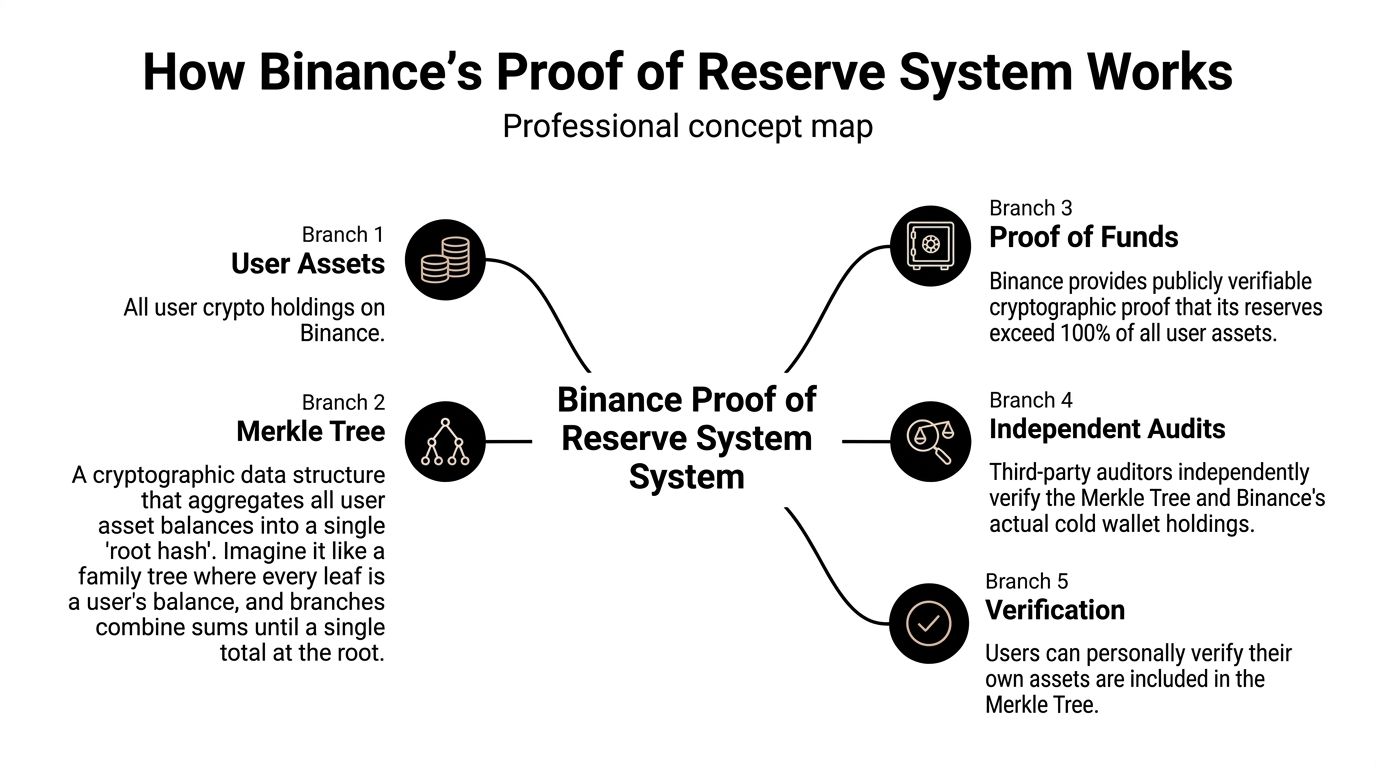
Binance’s PoR system has two jobs. First, it needs to prove liabilities, meaning what the exchange owes users. Second, it needs to prove assets, meaning what the exchange controls in wallets. The system only makes sense if you understand both sides together.
How liabilities are represented
Binance uses a Merkle tree for the liability side. The simple way to think about it is a family tree of balances.
Each user’s hashed ID and balance sits at a leaf. Those leaves are combined pair by pair into branches, then into larger branches, until the structure produces a single top-level value called the Merkle root. If any leaf changes, the root changes too. That’s what gives the structure integrity.
Users don’t need to inspect every account to verify inclusion, because they only need their own path from leaf to root.
Why zk-SNARKs are part of the model
A raw liabilities file would expose too much user information. Binance says it uses zk-SNARKs proofs alongside the Merkle structure to support trust-minimized verification without exposing sensitive account data. The method is described in Binance’s explanation of its PoR cryptographic model, which states that Binance’s PoR uses a Merkle tree combined with zk-SNARKs and shows BTC reserves at 100.77% of liabilities and ETH at 100.00%.
For traders, the technical takeaway is simple. You get a way to verify that your balance was included in the liability snapshot without forcing the exchange to publish everyone’s balances in the clear.
How assets are verified
The asset side works differently. Binance needs to demonstrate ownership or control of reserve wallets. The verified material describes three methods:
- Message signing with wallet private keys
- On-chain test movements of funds at a specified time and amount
- Explorer-based checks using public wallet labels
Those methods are less elegant than the Merkle tree, but they’re necessary. A liabilities proof without wallet ownership evidence is incomplete.
What works and what doesn’t
What works:
- User inclusion verification is strong because it lets individuals test whether their account was part of the liabilities set.
- Public wallet evidence gives analysts something concrete to inspect on-chain.
- Cryptographic structure reduces the need for blind trust.
What doesn’t:
- Technical complexity means many users never verify anything themselves.
- Snapshot logic can create false comfort if traders assume the report is continuously live.
- Asset proof alone doesn’t answer every solvency question.
Practical rule: If you can’t explain how liabilities and assets are linked in a PoR model, you shouldn’t treat a reserve ratio as the whole risk picture.
How to Personally Verify Your Binance Account
Individuals often stop at reading the headline reserve ratio. That’s useful, but it’s passive. The stronger move is to verify your own inclusion in the liability snapshot and then compare that with the public reserve side.
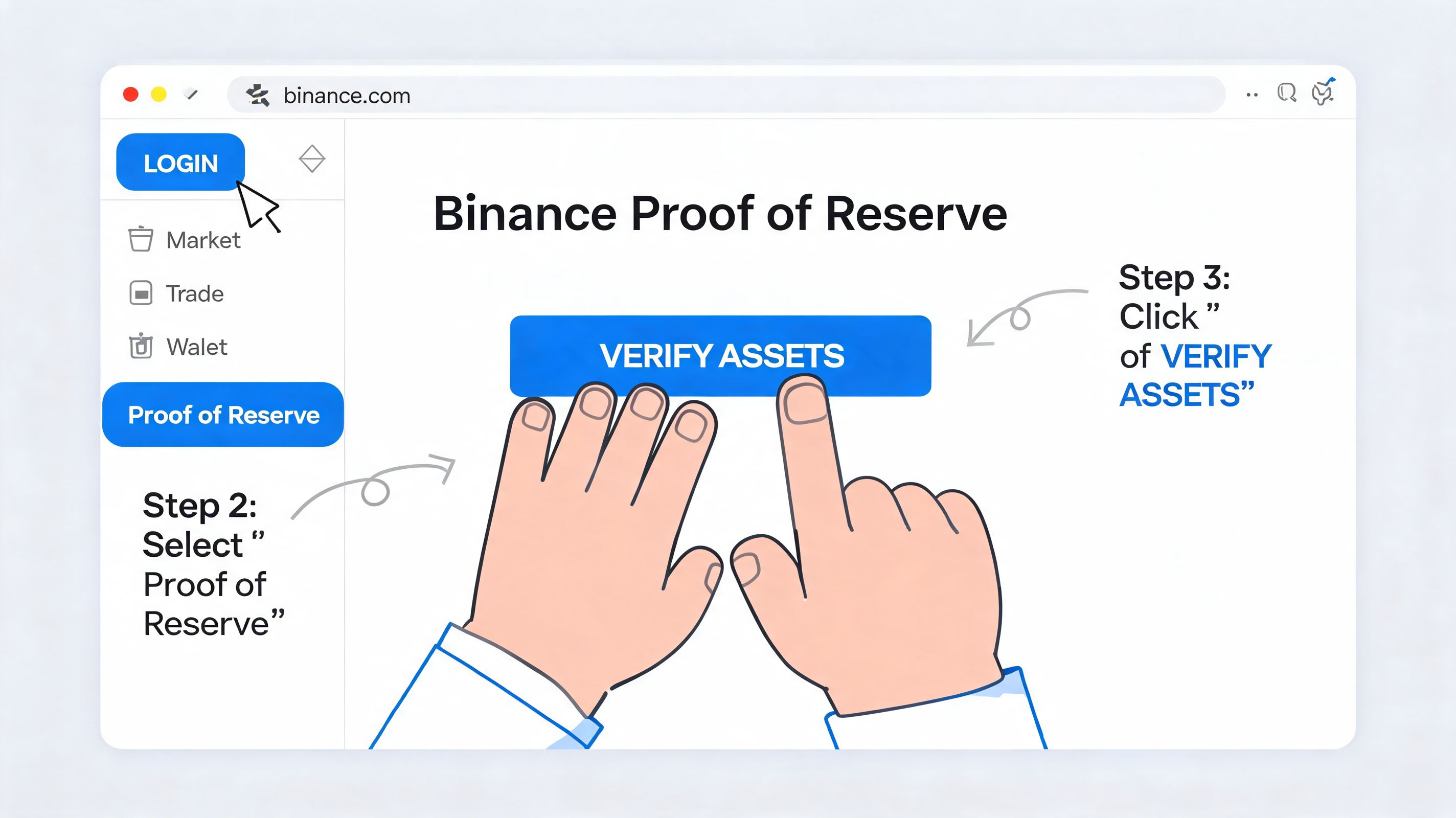
The account-level verification process
Use this workflow:
- Log in to Binance and open the latest Proof of Reserves page.
- Find the snapshot details for the asset you care about most. This is important because PoR is tied to a specific point in time.
- Locate your verification record. Binance provides the data needed to confirm that your hashed account entry was included in the Merkle tree.
- Check your Merkle path and confirm it resolves to the published root.
- Save the snapshot reference so you can compare later disclosures instead of treating each report in isolation.
This is not a trading signal by itself. It’s a trust check. But that trust check matters before you leave meaningful capital on any venue.
What to look for in the published snapshot
A useful example comes from Binance’s January 2026 Bitcoin PoR snapshot. At block height 930,340, Binance reported 636,914 BTC in on-chain wallet balances against 636,535 BTC in net user liabilities, which produced a 100.06% reserve ratio, according to the January 2026 BTC PoR discussion.
That example shows what a proper snapshot gives you:
- a precise chain reference
- an asset-specific reserve figure
- a liability figure
- a ratio you can test against the wallet evidence
How to verify the wallet side yourself
After checking your own inclusion, move to public wallet verification.
Open the reserve wallet disclosures from Binance, then inspect the addresses in a blockchain explorer relevant to the asset you’re reviewing. For Bitcoin, that means using a BTC explorer and checking whether balances and movements line up with the disclosed reserve picture. For EVM assets, that often means looking through explorer labels and recent transfers.
A few practical checks help:
- Match timing: Compare the wallet state to the published snapshot timing, not to current balances only.
- Ignore internal noise: Exchange wallets move funds for operational reasons all the time.
- Watch concentration: If a reserve picture relies heavily on a small number of wallets, monitor those more closely over time.
The point of personal verification isn’t to become an auditor. It’s to reduce the amount of trust you’re outsourcing.
What traders usually miss
The biggest mistake is checking inclusion once and then forgetting about it. Better practice is to repeat the process occasionally, especially before parking larger balances on the venue or during periods of market stress.
The second mistake is reading reserve data without checking the chain context. A ratio looks strong on paper, but the practical value comes from linking it back to actual reserve wallets and actual snapshot timing.
Analyzing PoR Reports and Published Audits
A trader checking Binance PoR should read it the way they read order flow. The headline matters less than the pattern underneath.
The useful question is simple. Does the report show a consistent reserve buffer in the assets you keep on the venue, and does that picture hold up across repeated disclosures and on-chain wallet behavior? That is where PoR becomes more than a trust exercise. It becomes counterparty-risk data.
How to read the ratios
A reserve ratio above 100% means Binance reported more reserves than customer liabilities for that asset at the snapshot date. For risk management, that matters because a visible buffer is better than a bare 100% line, especially during periods when withdrawals spike and traders start moving stablecoins or BTC off exchanges fast.
Here’s a practical reading framework for the published disclosure figures referenced earlier:
| Asset or metric | How to interpret it |
|---|---|
| BTC reserves vs. BTC liabilities | Check whether reserves exceed liabilities, not just whether both numbers look large |
| BTC reserve ratio | A ratio above 100% shows reported excess coverage at the snapshot |
| USDT reserve ratio | Useful for traders who park quote currency on Binance between rotations |
| Total disclosed reserves | Better used as scale context than as a standalone safety signal |
Start tracking smart money today
Join thousands of traders using WalletFinder.ai to find profitable wallets and copy their trades.
Start Free Trial →

