Coin Profitability Calculator: Your 2024 Guide
Unlock smarter crypto decisions with our guide to using a coin profitability calculator. Learn to accurately forecast mining and trading profits.

December 21, 2025
Wallet Finder

December 22, 2025

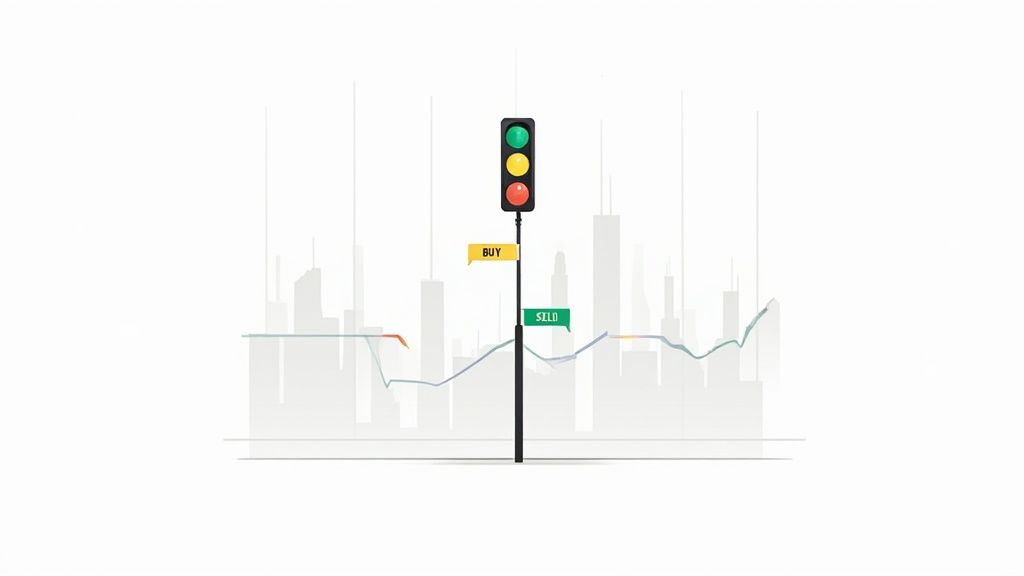
A buy sell indicator is a tool that uses math to comb through historical price, volume, or on-chain data and spit out signals for when to get into or out of a trade.
Think of it like a traffic light for the market. It’s designed to flash a potential green light (buy), red light (sell), or yellow light (hold). These aren't crystal balls, of course, but they give you objective, data-driven insights to help manage risk and spot opportunities that you might otherwise miss.

At its core, a buy sell indicator turns a firehose of complex market data into simple, visual cues right on your trading chart. Instead of getting overwhelmed by a chaotic screen of price candles, traders use these tools to cut through the noise and focus on what really matters: potential shifts in market direction, momentum, or volatility.
It's like trying to guess how fast a car is moving just by watching it go by. You could make a decent guess, but you wouldn't be precise. An indicator is like the car's speedometer—it gives you a clear, objective reading of whether the trend is accelerating, slowing down, or about to reverse.
The real mission of any buy sell indicator is to swap emotional, gut-feeling decisions for a systematic, evidence-based approach. We’ve all been there—fear of missing out (FOMO) and panic selling are the twin demons that can wreck a portfolio. Indicators create rules-based triggers that force you to trade with discipline.
For instance, a simple moving average smooths out wild price swings to show you the real underlying trend. One classic example is the 200-day moving average (MA). A historically solid rule for major indices like the Dow is to buy when the price is above a rising 200-day MA and get out when it drops below. It's a method that helped traders sidestep massive meltdowns like the 2008 financial crisis.
While there are hundreds of indicators out there, they mostly fall into a few key categories, with each one built to answer a different question about the market. Getting a handle on these categories is the first step to building a trading system that actually works for you.
If you're looking for more practical tools, you might want to check out our guide on the top 7 tools for entry and exit signal alerts.
The real value of an indicator isn't just the signal it produces, but the discipline it enforces. It encourages traders to wait for confirmation, respect their strategy, and avoid impulsive decisions driven by market hype or fear.
To get you started, here’s a quick breakdown of the main indicator types you'll run into.
This table gives you a snapshot of the different kinds of buy sell indicators and what they’re best used for in a trading strategy.
Each category gives you a different piece of the puzzle. The real magic happens when you start combining them to get a more complete picture of what the market is doing.
Every buy/sell indicator you'll ever use falls into one of three buckets, each built to answer a specific question about what the market is doing right now. Think of them like different specialists on a medical team. One checks the patient’s general health, another measures their heart rate, and the third assesses their mood swings. Getting a handle on these three types is your first real step toward building a trading strategy that actually makes sense.
Instead of just slapping random indicators on your chart and hoping for the best, understanding their purpose lets you pick the right tool for the job. You wouldn't use a thermometer to check blood pressure, right? Same logic applies here—you don't use a volatility indicator to confirm a trend.
Let's break down what each of these categories actually does.
Trend-following indicators are your trading compass. Their one and only job is to show you the market's general direction. They cut through the noise of day-to-day price swings to reveal the underlying current, helping you figure out if you should be hunting for buys or sells. Their goal is simple: keep you on the right side of the market.
Key Actionable Uses:
The most famous trend indicator is the Moving Average (MA). It just calculates the average price of an asset over a set period, smoothing it out into a single, flowing line on your chart. When the price stays consistently above the MA, you’re likely in an uptrend. If it's below, you're in a downtrend.
If trend indicators are your compass, momentum oscillators are your speedometer. They measure the speed and strength of price moves, telling you if a trend is picking up steam or about to run out of gas. These tools bounce back and forth between set levels, which helps you spot overbought (potentially overpriced) or oversold (potentially underpriced) conditions.
Momentum doesn't just measure speed; it measures conviction. A price move on strong momentum is more likely to continue, while a move on weakening momentum may be nearing a reversal.
Key Actionable Uses:
These indicators are gold for timing your entries and exits. For example, if your moving average confirms you're in an uptrend, you might wait for the RSI to dip into oversold territory before pulling the trigger on a buy.
Finally, volatility indicators act like the market's barometer, measuring how much prices are swinging around. They tell you if the market is calm and cruising or completely chaotic. This is critical for managing your risk and spotting potential breakout moves before they happen.
The textbook example is Bollinger Bands (BB). This indicator draws three lines on your chart: a moving average in the middle and two outer bands that are usually set two standard deviations away from it.
Key Actionable Uses:
Volume is another huge piece of this puzzle, telling you how much conviction is behind a move. To really get a feel for the tug-of-war between buyers and sellers, you can learn more about how Cumulative Volume Delta provides key insights into who's actually in control. When you start combining these different types of indicators, you get a much clearer, more complete picture of what the market is telling you.
Picking the right buy sell indicator can feel like staring into a massive toolbox—sure, there are dozens of options, but each one is built for a specific job. One might be a sledgehammer, perfect for riding long, powerful trends. Another is more like a scalpel, designed to spot quick reversal opportunities in a choppy, sideways market.
It's not about finding the single "best" indicator. That's a myth. The real skill is learning which tool works best for the current market conditions and your personal trading style.
To get there, you have to look past the textbook definitions and see how these tools perform in the wild. Some indicators are built to follow the market's direction, others measure its internal energy, and a third type gauges its wild emotional swings.
This flowchart breaks down the three core functions that indicators measure: Trend, Momentum, and Volatility.

Before you even add an indicator to your chart, the first step is knowing what you're trying to accomplish. Do you need to confirm a trend, measure buying pressure, or anticipate a breakout? Answering that will point you to the right tool.
Let's put the most popular indicators to the test. Every single one has distinct strengths that make it shine in certain scenarios and glaring weaknesses that make it a liability in others.
A trend-following indicator like a Moving Average, for example, will drive you crazy with false signals in a sideways market. But in that same environment, a momentum oscillator like the RSI would be right at home, helping you pinpoint tops and bottoms.
This is exactly why blindly slapping the same indicator on every chart, for every asset, is a recipe for disaster. You need a more thoughtful approach—one that matches the tool to the environment.
This table gives you a head-to-head comparison of four of the most common indicators. I’ve broken them down by their core function, the ideal market conditions for using them, and the specific signals they generate.
Looking at the data, one thing becomes crystal clear: an indicator’s effectiveness is completely situational. No single tool wins every time.
A trader's job isn't just to find good signals, but to understand the context in which those signals are generated. The best buy sell indicator is the one that aligns with the current market's personality.
This is where real performance data becomes so valuable. In a massive backtest covering over 100 years of market history, the Relative Strength Index (RSI, period 14) and Bollinger Bands were the clear standouts. The RSI(14) pulled off an impressive 71.64% win rate, absolutely crushing the 50-period SMA (30.85%) and MACD (37.56%). It just goes to show how powerful it can be for spotting overbought and oversold extremes. You can dive deeper into these results and learn more about technical indicator performance.
So, how do you pick the right tool for the job? It all comes down to what you're trying to do and what the market is doing right now.
Here’s a simple framework to guide your decision:
By starting with the market’s behavior, you can pick an indicator that’s naturally suited for that environment. This dramatically improves its reliability and cuts down on frustrating false signals. It’s a much smarter approach than trying to force one indicator to work in all conditions.

Relying on just one buy/sell indicator is a rookie mistake. It’s like trying to navigate a ship with only a compass—sure, it tells you which way is north, but it says nothing about the storm brewing ahead or the iceberg hiding just under the surface. This tunnel vision is a fast track to false signals and expensive trading errors.
The secret to stacking the odds in your favor is confluence. This is just a fancy term for getting multiple, unrelated indicators to agree on the same trade idea. When your trend, momentum, and volume indicators all flash the same signal, you've got something far more reliable. It's the market's equivalent of getting a second and third opinion before making a big decision.
You don't need a perfect, mythical indicator. Instead, smart traders build simple, repeatable systems that combine the strengths of a few proven tools. Below are two straightforward strategies you can start using right away to build much stronger, more confident signals.
This one is all about going with the flow. The goal is to identify a strong, dominant market trend and then use a momentum tool to pinpoint the perfect moment to jump in during a temporary dip. It’s for traders who’d rather ride the wave than try to swim against it. The plan is simple: confirm the bigger trend, then patiently wait for a pullback to buy.
Here is the step-by-step action plan:
Tools Needed:
Actionable Checklist:
This combination ensures you aren't just buying at random. You're strategically entering a strong trend at a much better price.
Breakout trading is exciting. It’s about catching those sudden, explosive price moves that happen after the market has been quiet for a while. The problem? Many breakouts are fakes, designed to trap eager traders. This strategy helps you tell the real deal from the imposters by using trading volume as your lie detector.
Tools Needed:
An explosive price move without a corresponding spike in volume is a major red flag. It suggests there's no real conviction behind it, and the breakout is likely to fizzle out and reverse.
Here’s how to put the pieces together to spot a high-probability breakout:
By waiting for all conditions—the squeeze, the price break, and the volume spike—you can filter out weak signals and focus only on the most promising opportunities. This methodical approach is what separates guessing from strategically using a buy/sell indicator.
While the old guards like RSI and Moving Averages are still foundational, the trading world never sits still. To really get an edge, you have to look past the standard toolkit and tap into deeper, more modern data streams. This is doubly true in crypto, where the blockchain itself is a wide-open book of market activity.
This is exactly where on-chain analysis changes the game. Instead of just staring at price charts, on-chain indicators dive into raw blockchain data. They measure things like investor sentiment, the flow of capital, and the overall health of the network, offering a layer of context that price action alone just can't give you.
Think of on-chain metrics as an X-ray of the market. They let you see what different players are doing, from the smallest retail holders to the massive "whale" wallets that can move markets. This gives you a much richer picture of supply and demand dynamics. You can learn more about the fundamentals in our complete guide to on-chain analysis.
Here are a few powerful examples of what this looks like in practice:
On-chain indicators shift the focus from what the price is doing to what investors are doing. This provides a leading edge, as investor behavior often precedes major price movements.
This screenshot from a platform like TradingView shows how traders can overlay multiple advanced indicators to build a more complete market picture.
The chart visualizes how a combination of price, volume, and specialized indicators come together to form a comprehensive trading dashboard.
Beyond just on-chain data, a new wave of technical indicators is using smarter algorithms that can actually adapt to changing market conditions. Unlike old-school tools with fixed formulas, these adaptive indicators are much better at filtering out the market noise and locking onto real trends.
For example, some modern tools now use artificial intelligence to analyze tons of data points at once, creating a much more dynamic buy sell indicator. These systems can even learn from their past performance to get more and more accurate over time.
One such tool, the Trend Speed Analyzer (TSA), produced a staggering 478% return in backtests on volatile currency pairs. That blew the 63% gain from a simple buy-and-hold strategy out of the water. With a 56% win rate and a 1.7 profit factor, its ability to latch onto genuine trends shows just how powerful these modern, adaptive algorithms can be. You can dive into a detailed breakdown of these innovative indicator findings to see exactly how they work.
These advanced tools represent the next step in technical analysis, offering a smarter way to navigate today's complex markets.
Even after you get the hang of how a buy sell indicator is supposed to work, a few questions always pop up when you try to put it all into practice. Let's tackle some of the most common ones head-on with practical answers to give you some extra clarity and confidence.
Think of this as a final sanity check before you start clicking buttons. It’s all about making sure you’re using these tools realistically and safely.
This is the million-dollar question, but the honest answer is: there isn't one. No single indicator is the "most accurate" in every single situation. An indicator's effectiveness really boils down to the market condition, the asset you're trading, and your timeframe. It’s the classic case of needing the right tool for the job.
For instance, plenty of backtesting shows the RSI can have a high win rate for spotting overbought and oversold levels, but it shines brightest in ranging (sideways) markets. On the flip side, the 200-day Moving Average is a historically reliable workhorse for confirming long-term trends in major stock indices, but it will give you tons of false signals in a choppy, directionless market.
The search for a single, perfect indicator is a trap. Success comes from learning to diagnose the market’s personality—trending, ranging, or volatile—and then deploying the indicator best suited for that specific environment.
The smartest approach is to look for confluence—using a combination of indicators to confirm signals—and to adapt your toolkit to what the market is telling you right now.
Absolutely not. Relying on a single indicator for your trading decisions is a recipe for disaster. Indicators are just math formulas based on past price data. Because of this, they are reactive, not predictive, and they can and will give you false signals.
A solid trading strategy uses indicators as just one piece of a much larger puzzle. That puzzle should always include other forms of analysis, like:
Above all else, your risk management rules need to be your top priority. Setting a stop-loss to define your maximum acceptable loss is the one thing that will protect your capital over the long run. Never, ever ignore it, no matter how perfect an indicator's signal looks.
Getting started is actually pretty simple on most modern trading platforms. It doesn't matter if you're using TradingView, MetaTrader, or the charting tools baked into your broker's website—the process is nearly identical.
Here’s a quick 3-step guide:
(fx).Pro-Tip: Always practice on a demo or paper trading account first. It lets you get a feel for how different indicators behave without risking a single dollar.
Ready to move beyond basic indicators and see what the smartest traders are doing in real time? Wallet Finder.ai turns on-chain data into actionable signals, allowing you to discover and mirror the strategies of top-performing crypto wallets. Start your 7-day trial and trade with an edge.
"I've tried the beta version of Walletfinder.ai extensively and I was blown away by how you can filter through the data, and the massive profitable wallets available in the filter presets, unbelievably valuable for any trader or copy trader. This is unfair advantage."
.avif)
Pablo Massa
Experienced DeFi Trader