Drawdown Analysis: A Trader's Guide to Crypto Risk
Master drawdown analysis to manage risk and protect capital. This guide explains key metrics, formulas, and how to apply them in DeFi with Wallet Finder.ai.

June 17, 2026
Wallet Finder

June 17, 2026

You spot a token ripping on one chain, pull up the chart, and feel that familiar frustration. By the time most traders react, the clean entry is gone, the first wallets are already rotating, and the next move is happening somewhere else.
That's the wrong way to read crypto.
A chain of markets is what you're trading. One venue moves first. Another reprices late. A bridge starts carrying inventory. A lending market gets tapped for collateral. A fresh liquidity pool absorbs the second wave. If you only watch the chart where the move began, you're staring at the first domino after it already fell.
Traditional retail learned this lesson long ago. Chain stores became a major retail force in the early 20th century, and by the 1920s they accounted for nearly half of all consumer sales in groceries, showing how standardized pricing and centralized purchasing could scale across local markets and turn fragmented commerce into concentrated networks, as summarized in EBSCO's history of chain stores. Markets behave the same way when infrastructure connects what used to be separate pockets of demand.
For traders, that changes the job. You're not just asking whether a token is bullish. You're asking where the move started, which linked market is slow to react, and what signal appears before capital spreads. That's where timing improves.
If you already use on-chain analysis workflows, the next step is widening the lens. Wallet behavior, bridge flows, liquidity migration, and repeated wallet cohorts often tell the story before headlines or social sentiment catch up.
Most missed trades don't start with bad analysis. They start with a narrow frame.
A trader sees momentum on Solana, Ethereum, or Base and assumes the opportunity lives only there. Then the same narrative leaks into adjacent markets. Liquidity providers reposition. Copy traders chase the first visible wallets. Market makers adjust quotes where they expect inventory to arrive next. By the time the second chain lights up, the move looks sudden, but it usually wasn't.
The practical edge comes from thinking in sequence instead of event. A chain of markets is not one market with noise around it. It's a set of connected venues, assets, and participants that transmit pressure from one place to another.
That matters because price rarely moves alone. It moves with routing, positioning, and attention.
Practical rule: If a move can spread, the earliest clue usually won't appear on the destination chart. It will appear in the path capital takes to get there.
Three habits usually separate proactive traders from late traders:
Single-chain analysis can still catch local setups. It struggles when a narrative migrates.
A meme rotation, an airdrop trade, or a tokenized asset theme often starts with a small group that acts early and moves capital quickly. If you only monitor one DEX, one screener, or one social feed, you see the market after propagation has begun. The better frame is to treat every move as part of a connected system with lead markets and lagging markets.
That's the lens for the rest of this piece. The goal isn't to define the term in abstract language. It's to trade the ripple before the crowd notices the wave.
A trader sees buying pressure hit a token on one chain, then assumes the move starts and ends on that chart. In practice, the first chart is often just the first visible stop. Capital can route through bridges, wrappers, lending markets, and perp venues before the broader market catches up.
Organized finance learned this lesson early. Once trading moved from scattered bilateral deals into formal exchanges, participants could track where price formed, where liquidity sat, and how orders traveled. The specific dates matter less than the market structure change itself. Standardized venues made capital flows easier to read, and readable flows are what make chain reactions tradable.
Traditional finance built a system of connected hubs. Exchanges handled price discovery. Brokers handled access. Clearing and settlement reduced confusion around who owed what and when.
Fragmentation still existed. It was just easier to map. Traders could identify the primary venue, judge where liquidity was thick or thin, and anticipate how a move in one instrument would affect another. That visibility is part of why cross-market trading became a discipline instead of guesswork.
Crypto is building a similar structure, but with open rails and faster feedback loops.
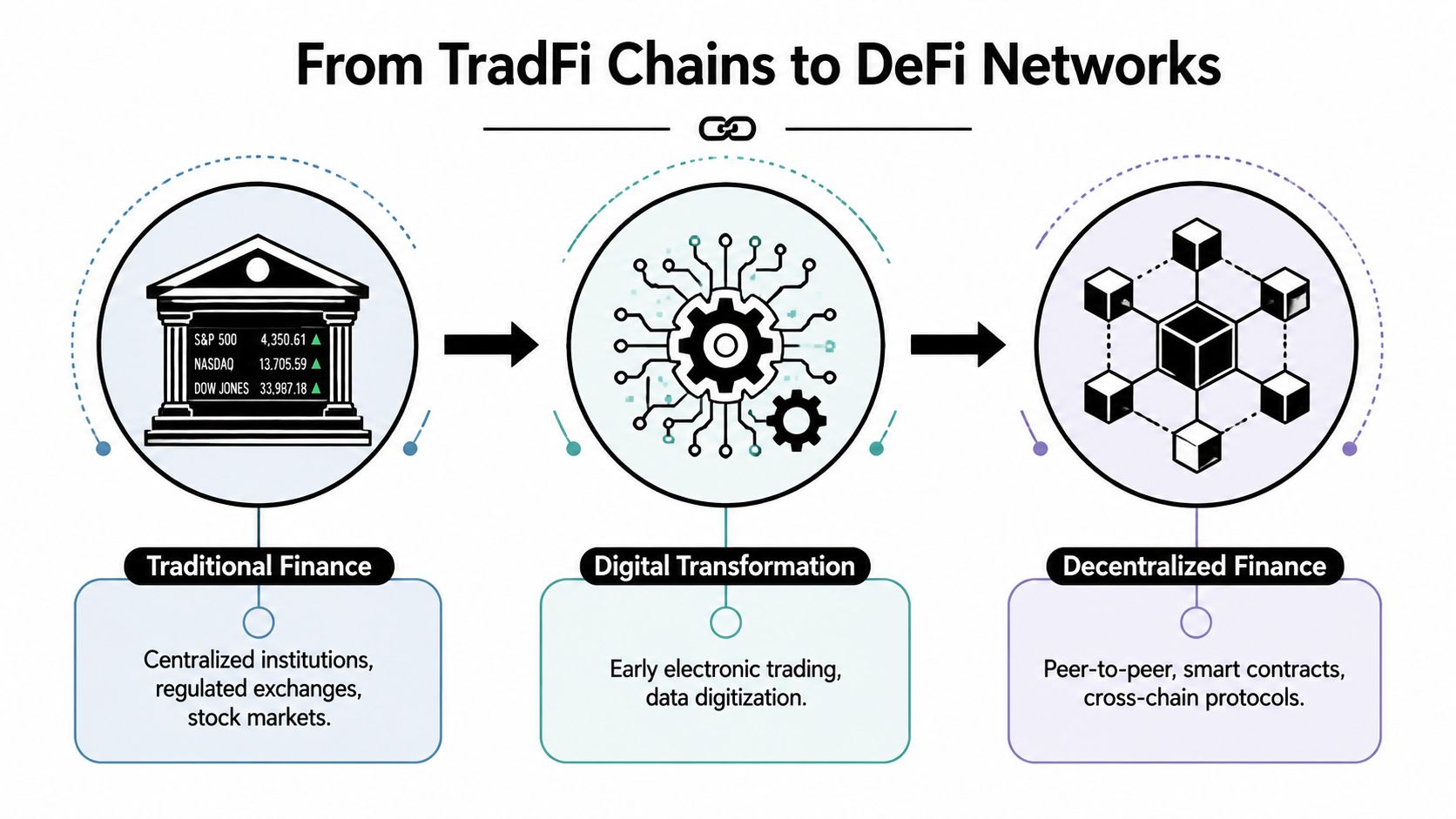
In DeFi, a market is not just a token pair on a DEX. It is the full set of venues where the same thesis can be expressed or hedged: spot pools, bridges, aggregators, perpetuals, lending protocols, wrapped assets, and the wallets moving between them.
That matters because one decision can echo through several layers at once. A wallet buys spot on the origin chain. Inventory gets bridged to a second chain. LPs rebalance after the price move. A related wallet cluster opens the same trade through perps or collateral elsewhere.
By the time the destination chart wakes up, the early actors may already be positioned.
Cross-chain rails change execution, not just infrastructure. If capital cannot move efficiently, the same idea trades at different speeds across chains. If capital can move cleanly, lag closes faster and weak pricing gets arbitraged away.
For traders, the practical question is simple. Is this move trapped inside one ecosystem, or is it starting to spread?
| Market feature | What it means in practice |
|---|---|
| Liquidity silo | Price can break out on one chain while related venues stay slow |
| Shared settlement paths | Capital can shift to the venue with better depth, lower slippage, or cleaner exposure |
| Portable market data | Traders can act on activity from another chain before local charts fully reflect it |
| Flexible routing | The best expression of a theme may appear on a different chain than where it started |
Bridge flow is often the first hard clue. A local pump usually stays local. A broader repricing starts showing up in transfers, wrapped supply changes, and repeated wallet behavior across venues. Traders who study cross-chain bridge transaction analysis can separate random noise from capital migration with intent.
A price chart shows the result. Market links show the route, the delay, and the next place pressure can surface.
Many traders still separate the market into neat buckets: Ethereum here, Solana there, Base somewhere else. That is a convenient dashboard view, but it is a weak trading model.
Capital does not care about chain identity. It cares about access, liquidity, speed, incentives, and where the next marginal buyer will show up. The useful framework is a connected network where each protocol can act as an origin point, relay, bottleneck, or lagging receiver. Once you start reading DeFi that way, cross-chain cascades stop looking random.
Interconnected markets produce mispricing. They also produce contagion. You want both ideas in view at the same time.
The alpha side is obvious once you've seen it a few times. A move appears where attention is concentrated first. Then linked venues adjust in stages, not all at once. Some traders chase the visible chart. Others track where the same wallets, same collateral, or same route will show up next.

Cross-market lag is rarely random. It usually comes from one of these frictions:
A good setup often appears when all four stack together.
The risk side is less glamorous and more expensive. Interdependence means a problem in one node can spill into others through repricing, liquidity withdrawal, or collateral stress.
That's why it helps to think about a chain of markets the same way operators think about supply systems. Analyzing a chain of markets can be framed as a supply-chain resilience problem. The key questions are which links create the most bottlenecks, and how shocks in one node affect downstream pricing, availability, and customer churn. Global trade remains vulnerable to geopolitical and shipping disruptions, as discussed in the U.S. Chamber's piece on underserved markets.
The trading translation is straightforward. Ask where your thesis depends on a fragile link.
| Weak link | What usually breaks first | What to watch |
|---|---|---|
| Bridge dependency | Transfer timing and execution certainty | Delays, unusual routing, rising failed transactions |
| Thin secondary liquidity | Clean exits | Sudden spread expansion, shallow depth |
| Collateral loop | Forced selling pressure | Borrowing against volatile assets, quick unwind behavior |
| Narrative concentration | Buyer diversity | Same wallet cohort repeating the same trade |
Don't ask only whether a market can go higher. Ask what infrastructure that move depends on, and what happens if that infrastructure stalls.
What works is building a map of dependencies before entering. Know the likely source chain, likely destination chain, and likely expression path.
What doesn't work is treating every sharp move as isolated momentum. That approach performs worst when markets are most connected, because your chart only shows the last visible symptom.
A market cascade leaves footprints before it becomes obvious. Your job is to read the footprints in order, not chase the headline move at the end.
The hard part is that demand often hides in fragmented paths. A key challenge is detecting demand where it isn't visible in standard market-sizing data, especially in informal or fragmented channels. The undercovered question is how to measure potential when the chain of markets is non-linear and multi-hop. Businesses are using granular analysis and local trade dynamics to identify overlooked buyers, as noted in Luth Research's discussion of underserved market measurement. Crypto has the same problem. The most useful signals often appear in routes, not in the final destination venue.

One signal alone is noise. A cascade becomes tradable when several signals align.
Use this checklist:
Bridge inflow with matching wallet behavior
If wallets that bought early on one chain start bridging the same base asset or related token inventory to another chain, that often signals preparation rather than exit.
Fresh swap activity on a lagging chain
A token that already moved on one chain but starts printing repeated buys on a newer or thinner venue can be entering its second discovery phase.
LP repositioning instead of only spot buying
Some advanced wallets won't chase spot first. They'll seed liquidity, hedge, or rebalance around expected demand. That often appears before retail notices the pair.
Cohort repetition
One wallet is a story. A cluster of wallets with similar past behavior repeating the same route is a pattern.
Not all cascades deserve capital. I usually rank them by three questions:
| Question | Strong answer | Weak answer |
|---|---|---|
| Is the origin credible? | Early move came from wallets with a coherent trading history | Move began with scattered, low-context wallets |
| Is the route clear? | There's an obvious bridge, pool, or venue path | Capital could disperse in too many directions |
| Is the destination underpriced? | Secondary venue hasn't fully repriced yet | Destination already looks crowded |
A tradable setup usually has at least two strong answers.
Here's a useful visual explainer before going further:
Build your daily process around sequences, not token names.
For traders focused on routing inefficiencies, liquidity flow analysis for cross-chain arbitrage is a practical extension of this framework.
The best early signal is often boring in isolation. It becomes valuable when it confirms the path capital is taking.
A cross-chain move usually looks obvious only after the second or third venue starts running. The edge sits earlier, when a small group of wallets buys on one chain, bridges capital, and starts building the same exposure somewhere else. Execution decides whether that sequence becomes a trade or just an interesting post-mortem.
On-chain traders need a repeatable process for three jobs. Find the wallets that act early. Separate specialists from tourists. Get alerted fast enough to check the setup before the destination market fully adjusts.

Wallet Finder.ai fits that workflow well because it organizes discovery, wallet history, watchlists, and alerts in one place. For this topic, the value is simple. It helps traders monitor the actors that often start or confirm a market chain before the crowd notices the route.
Open the discovery view and focus on the first venue where the move likely began. The goal is not to chase the biggest volume spike. The goal is to isolate wallets that entered before attention broadened and before the copy flow arrived.
Three traits matter most:
A wallet with one spectacular win is less useful than a wallet with a consistent pattern. Repeatability matters because market chains are sequence trades. You need traders whose behavior is likely to recur when the next theme starts spreading.
Some profitable wallets are chain-bound. They know one ecosystem well, trade local order flow, and rarely move capital elsewhere. Those wallets can still be worth studying, but they are weaker signals for a cross-chain setup.
The better candidates show habits that transfer:
This trade-off matters. The fastest wallets often see the move first, but if they complete the rotation before you can confirm the destination setup, their signal has less trading value for you.
A single good wallet can surface an idea. A cohort gives conviction.
The strongest watchlists usually mix several types of actors:
That structure gives better context than a list of famous addresses. If only one wallet buys, the signal is weak. If an early buyer enters, a bridge wallet moves capital, and a second wallet starts accumulating the likely beneficiary on the destination chain, the odds of a real cascade improve.
Watchlists work best when each address represents a job in the market chain.
Alerts compress decision time. They let you spend energy on review instead of staring at dashboards.
Set notifications for buys, swaps, sells, and cross-chain transfers. Then treat each alert as a prompt to verify the sequence. A fresh buy can mark thesis formation. A swap can show rotation within the same theme. A bridge event often matters most because it points to the next venue before local traders there have fully reacted.
A useful alert stack usually answers these questions quickly:
| Alert type | What it tells you |
|---|---|
| New buy alert | The wallet is expressing a fresh thesis |
| Swap alert | The wallet is rotating within the theme |
| Sell alert | The move may be maturing or weakening |
| Cross-chain activity alert | Capital may be moving toward the next market |
Blind copying is how traders inherit someone else's context without their timing.
Check the wallet's history before acting. Review whether its gains came from consistent early entries, from one mania phase, or from a niche it trades better than the rest of the market. Study holding periods, scaling behavior, and how often the wallet repeats the same playbook across chains.
I trust a wallet signal more when it matches an existing market-chain map. If I already see early accumulation on one venue, a bridge into a thinner destination market, and related assets that have not repriced yet, wallet activity becomes confirmation rather than temptation.
That is the genuine edge. It is not "follow smart money" as a slogan. It is knowing which wallets tend to start, route, or confirm a cross-chain move early enough to trade the ripple before it becomes the obvious wave.
The next phase of crypto trading belongs to people who stop treating chains as separate countries and start treating them as connected exchanges in one evolving system.
That doesn't mean every move becomes efficient immediately. It means the route between markets matters more every cycle. Interoperability, tokenized assets, and better settlement rails will tighten the connection between venues. When that happens, simple chart watching gets weaker, and flow analysis gets stronger.
The durable skill is reading a chain of markets as a live network of incentives. Which wallets moved first. Which venue still hasn't repriced. Which bridge or protocol is carrying the next leg. Which weak link could break the trade before it matures.
Traders who can answer those questions won't catch every move, but they'll stop arriving after the obvious breakout. That's a meaningful upgrade in a market where timing decides whether you're participating in discovery or donating to it.
The toolset will keep changing. The core job won't. Follow capital, map dependencies, and trade the sequence instead of the snapshot.
If you want a faster way to monitor wallet cohorts, cross-chain flows, and trade history in one place, Wallet Finder.ai can fit into that process. It helps traders track profitable wallets across major chains, build watchlists, and set alerts so developing market cascades are easier to spot before they become crowded.