Chinese Crypto Coins 2026: Insights & Top Projects
Discover top Chinese crypto coins like NEO, VeChain, & Conflux. Learn about regulations, key projects, and tracking smart money with Wallet Finder.ai.

May 25, 2026
Wallet Finder

May 25, 2026

Most advice on Chinese crypto coins is lazy. It either says the theme is dead because mainland China banned crypto, or it treats any China-linked token as an automatic momentum trade. Both views miss the only part that matters to traders: the China narrative is now a market structure story, not a simple nationality story.
If you're trading this theme seriously, stop asking which coin is “the Chinese Ethereum” or which ticker might pump on a headline. Ask better questions. Where can the asset trade? Which venue matters, mainland or Hong Kong? Is the move coming from ecosystem activity, offshore liquidity, or pure narrative reflex?
That shift in framing is where most of the edge sits.
The common claim is simple: China banned crypto, so Chinese crypto coins don't matter anymore. That's wrong.
China was once one of the world's largest crypto markets, and its industry grew rapidly in the early 2010s before the 2021 crackdown that banned mining and trading. Even after that shift, China still accounted for 21.1% of global bitcoin mining hashrate in Statista's market overview, which shows how much influence remained beneath the surface of the ban (Statista's China cryptocurrency market overview).
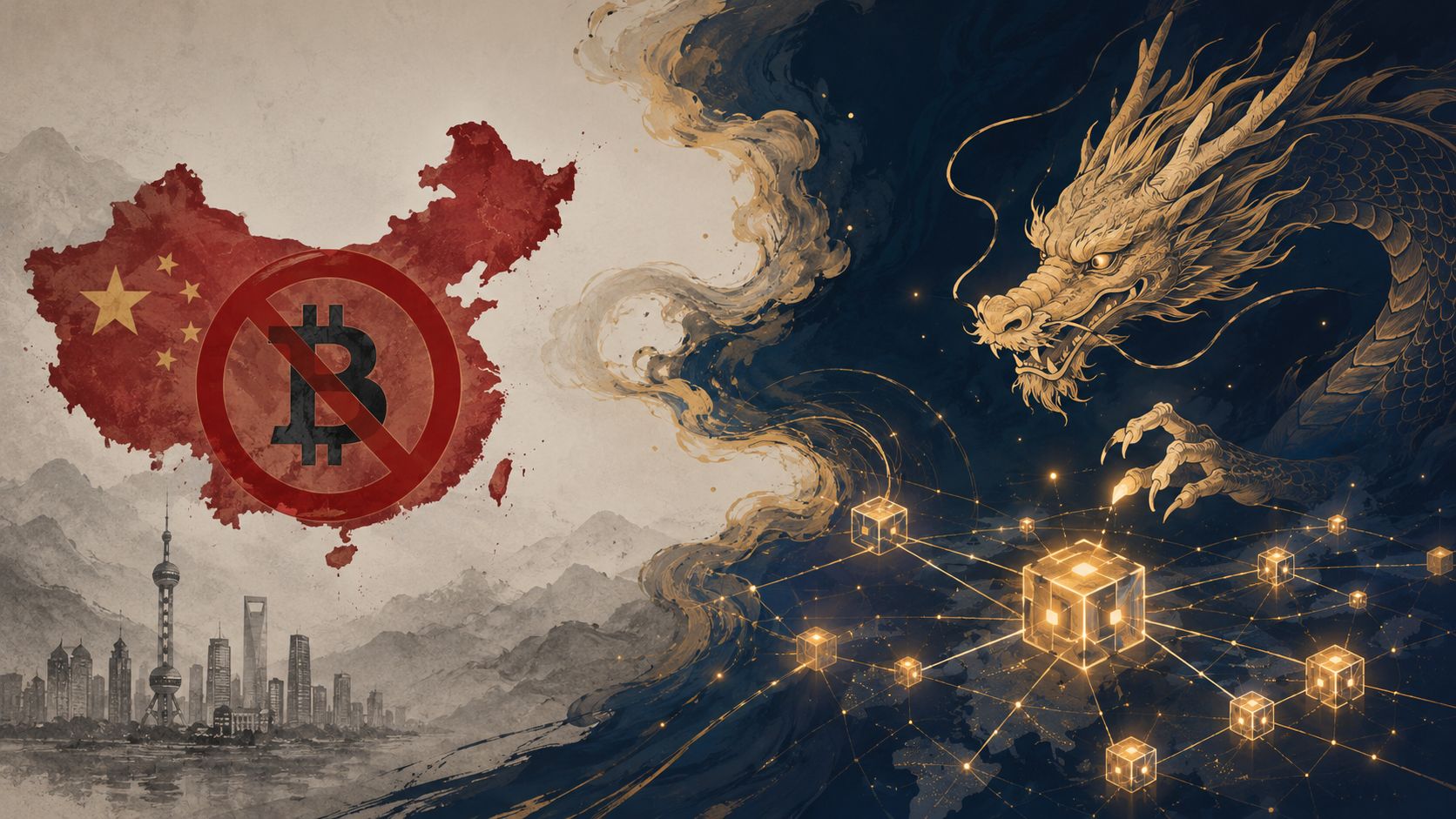
That historical weight still affects trading today. A lot of projects that traders group under Chinese crypto coins came out of that earlier era. Some were founded by Chinese teams. Some built infrastructure that fit Chinese enterprise or blockchain policy narratives. Some inherited the label because traders needed a basket to express macro views on China, Hong Kong, and regional liquidity.
The narrative survives because the market doesn't trade legal theory. It trades attention, access, and positioning.
A mainland restriction can hurt direct participation while still making offshore venues more important. A Hong Kong policy signal can revive interest in old China-linked tickers even when nothing has changed in the underlying protocol. Historical memory also matters. Traders remember which assets were previously associated with Chinese capital, founders, or user bases, and that memory becomes a reflexive trade during regional news cycles.
Practical rule: Don't dismiss the theme, and don't romanticize it. Treat it as a rotating basket driven by venue access, policy interpretation, and liquidity migration.
If you want a broader framework for how regional shocks and policy events feed into crypto rotations, this breakdown of lessons from past geopolitical events in crypto is a useful companion.
They confuse China-linked identity with China-based usability.
Those are not the same thing. A token can have Chinese roots and still trade mainly as an offshore asset with global order flow. Another can attract attention because of a Hong Kong development even though mainland users can't legally touch it in the way retail traders imagine.
That's why “Chinese crypto coins” is a valid market narrative, but a poor analytical category unless you break it down properly.
The label sounds precise, but it isn't. In practice, traders use it to describe several different kinds of assets that only partially overlap.
That matters because the wrong classification leads to the wrong trade. If you mistake a legacy founder story for an active ecosystem play, you'll overweight headlines and ignore usage. If you mistake a policy-friendly infrastructure project for a pure momentum coin, you'll miss why it reacts differently to regulation.
The cleanest way to analyze Chinese crypto coins is to sort them into three buckets.
Legacy founder projects
These are the names most traders think of first. They usually trace back to Chinese founders, early Chinese developer communities, or branding that became tied to the country during crypto's earlier cycles. Their relevance often comes from market memory as much as from current adoption.
Infrastructure projects with a China policy angle
These are the more interesting names for serious traders. They tend to map onto themes that fit broader technology priorities such as blockchain infrastructure, enterprise integration, supply chain systems, or data rails. These assets usually hold up better when the market starts asking whether there's an actual use case underneath the narrative.
Narrative-first tokens
These are the dangerous ones. They rally because traders want China exposure, not because the token has a strong product, defensible network activity, or durable exchange access. They can move fast, but they also fade fast when the headline impulse disappears.
When I'm evaluating whether a token belongs in the Chinese crypto coins basket in a way that matters, I look at four questions:
Founding and operating roots
Was the project built by a Chinese team or primarily marketed into that narrative later?
Regulatory fit
Does the project have any plausible path to relevance in jurisdictions that matter, especially Hong Kong, or is the “China angle” just branding?
Exchange reality
Can serious traders and institutions access it on credible venues, or is liquidity too fragmented to trust the move?
Ecosystem proof
Are developers, users, and capital doing anything measurable on-chain, or is this only a social media story?
A useful filter is simple: if the only bull case is “it's Chinese,” that's not a thesis. That's borrowed momentum.
What works is treating the label as a starting point for due diligence. You want projects with a visible identity, a clear technical role, and enough exchange presence that a narrative wave can translate into tradeable flow.
What doesn't work is buying every token that appears in a “top Chinese coins” list and assuming they share the same drivers. They don't. Some are infrastructure names. Some are legacy brands. Some are only grouped together because the market likes thematic baskets.
That distinction becomes even more important once you factor in the split between mainland China and Hong Kong, because that split changes who can access which asset, and why.
Most traders still read “China news” as if it refers to one unified crypto market. It doesn't.
You need to separate mainland China from Hong Kong or your read on the headline will be sloppy from the start. Mainland policy is built around control, surveillance, and state-issued digital money. Hong Kong operates as the more relevant venue for regulated private digital asset activity. If you mix those together, you'll misprice both risk and opportunity.

China's most important digital asset project is the e-CNY, not Bitcoin, not altcoins, and not a state-tolerated version of public crypto. The technical design tells you everything. Distribution requires real-name authentication and national ID numbers, and the central bank can view transaction data, which makes it distinct from permissionless networks (EUISS analysis of China's blockchain and cryptocurrency ambitions).
For traders, the takeaway is clear. Mainland China's crypto stance isn't contradictory once you stop thinking in crypto-native terms. Beijing opposes private, permissionless monetary rails while supporting a state-controlled digital fiat layer. That's why a bullish headline about the e-CNY is not a bullish headline for decentralized coins by default.
The more useful way to frame the region is this:
| Jurisdiction | What it favors | What it suppresses | Trading implication |
|---|---|---|---|
| Mainland China | State-controlled digital money and traceable payments | Private crypto trading and mining | Read headlines as control and capital channel signals |
| Hong Kong | Regulated digital asset activity and market infrastructure | Unlicensed or noncompliant access paths | Read headlines as venue and liquidity signals |
This is why the “Chinese crypto” theme still exists. The capital, founders, users, and narratives did not vanish. They were redistributed. Some activity moved offshore. Some got routed through Hong Kong. Some remained relevant only as a speculative identity trade.
Use this quick framework.
The edge isn't in reacting faster to every China headline. It's in identifying whether the headline affects legality, venue access, or only sentiment.
The deeper policy issue is that a token can be called Chinese while still being irrelevant to mainland users in any practical sense. That access gap is the core thesis risk, and the Council on Foreign Relations discussion of why China spooked dollar stablecoins and how it will respond is useful for understanding that split at a structural level.
A market roundup from Binance grouped together NEO, VeChain (VET), Conflux (CFX), Huobi Token (HT), Filecoin (FIL), Ontology (ONT), NeoGas (GAS), Zilliqa (ZIL), Theta (THETA), and Nervos Network (CKB), along with quoted market prices at the time that underline how broad this category is (Binance roundup of top Chinese cryptocurrencies). That same roundup is the clearest reminder that Chinese crypto coins are not one sector. They span smart contracts, supply chain, storage, identity, streaming, and public infrastructure.
For trading purposes, I'd keep the focus on the names where the China angle is both recognizable and still relevant to positioning.
| Project (Ticker) | Primary Use Case | China Angle | Consensus Mechanism |
|---|---|---|---|
| NEO | Smart contracts and digital asset infrastructure | One of the most recognized legacy China-linked smart contract brands | Project-specific consensus design |
| VeChain (VET) | Supply chain and enterprise data tracking | Often grouped into the China narrative because of its enterprise and infrastructure positioning | Project-specific consensus design |
| Conflux (CFX) | Public blockchain infrastructure | Frequently viewed as one of the stronger pure “China narrative” infrastructure plays | Project-specific consensus design |
| Filecoin (FIL) | Decentralized storage | Included in China-linked market baskets despite having a broader global use case | Project-specific consensus design |
| Ontology (ONT) | Identity and data-related infrastructure | Fits the older China-linked infrastructure category | Project-specific consensus design |
NEO still matters because markets remember it. It became one of the strongest early examples of a China-linked smart contract platform, and that legacy means it can attract narrative rotation when traders want exposure to older regional brands.
The problem is that legacy recognition isn't enough on its own. For NEO, the trade only gets interesting when the narrative lines up with actual exchange liquidity and a visible pickup in ecosystem attention. Without that, it often behaves more like a historical ticker than a current operating ecosystem.
VeChain sits in a different lane. Traders usually place it in the Chinese crypto coins basket because it aligns with a more enterprise-facing blockchain story, especially around supply chain use cases.
That gives it a more grounded profile than a pure momentum narrative token. But there's a trade-off. Enterprise-facing stories often move slower than speculative narratives. They can be easier to justify on solid grounds, but they don't always react with the same speed when regional headlines hit.
If you want a ticker that more directly reflects the China narrative, Conflux is one of the cleaner examples. It's easier for the market to map CFX onto a thesis about China-linked public blockchain infrastructure.
That clarity is useful. Traders don't need to guess what role the token is supposed to play. The risk, though, is that clear narrative mapping also turns it into a favorite for crowded trades. When everyone reaches for the same “obvious” China proxy, the move can overshoot and then reverse hard.
Trading lens: The best narrative proxies are usually the easiest to enter and the hardest to hold once the crowd arrives.
Filecoin shows why the category can get messy. It appears in China-linked token lists, but its use case is much broader than the regional label suggests.
That doesn't make the association useless. It just means you shouldn't assume FIL reacts for the same reasons as NEO or CFX. Sometimes it trades as part of the China basket. Other times it trades as a storage and infrastructure asset with a global narrative. If you don't separate those drivers, you'll assign the wrong catalyst.
When comparing notable Chinese crypto coins, rank them on these dimensions:
Narrative purity
How directly does the market associate the token with the China trade?
Use-case clarity
Can you explain the protocol in one sentence without resorting to branding?
Venue access
Is there enough exchange support and liquidity to trust the signal?
On-chain confirmability
Can you verify accumulation, activity, or distribution through data rather than social chatter?
That last one matters most. A China-linked token with weak on-chain evidence is usually just a story waiting to unwind.
Traders lose money in this niche when they react to headlines without checking whether capital is moving. The better approach is to treat policy and narrative as triggers, then confirm with wallet behavior, exchange flow, and ecosystem activity.
China-related policy signals have shown direct effects on market liquidity before. Rhodium Group reported that when Chinese exchanges faced withdrawal suspensions and regulatory inspections, local Bitcoin trading volumes dropped sharply. After suspensions were lifted, daily yuan trading volume rebounded to more than 75% above March to April levels, and Bitcoin later reached an all-time high RMB price near 20,000 yuan in late June (Rhodium Group's analysis of cryptocurrency in China). That's the template serious traders should remember. Regulation changes flow. Flow changes price behavior.

I'd break it into five layers.
Wallet concentration
Watch whether profitable wallets are accumulating a China-linked token before the headline gets broad attention. Quiet concentration often matters more than visible retail excitement.
Exchange routing
Track whether the asset is moving toward venues that matter for Asia-driven liquidity. A token can trend on social media and still fail because the tradable flow never shows up on the right exchanges.
Active address behavior
Rising address activity helps separate a living network from a dead narrative. It's not enough by itself, but it's a useful filter.
Perpetual and spot alignment
If derivatives run far ahead of spot, you may be looking at a reflexive momentum burst rather than durable demand.
Social spillover from regional platforms
Weibo and similar channels can help identify when a topic is shifting from niche to mainstream discussion. Use them as early context, not as a trade trigger.
When a new China or Hong Kong headline lands, use a short checklist instead of chasing candles.
Identify the jurisdiction
Mainland and Hong Kong headlines don't carry the same implications.
Map the directly exposed tokens
Don't trade the entire basket if only one subgroup is logically affected.
Check wallet accumulation
If smart money isn't moving, the headline may be noise.
Check exchange availability and spreads
If liquidity is thin, even the right thesis can become a bad trade.
Wait for confirmation
The first move is often narrative repricing. The better move is the one that survives once order flow confirms it.
Most bad China narrative trades are entered on the headline and exited on the data. Flip that order.
If you want to build a repeatable workflow for this, use an on-chain process that starts with wallet and token behavior rather than social media. A practical place to start is this guide on how to check on-chain signals before taking a trade.
Three things usually fail in this theme:
The traders who do best here are usually the ones who wait for the narrative to show up in wallets, exchange flow, and persistent market behavior.
If you want to trade Chinese crypto coins with discipline, the workflow should start with wallets, not watchlists. The useful question isn't “which China-linked token is trending?” It's “which profitable wallets are building exposure before the trend becomes obvious?”

A tool built for that process is Wallet Finder.ai. The platform is designed to surface profitable wallets, token-specific trading activity, and complete trading histories so you can evaluate whether a move is backed by experienced operators or just noise.
Start in the token discovery view and search for the names you care about, such as CFX, VET, or NEO. Don't stop at price action. Pull up the wallets that have traded the token profitably and sort for consistency rather than one lucky trade.
Then inspect individual wallets more closely. Look for three things:
Entry quality
Did the wallet accumulate before the token became crowded?
Holding behavior
Does the wallet scale in patiently, or is it flipping on short narrative bursts?
Cross-token pattern
Is the wallet also trading related infrastructure or regional narrative names, suggesting an intentional basket thesis?
That last point is underrated. A wallet that buys one China-linked token might be taking a random swing. A wallet that rotates through a cluster of related names with good timing is giving you a stronger read on the underlying theme.
After you identify a wallet worth tracking, review its history in full. You want to understand whether its wins came from early entries, disciplined exits, or repeated success in a specific sector. If the wallet's edge is obvious, the next step is setting alerts rather than manually checking for changes.
Use real-time notifications to catch buys, swaps, and exits as they happen. That turns a passive research process into an active monitoring system.
For a quick walkthrough of the platform in action, this video is worth watching.
This approach helps you avoid the two classic errors in the China narrative trade. First, it stops you from buying a token just because it has the right story. Second, it helps you distinguish between random rotation and coordinated accumulation by wallets that have a track record of timing sectors well.
Follow the wallets that act before the narrative peaks, not the crowd that discovers it after the move is obvious.
That's a much better way to trade this niche than relying on recycled token lists or headline-only conviction.
The China narrative pays traders who stay specific. It punishes anyone trading labels.
The edge is not "China coin" branding by itself. The edge comes from reading the split correctly. Mainland China still drives headlines, policy fear, and sentiment shocks. Hong Kong matters more for venue access, licensing optics, and the parts of the market that can attract capital without hiding what they are. That difference changes how I rank setups.
A practical filter helps. Start with whether a token has real links to Chinese founders, users, infrastructure, or exchange flow. Then check whether liquidity is strong enough to support size and whether the wallet activity shows deliberate accumulation instead of retail chasing. If those pieces do not line up, the narrative is weak no matter how good the social posts look.
Good trades in this theme usually show up before the story gets crowded. You will often see positioning in related names, rotation through a small cluster of tokens, or repeat entries from wallets that have traded policy-driven moves well before. By the time broad crypto Twitter turns the move into a "China season" call, the clean entry is often gone.
Treat this category like a flow trade, not a belief system. Track the wallets, respect the regulatory split, and wait for confirmation from price, liquidity, and positioning. That approach will keep you out of low-quality narrative traps and put you in better spots when the market starts pricing the theme seriously.