Coin Market Cap ADA Explained for Traders
Decode the Coin Market Cap ADA page. Learn what ADA's market cap means, how to read the data, and combine it with on-chain wallet tracking for smarter trades.

April 22, 2026
Wallet Finder

April 22, 2026

You open CoinMarketCap, type in ADA, and see a market cap in the billions. The number looks important. It is important. But if you're trying to trade, that single figure rarely answers the actual question.
The main question is usually this: what is the market doing around ADA right now, and who is driving it?
That’s where many traders stall. They can read the public dashboard, but they can’t turn public data into a usable edge. They see price, rank, supply, and volume. They still don’t know whether ADA is attracting conviction, drifting on momentum, or sitting at a level where larger players might be active.
A strong coin market cap ada workflow starts with the basics, then moves into interpretation. Public market data gives you the broad map. On-chain analysis helps you look for footprints inside that map.
Open ADA on CoinMarketCap and the first figure pulling your eye is usually market cap. That is normal. It is the headline number, the one that signals size, rank, and broad market relevance in a single glance.
For traders, though, market cap works more like a map than a trade trigger. It shows the territory. It does not show which wallets are entering, which holders are selling into strength, or whether a price move is being pushed by broad participation or a few large players.
That is the key distinction with coin market cap ada analysis. Market cap is a valuation snapshot built from price and circulating supply. Useful, yes. Actionable on its own, rarely.
ADA has gone through strong expansions and painful reversals before. A large market cap can make an asset look stable, even when positioning underneath that number is changing fast. That is why experienced traders treat CoinMarketCap as the starting screen, then look deeper for order flow clues and wallet behavior.
A simple analogy helps. Market cap is the size of the stadium. It does not tell you who just walked onto the field, who is heading for the exit, or which side controls the pace of the game.
Market cap is useful for framing the bigger picture:
Short-term decisions need more than a large headline figure:
That gap is where many traders lose their edge. They stop at public data. Smarter operators use public data as the first layer, then confirm it with on-chain tools that track wallet behavior. Wallet Finder.ai is useful here because it helps connect the broad CoinMarketCap picture with the addresses that may be driving the move.
If you want a cleaner framework for how price and supply combine into valuation, this guide on how to calculate coin value gives the math in plain English without turning it into theory for theory's sake.
A trader pulls up ADA on CoinMarketCap, sees the price ticking, notices the market cap, and assumes the job is done. It is not. The useful read starts when you connect those surface numbers to the mechanics underneath them, then ask which wallets may be acting on that setup before the crowd does.
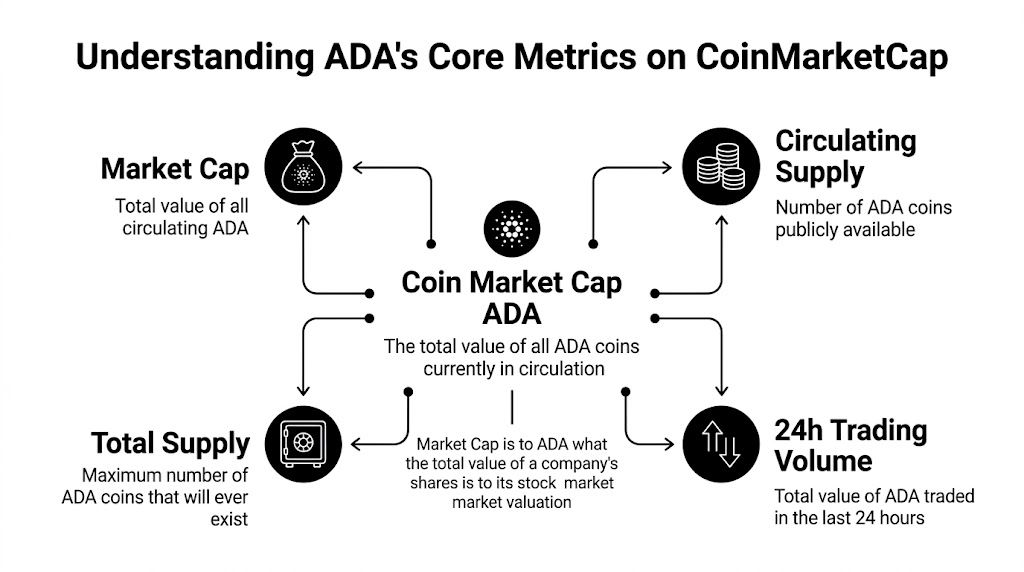
CoinMarketCap gives you the public scoreboard for ADA. Price shows where the token changes hands right now. Supply figures show how many units the market is valuing. Volume shows how active that market has been. Together, those numbers form the base layer of analysis.
The mistake many traders make is stopping at the headline.
For ADA, supply context matters more than it does for many newer tokens because Cardano has a known maximum supply. That gives you a cleaner way to judge valuation pressure. If price rises while the supply picture stays stable, the move is mostly demand-driven. If traders start discussing valuation without checking supply, they are reading only half the page.
Start with four fields on the ADA page:
That order matters. Price gets attention, but market cap tells you how much value the market is assigning to the circulating ADA base. Circulating supply tells you what that valuation is built on. Volume helps you judge whether the move has real participation behind it or is drifting on thin activity.
A simple analogy helps here. Price is the price tag on one unit. Market cap is the price of the whole shelf that is already available for sale. Volume shows how much of that shelf traders touched today.
These metrics are not just labels. They shape trade selection.
If ADA is rising but volume is weak, the move may lack conviction. If ADA is flat while volume expands, larger positioning may be building under the surface. If market cap holds steady relative to peers while wallet activity shifts on-chain, that is often where the more interesting signal appears.
That is the jump from public data to smart-money tracking.
CoinMarketCap helps you identify the setup. On-chain tools such as Wallet Finder.ai help you test whether large wallets are accumulating, distributing, or rotating between addresses. Public metrics show the stage. Wallet behavior shows who may be directing the play.
Use this quick filter before you make any judgment:
That process keeps you from treating CoinMarketCap like a definitions page. For traders, it works better as a screening tool. Once the screen identifies an unusual shift in ADA, the next question is the one public dashboards cannot answer on their own: which wallets are behind it?
You open the ADA page after a sharp price move. At first glance, the screen looks clear enough. Green candles, a large valuation, active trading. Then the harder question shows up. Is this broad market interest, or a move driven by a smaller set of aggressive participants?
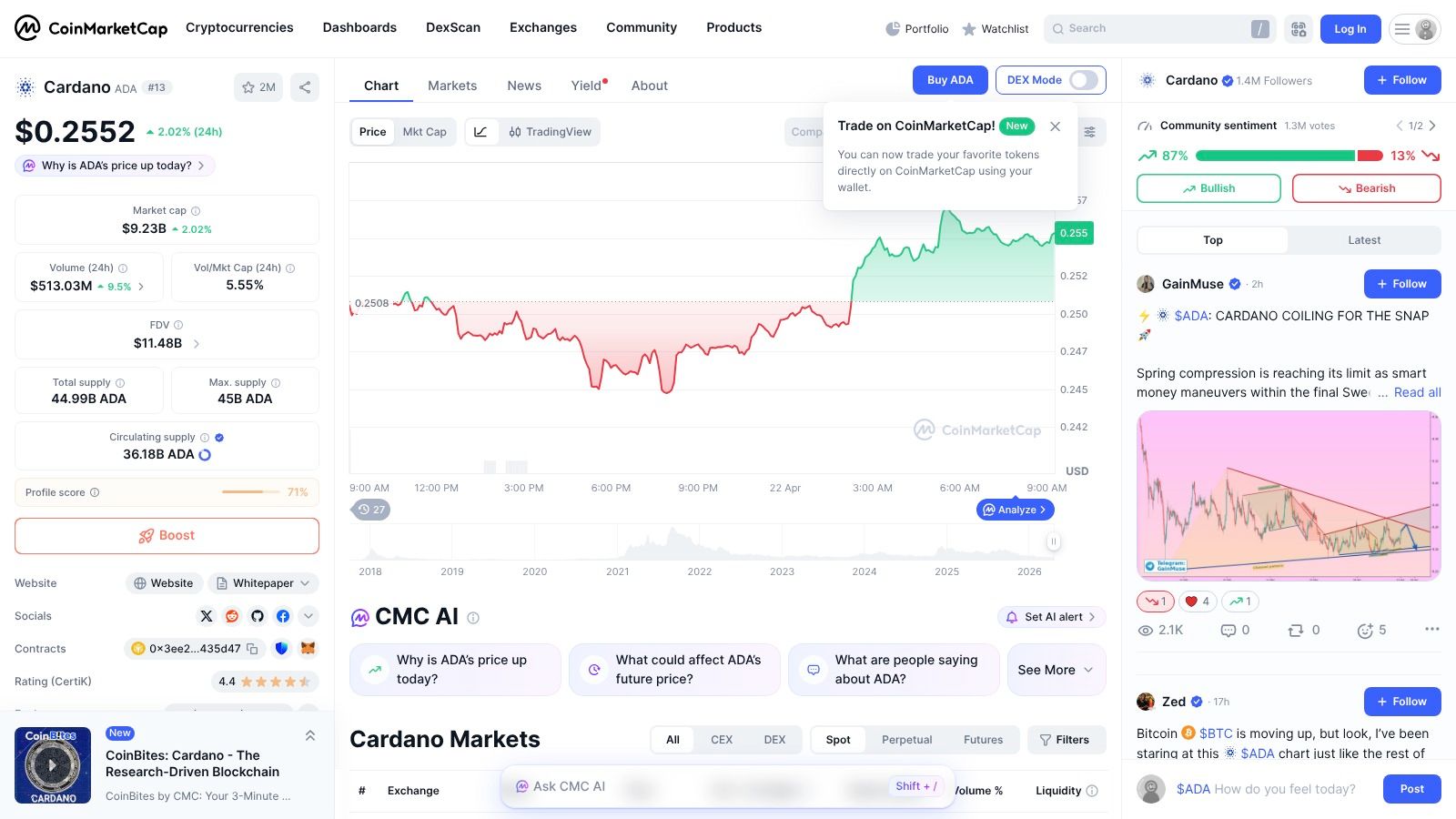
That is why the ADA page matters. CoinMarketCap gives the public scoreboard. Traders still need to read the pace of the game.
The most useful fields here are not the ones that define ADA. They are the ones that show whether current trading activity supports the move you are seeing.
| Metric | Why It Matters | What to Watch For |
|---|---|---|
| 24h Trading Volume | Shows how much capital actually changed hands in the last day | A price move with rising volume usually carries more conviction than a move on thin activity |
| Volume / Market Cap | Compares current trading activity with ADA’s overall size | A higher ratio can signal unusual participation, while a lower ratio can point to a quieter session |
| Total Supply | Adds long-range supply context beyond the tokens already circulating | Useful when traders want to frame valuation discussions more carefully |
| Rank | Places ADA against the rest of the crypto market | Helps you judge whether ADA is holding leadership status or slipping relative to peers |
A simple analogy helps here. Price is the headline. Volume is the crowd size. The volume-to-market-cap ratio is crowd size relative to the stadium.
That distinction matters because large assets can still have dull sessions, and smaller moves can matter a lot when participation expands fast.
Start with the daily move, but do not stop there. A 4 percent rise means one thing if volume is average and something very different if volume suddenly expands.
Next, check the volume-to-market-cap ratio. This is one of the fastest ways to judge whether ADA is being actively repriced or drifting with the broader market. If the ratio pushes higher during a breakout, the move has more evidence behind it. If price climbs while the ratio stays muted, caution is reasonable.
Then look at rank and total supply. Rank gives market context. Total supply helps you avoid reading valuation in a vacuum, especially when comparing ADA with other large-cap assets that have very different issuance structures.
CoinMarketCap can show that activity is increasing. It cannot show who is driving it.
That is the gap advanced traders try to close. If ADA volume spikes and the ratio strengthens, the next step is to check whether large wallets are accumulating, distributing, or rotating. Tools such as Wallet Finder.ai help separate broad retail noise from concentrated wallet behavior. Public metrics identify the unusual day. On-chain wallet tracking helps explain the source of that pressure.
Use this order when ADA starts moving:
A trader who stops at price sees movement. A trader who adds volume context sees conviction. A trader who checks wallet flows after that has a much better shot at spotting smart-money intent before the crowd catches up.
You pull up ADA on CoinMarketCap, then check a second tracker, and the market cap is different. Newer traders often treat that as a red flag. Experienced traders treat it as a prompt to inspect the inputs.
Market cap is a live calculation, not a fixed label. If price updates at one speed, circulating supply is counted with slightly different rules, or exchanges are weighted differently, the final number can drift from platform to platform. The gap is often small, but during fast moves it can look larger than it really is.
A CoinMarketCap number sits on top of several moving parts:
A simple analogy helps here. Two weather apps can show slightly different temperatures because they pull from different stations at different times. Crypto dashboards work in a similar way. The asset is the same. The measurement process is not identical.
Market cap is better used as a range and a relative measure than as a number to the last decimal. If ADA looks meaningfully larger or smaller across platforms, the useful question is what changed in the calculation, not which homepage looks more polished.
A large market cap can tell you ADA is widely followed and heavily traded. It does not tell you whether buyers are stepping in now, whether sellers are distributing into strength, or whether the current move has support from larger participants.
That distinction matters.
CoinMarketCap shows the public scoreboard. On-chain tools help you inspect who is moving the ball. If ADA holds its valuation while price chops sideways, wallet tracking can reveal whether larger addresses are accumulating or whether the market is just drifting on retail activity. Traders who want a stronger framework usually pair public metrics with chart-reading methods that separate structure from noise.
Professional traders compare sources, then verify the story with behavior. If ADA’s market cap looks stable but exchange inflows rise or large wallets begin trimming exposure, the cleaner signal may come from on-chain activity rather than the headline number itself.
When two dashboards disagree, check the calculation first. Then check whether wallet flows support the same conclusion.
That habit turns a common data annoyance into an edge. Instead of asking which number is “correct,” ask which mix of price, supply method, and wallet behavior best explains what ADA is doing right now.
The ADA chart on CoinMarketCap is where raw numbers start turning into market structure. If the metrics page gives you valuation context, the chart gives you behavior.

Most traders make one of two mistakes. They either zoom too far in and lose historical context, or they zoom too far out and miss the levels that matter now.
A better approach is to toggle between broader history and current structure. Use the chart to locate the major turning points first, then narrow your view to current price action. If you want a deeper framework for chart reading, this guide on how to read crypto charts is a useful companion.
Verified technical data points to several levels traders keep revisiting. ADA’s 1D RSI is around 46.17, which reflects a neutral reading, while the broader weekly chart remains under bearish control in the referenced technical view. The same data notes that reclaiming $1.50 could signal a structural shift, while losing the monthly pivot around $1.10 to $1.30 could risk a deeper move, according to ADA technicals on TradingView.
That gives you a useful lens for the CMC chart. You're not just drawing random lines. You're watching historically important zones where price structure may change.
Use this checklist:
A short visual explainer can help if you prefer seeing chart concepts in motion:
The chart won't tell you who bought first. It will tell you where the battle is taking place.
You open ADA on CoinMarketCap after a sharp bounce. Price is up, volume is active, and the market cap looks healthier than it did a few days ago. The public dashboard gives you the scoreboard. A serious trader still needs the play-by-play.
CoinMarketCap is strong at showing the visible result of market activity. You can track market cap, volume, rank, and chart structure in one place. What you cannot see on a standard market page is which wallets started building positions before the move became obvious to everyone else.

That distinction matters.
A market cap reading is like seeing the final box score after a game. Useful, but incomplete. On-chain wallet analysis adds the tape study. It helps you examine who was active, whether buying came from scattered retail flows or concentrated larger holders, and whether the behavior looks deliberate or reactive.
CoinMarketCap’s Cardano page can show broad context around ADA, including the main pricing and market data traders monitor every day. To turn that into a trading signal, you need a second layer of evidence.
A stronger workflow combines both sides of the market:
That last question separates observation from analysis.
For ADA, this matters because a bounce on a public chart can come from short covering, temporary speculation, or real accumulation. Those are very different setups. The candle may look the same at first. The wallet behavior underneath it often does not.
Using Wallet Finder.ai alongside CMC gives you a cleaner way to study that second layer. If you want to build that habit, start with this guide on how to check on-chain wallet activity and transaction flows.
The practical takeaway is simple. Use CoinMarketCap to identify where attention is forming. Use on-chain tracking to judge whether informed participants are entering before the crowd fully reacts.
That is the pro move.
A disciplined ADA copy-trading process starts with context, then moves to confirmation.
Start with the chart. If ADA is drifting in the middle of nowhere, wallet activity matters less because there is no clear decision point. The higher-quality setups appear when price reaches an area that has already acted like a floor or ceiling on CoinMarketCap. That level is your map.
Then shift to on-chain behavior. Wallet tracking works like reading the order flow behind the candle. A price bounce can look strong on a public chart, but the wallets involved tell you whether the move came from experienced buyers building a position or from short-term traders reacting late.
Open ADA on CoinMarketCap and mark the nearest support or resistance zone that has obvious chart memory. You want a level where traders have reacted before, not a random point picked after the fact.
Next, check whether participation is increasing around that area. Rising activity matters because a level only becomes tradeable when enough market participants care about it.
Once you have the level, search for wallets with a real history of trading ADA well. Focus on wallets that show repeatable behavior, such as entering near inflection points, scaling rather than aping into one price, and avoiding frantic in-and-out churn.
Wallet Finder.ai is useful here because it lets you study behavior, not just balances. A large wallet alone is not a signal. A wallet with size, timing, and a consistent record is far more informative.
The setup gets stronger when wallet accumulation begins while ADA is testing a chart level that already matters.
As noted earlier, analysts have pointed to periods where ADA rebounds aligned with heavier whale interest near key support. You do not need to treat that as a prediction model. Use it as a framework. If public price structure and informed wallet behavior point in the same direction, the trade has more logic behind it.
That gives you a cleaner copy-trading question: not whether someone bought ADA, but whether skilled wallets bought ADA at a location where the risk and reward were already favorable.
Risk control still decides the result. Copy-trading is not outsourcing judgment. It is using public market structure from CMC and private-looking behavioral clues from on-chain data to make a better informed ADA trade.
Because market cap moves with price, and ADA has a history of sharp repricing. Supply matters too, but price changes usually drive the faster swings traders notice.
You can use it for valuation context, liquidity checks, rank, and chart structure. You shouldn't rely on it alone if your goal is timing. Public data shows broad conditions, not the wallet behavior behind many moves.
Market cap values the circulating token supply. TVL refers to assets deposited in DeFi protocols. They measure different things. Market cap tracks token valuation. TVL tracks capital committed inside protocols.
Platforms can use different prices, update schedules, and supply calculations. Small input differences can produce visibly different market cap figures.
Start with market cap for scale. Add volume for participation. Use the chart for structure. Then use on-chain data to look for wallet activity near the levels that matter most.
If you want to move beyond public dashboards and study the wallets behind market moves, Wallet Finder.ai helps you track profitable on-chain behavior, inspect trade histories, and follow smart money activity in real time. For traders who already understand the basics of coin market cap ada, that extra layer can turn observation into action.