The Orion Protocol: A Guide to Aggregated Trading
Discover how the orion protocol aggregates liquidity across major exchanges and boosts trading efficiency.

January 7, 2026
Wallet Finder

January 6, 2026

Think back to the simple, physical tokens you might've used for a parking meter or a laundromat. Each one bought you access to a specific service, right? Now, imagine that same concept, but supercharged for the digital age.
We're going to use the coin meter token as a powerful analogy to really get a handle on what utility-focused assets in DeFi are all about.
The idea of a token granting access is nothing new. In fact, its roots go way back, decades before anyone even dreamed up a blockchain. Understanding this history gives you a surprisingly solid framework for seeing the real value in modern digital assets.
Those early tokens were dead simple, single-purpose tools. A metal disc for a parking meter or a plastic coin for a washing machine did the exact same thing: they represented pre-paid access to a service. This core concept—a token for a utility—is the direct ancestor of countless cryptocurrencies you see being traded today. The only real difference is the tech that powers them.
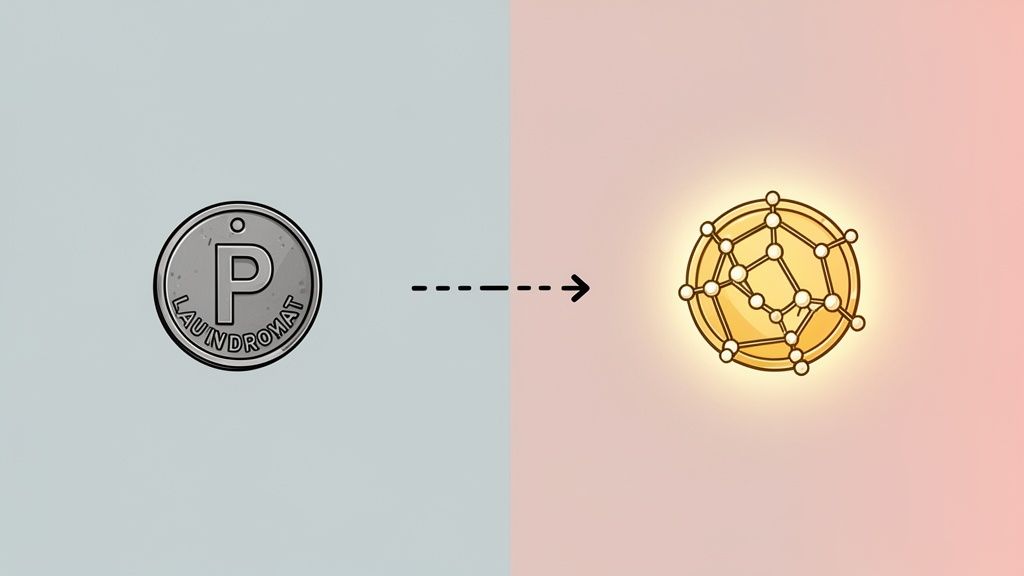
Back in the mid-20th century, physical coin meter tokens were a small but revolutionary part of urban life. The iconic U.S. parking meter tokens first appeared in the 1930s, and by 1950, over 1.5 million meters were installed, pulling in revenue equal to about $1.2 billion today.
That little token economy has an echo in today's DeFi world. We've just swapped metal for on-chain tokens like stablecoins, which recently hit an insane $4 trillion in volume—that's up 83% year-over-year. You can read more about the growth of stablecoin usage to see just how fast things are moving.
Just like you could "read the meter" to see how much it was used, today's on-chain analysis lets traders see exactly which digital tokens are getting real traction.
This guide will show you how to:
This article bridges the gap between a simple, old-school concept and the modern, actionable trading strategies you need today. By the end, you'll be able to turn complex on-chain data into your own unique trading edge.
We're going to start with the basics, moving from fundamental checks to advanced techniques for mirroring the moves of top traders. Get ready to shift your approach from pure speculation to sharp, data-driven decision-making.
"Coin meter token" isn't a term you'll see listed on major exchanges, but it’s a killer mental model for understanding a specific kind of digital asset. Think of it as a quick way to describe any token built with a clear, measurable job to do beyond just pure speculation.
Unlike a memecoin that rides on pure hype or a governance token that gives you voting rights, a coin meter token is a workhorse. Its main job is to unlock access, measure usage, or act as the gasoline for a decentralized application (dApp). This means its value is directly linked to how useful it is inside its own little economy.
Under the hood, every one of these tokens runs on a smart contract. This isn't some dusty legal document; it’s a piece of code that lives on the blockchain and executes itself automatically. This code lays down the law for the token—how many can ever exist, what you can do with it, and how it moves from one wallet to another.
These on-chain mechanics are what give the token its real function. For example, a token might be the only way to pay for transaction fees on a certain network, unlock special features in a DeFi protocol, or serve as the in-game currency for a blockchain game. The smart contract is the blueprint for the token's entire life. If you want to dive deeper into vetting these functions, our guide on how to identify DeFi tokens is a great place to start.
A token's utility is its purpose. A token without a clear, functional purpose is like a car key without a car—it might look interesting, but it doesn't actually do anything. On-chain analysis lets you check if the key truly fits a working engine.
This idea of using tokens for access actually has some pretty cool historical roots. Think about the rise of coin-operated laundromats from the 1940s to the 1970s, which created a massive, local token economy. By 1960, more than 30,000 laundromats in the U.S. were issuing tens of millions of their own unique tokens every year.
Fast forward to today, and you see the same concept playing out on a global scale. The number of crypto users has skyrocketed to 861 million, and stablecoin volume alone has hit $4 trillion just this year. The principle is the same—a token for a specific machine—but the scale and technology have changed dramatically.
The table below breaks down the shift from a physical, localized token to a global, transparent digital one. While the core idea of "a token for a service" remains, the underlying technology couldn't be more different.
This evolution from a simple metal disc to a cryptographically secure asset on a global ledger highlights the power of blockchain. The core utility is familiar, but the trust, transparency, and accessibility are on a completely different level.
In DeFi, you don't have to trust—you can verify. The blockchain itself gives you all the evidence you need to tell if a project is the real deal or just smoke and mirrors. Before you even think about investing, doing your on-chain homework is non-negotiable. This is how you move past the social media hype and start using the same verification toolkit the pros rely on.
First things first, you need to know what kind of token you're actually looking at. Not every token is created equal, and its core function completely changes how you should analyze its potential. This framework breaks down the common token types by what they're built to do.

As you can see, tokens are usually designed for one of three things: granting access, driving community hype, or giving holders control over the project's future. Figuring out which bucket a coin meter token fits into is your starting point for a real on-chain investigation.
The absolute most important on-chain check you can do is to confirm the smart contract is verified. An unverified contract is a massive, flashing red flag. It means the code is a black box, and you have no idea what it's programmed to do.
Actionable Checklist: Contract Verification
mint(), pause(), or blacklist() which could give developers malicious control.A verified contract lets you scan for nasty surprises. Malicious functions—like the power to freeze trading, blacklist wallets, or mint an infinite number of new tokens—are hallmarks of scam projects. If you can't see the code, you have to assume the worst.
Next up: who actually owns the token? A healthy project will have its tokens spread out across a wide base of holders. This is crucial because it means no single person or group has enough power to crash the price by dumping their entire bag on the market.
Block explorers have a "Holders" tab that breaks this down for you, listing every wallet and the percentage of the total supply it owns. Keep an eye out for these warning signs:
Digging into these distribution patterns is a core part of what experts call crypto on-chain analysis. It gives you a clear, data-backed picture of the risks baked into the token's supply.
The classic "rug pull"—where developers drain every last cent of value from a project—is only possible if they control the liquidity pool (LP). A legitimate team will lock their LP tokens in a separate smart contract for a fixed amount of time, proving to everyone that they can't just run away with the money.
You can check for a liquidity lock using a dedicated platform that scans the blockchain for this data. A lock lasting at least six months to a year shows a real commitment from the team. If there's no lock, or a very short one, consider it a critical warning. This one step is your best defense against the most common scam in DeFi.
A technically perfect smart contract and a locked liquidity pool are great, but they don't guarantee a token will actually go anywhere. A project also needs real market momentum—that mix of social hype and financial energy that pushes a token from a "good idea" into a profitable trade. Learning to spot this momentum is how you connect the dots between on-chain safety and real-world viability.
Think of it this way: on-chain analysis is like popping the hood of a car. You're checking to make sure the engine is sound and won't fall apart. Market momentum analysis, on the other hand, is checking the fuel gauge and listening to the crowd of people trying to buy it. You need both before you get behind the wheel.
To really get a feel for the market's pulse on a coin meter token, you have to look past the price chart. When you combine a few key metrics, a much clearer picture of a token's health and potential starts to emerge.
Just as crucial as spotting the green flags is learning to recognize the warning signs that pop up right before a token's price nosedives. Ignoring these is probably the fastest way to get wrecked in DeFi.
Vending machine tokens from the 1920s give us a baseline for scalable token ecosystems, a concept now magnified by blockchain. The crypto market recently surpassed $4 trillion, with Bitcoin claiming $2 trillion and stablecoins exceeding a $300 billion supply—a 16% jump after regulatory approvals. This explosive growth underscores the importance of tracking smart money on platforms like Wallet Finder.ai, especially as the APAC region's crypto market grew 69% YoY to $2.36 trillion. You can read the full research on crypto sector growth for more details.
Tread very carefully if you see any of these signs:
Okay, so we've established what the Coin Meter token is and checked its vital signs on-chain and off-chain. Now for the fun part: seeing what the sharpest traders are actually doing about it. This is where we move from theory to action, and it's how you can gain a real edge.

The image above gives you a peek into Wallet Finder.ai. It's designed to cut through the noise of the blockchain and show you exactly who's buying, who's selling, and when. Seeing these moves in real-time transforms raw transaction data from a confusing mess into a clear trading signal.
First things first, you need to find the "smart money." This isn't about picking random wallets and hoping for the best. It’s about methodically identifying traders who consistently crush the market. The Discover Wallets feature on Wallet Finder.ai is built for exactly this. It lets you filter wallets by performance metrics that actually prove they know what they're doing.
This turns on-chain analysis from a blind search into a targeted hunt. You can sort and filter by things like:
For example, you could set a filter for wallets that have pulled in over $100,000 in profit in the last 30 days with a win rate higher than 75%. Just like that, you’ve filtered out 99% of the noise and are left with a curated list of elite traders.
Once you’ve found a few wallets that look promising, you don’t want to lose track of them. The next step is to bundle them into a custom watchlist. Think of this as creating your own private trading group where you get to look over the shoulders of proven pros. A watchlist pulls all their activity into one clean, real-time feed.
This is worlds better than trying to track wallets one-by-one on a block explorer. You’ll never miss a key move again. Inside your watchlist, every single buy, sell, and token swap they make appears as it happens. This gives you a front-row seat to their strategy, whether they're trading a coin meter token or jumping on the next big narrative.
Your watchlist is basically an intelligence briefing. You're not just seeing what they trade, but when they trade it. In DeFi, that timing is often the only thing separating a monster gain from a painful loss.
In a market that moves at the speed of light, information from an hour ago might as well be from last year. This is why getting instant alerts is non-negotiable. It’s what turns your passive watchlist into an active trading weapon.
You can set up alerts to ping you the second a wallet on your list makes a move.
Here are a few killer alert setups:
This setup puts you in a position to mirror their trades almost instantly, acting on the same information they have. It effectively closes the gap between you and the full-time pros, giving you a chance to catch momentum before the rest of the market even knows what's happening.
We’ve covered a lot of ground, starting with a simple coin meter and ending with a professional-grade trading workflow. If there’s one thing to take away, it's that real, sustainable success in DeFi trading is a blend of three key things: solid on-chain research, sharp market analysis, and the right tools for the job.
By bringing these skills together, you can finally step off the hype rollercoaster. You learn how to actually verify a token's legitimacy, size up its market momentum, and then—crucially—confirm your instincts by watching what the top traders are doing. This is the difference between a wild guess and a calculated risk.
Platforms like Wallet Finder.ai give you a serious advantage. They provide a clear window into what the most profitable wallets are buying and selling in real-time. This isn’t just random data; it’s actionable intelligence that closes the gap between your research and your final decision to trade.
Now, it’s your turn to put this into practice. It's time to stop chasing pumps and start building a strategy backed by on-chain evidence and the moves of proven winners.
Diving into the world of token analysis and smart money tracking always brings up a few questions. Let's tackle some of the most common ones to help you sharpen your trading strategy and make better sense of on-chain data. Getting these concepts down is what separates the real opportunities from all the market noise.
So, how do you know if you're tracking a genuinely skilled trader or just someone who got lucky on a single memecoin pump? The answer, in one word, is consistency. A truly smart wallet shows a repeatable strategy that works over time, not just one lottery-ticket win.
Look for these dead giveaways of real skill:
A single massive win is just an outlier. A clear pattern of profitable trades? That's a signal worth paying attention to.
When it comes to mirroring trades for a new coin meter token, what are the real dangers? Following smart money can be an incredibly powerful edge, but it’s definitely not a risk-free game. The biggest risk is slippage, especially on tokens with low liquidity. This means you could end up paying a much higher price than the trader you're copying.
Another huge one is getting front-run by bots that spot your transaction in the mempool and jump in ahead of you.
The golden rule here is simple: never invest more than you are truly willing to lose. Even if you're following the best wallet in the world, you have to do your own on-chain homework. Their risk tolerance is not your risk tolerance.
Is it actually possible for tools like Wallet Finder.ai to help you get into tokens before they hit the mainstream? Yes, absolutely. This is precisely what the platform is built for. The secret is to focus on early smart money movements.
Instead of waiting for a token to pop up on crypto Twitter or big news sites, you can use filters to find brand-new token pairs that are quietly attracting capital from proven, profitable wallets. By setting up real-time alerts for these specific wallets, you get a notification the second they make their first move. This gives you a massive head start on the rest of the market.
Ready to stop guessing and start making data-driven moves? Wallet Finder.ai gives you the toolkit to find top-performing wallets, get real-time alerts, and act on smart money signals before everyone else catches on. Start your 7-day free trial today.