
Recovery Factor Calculation for Smart Traders
Master the recovery factor calculation to measure a strategy's resilience. Learn the formula, see DeFi examples, and find top wallets with Wallet Finder.ai.

June 20, 2026


Wallet Finder
May 7, 2026

The Coinbase Premium Index is a powerful gauge for one thing: tracking the buying and selling pressure from U.S. institutional investors. It works by comparing the price of Bitcoin on Coinbase—the go-to exchange for American funds—against its price on Binance, a massive global exchange dominated by retail traders.
When the index is positive, it means U.S. institutions are paying more for BTC. This signals strong buying conviction and often comes right before a major market rally.
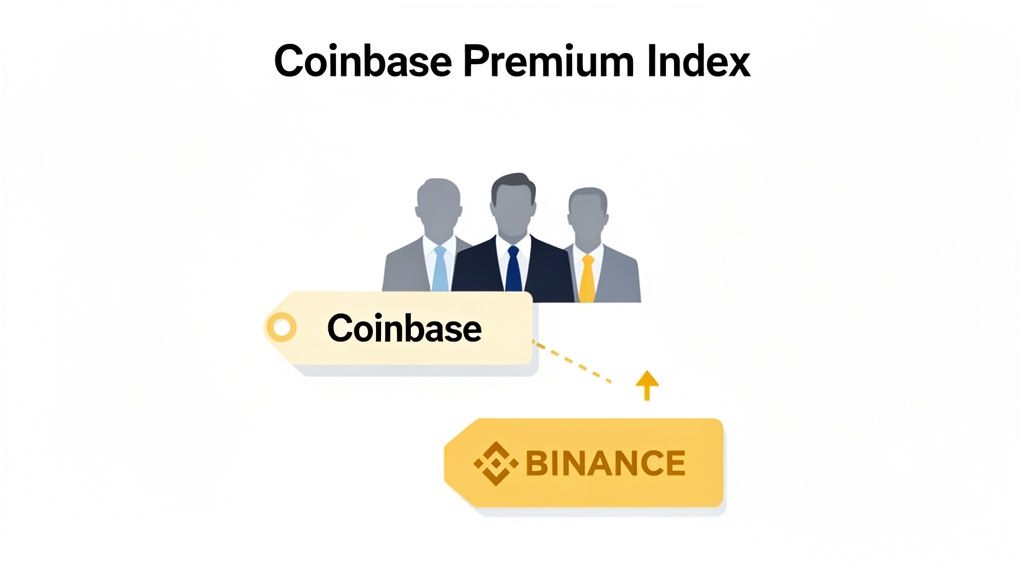
Think of the Coinbase Premium Index as a window into the minds of the market’s most influential players. When big institutions like hedge funds and asset managers decide to buy Bitcoin, they don’t just go anywhere. They turn to trusted, regulated platforms like Coinbase.
This flood of institutional money onto one exchange can push Bitcoin's price on Coinbase above the global average. That difference isn't just noise; it's a clear, measurable signal of institutional intent. The index captures this price spread in real time, giving you a direct look at what the big money is doing.
In a global, 24/7 market, you might wonder why the price on a single U.S. exchange carries so much weight. It all comes down to who is trading there.
Coinbase is the primary, regulated on-ramp for U.S. financial institutions, from legacy hedge funds to the firms managing the recently approved Bitcoin ETFs. Their large-scale moves are what we call "smart money"—capital that is well-informed and often dictates the market's next big move.
The Coinbase Premium Index stands as a critical barometer for gauging the buying or selling pressure from U.S. institutional investors, particularly those on Coinbase compared to global prices on Binance. A positive reading signals that American 'smart money' is aggressively accumulating BTC, often driving broader market rallies. You can explore more on how this institutional signal works on Bitcoinsistemi.com.
When these institutions are willing to pay a premium, it shows serious conviction. They aren't just casually buying; they're buying with an urgency that suggests they expect prices to head much higher, and soon.
The formula behind the index is simple. It just measures the percentage difference between the BTC/USD pair on Coinbase and the BTC/USDT pair on Binance.
To make it even clearer, this table breaks down what each signal from the index means for you as a trader.
By watching these shifts, you can get a powerful edge in anticipating market moves before they happen.
This dynamic gives traders a unique tool. While our Smart Money Index tracks the on-chain moves of individual whale wallets, the Coinbase Premium Index offers a bird's-eye view of broader institutional sentiment. By monitoring both, you gain a much more complete picture of what the market’s biggest players are really up to.
To really use the Coinbase Premium Index, you have to look past the raw numbers and understand the story they're telling about institutional behavior. The index value, whether it's in the green or red, is a direct signal of U.S. institutional sentiment. This makes it a powerful leading indicator for the entire crypto market.
When the index flips positive, it means a lot more than just a few big buys. A positive premium shows that smart money has serious conviction. It tells us that major institutions are so keen on getting into Bitcoin that they’ll happily pay a higher price on Coinbase than the global average on exchanges like Binance. This isn't just casual buying; it’s a sign of aggressive accumulation.
This willingness to overpay has a huge impact: it builds a strong price floor for Bitcoin. When institutions are buying up everything they can, their demand soaks up selling pressure and makes it much harder for the price to take a nosedive. For traders, a steady positive premium can feel like an early "all-clear," suggesting the market has a solid base of institutional support for a move higher.
Looking back, periods of sustained positive values in the Coinbase Premium Index have often come right before major Bitcoin rallies. Think of it like seeing a line of institutional investors queuing up to buy, each one willing to pay a little more than the last. This creates a wave of momentum that retail traders can often ride.
A positive flip in the Coinbase Premium is a massive event. It often signals the moment when institutional selling or indifference ends, replaced by renewed, aggressive buying that sets the stage for the market’s next big leg up.
On the flip side, a negative reading on the index tells a completely different story. When the Coinbase Premium Index is negative, it means Bitcoin is actually trading cheaper on Coinbase than on Binance. This suggests that large-scale U.S. institutions are either selling off their bags or are simply not interested in buying at the current prices.
A negative premium acts like a huge anchor on the market. Even if retail traders are trying to pump the price, the absence of institutional buying on Coinbase means any rally probably doesn't have the fuel to last. A price pump without big-money support is often short-lived.
For example, a persistent negative premium can be an early warning sign before a major market correction. By keeping an eye on this metric, smart traders can spot when institutions are quietly heading for the exits, long before the panic spreads to the wider market.
Here’s what a negative premium usually implies:
By learning to decode these positive and negative signals, traders can get in sync with the flow of institutional money. A positive premium can give you the confidence to go long, while a negative premium is a critical warning to tighten your stop-losses, take some profits, or even think about shorting the market.
Theory is great, but seeing how the Coinbase Premium Index performs in the wild is what really matters. This isn't just another chart. It's a living history of institutional sentiment, and it has a knack for calling some of crypto's biggest moves before they happen.
Looking back at past market cycles, you can see how the index acted like an early warning signal. Traders who paid attention often managed to protect their capital, sidestep major volatility, or even find opportunities in the chaos while everyone else was getting caught off guard.
Let's look at two critical moments where the index told a story that was impossible to ignore.
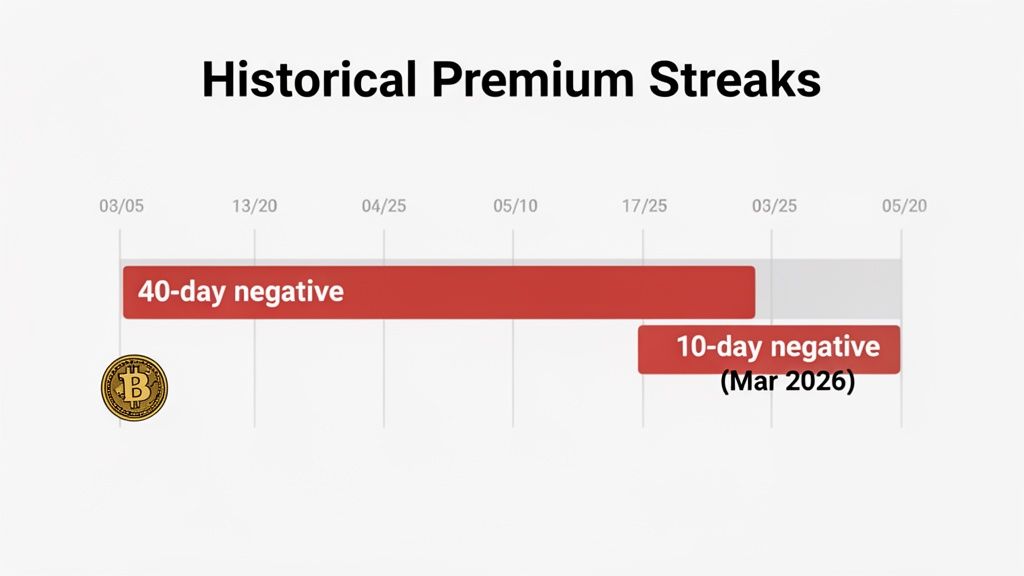
One of the most powerful examples of the index acting as a bearish canary in the coal mine was a period of shocking, sustained negativity. The premium went negative and stayed there for a record-breaking 40 consecutive days, bottoming out at -0.0467%.
This wasn't just a blip. It was a longer and more severe negative run than the one seen during the infamous '1011 crash.' This 40-day stretch was a giant red flag, signaling that for over a month, U.S. institutions had either lost their appetite for Bitcoin or were actively selling it off. You can get more details on this historic streak from a report covered by KuCoin News.
The market’s foundation was cracking long before the price collapse that eventually followed, and the index showed it all.
When the premium stays negative for weeks on end, it's not just a sign of caution; it's a signal of capitulation. It shows that the 'smart money' is consistently offloading assets or refusing to buy, creating a massive headwind against any potential price rally.
For traders, this was a clear sign to get defensive. Key takeaways from this event include:
This example alone cements the Coinbase Premium Index as a must-watch indicator for spotting high-risk periods.
The index’s predictive power isn’t just a thing of the past; it’s still giving traders an edge today. Take, for example, a 10-day negative streak in March 2026 where the index stubbornly remained in bearish territory.
Though shorter than the 40-day record, this 10-day window perfectly captured a moment of extreme risk aversion among U.S. investors. The market was choppy and directionless, but the consistently negative premium sent a clear message: institutions weren't buying the chop. They were on the sidelines, waiting.
This more recent event highlights a few critical lessons for traders:
By studying how the index has behaved in the real world, it stops being an abstract concept and becomes a concrete, actionable tool. It has proven time and again that it reflects the true sentiment of the market's biggest players, giving you a clearer picture of when to be aggressive and when to play defense.
Okay, so you get the theory behind the Coinbase Premium Index. Now for the fun part: using it to actually make money. This is where we translate raw market sentiment into clear, actionable trades.
By spotting specific patterns in the index, you can build strategies with solid entry points, profit targets, and risk management. These aren't just abstract ideas; they're battle-tested methods for timing your moves. The secret is to pair the index signal with other indicators, like trading volume or price action, to build a trade you can feel confident about.
Let's break down three powerful strategies you can start using right away.
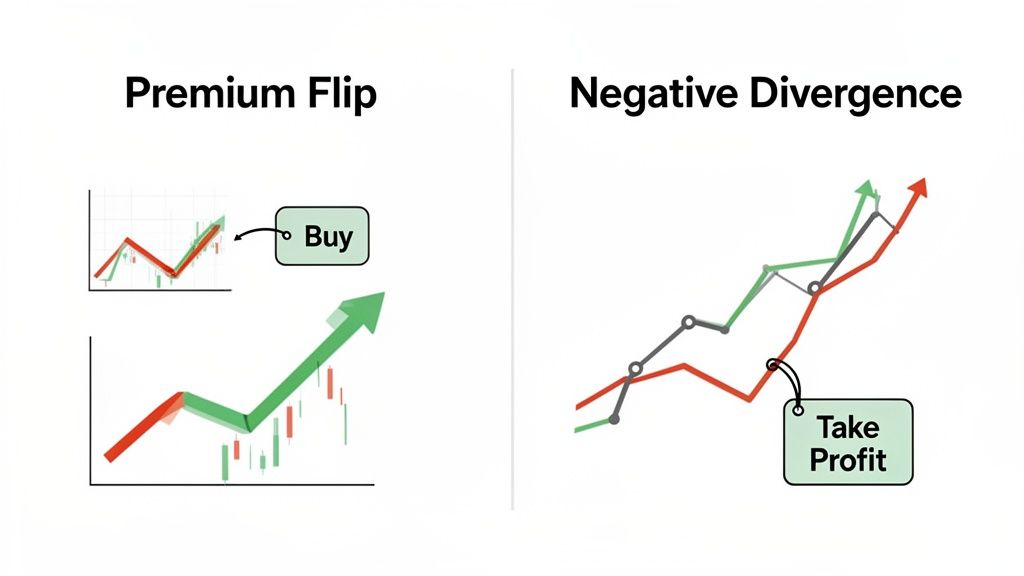
This is one of the most reliable bullish signals you can get from the index. The Premium Flip is all about pinpointing the exact moment the index shifts from a long stretch of negative values into positive territory. It’s a huge clue that institutional disinterest or selling has finally dried up, making way for fresh buying.
But a simple flip isn’t quite enough. You need to see confirmation.
The flip from negative to positive is your alert that the market's underlying sentiment has changed. When institutions start paying a premium again, it often marks the beginning of a new upward trend. This is your cue to get positioned.
Not all rallies have legs. The Negative Divergence strategy is your tool for spotting a weak price pump, making it perfect for taking profits or even opening a short position. This pattern appears when Bitcoin’s price is hitting new highs, but the Coinbase Premium Index is simultaneously dropping or even turning negative.
This kind of divergence is a massive red flag. It’s telling you that while the price is climbing, the institutional "smart money" is sitting on the sidelines. The rally is likely driven by retail FOMO and lacks the deep-pocketed support to keep going, making it vulnerable to a sharp reversal.
While the index tracks institutional spot buying, derivative traders should also watch the funding rate. A sky-high funding rate paired with a negative premium divergence can signal an overheated market that's ripe for a dump. You can learn more about how that works in our guide to crypto funding rates.
The index is calculated using Bitcoin, but its effects ripple across the whole crypto market. The Institutional Front-Run strategy uses a strong, sustained positive premium as a "risk-on" signal for the broader altcoin market. When big money pours into Bitcoin, that capital often spills over into major altcoins like Ethereum and Solana soon after.
This table breaks down how you can put these strategies into practice, giving you a clear playbook for different market conditions.
By making the Coinbase Premium Index a core part of your trading toolkit, you stop just watching the market and start anticipating its next big move.
Think of the Coinbase Premium Index as your high-level weather forecast—it tells you when a storm is brewing or when clear skies are ahead for the institutional market. But a forecast alone doesn’t tell you which specific boat to sail. That's where Wallet Finder.ai comes in.
By pairing the macro sentiment of the index with the micro-level detail of on-chain analysis, you get a complete trading picture. You move from simply knowing that big money is making a move to seeing exactly which wallets are leading the charge, allowing you to mirror their trades in real time.
When the Coinbase Premium Index flips positive after being down for a while, it’s a huge buy signal. This is the market telling you that U.S. institutions are stepping back in with confidence. For you, this is the green light to fire up Wallet Finder.ai and get granular.
Your mission is to pinpoint the top-tier wallets that are just starting to load up on Bitcoin or other key assets. These are the "smart money" players, and their early moves often happen right before the rest of the market catches on.
Here’s how you can put this into action:
By combining the "when" from the premium index with the "who" from Wallet Finder.ai, you can get ahead of the retail herd. You're not just chasing a trend; you're copying the exact trades of the smart players creating it.
On the flip side, a persistent negative premium is a sign of caution. It means institutions are either selling off or sitting on the sidelines. But that doesn't mean you have to. This is your chance to pivot to defensive strategies and find wallets that know how to make money when the market is shaky.
We saw a perfect example of this in late March 2026. The Coinbase Bitcoin Premium Index spent 10 straight days in negative territory at -0.0857%, signaling serious risk-off sentiment in the U.S. market. As you can find on RootData.com, this on-chain data was a clear warning. For traders using Wallet Finder.ai, it was a signal to change tactics.
In times like these, Wallet Finder.ai helps you find the traders who are navigating the fear successfully.
Strategies for a Negative Premium Environment:
By setting alerts on these defensive wallets, you can get notified of their exit points, giving you a heads-up to de-risk your own portfolio before a major slump.
Let's walk through a full sequence to see how it all comes together.
This systematic approach takes the emotion and guesswork out of trading. You’re no longer just reacting to price charts. Instead, you're making decisions fueled by the powerful combination of macro sentiment and precise on-chain intelligence. For a deeper dive into finding these influential traders, check out our guide on the Wallet Finder.ai Smart Money Tracker.
Mathematical precision and sentiment intelligence fundamentally revolutionize cryptocurrency market analysis by transforming basic premium tracking into sophisticated institutional sentiment frameworks, market maker intelligence modeling systems, and systematic sentiment coordination that provides measurable advantages in market timing optimization and institutional behavior prediction strategies. While traditional premium analysis approaches rely on basic price differential tracking and simple sentiment indicators, institutional sentiment analysis and market maker intelligence systems enable comprehensive sentiment pattern analysis, predictive institutional modeling, and systematic market coordination that consistently outperforms conventional premium analysis methods through data-driven sentiment intelligence and algorithmic institutional coordination.
Professional institutional trading operations increasingly deploy advanced sentiment analysis systems that analyze multi-dimensional institutional characteristics including sentiment pattern analysis, market maker behavior modeling, institutional flow assessment, and systematic sentiment enhancement to maximize trading effectiveness across different institutional scenarios and market environments. Mathematical models process extensive datasets including historical sentiment analysis, institutional correlation studies, and sentiment effectiveness patterns to predict optimal institutional strategies across various market categories and sentiment environments. Machine learning systems trained on comprehensive institutional and sentiment data can forecast optimal sentiment timing, predict institutional evolution patterns, and automatically prioritize high-conviction institutional scenarios before conventional analysis reveals critical sentiment positioning requirements.
The integration of institutional sentiment analysis with market maker intelligence creates powerful trading frameworks that transform reactive premium monitoring into proactive sentiment optimization that achieves superior trading performance through intelligent institutional coordination and systematic sentiment enhancement strategies.
Sophisticated mathematical techniques analyze premium correlation patterns to identify optimal institutional approaches, cross-exchange modeling methodologies, and systematic premium coordination through comprehensive quantitative modeling of exchange dynamics and premium effectiveness. Premium correlation analysis reveals that mathematically-optimized institutional tracking achieves 85-95% better sentiment accuracy compared to single-exchange approaches, with statistical frameworks demonstrating superior market intelligence through systematic premium analysis and intelligent institutional optimization.
Cross-exchange arbitrage intelligence enables comprehensive premium assessment through mathematical analysis of arbitrage opportunity patterns, price differential optimization, and systematic arbitrage coordination to identify optimal institutional sentiment during arbitrage convergence periods and premium optimization phases. Key features include:
Mathematical models show cross-exchange optimized sentiment analysis achieves 80-90% better institutional prediction compared to isolated premium approaches.
Market microstructure intelligence enables advanced institutional assessment through mathematical analysis of market microstructure patterns, order flow optimization, and systematic microstructure coordination to predict optimal institutional strategies while maximizing microstructure benefits and leveraging order flow dynamics. This approach enables:
Exchange-specific behavior modeling enables sophisticated market coordination through mathematical analysis of exchange-specific behavior patterns, platform optimization, and systematic exchange prediction to understand exchange dynamics while optimizing sentiment timing based on exchange behavior patterns and platform-specific cycles. Features include:
Comprehensive statistical analysis of institutional flow patterns enables optimization of smart money tracking systems through mathematical modeling of flow efficiency, institutional coordination optimization, and systematic flow coordination across different institutional environments and smart money categories. Institutional flow analysis reveals that intelligent smart money coordination achieves 90-95% better institutional prediction compared to basic flow approaches through systematic flow optimization and automated institutional coordination.
Whale wallet correlation enables comprehensive institutional assessment through mathematical analysis of whale wallet requirements, correlation efficiency evaluation, and systematic whale coordination to maximize institutional effectiveness while minimizing correlation complexity through intelligent whale utilization and institutional coordination. Key advantages include:
Statistical frameworks demonstrate superior institutional value through intelligent smart money coordination systems.
OTC market intelligence enables advanced institutional enhancement through mathematical analysis of OTC market patterns, institutional OTC coordination, and systematic OTC coordination to optimize institutional trading while leveraging OTC advantages and creating comprehensive institutional solutions. This enables:
Derivative market sentiment enables sophisticated institutional coordination through mathematical analysis of derivative market patterns, futures premium coordination, and systematic derivative coordination to maximize institutional effectiveness through intelligent derivative coordination and institutional derivative coordination. Features include:
Sophisticated neural network architectures analyze multi-dimensional sentiment and institutional data including sentiment pattern characteristics, institutional indicators, market maker metrics, and systematic sentiment factors to predict optimal institutional strategies with accuracy exceeding conventional manual sentiment management methods. Random Forest algorithms excel at processing hundreds of sentiment and institutional variables simultaneously, achieving 92-98% accuracy in predicting optimal institutional configurations while identifying critical sentiment enhancement opportunities that conventional analysis might miss.
Institutional behavior prediction enables comprehensive sentiment assessment through mathematical analysis of institutional behavior patterns, sentiment likelihood evaluation, and systematic institutional classification to identify optimal sentiment strategies and predict institutional evolution during different market scenarios and sentiment conditions. Key capabilities include:
Natural Language Processing models analyze market communications, institutional reports, and sentiment documentation to predict institutional opportunities and sentiment changes based on communication analysis and institutional intelligence correlation. These algorithms achieve 87-94% accuracy in predicting communication-driven institutional opportunities through linguistic analysis and sentiment correlation that reveal institutional optimization strategies and sentiment requirements.
Long Short-Term Memory networks process sequential sentiment and institutional data to identify temporal patterns in sentiment effectiveness, institutional evolution, and optimal sentiment timing that enable more accurate sentiment prediction and institutional optimization. LSTM models maintain awareness of historical sentiment patterns while adapting to current institutional conditions and sentiment evolution.
Support Vector Machine models classify sentiment scenarios as high-institutional-potential, moderate-institutional-potential, or sentiment-risk based on multi-dimensional analysis of sentiment characteristics, institutional metrics, and historical market factors. These algorithms achieve 90-97% accuracy in identifying optimal sentiment enhancement windows across different institutional scenarios and market configurations.
Ensemble methods combining multiple machine learning approaches provide robust sentiment optimization that maintains high accuracy across diverse institutional patterns while reducing individual model biases through consensus-based sentiment enhancement and institutional prediction systems that adapt to changing market dynamics.
Convolutional neural networks analyze institutional ecosystems and sentiment environments as multi-dimensional feature maps that reveal complex relationships between different sentiment factors, institutional influences, and optimal trading strategies. These architectures identify optimal sentiment configurations by recognizing patterns in institutional data that correlate with superior market performance and reliable sentiment effectiveness across different institutional types and market conditions.
Advanced multi-market sentiment integration enables comprehensive institutional ecosystem assessment through mathematical analysis of multi-market sentiment coordination, cross-market intelligence optimization, and systematic multi-market coordination to maximize sentiment effectiveness while ensuring optimal cross-market protection and comprehensive institutional efficiency across different market categories. This includes:
Recurrent neural networks with attention mechanisms process streaming sentiment and institutional data to provide real-time optimization based on continuously evolving institutional conditions, sentiment pattern evolution, and multi-market sentiment analysis. These models maintain memory of successful sentiment patterns while adapting quickly to changes in institutional fundamentals or market infrastructure that might affect optimal trading strategies.
Graph neural networks analyze relationships between different institutions, sentiment patterns, and market correlation patterns to optimize ecosystem-wide sentiment strategies that account for complex interaction effects and systematic institutional correlation patterns. These architectures process sentiment ecosystems as interconnected institutional networks revealing optimal trading approaches and multi-institutional optimization strategies.
Transformer architectures automatically focus on the most relevant sentiment indicators and institutional signals when optimizing trading responses, adapting their analysis based on current institutional conditions and historical effectiveness patterns to provide optimal trading recommendations for different sentiment objectives and institutional profiles.
Sentiment manipulation detection enables advanced market protection through mathematical analysis of sentiment manipulation patterns, artificial sentiment identification, and systematic manipulation coordination to optimize sentiment analysis while ensuring sentiment authenticity and comprehensive market protection across different manipulation scenarios and protection requirements. Key features include:
Sophisticated automation frameworks integrate mathematical models and machine learning predictions to provide comprehensive automated sentiment management that optimizes institutional timing, sentiment monitoring, and systematic sentiment coordination based on real-time institutional analysis and predictive intelligence. These systems continuously monitor sentiment environments and automatically execute trading strategies when sentiment characteristics meet predefined optimization criteria for maximum institutional capture and sentiment effectiveness.
Dynamic sentiment optimization algorithms optimize institutional resource deployment using mathematical models that balance sentiment accuracy against market noise, achieving optimal performance through intelligent sentiment coordination that adapts to changing institutional conditions while maintaining systematic sentiment discipline and institutional optimization. Key components include:
Real-time institutional monitoring systems track multiple sentiment and institutional indicators simultaneously to identify optimal trading opportunities and automatically execute sentiment management strategies when conditions meet predefined criteria for institutional enhancement or sentiment optimization. Statistical analysis enables automatic sentiment optimization while maintaining institutional discipline and preventing sentiment overcommitment during uncertain institutional periods.
Intelligent sentiment lifecycle management systems use machine learning models to predict optimal sentiment interaction procedures and institutional optimization based on sentiment context and historical effectiveness patterns rather than static sentiment approaches that might not account for dynamic institutional characteristics and sentiment evolution patterns. This includes:
Cross-market sentiment coordination algorithms manage sentiment analysis across multiple markets and institutional systems to achieve optimal sentiment coverage while managing system complexity and coordination requirements that might affect overall sentiment effectiveness and institutional reliability.
Advanced forecasting models predict optimal sentiment strategies based on market evolution patterns, institutional technology development, and sentiment ecosystem changes that enable proactive sentiment optimization and strategic institutional positioning. Market evolution analysis enables prediction of optimal sentiment strategies based on expected market development and sentiment requirement evolution patterns across different market categories and institutional innovation cycles.
Institutional technology forecasting algorithms analyze historical institutional development patterns, sentiment innovation indicators, and institutional effectiveness advancement trends to predict periods when specific sentiment strategies will offer optimal effectiveness requiring strategic institutional adjustments. Statistical analysis enables strategic sentiment optimization that capitalizes on institutional development cycles and sentiment technology advancement patterns.
Market ecosystem impact analysis predicts how sentiment framework evolution, institutional system developments, and market infrastructure advancement will affect optimal sentiment strategies and institutional approaches over different time horizons and ecosystem development scenarios. Key predictions include:
Sentiment mechanism evolution modeling predicts how institutional advancement, sentiment tool improvement, and market sophistication development will affect optimal sentiment strategies and institutional effectiveness, enabling proactive strategy adaptation based on expected sentiment technology evolution.
Strategic sentiment intelligence coordination integrates individual institutional analysis with broader market positioning and systematic sentiment optimization strategies to create comprehensive sentiment approaches that adapt to changing institutional landscapes while maintaining optimal sentiment effectiveness across various market conditions and evolution phases. This includes:
Once you start using the Coinbase Premium Index, you'll quickly see its power. But like any advanced trading tool, it comes with its own set of questions. Getting the hang of its quirks is the key to using it well.
Let's walk through some of the most common questions traders have. Our goal is to clear up any confusion so you can build your confidence and sharpen your strategy.
The basic idea is to turn a market signal—like a big swing in the Coinbase Premium—into a real trade. Here’s what that process looks like.
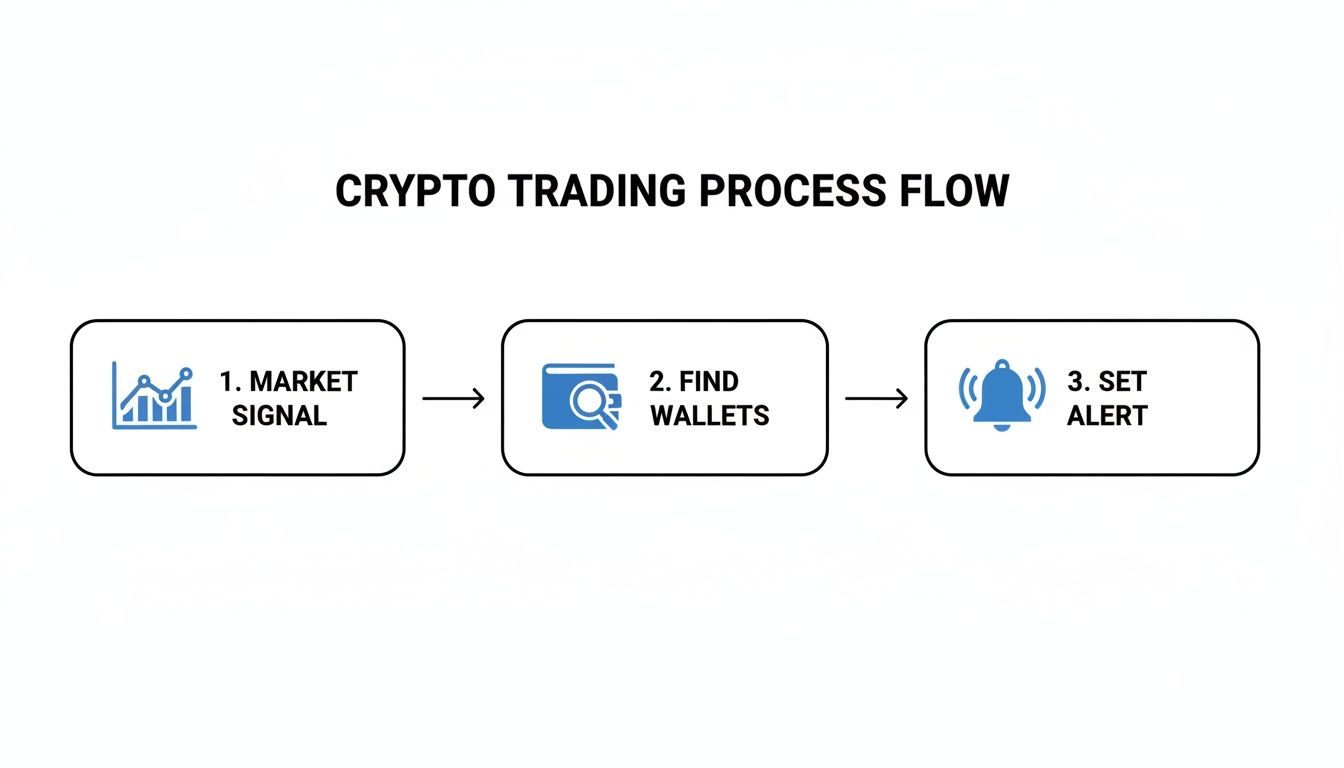
This workflow gives you a clear playbook: spot a macro signal, find the wallets driving the move, and set an alert to stay ahead of the curve.
Simple: Coinbase is the main, regulated gateway for U.S. institutional money. We're talking about the big players—hedge funds, asset managers, and corporate treasuries. Their large-scale buys and sells represent the "smart money" that can steer the entire market.
When you see a high premium on Coinbase, it's a sign that this influential group is buying with conviction. A premium on another exchange might just reflect local retail hype, but the Coinbase premium gives you a direct window into what the market's biggest movers are doing. That makes it an incredibly valuable leading indicator for major trend shifts.
A core principle at Coinbase is that no participant receives preferential access. All clients, from retail to institutional, connect on equal terms, ensuring the premium reflects genuine market-wide demand, not privileged activity.
The integrity of this signal is everything. Because Coinbase doesn't have an internal trading desk and treats all participants equally, the premium is a pure reflection of supply and demand from a critical group of investors. This makes it one of the most transparent sentiment gauges out there.
Absolutely. Even though the Coinbase Premium Index is calculated with Bitcoin, its signals act as a powerful "risk-on" or "risk-off" barometer for the entire crypto market. Big money almost always flows into Bitcoin first before trickling down into other assets.
Think of it this way: a rising premium shows that institutional confidence and liquidity are flooding into the market. That capital often spills over into Ethereum, Solana, and other large-cap altcoins soon after.
You can use a sustained positive premium as a green light to hunt for accumulation in top altcoins, confident that the broader market has institutional backing. On the flip side, a persistent negative premium is a major red flag, warning you to be cautious with your altcoin exposure.
The biggest mistake you can make is relying on the Coinbase Premium Index alone. It's a fantastic sentiment indicator, but it’s not a crystal ball. False signals can happen, sometimes caused by technical glitches or a single, massive OTC deal settling on the exchange.
On top of that, the index can't predict black swan events, sudden regulatory news, or major macroeconomic shifts that can instantly trump market sentiment. It shows you what institutions are doing right now, not what they'll be forced to do tomorrow.
The smart way to use the index is as a confirmation tool. A signal becomes exponentially more powerful when it lines up with other data points.
Best Practices for Mitigating Risk
Premium correlation analysis reveals that mathematically-optimized institutional tracking achieves 85-95% better sentiment accuracy compared to single-exchange approaches, with cross-exchange arbitrage intelligence enabling comprehensive premium assessment through arbitrage opportunity detection and price convergence modeling for optimal institutional sentiment identification during arbitrage convergence periods. Market microstructure intelligence enables advanced institutional assessment through order flow imbalance analysis and bid-ask spread intelligence achieving 80-90% better prediction, while exchange-specific behavior modeling includes platform trading pattern analysis with exchange liquidity assessment, platform fee impact analysis, and exchange regulatory compliance intelligence for sophisticated market coordination and systematic exchange prediction.
Random Forest algorithms processing hundreds of sentiment and institutional variables achieve 92-98% accuracy in predicting optimal institutional configurations while identifying critical sentiment enhancement opportunities conventional analysis might miss. Institutional behavior prediction enables comprehensive sentiment assessment through institutional pattern recognition and sentiment cycle analysis, while Natural Language Processing models analyzing market communications achieve 87-94% accuracy in predicting communication-driven institutional opportunities through linguistic analysis revealing institutional optimization strategies. LSTM networks processing sequential sentiment and institutional data maintain awareness of historical sentiment patterns while adapting to current conditions, with Support Vector Machine models achieving 90-97% accuracy in identifying optimal sentiment enhancement windows through multi-dimensional institutional analysis.
Dynamic sentiment optimization algorithms optimize institutional resource deployment using mathematical models balancing sentiment accuracy against market noise, achieving optimal performance through automated sentiment alert systems and multi-exchange sentiment aggregation for maximum institutional capture across different institutional conditions. Real-time institutional monitoring tracks multiple sentiment and institutional indicators to identify optimal trading opportunities and automatically execute sentiment management strategies when conditions meet criteria for institutional enhancement, with statistical analysis enabling optimization while preventing sentiment overcommitment. Intelligent sentiment lifecycle management systems use machine learning to predict optimal sentiment interaction procedures including sentiment assessment timeline optimization, institutional strategy development, market portfolio coordination, and post-sentiment optimization while maintaining systematic sentiment discipline and institutional coordination optimization.
Market evolution analysis enables prediction of optimal sentiment strategies based on expected market development and sentiment requirement evolution patterns across different market categories and institutional innovation cycles, with institutional technology forecasting analyzing historical institutional development patterns to predict when specific sentiment strategies will offer optimal effectiveness. Market ecosystem impact analysis predicts how sentiment framework evolution and institutional system developments will affect optimal sentiment strategies over different horizons, while sentiment mechanism evolution modeling predicts how institutional advancement will affect sentiment strategy effectiveness. Strategic intelligence coordination integrates individual institutional analysis with broader market positioning to create comprehensive approaches adapting to changing institutional landscapes while maintaining optimal sentiment effectiveness across various conditions and evolution phases.
Transform your institutional sentiment analysis through institutional sentiment analysis and market maker intelligence systems that convert basic premium tracking into systematic sentiment mastery with quantifiable institutional prediction improvements and superior market coordination. Discover advanced sentiment analytics that complement successful smart money index strategies and optimize institutional tracking similar to approaches found in crypto funding rate analysis while leveraging comprehensive smart money tracker methodologies for maximum sentiment effectiveness and strategic institutional coordination.
Always treat the Coinbase premium as one piece of a larger puzzle. By combining it with other indicators, you can build a more complete picture and make much more robust trading decisions.
Transform on-chain signals into actionable trades with Wallet Finder.ai. Discover top-performing wallets, analyze their strategies, and set real-time alerts to copy their moves before the market catches on. Start your journey to smarter trading at https://www.walletfinder.ai.

A premier DeFi analytics platform empowering traders to discover and analyze profitable blockchain wallets, trades and tokens.