Protect Your Tokens: A Honeypot Scanner Guide

Wallet Finder

Blank calendar icon with grid of squares representing days.

May 19, 2026

You're staring at a fresh token chart, volume is flying, buys keep printing, and the comments are full of people calling it the next breakout. The contract looks live, liquidity looks active, and the urge to jump in gets stronger with every green candle.

Then a critical question arises. Can you sell after you buy?

That's the line between a trade and a trap. In DeFi, a honeypot scam doesn't need to drain your wallet to hurt you. It only needs to let you in and block your exit. A good honeypot scanner helps you catch that before you commit real capital, but most traders use these tools too casually. They look for a green badge, assume they're safe, and skip the manual checks that actually matter when a token uses messy tax logic, anti-bot code, or owner-controlled permissions.

The better approach is to treat a honeypot scanner like a first-pass filter, not a final verdict. In broader security work, scanner logic became a core part of threat intelligence because defenders learned to probe risky systems before attackers did, especially around exposed services like SMB and SSH, as described by Palo Alto Networks on honeypots. DeFi adapted the same mindset. Before risking money, traders probe a contract's behavior.

That's the practical skill worth learning. Not just how to run a honeypot scanner, but how to test whether the scanner itself is telling you the truth.

The Billion Dollar Question Before Every Trade

A lot of bad trades start the same way. You find the token early enough that it still feels like an edge. The chart is moving, the socials are loud, and a few respected wallets are already in. You know hesitation can cost opportunity, but rushing can lock your funds into a contract you can't exit.

That tension is why honeypot scanners matter. They answer the most basic pre-trade question a DeFi trader has. If I buy this token, will the sell path work?

The trade setup that traps people

A typical trap doesn't always look obvious. Some contracts allow buys through the normal router, then fail sells only under certain conditions. Others block specific wallets, change fees after launch, or route transfers through code that behaves differently once enough buyers arrive.

A scanner helps because it checks the contract before you become the test case.

Practical rule: If a token only looks attractive when you ignore contract risk, it's not attractive.

What makes this more important is speed. In active markets, traders often make decisions from DexScreener, Telegram, X, and a block explorer within minutes. That workflow leaves almost no room for deep code review on every ticker. A honeypot scanner compresses the first layer of due diligence into something fast enough to use in real trading.

Why this belongs in every workflow

The mistake is thinking a scanner is just for beginners. It isn't. Good traders use scanners the way security teams use probes and verification tools. They want an early warning before they interact with something hostile.

Use it at the same point in your process every time:

  • Before first entry: Run the contract before your first buy, not after.
  • Before adding size: Re-check if ownership, taxes, or liquidity conditions have changed.
  • After unusual contract updates: If the token suddenly behaves differently, assume the risk model changed too.
  • When the crowd gets emotional: The louder the promotion, the more useful a mechanical check becomes.

The point isn't paranoia. It's discipline. A honeypot scanner won't save every bad trade, but it will stop you from making some very avoidable ones.

What Is a Crypto Honeypot Scanner

A crypto honeypot scanner is a tool that checks whether a token behaves like a trap, usually by analyzing contract logic and simulating trade behavior to see whether buying and selling appear possible under realistic conditions.

That's different from the cybersecurity version of a honeypot. In network security, a honeypot is a decoy system designed to attract attackers. In crypto, the scanner is the defensive tool, and the token contract is the thing being tested.
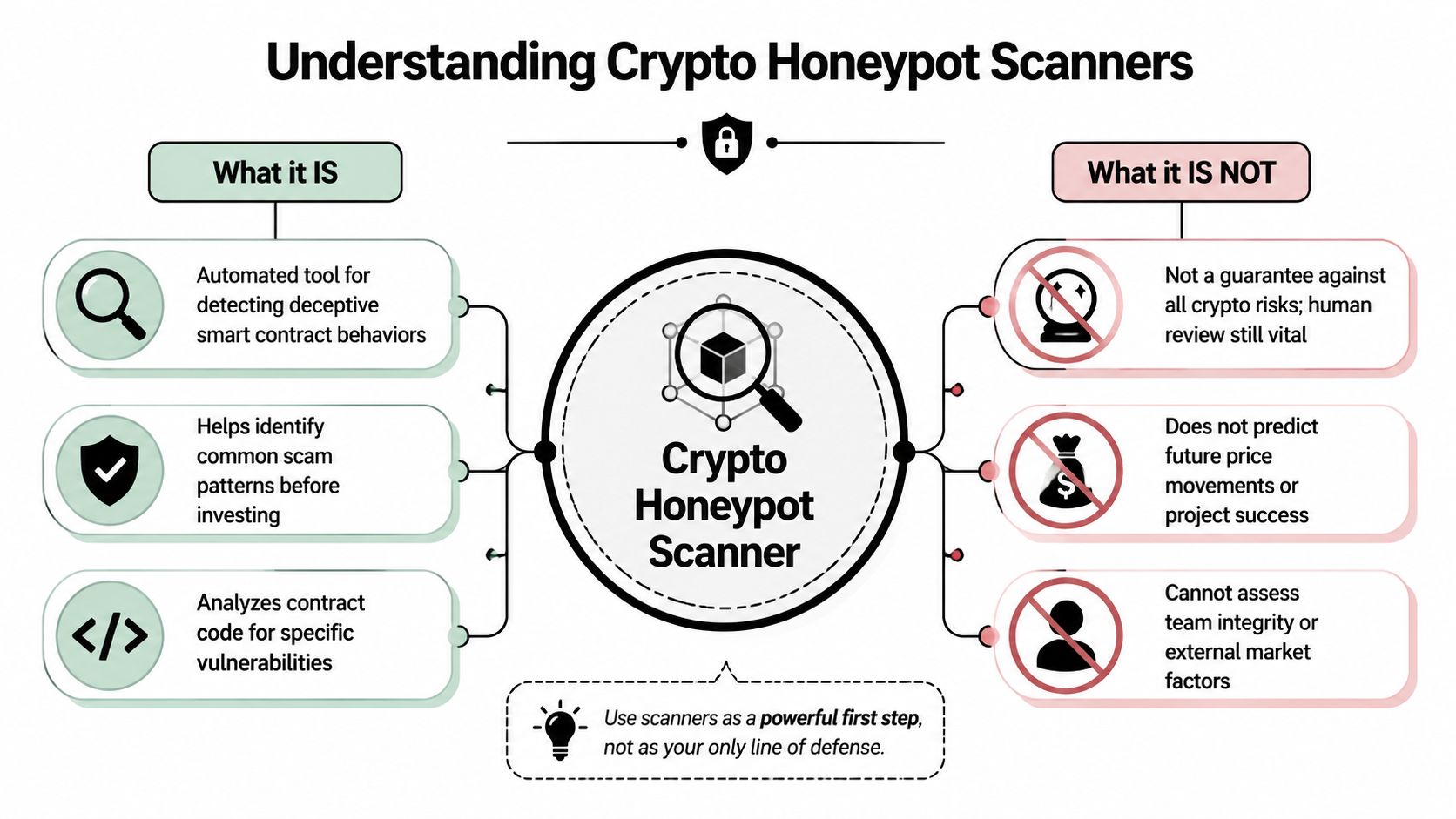
A diagram explaining what crypto honeypot scanners are, their capabilities, and their limitations for investors.

What the tool actually does

Think of it as a fitting room for a trade. You're not asking, “Will this token go up?” You're asking, “Does this token behave normally enough that I can enter and exit?”

Most scanners try to answer questions like these:

  • Can a wallet buy and then sell?
  • Are there transfer restrictions hidden in the contract?
  • Does the token use blacklist or pause logic?
  • Do taxes or fees make the token practically unsellable?
  • Does ownership still control dangerous functions?

That's why scanner output often includes more than a simple pass or fail. The better tools surface taxes, transfer behavior, owner permissions, liquidity context, and contract warnings that need human judgment.

What a scanner doesn't do

A honeypot scanner is not a lie detector for the entire project.

It doesn't tell you whether the team is honest. It doesn't tell you whether insiders will dump. It doesn't tell you whether liquidity will be removed later. It doesn't tell you whether momentum is real or manufactured. And it definitely doesn't predict price.

A green result means “I didn't find a clear sell trap right now.” It does not mean “this is a good investment.”

If you want a baseline explanation of the scam itself before going deeper, this guide on what a honeypot in crypto is is a useful companion.

The right mental model

Treat the scanner as a behavior check. It's there to reduce obvious contract risk, not replace judgment. That framing matters because plenty of tokens sit in the gray zone. They aren't clean enough to trust instantly, but they aren't obvious honeypots either.

That's where most traders get into trouble. They expect certainty from a tool built to provide probability.

How Scanners Detect Honeypot Tokens

Scanner results can look mysterious if you've never thought about the contract side of the trade. In practice, the logic is fairly straightforward. The tool looks for patterns that commonly block exits, distort transfers, or give the owner too much control over whether your wallet can move tokens.

The checks behind the verdict

Some scanners rely mostly on behavior simulation. Others combine simulation with contract inspection. The stronger approach uses both.

Behavior checks try to answer whether a token can be bought and sold through the expected router path. Contract checks look for dangerous permissions or code paths that could change the answer depending on wallet, timing, or owner action.

Here's a practical map of what many scanners look for:

Honeypot CharacteristicScanner Check PerformedWhat It Means for a Trader
Blacklist logicLooks for functions or conditions that can block specific addressesYou may be allowed to buy but prevented from selling later
Transfer pause or trading lockChecks whether transfers can be disabled globally or selectivelyTrading may depend on owner action rather than open market access
Extreme sell taxSimulates sell behavior and inspects fee logicA sale may be technically possible but economically useless
Router restrictionsChecks whether only specific addresses or paths can transfer or swapYour wallet may not be able to exit through the normal DEX route
Owner-controlled parametersReviews whether the owner can change taxes, limits, or permissionsA token that looks safe now can become dangerous later
Max wallet or max transaction trapsTests whether limit logic blocks ordinary user behaviorYou might enter with one size and discover you can't exit cleanly
Hidden conditional logicScans for unusual branches tied to sender, recipient, or state changesThe contract may behave differently for scanners than for real users
Liquidity-related frictionInspects whether the trade path depends on fragile or abnormal pool conditionsA scanner result may look fine while real execution still fails or slips badly

What usually works and what doesn't

The checks that work best are the ones tied to actual trade behavior. If a scanner can model a buy and sell path and combine that with contract inspection, it's more useful than a tool that only pattern-matches code snippets.

What doesn't work as well is blind trust in a label. Some scam contracts are simple enough to catch with static flags. Others hide the trap in conditionals, external calls, or owner-controlled settings that don't show their teeth immediately.

A useful scanner result should make you ask follow-up questions:

  • Is the sell path open for everyone or only under certain conditions?
  • Are taxes stable or adjustable?
  • Can the owner blacklist wallets after launch?
  • Does the token rely on custom routing?
  • Is the contract verified enough that you can inspect the logic directly?

If the scanner gives you a verdict without enough detail to explain the verdict, treat it as weak evidence.

A scanner is strongest when it reduces your search area. It shows you where to look next.

A Practical Guide to Using a Honeypot Scanner

The workflow is simple, but execution matters. Most bad scans come from one of three mistakes. Traders use the wrong contract, choose the wrong chain, or read the headline result without checking the details underneath.

A step-by-step infographic titled Practical Guide: Using a Honeypot Scanner illustrating six steps for smart contract security.

Start with the exact contract

Never scan based on ticker alone. Copy the exact contract address from a trustworthy listing page or block explorer. Scam tokens often clone names and symbols, so symbol search is where people get fooled first.

Good places to verify the address include DexScreener and the relevant chain explorer. Match the token page, pair page, and explorer entry before you paste anything into a scanner.

Run the scan correctly

Most tools follow the same flow:

  1. Pick the scanner you trust. Use one with visible output, not just a badge.
  2. Paste the contract address. Double-check the first and last characters.
  3. Select the right chain. Ethereum, BNB Chain, Base, Solana-adjacent tooling, and others often have separate support paths.
  4. Launch the scan. Let it complete fully.
  5. Read the full report. Don't stop at safe or unsafe.
  6. Cross-check with a second tool if the trade matters.

If you want another trader-focused walkthrough, this guide to a BSC honeypot detector covers a similar workflow.

What to read first in the report

The first things I check are usually these:

  • Sellability status: Can the scanner complete a sell path?
  • Tax behavior: Are fees normal, aggressive, or changeable?
  • Transfer restrictions: Is there language suggesting blacklists, pausing, or wallet-specific limits?
  • Liquidity context: Is the pool active enough for the result to mean anything?
  • Ownership warnings: Can someone still modify key variables?

This video gives a quick visual overview of the process many traders follow:

How to avoid user error

Most false confidence comes from sloppy input, not complex scam design.

  • Wrong chain selected: The contract can exist on one network while you're scanning another.
  • Proxy or migrated token confusion: You may scan an old address while trading a new one.
  • Fresh launch assumptions: A very new token may not have enough on-chain behavior yet for clean interpretation.
  • Single-tool dependence: One scanner can miss what another catches.

A good routine is boring on purpose. Correct address, correct chain, first scan, second scan, then manual review if anything feels off.

Interpreting Scanner Results Beyond Green or Red

A scanner verdict is useful. It is not final. Traders get burned when they treat “safe” as a promise or “unsafe” as automatic proof of a scam.

That's not how real-world detection works. In mature security programs, honeypot performance is judged partly by false positive rate, and Wiz notes a target of under 20% false positives after tuning in operational environments, as explained in Wiz's guide to honeypots in cloud security. The lesson for DeFi is simple. Automated tools produce signals, not certainty.

False positives happen

A false positive is when the scanner flags a token that isn't a honeypot. This often happens when a contract uses rough anti-bot mechanics, launch-phase taxes, cooldown logic, max wallet rules, or non-standard router behavior that looks suspicious to automated checks.

That doesn't mean you should dismiss the warning. It means you need context.

Common examples include:

  • Launch restrictions: Some projects temporarily limit early transfer behavior.
  • Tax-heavy tokenomics: A token may be expensive to trade without being unsellable.
  • Custom contract architecture: Unusual implementation can trigger scanner rules even when sells still work.
  • Liquidity edge cases: Poor routing or unstable pools can make behavior look broken.

False negatives matter more

A false negative is more dangerous. That's when the scanner says the token looks fine, but the actual user experience turns out to be blocked or manipulated.

This happens when contracts hide the trap well. They may behave normally during a generic simulation but switch rules based on wallet status, owner changes, timing, or conditions the scanner didn't reproduce.

Green means “proceed to the next check,” not “size up confidently.”

How to read ambiguous output

When a scanner report isn't clean, ask three specific questions:

SignalWhat to askWhy it matters
High feesAre these fixed, temporary, or owner-adjustable?Adjustable fees can turn a trade into an exit trap
Owner permissionsCan the owner still change restrictions?Current safety can disappear fast
Sell resultWas the sell path tested under realistic conditions?A narrow simulation can miss the actual failure case

A useful habit is to downgrade every verdict by one level in your head. “Safe” becomes “probably safe, pending manual checks.” “Risky” becomes “requires evidence.” That mindset keeps you out of the biggest trap of all, which is overconfidence in automation.

Advanced Manual Verification Techniques

When scanner output is messy, manual verification matters more than one extra opinion from another tool. In such situations, traders separate obvious noise from genuine sell-lock risk.

A focused developer reviews solidity smart contract code on a computer screen using a magnifying glass.

Use a canary trade

The most practical manual test is a small buy followed by an immediate sell attempt. Security teams validate their own detection systems with active probes, and Rapid7 explicitly recommends testing honeypot behavior with scans, brute-force attempts, and exploit probes in its honeypot validation documentation. Traders can apply the same logic. A tiny transaction is your live probe.

You're not testing profit. You're testing exit access.

Run the canary test like this:

  1. Buy a very small amount. Keep it small enough that failure won't matter.
  2. Try to sell immediately. Don't wait for the chart to move.
  3. Watch the actual transaction behavior. Failure reasons matter.
  4. Compare expected output with real output. If slippage, tax, or routing is far worse than expected, dig deeper.
  5. Repeat only if needed. Don't keep donating test buys to a questionable contract.

Small test transactions are the fastest way to expose a scanner false negative.

Inspect the contract page

If the token still interests you after the canary test, go to the chain explorer and inspect what you can without pretending to be a Solidity auditor.

Start with the basics:

  • Verified source code: Unverified contracts deserve more suspicion because you can't inspect their logic cleanly.
  • Ownership status: See whether ownership is renounced or still active. Active ownership isn't automatically bad, but it raises the importance of permission review.
  • Read and write functions: Look for names related to blacklist, fee changes, trading enablement, limits, exemptions, or router settings.
  • Recent transactions: Check whether users are selling, not just buying.

If you want a broader due diligence framework, this primer on a blockchain audit helps traders understand what to look for.

Read the holder and liquidity picture

Manual verification also means reading the distribution and pool setup with common sense.

Look for signs like:

  • Concentrated holdings: A few wallets controlling too much supply can create trade risk even if the token isn't a honeypot.
  • Strange wallet labels: Exempt wallets, deployer-linked wallets, or clustered fresh wallets deserve attention.
  • Liquidity status: Locked liquidity helps, but don't confuse it with a guarantee of fair contract behavior.
  • Transaction pattern imbalance: If you mostly see buys and very few successful sells, stop and investigate.

Many traders overcomplicate things. You don't need full reverse engineering. You need enough evidence to answer one question: Can regular buyers enter and exit under normal conditions?

Your Pre-Trade Honeypot Detection Checklist

The safest process is repeatable. You don't want to improvise when the chart is moving fast. A fixed checklist keeps you from skipping the boring steps that protect your capital.

A checklist infographic titled Pre-Trade Honeypot Detection Checklist for analyzing cryptocurrency projects and smart contracts.

The checklist I'd use before sizing in

  • Verify the exact contract address. Match the token across the pair page and chain explorer before scanning anything.
  • Run more than one honeypot scanner. If tools disagree, assume the contract needs manual review.
  • Read the details, not just the badge. Taxes, owner permissions, transfer restrictions, and routing notes matter more than a green label.
  • Check whether real sells are happening. Explorer activity often reveals problems before social posts do.
  • Review contract transparency. Verified source code and readable functions make risk easier to assess.
  • Inspect ownership and adjustable settings. If someone can still change fees or restrictions, current safety may not last.
  • Check holder concentration and liquidity structure. Even a sellable token can still be a bad trade if the setup is fragile.
  • Use a canary transaction when anything is unclear. A small live buy-and-sell test beats guesswork.
  • Avoid urgency-based entries. If the only reason to skip checks is fear of missing out, skip the trade instead.

A simple decision rule

Use this framework:

SituationAction
Scanner results are clean and manual context looks normalConsider a small initial entry
Scanner results conflictPause and verify manually
Sell test fails or behaves abnormallyDon't trade it
Owner permissions and transaction flow look suspiciousMove on

Most traders don't need more opportunities. They need fewer avoidable mistakes. A disciplined honeypot scanner workflow does exactly that.

Frequently Asked Questions About Honeypot Scanners

Can a token become a honeypot after launch

Yes. If the contract owner can still change taxes, blacklist wallets, pause transfers, or alter trade conditions, behavior can worsen after an initially normal launch. That's why ownership and adjustable permissions matter as much as the first scanner result.

Are all high-tax tokens honeypots

No. High tax alone doesn't prove a honeypot. Some tokens use heavy fees, especially around launch or anti-bot phases. The primary concern is whether the sell path remains open under normal user conditions and whether those fees can be changed later.

What's the difference between anti-bot logic and a honeypot

Anti-bot logic tries to restrict abusive trading behavior. A honeypot traps buyers by preventing or crippling exits. The line gets blurry when anti-bot code is aggressive, badly implemented, or owner-controlled. That's why behavior-based validation matters more than labels.

Do honeypot scanners work on every blockchain

Not uniformly. Scanner quality depends on chain support, router compatibility, explorer data, and how the tool models token behavior on that network. Always make sure the scanner supports the exact chain and token standard you're trading.

If the scanner says safe, can I skip the test sell

You can. You just shouldn't when the contract is new, unusual, or heavily promoted. A small live probe is often the fastest way to confirm that scanner output matches reality.


If you want to go beyond contract safety checks and see what skilled wallets are buying, selling, and rotating into across major chains, Wallet Finder.ai helps you track smart money in real time. It's a practical way to pair token-level risk checks with wallet-level conviction, so you're not trading blind on hype alone.