Recovery Factor Calculation for Smart Traders
Master the recovery factor calculation to measure a strategy's resilience. Learn the formula, see DeFi examples, and find top wallets with Wallet Finder.ai.

June 20, 2026


Wallet Finder
May 6, 2026

You spot a fresh BSC token flying on the chart, buys are pouring in, and a tracked wallet you respect just entered. You move fast, hit buy, and then the trap closes. The token lets you in but won't let you out. That single mistake can turn a strong signal into dead capital.
That's why a bsc honeypot detector belongs in the trade entry process, not in the post-mortem. On BSC, honeypot detectors have become essential because they simulate buys and sells, inspect contract bytecode, and look for malicious logic such as blacklist functions, transfer restrictions, and owner-controlled permissions that can trap funds, as described by Honeypot.is. Some detectors also flag extremely high sell taxes that can act like a practical exit ban.
For copy traders, speed matters, but blind speed gets punished. If you're using wallet-tracking platforms to find new entries, the safest move is simple: treat every new token alert as untrusted until a detector clears it. The tools below are the ones I'd keep in rotation for that job, along with where each one fits, where each one falls short, and how to combine them into a workflow that works in live conditions.
A Wallet Finder-style alert hits, the chart is still climbing, and the window to enter looks small. This is the checker I run first. Honeypot.is gives a fast read on whether a BSC token can be bought and sold under live conditions, which is the first question that matters before I size a copy trade.

What makes it useful is focus. Instead of burying the answer under a broad risk score, it centers on transaction simulation and contract behavior that can block exits, distort taxes, or give the owner too much control over transfers. For fast BSC trading, that narrow scope is a strength.
I use it as the first gate, not the final verdict. If a tracked wallet buys a new token, I check Honeypot.is before I care about chart structure or momentum. A clean result does not guarantee a good trade, but a bad or uncertain result is usually enough to kill the setup.
Practical rule: If wallet flow looks strong but sellability looks questionable, pass. Good copy trading is as much about filtering as finding entries.
There are limits. Simulation can miss edge cases, especially if the contract changes behavior after launch or uses conditions that only trigger in specific states. That is why I treat Honeypot.is as a first filter, then pair it with broader contract review before committing real size. If you want more context on scam screening beyond sellability alone, this guide to a crypto rug check workflow is a useful companion.
Token Sniffer is less of a pure honeypot simulator and more of a broad token risk scanner. That's exactly why it earns a place on the list. When you want more than a yes-or-no sellability check, it gives another lens.
Its "Smell Test" style approach works well for identifying code patterns, copycats, and suspicious contract behavior across EVM ecosystems, including BSC. For traders who screen a lot of contracts each day, the address, token, and pair endpoints are more useful than the homepage itself.
I use Token Sniffer more as a second opinion than as the final call. It adds pattern recognition and context around contract quality, not just exit mechanics.
A common mistake is treating any single risk score as gospel. That's how traders reject good setups or, worse, accept bad ones because one scanner looked clean enough. Token Sniffer works best when paired with a dedicated bsc honeypot detector that tests sell behavior.
A good scanner reduces your workload. It shouldn't replace your decision-making.
If you're comparing scanner outputs more broadly, this piece on rug check crypto workflows is a helpful companion.
GoPlus Security is the security data layer I'd pick if I were wiring token risk checks directly into an app, dashboard, or automated trading workflow. A lot of consumer-facing tools feel polished first and programmable second. GoPlus leans the other way.

Its Token Security Check surfaces honeypot risk, blacklist and whitelist status, tax behavior, ownership details, and related token security signals. For a trader, that means one interface for fast checks. For a team, it means an API and SDK path that can sit behind alerts, watchlists, and internal terminals.
If your process starts with wallet alerts and ends with a trade execution engine, GoPlus fits naturally in the middle. It can act as the risk gate before a token ever shows up in your actionable queue.
This category is moving beyond narrow honeypot checks. Broader on-chain fraud analysis now blends simulation with graph and metadata analysis, and enterprise platforms increasingly use AI and machine learning to detect hidden smart contract traps, liquidity manipulation, and unsafe intents, as discussed in Rango's on-chain scam analysis overview. That matters because a copy trader doesn't just need to know "can I sell?" but also "should this token even be on my radar?"
De.Fi Scanner is a practical triage tool. I like it for quick public checks on brand-new tokens when I want a broad read on risk without opening five tabs first.

It aims to catch honeypot and rug-style mechanics, and it pairs that with extra utility such as express audit PDFs and a wallet approval manager. That combination matters more than it sounds. In real trading, bad approvals can hurt you just as much as a bad entry.
De.Fi works well when you need a broad security sweep before doing deeper manual inspection. It isn't pretending to be a full manual audit. That's a plus, because the output stays usable.
For BSC memecoin trading, De.Fi is strongest as a front-door filter. Run the scan, note the major flags, then confirm sellability elsewhere. That's the repeatable part most traders skip when they get excited by momentum.
BSC traders have kept StaySAFU Scanner in their toolkit for one reason: speed. The Telegram bot workflow is its primary appeal. When you're active in launch channels or group chats, fast contract lookup matters.

StaySAFU focuses on honeypot and tax checks, then layers in liquidity and ownership warnings. That makes it good for yes-or-no triage. If you're trying to decide whether a signal deserves a second look, simple output beats fancy dashboards.
A lot of traders don't lose money because they had no tools. They lose money because the tool added too much friction, so they skipped it. StaySAFU reduces that friction.
Don't let convenience become trust. A quick result is useful only if you treat it as one signal, not the signal.
I wouldn't use StaySAFU as my only bsc honeypot detector for size entries. I would use it as the first fast gate when moving through many candidates.
BSCheck.eu feels old-school in a good way. It's lightweight, fast, and focused on practical token checks rather than polished branding. For BSC traders who want a second reference point, that's enough.
It aggregates explorer data and selected third-party signals, then presents quick checks around honeypot risk, sellability, and taxes. The last-scanned and newest-token dashboards also help when you're scouting fresh contracts and want a quick pulse on what's circulating.
BSCheck isn't the tool I'd build an entire operation around. It's the one I'd keep bookmarked because it gives another angle fast.
That makes it a support tool, not a lead tool. If you're organizing wallets and contracts for this kind of workflow, a dedicated Binance Smart Chain wallet guide can help clean up your operational setup before you start scanning aggressively.
Quick Intel is one of the cleaner options for fast human triage. Some scanners obscure the core decision under too many labels. Quick Intel usually gets you closer to the question traders care about most: can this token be traded safely enough to investigate further?

It combines honeypot testing cues with ownership, blacklist, whitelist, and mint-related flags across many chains. For BSC, the value is speed plus clarity. You don't need to decode a wall of technical output to make a first-pass decision.
This is a scanner I'd give to a teammate who wants quick operational answers. The UI is built for that.
The stronger use case is combining it with a live trading screen. If Quick Intel looks clean but the pair shows odd trade flow, no real sells, or suspicious wallet clustering, don't force the setup.
HoneypotCheck.io is a newer-feeling, focused checker that keeps the experience simple. That's useful when your decision window is short and you're only trying to answer one question before a test entry.
It supports Ethereum, BSC, and Base and emphasizes automated checks around taxes, ownership, transfer limits, and contract verification. The recent-token feed is also handy if you're doing pre-trade triage on a batch of newly deployed contracts.
I don't treat HoneypotCheck.io as the only authority. I do like it as a supplemental pass before capital goes in, especially when another detector's result feels borderline or incomplete.
This is the kind of tool that helps prevent impulsive trades. It doesn't need to be your entire workflow. It just needs to slow you down enough to avoid obvious traps.
OnChainRisk Honeypot Checker adds something many scanners don't. It gives visual context alongside the honeypot-style analysis.
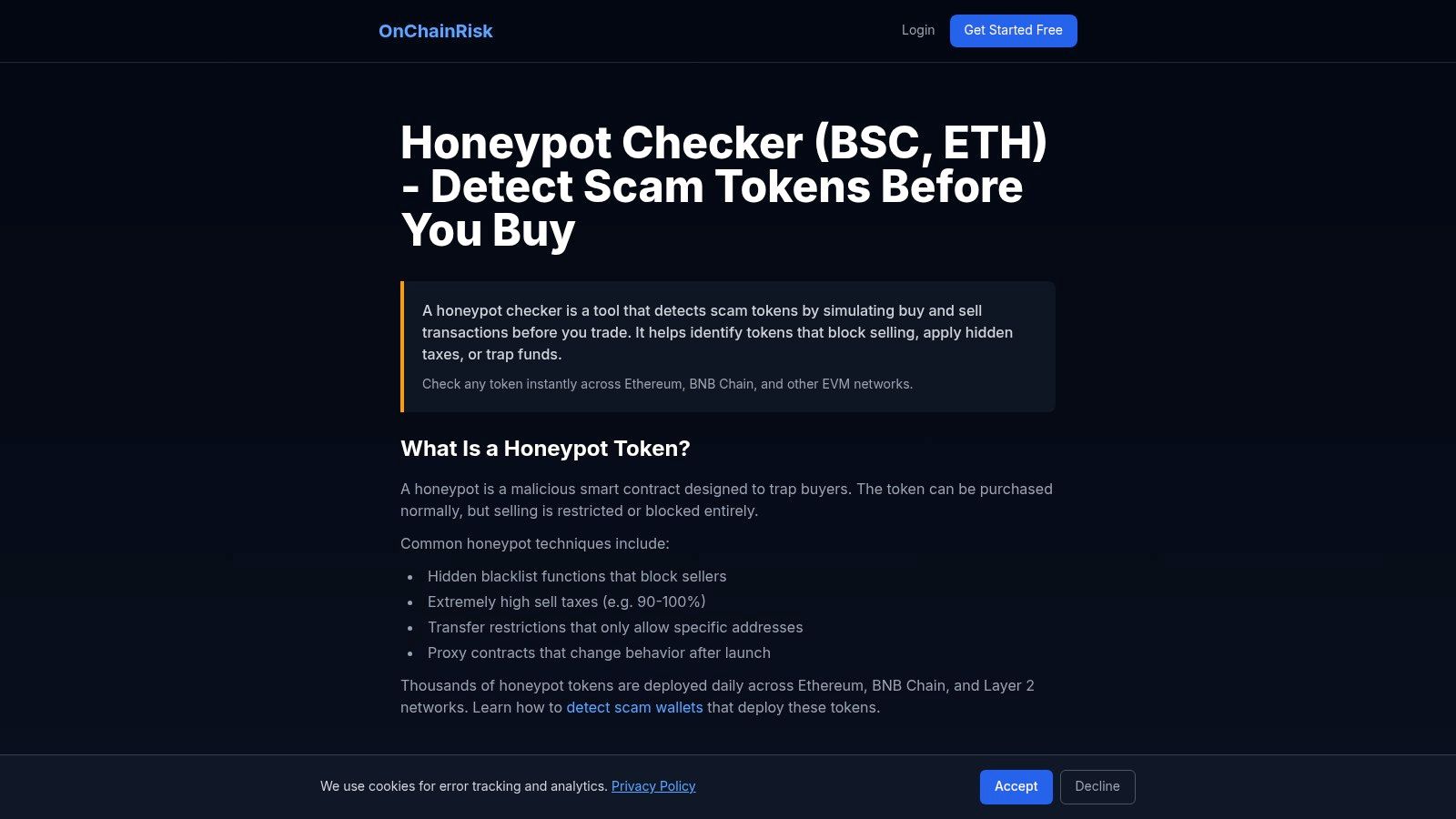
That matters because a token can technically pass a sellability check and still be a terrible trade. Holder concentration, pair behavior, and basic distribution visuals often reveal risks that a narrow detector won't emphasize.
If I'm on the fence about a token, visual context helps. I want to know whether the broader picture matches the surface-level detector result.
If the contract check says "probably okay" but the holder picture looks unhealthy, trust the conflict and dig deeper.
OnChainRisk isn't trying to win on brand familiarity. It wins when you need a quick contextual read before deciding whether the token deserves more work.
DEXTools isn't a dedicated honeypot simulator, and that's exactly why it belongs at the end of this list. It gives the market context that single-purpose detectors can't.
The pair explorer, liquidity view, and live trade feed are valuable when you're checking whether a detector result matches actual market behavior. If sells are missing, liquidity is behaving oddly, or security flags look inconsistent with what you're seeing on-chain, DEXTools helps surface that tension fast.
This isn't where I run the first security check. It's where I validate that a clean-looking token is behaving like a real market, not a staged one.
For copy trading, that distinction matters. A wallet may have bought early, but if the pair behavior turns abnormal by the time you arrive, the trade quality has changed. DEXTools helps catch that.
| Tool | ✨ Core / Unique Features | ★ Quality | 💰 Pricing / Value | 👥 Target Audience | 🏆 Best for |
|---|---|---|---|---|---|
| Honeypot.is | ✨ Live buy/sell simulation & flag taxonomy | ★★★★ | 💰 Free + API | 👥 Traders & bots (pre-trade checks) | 🏆 Pre-trade single-token checks |
| Token Sniffer | ✨ Bytecode pattern matching & "Smell Test" | ★★★★ | 💰 Freemium → Pro/Enterprise | 👥 Researchers & integrators | 🏆 Pattern-based broad screening |
| GoPlus Security | ✨ AI DeepScan audits, SDKs & dev APIs | ★★★★ | 💰 Freemium / Paid DeepScan | 👥 Dev teams, wallets & apps | 🏆 Dev-friendly embedded checks |
| De.Fi Scanner | ✨ Express audit PDFs & Shield wallet manager | ★★★ | 💰 Free | 👥 Retail traders needing fast triage | 🏆 Free quick token triage |
| StaySAFU Scanner | ✨ Telegram bot, BSC-focused tax/liquidity flags | ★★★ | 💰 Freemium / Monthly API | 👥 BSC traders & Telegram users | 🏆 Fast BSC bot workflow |
| BSCheck.eu | ✨ Explorer aggregation & newest/last-scanned dashboards | ★★★ | 💰 Free (ad-supported) | 👥 Quick cross-checkers, BSC users | 🏆 Lightweight BSC cross-reference |
| Quick Intel | ✨ Clear "can sell?" outputs + 50+ chains | ★★★★ | 💰 Freemium / Paid API | 👥 Traders & tool integrators | 🏆 Clear sellability signals at scale |
| HoneypotCheck.io | ✨ 50+ automated checks + recent-token feed | ★★★ | 💰 Free / Limited API | 👥 Retail traders wanting fast go/no-go | 🏆 Simple go/no-go UX |
| OnChainRisk Honeypot Checker | ✨ Simulation + holder charts & security score | ★★★ | 💰 Free / Limited | 👥 Traders seeking visual risk context | 🏆 Visual risk gut-checks |
| DEXTools | ✨ Pair explorer, real-time trade feed & tutorials | ★★★★ | 💰 Freemium / Pro | 👥 Traders & analysts needing market context | 🏆 Real-time market context & education |
The tools matter, but the sequence matters more. Most losses from BSC honeypots don't happen because the trader had zero access to scanners. They happen because the trader skipped the check, trusted a single result, or confused a fast-moving chart with a safe contract.
The workflow that holds up under pressure is simple. Start with the signal source. If a platform like Wallet Finder.ai shows a buy from a wallet you track, grab the contract address first, not the chart first. Run that address through one dedicated detector such as Honeypot.is or another focused checker. Then run a second scan through a broader risk tool like Token Sniffer, GoPlus, or De.Fi.
After that, check market context. Open the pair view in DEXTools or a similar explorer and look for signs that the market behavior matches the scanner result. Are there real sells? Does liquidity look normal? Are trades flowing from diverse wallets or does the activity look staged? That extra minute is often the difference between a tradable opportunity and a trap with good marketing.
Manual checks still matter. Look at ownership, transfer restrictions, taxes, verification status, and whether the contract structure gives too much power to the deployer. Automated tools are strong filters, but scammers adapt. Even advanced systems can miss unusual logic, delayed restrictions, or contract changes introduced after launch. That's why cross-referencing isn't optional.
For copy traders, the practical workflow looks like this:
This process doesn't remove risk. It cuts avoidable risk. That's the primary objective. In fast BSC environments, you won't have perfect certainty. You can still build a repeatable filter that keeps obvious scams out of your queue and leaves your attention for the setups worth real analysis.
The biggest mindset shift is this: treat honeypot detection as part of trade entry, not as a separate security chore. Once you do that, a bsc honeypot detector stops being just another utility tab and becomes part of how you preserve capital, protect your wallet, and follow strong signals without walking straight into a trap.
If you're using wallet tracking to find your next BSC trade, Wallet Finder.ai gives you the signal layer that these detectors can validate. It helps you spot profitable wallets, monitor buys and sells in real time, and build a copy trading process where every alert gets vetted before capital goes in. Used together, wallet discovery and honeypot screening create a much safer way to act on fast on-chain opportunities.

A premier DeFi analytics platform empowering traders to discover and analyze profitable blockchain wallets, trades and tokens.