Recovery Factor Calculation for Smart Traders
Master the recovery factor calculation to measure a strategy's resilience. Learn the formula, see DeFi examples, and find top wallets with Wallet Finder.ai.

June 20, 2026


Wallet Finder
May 18, 2026

There is no officially endorsed MrBeast coin, and the tokens currently trading under that name are unofficial meme coins with conflicting market data. One BEAST listing shows a price around $0.01564 with a market cap near $155.09K and $0 in reported 24-hour volume, while a separate Mr Beast coin variant shows a price around $0.000000388855, a market cap near $3,888.55, and only $41.4793 in liquidity.
If you're here because you saw “mr beast coin” trending and you're wondering whether you're early, you're already in the danger zone. The biggest mistake traders make with celebrity meme tokens isn't buying late. It's assuming the name refers to one real asset with one market.
That assumption breaks fast on-chain. “Mr Beast coin” is a loose label attached to multiple unofficial tokens, different contracts, thin pools, and a lot of room for bad fills, fake momentum, and outright contract risk. The useful question isn't “should I buy mr beast coin?” It's “which contract am I even looking at, who controls it, and can I get out if I get in?”
Celebrity tokens spread through the same loop every time. A name trends on social media, screenshots start circulating, someone posts a chart, and traders begin treating attention as legitimacy.
That doesn't work with mr beast coin. The name carries reach, but reach is not issuance, endorsement, or support. The available source material points the other way. There isn't evidence of an official token launch endorsed by Jimmy Donaldson, and coverage around these tokens describes them as community-created or unofficial meme coins (WEEX analysis of unofficial MrBeast meme coins).
Most traders don't lose on the first click. They lose in the minutes before the first buy.
They open a chart aggregator, see a live price, then assume the rest of the market structure is normal. With unofficial celebrity coins, that assumption fails because the ticker, the contract, the liquidity venue, and the holder base may all be unstable at the same time.
A practical way to think about the hype:
Practical rule: Treat celebrity branding as a warning label until the contract, liquidity, and holder distribution prove otherwise.
A better posture is to treat mr beast coin like a forensic exercise, not a fan trade.
That means slowing down and answering four questions before risking capital:
What doesn't work is chasing screenshots, trusting ticker symbols, or relying on “market cap” without checking how that figure was derived. On unofficial meme coins, the safest edge usually comes from avoiding the wrong trade, not forcing the right one.
A trader sees "BEAST" on an aggregator, spots a live price, and assumes the market has settled on one token. That assumption causes a lot of bad entries.
"Mr beast coin" is not one asset with one accepted contract. It is a rotating label attached to multiple unofficial tokens, and the first edge is figuring out which one the crowd is trading.
One widely tracked BEAST listing showed a live price, a fully diluted valuation in the same rough range, and no reported 24 hour volume, as noted earlier. Other major platforms displayed similar pricing but different supply fields and market cap assumptions. That is enough to change how I treat the trade. If supply presentation is inconsistent across large data sites, I stop looking at the chart and go back to the contract.
A separate token tracked by CoinBrain under contract 0x617a5DBB6Ce235AcdA58b86AC496D0Dcf49835F6 showed a micro-cap profile with extremely thin pool depth and weak exit conditions (CoinBrain contract listing for a separate Mr Beast coin).
Fragmented pricing is not a minor data issue. It usually points to one of three conditions: multiple contracts using the same branding, stale aggregator indexing, or a market so thin that small trades distort public metrics.
For a trader, the conclusion is practical. The ticker has almost no value without the contract address, the active pair, and proof that real holders can exit.
Use this as the baseline:
| Token view | What the listing shows | What it means for a trader |
|---|---|---|
| Widely tracked BEAST pages | Similar headline price ranges, but different supply and activity fields | Aggregators may be describing different market states, or different assumptions about the same token |
| Low-activity BEAST listing | Visible price with little or no recent trading activity reported | A quoted price does not guarantee executable size |
| CoinBrain Mr Beast variant | Separate contract with very low liquidity relative to headline value | Slippage and failed exits become the main risk, not just volatility |
The clean split looks like this:
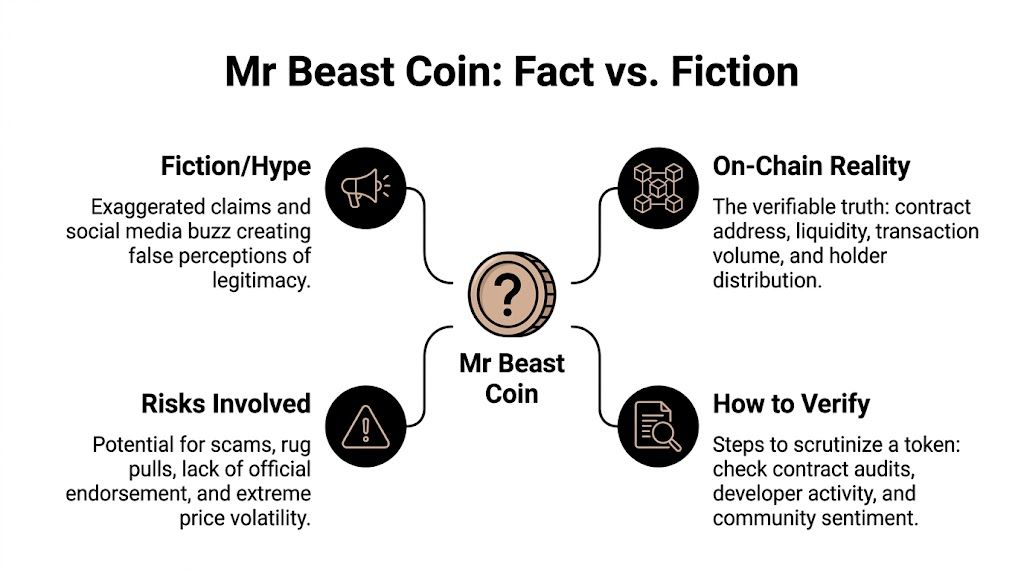
Fiction: "Mr beast coin" refers to one official token.
Fact: Multiple unofficial tokens can share the name, ticker theme, or branding.
Fiction: If several aggregators show a price, the market is validated.
Fact: Aggregators often index whatever contract gains attention first. Validation comes from contract review, liquidity depth, and holder behavior.
Fiction: Brand recognition lowers diligence requirements.
Fact: Celebrity branding raises the need for diligence because impersonation risk is part of the trade.
Fiction: Market cap is enough to judge opportunity.
Fact: On unofficial meme coins, market cap without verified supply and usable liquidity is weak analysis.
The practical move is simple. Verify the contract first, then assess whether the token is tradeable at all. If you need a quick refresher on the process, this guide on how to check a token contract address covers the basics.
I treat every new "Mr Beast Coin" as a repeatable on-chain exercise. Identify the exact contract. Confirm where liquidity sits. Check whether holder concentration can crush the chart. Then watch whether smart money wallets are entering or only retail is chasing. That framework works on this token theme, and it works again on the next celebrity coin that shows up.
Most losses on unofficial meme coins happen before the swap. They come from weak pre-trade work.
The main risk isn't only volatility. Unofficial tokens can include centralized controls, unaudited code, rug-pull paths, or honeypot behavior that lets people buy but blocks normal selling, a pattern highlighted in the earlier WEEX source on contract-level exploits. You don't need a perfect audit process to reduce that risk, but you do need a repeatable checklist.
First, find the exact contract address from the token page you're evaluating, then confirm it on a block explorer such as Etherscan or Solscan. If you're not certain how to read and verify token identifiers, this guide on checking a token contract address is a useful starting point.
What you want to know:
If the contract hides basic transparency, skip it.
A meme coin can look active and still be one wallet away from collapse.
Open the holders tab and look for obvious concentration. You're not looking for perfection. You're looking for signs that a few wallets can dominate the market, control supply, or dump into attention.
Questions worth asking:
Field note: If a token needs social momentum to survive, concentrated ownership turns every rally into a potential exit event for insiders.
Market cap is often the least useful number in this category. Liquidity tells you whether the market is tradeable.
For unofficial mr beast coin variants, this matters even more because one version had liquidity under $50 in the verified source set. A low-liquidity pool can print eye-catching gains and still be practically untradeable at size.
| Area of Concern | What to Look For (Potential Green Flag) | Major Red Flag |
|---|---|---|
| Contract control | Verified code, limited admin powers, no obvious sell restrictions | Owner can block trading, change fees sharply, or blacklist wallets |
| Supply structure | Clear fixed supply and no hidden mint path | Unclear minting rights or contradictory supply presentation |
| Holder distribution | Broad distribution with no obvious private-wallet dominance | A small wallet cluster controls too much supply |
| Liquidity pool | Visible pool, reasonable depth for your size, signs of stability | Tiny pool depth, abrupt liquidity shifts, or removable liquidity |
| Trading behavior | Real swaps on-chain with two-way flow | One-sided buys, stalled sells, or activity that looks staged |
| Audit and transparency | Public docs, verified contract, straightforward disclosures | No audit, anonymous deployer behavior, missing basic details |
The chart can mislead you. The swap history usually won't.
Open the DEX pair and inspect recent trades. You're looking for whether actual participants are both entering and exiting, whether wallets are rotating in a natural way, and whether buys are tiny and repetitive in a pattern that suggests manufactured activity.
A useful sanity check:
An audit isn't a guarantee, but no audit plus centralized controls is a combination that deserves suspicion. Also check the deployer's wallet history. If the same wallet launched multiple throwaway meme tokens, that context matters.
You don't need a long memo. You need a simple conclusion: Can this contract be trusted enough for a speculative trade? If the answer isn't clear, pass.
You find a BEAST token pumping on social, the chart is vertical, and the pair looks active. Ten minutes later, you realize there are three contracts with the same ticker, one pool has almost no depth, and the route you clicked is not the one traders are using. That is how small losses turn into expensive lessons.
Treat unofficial BEAST tokens like short-lived, low-liquidity instruments. The job is not to get in first. The job is to enter the right contract, in the right pool, at a size you can still exit.

Use the same order of operations every time:
That last step saves traders more often than any entry signal. A buy can succeed in a bad token. A clean round-trip trade is what matters.
Execution quality matters more than headline price. As noted earlier, some BEAST listings have shown a quoted price while real trading activity remained thin. In that setup, even modest orders can push price hard, trigger poor fills, and leave you boxed into an exit that is worse than expected.
A few habits help:
The biggest mistake is trading from a token name, an aggregator card, or a trending search result instead of from the verified contract path. Celebrity memecoins attract copycats fast. Duplicate tickers, dead pools, and lookalike contracts are common because attention arrives before verification.
For broader context on how attention-driven setups behave, this guide to top meme coins and their trading risks is a useful reference point.
Use the contract address as the anchor for every step. Pair selection, slippage, and position size all come after that. In these trades, survival starts with execution discipline.
A BEAST token can look tradable for an hour, print a few aggressive green candles, and still be a trap. The wallets that bought first usually matter more than the posts that made it trend. If you want a repeatable edge on any new "Mr Beast Coin" clone, study the money path before you study the meme.
On-chain review helps answer the questions that price alone cannot. Which wallets entered before attention hit. Whether those entries came from traders with a real history of rotating into new pairs early. Whether they held through volatility with a plan, or dumped into the first retail spike. This is why raw chart watching isn't enough.

The useful sequence is simple, but it takes discipline:
Tools matter here. Wallet Finder.ai wallet tracking tools let traders review wallet histories, token activity, and behavior patterns so they can judge process instead of copying hype.
Profit by itself is weak evidence.
A wallet can win on one mr beast coin variant because it was funded by related addresses, bridged in before the crowd noticed, or got exposure through a route that ordinary traders cannot repeat. That is context, not signal. A better candidate is a wallet that shows the same playbook across many launches: early entry, selective participation, controlled size, and exits before the pool thins out.
Useful filters in any wallet review:
Follow visible process. Ignore the mythology around a big win.
Say a new BEAST contract clears your first pass on contract checks and liquidity structure. Do not rush the buy. Watch the earliest active wallets for a bit and compare them against their broader history.
One wallet may show the profile you want: early entries in fresh meme pairs, quick recognition of failed launches, and exits into strength rather than into panic. Another may appear only around this token, receive transfers from clustered addresses, and sell directly into retail volume. The first wallet gives you a model to monitor. The second gives you a warning.
A short walkthrough helps here:
Use a framework:
That approach does not make celebrity memecoins safe. It makes your decision process more grounded. For unofficial BEAST tokens, that is the difference between guessing and running a repeatable on-chain setup.
The verdict on mr beast coin is simple. Treat every version of it as a high-risk, unofficial meme token unless a verified issuer and contract prove otherwise.
That doesn't mean no one can trade it. It means the only sensible approach is narrow sizing, contract-level verification, liquidity-first analysis, and wallet tracking before execution. If you skip those steps, you're not taking calculated risk. You're donating to chaos.
The bigger story is that MrBeast's actual business orbit looks more like fintech infrastructure than memecoin issuance. Recent coverage noted that Beast Industries received a $200 million strategic investment from BitMine Immersion Technologies and then acquired Step, a Gen Z banking app with 6.5 million users and FDIC-backed spending accounts (CoinMarketCap Academy coverage of the Step acquisition). That's a very different direction from an official celebrity memecoin launch.
For traders, that distinction matters. The meme coin story is mostly unofficial branding plus speculation. The more serious long-term angle is whether creator businesses use regulated finance rails, banking apps, payments, loyalty systems, or tokenized products instead of launching hype-driven coins.
That future is less exciting on a one-hour chart. It's also more real.
If you want to analyze wallets before touching any unofficial mr beast coin, Wallet Finder.ai gives you a practical way to inspect trading histories, monitor smart-money behavior, and build alerts around the addresses that matter instead of trading off hype alone.

A premier DeFi analytics platform empowering traders to discover and analyze profitable blockchain wallets, trades and tokens.