Token Contract Address: Find, Verify & Avoid Scams

Wallet Finder

Blank calendar icon with grid of squares representing days.

April 9, 2026

A new token starts trending. You see screenshots of early buys, a few wallet trackers lighting up, and chat rooms posting what looks like the ticker you need to catch before everyone else does.

Then the problem appears. Two different token contract addresses are circulating. One is probably real. The other may be a clone built to trap late buyers, split liquidity, or impersonate the original. If you trade the wrong one, the chart can still look active while your exit path disappears.

That is why the token contract address matters so much. It is not background technical detail. It is the identity layer of the asset you are about to buy, track, import, or copy from another wallet. If you trade DeFi seriously, you need to know how to find it, verify it, and use it without making the common mistakes that wipe out otherwise good trade ideas.

The Trader's Dilemma A New Token Appears

A trader spots a new launch on social media. The token is moving fast, and a few recognizable wallets have already touched it. The ticker looks right. The logo looks right. The replies are full of urgency.

Then the first real check happens on a block explorer. There is more than one contract using the same name or symbol.

This is a normal DeFi problem. Tickers are cheap to copy. Logos are cheap to copy. Narratives are cheap to copy. The token contract address is what separates the asset from the lookalike.

For traders, this changes the workflow completely. You are not asking, “Is this the right token name?” You are asking, “Am I interacting with the exact smart contract that the market, the team, and the smart money wallets are using?”

Why this matters in live trading

When speed matters, traders often cut corners. They paste a contract from a Telegram post, import a token from a random DEX search result, or mirror a wallet trade without checking whether the wallet bought the original contract or a copy.

That is how good setups turn into bad executions.

A contract address is the anchor for almost everything that follows:

  • Wallet imports: Your wallet needs the correct contract to display the right asset.
  • DEX swaps: The pool you trade against is tied to a specific token contract.
  • Explorer research: Holder data, transfers, and bytecode all point back to that address.
  • Copy trading: If you mirror a wallet, you need the exact contract they bought, not a token with a similar ticker.

Practical takeaway: In DeFi, the address is the asset. Treat the name and symbol as labels, not proof.

What separates careful traders from reactive traders

Careful traders slow down for one minute before they commit capital. They verify the address, confirm the network, check whether the contract is verified, and inspect whether trading activity looks organic.

Reactive traders skip those checks because they fear missing the move. Usually, they are not avoiding risk. They are just moving it from market risk to contract risk.

That is a bad trade-off. Market risk can be managed. Contract risk can make the position worthless before the market even has a chance to move in your favor.

What Exactly Is a Token Contract Address

A token contract address is the unique on-chain identifier for the smart contract that defines a token. On Ethereum and similar networks, that contract contains the token’s rules, including how balances are tracked and how transfers work.

The easiest way to think about it is this. The contract address is like a bank’s headquarters. Your wallet address is your personal account number. You interact with the bank’s system through the main office, but your funds belong in your own account, not in the building itself.
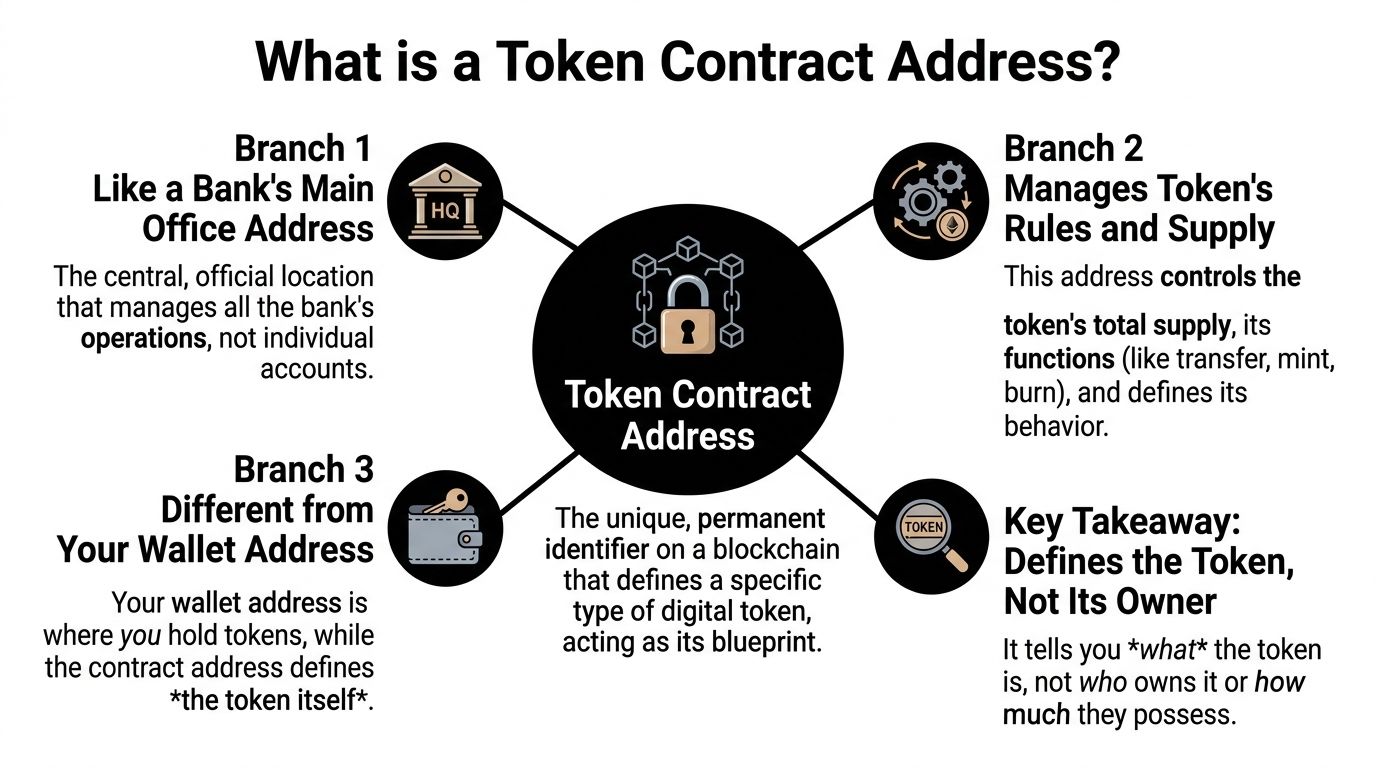
Infographic

What the contract controls

A token contract is not just a label on-chain. It is the executable rulebook for the asset.

For ERC-20 tokens, that typically includes functions such as:

  • balanceOf(address) to read how many tokens a wallet holds
  • transferFrom(address _from, address _to, uint256 _value) to move tokens under approved conditions
  • totalSupply() to expose the token’s total supply

That is why wallets, DEXs, portfolio trackers, and analytics tools all rely on the contract address. They are querying the contract directly to understand what the token is and how balances move.

Why each address is unique

A token contract address is generated deterministically from the deployer and their nonce. That makes it unique on its chain and immutable once deployed. The practical implication is simple. Once traders, wallets, and dApps point to that contract, they are all referring to the same on-chain object.

This also explains why chain context matters. The same token brand can exist on multiple networks, but each network has its own contract address.

The mistake that keeps costing traders money

The bank analogy matters for one more reason. You do not send your money to the bank’s building. You send it to your own account or to another person’s account.

The same logic applies here. If you send tokens directly to the token contract address itself, those assets can become permanently stuck. The reason is mechanical. The contract often has no logic to receive and reassign those tokens back out. According to Cointracker’s explanation of contract addresses, this mistake has historically led to over $100M in frozen ERC-20 assets.

That is not an edge case. It is a recurring operational error.

Tip: Before any transfer, ask one question. Am I sending to a wallet that can own and control tokens, or am I sending to a contract that was never designed to hold them on my behalf?

What traders should remember

A token contract address tells you:

What it tells youWhat it does not tell you
Which exact token contract you are looking atWhether the token is safe
Which rules govern balances and transfersWhether liquidity is healthy
Which asset your wallet or DEX should recognizeWhether the project team is trustworthy

That distinction matters. The address identifies the asset. Verification tells you whether the asset is worth touching.

How to Locate the Correct Contract Address

Finding a token contract address is easy. Finding the correct one under time pressure is where traders make mistakes.

The safest approach is to use a hierarchy of trust. Start with the most direct source, then confirm it through an independent source, then inspect it on a block explorer before you trade.

Start with official project channels

The first place to look is the project’s own documentation, website, or official announcements. If a team is legitimate, they usually publish the contract address where users can copy it directly.

That said, this is not enough on its own. Social accounts get compromised. Fake reply threads appear under real announcements. Even the right website can be spoofed if you click the wrong link.

Use official channels as the first clue, not the final answer.

A practical routine works well:

  1. Find the address on the project’s official site or docs.
  2. Compare it against another trusted listing.
  3. Open it on a block explorer and inspect the contract page.

Confirm with a trusted token data platform

Aggregators are useful because they normalize token metadata and tie it back to a specific network. If a token is listed on a service such as CoinGecko, you can usually view the contract address tied to that listing.

This is especially helpful when a token exists on more than one chain. The listing usually separates Ethereum from Base, Solana, and other networks instead of presenting one universal address.

Use these platforms to reduce transcription mistakes. Copying from a recognized listing is safer than copying from a screenshot or a chat message.

Use a block explorer as the final check

Block explorers are where the contract becomes real. You can inspect:

  • Whether source code is verified
  • Whether transfers are active
  • Whether holders look organic
  • Whether the contract was deployed recently
  • Whether the address is tagged or recognized

If you are new to explorer workflows, this guide on what a blockchain explorer is gives a useful foundation.

Pull it from the DEX interface carefully

Sometimes the fastest route is through the DEX where the token trades. On Uniswap, Jupiter, and similar interfaces, importing a token often reveals the contract address directly.

This method is useful, but it can also create false confidence. DEX search bars can surface multiple tokens with the same symbol. The presence of a pool does not prove legitimacy. Clones often create small pools precisely to appear tradable.

Use the DEX to confirm what the market is trading. Do not use it as your only source of truth.

Key habit: If you found a token through a DEX search, stop before swapping and compare that contract against an explorer and a trusted listing.

A practical source ranking

Here is the order I trust most in live trading:

| Source type | Best use | Main risk |
|---|---|
| Official docs or website | Initial discovery | Spoofed links or compromised social posts |
| CoinGecko or similar aggregator | Independent confirmation | Delayed listings for very new launches |
| Block explorer | Final verification | User error when reading cloned contracts |
| DEX interface | Execution check | Symbol collisions and misleading pools |

What works and what does not

What works

  • Checking the address in at least two places
  • Opening the contract page before any swap
  • Matching the network before copying the address
  • Looking for verified code and genuine transfer activity

What does not

  • Trusting a ticker alone
  • Copying addresses from screenshots
  • Using the first DEX search result without inspection
  • Assuming one token has one address everywhere

Most losses around token contract address mistakes are not caused by difficult analysis. They come from skipping basic verification while trying to move fast.

Understanding Cross-Chain Contract Addresses

A trader copies a winning wallet on Base, buys the same ticker on Ethereum, and still ends up in the wrong asset. That mistake happens every day because token symbols travel across chains, but contract addresses do not.

USDC makes the point clearly. Its Ethereum contract address is 0xA0b86991c6218b36c1d19D4a2e9Eb0cE3606eB48. That address identifies Ethereum USDC only. It does not apply on Solana, Base, Arbitrum, or any other network.

A conceptual illustration showing two separate blockchain islands with a silver coin connecting token IDs.

One token brand, separate contracts

Each chain runs its own settlement environment, its own liquidity, and its own contract registry. Even when the asset name stays the same, the on-chain identity changes with the network.

On Ethereum and Base, the format looks familiar because both are EVM chains. Traders still need the contract that belongs to that specific chain. Solana adds another layer of confusion because the token architecture is different, so the identifier and verification process are not interchangeable with EVM habits.

This matters fast in copy trading. If a smart wallet buys a token on Base, the profitable move is not "buy the same ticker anywhere." The profitable move is "confirm the exact chain, then confirm the exact contract, then decide whether the setup on that chain still offers good entry conditions."

Where cross-chain mistakes hurt PnL

Cross-chain confusion creates three expensive problems:

  • Bad copy trades. You mirror the symbol but miss the actual asset the wallet bought.
  • Failed transfers and bridges. Funds land on the wrong network or in the wrong token version.
  • Broken market reads. Liquidity, holder concentration, and slippage can look completely different from one chain to another.

That last point gets underestimated. A token can trade tightly on one chain and be thin, manipulated, or barely active on another. If you track whale accumulation or try to front-run momentum, chain-level differences change the trade.

Each chain operates like its own market venue. USDC can exist in several venues at once, but each one has its own address, liquidity profile, and trading behavior.

The practical check that avoids confusion

Serious traders verify three fields together every time:

  1. Token name
  2. Exact contract address
  3. Exact network

Miss one, and the rest of your analysis can be correct while the trade is still wrong.

This is also why automated research tools matter in DeFi copy trading. Manual checks work when you have time. They break down when you are chasing a fast wallet across multiple chains and trying to separate the intended contract from copycats in minutes. Platforms such as Wallet Finder.ai shorten that process by tying wallet activity to the actual asset and network, which removes a common source of avoidable losses.

For a tighter security perspective, read how cross-chain contract calls impact DeFi security.

A short visual explainer helps here:

Rule of thumb: Before any bridge, swap, or copy trade, confirm the network first, then confirm the contract address for that network. In multi-chain trading, that order prevents a large share of avoidable mistakes.

Verifying Addresses and Spotting Security Red Flags

A wallet you track buys a new token. The chart is vertical, the ticker looks familiar, and social posts are calling it the next runner. You copy the contract, pull up the explorer, and now the actual work begins. This is the point where DeFi copy traders either protect capital or donate it.

Contract verification is not admin work. It is trade selection.

A bad token can look active for long enough to trap fast followers. The logo can be clean. The pair can have liquidity. The feed can show buys every second. None of that matters if the contract gives insiders control, blocks exits, or sits inside a market structure built to unload on late entrants.

Good traders filter these setups fast. Copy traders need to be even stricter, because speed creates pressure to trust what the lead wallet bought without checking whether the contract is safe to follow. That is one reason automated research matters. Wallet Finder.ai helps connect wallet activity to the actual token contract and surfaces the diligence that traders often skip when a move is happening in real time.

What a serious verification pass looks like

Start on the block explorer. Read the contract page before you read the chart.

Check whether the source code is verified

Verified code does not mean safe. It does mean visible. If the source is unverified, you cannot inspect transfer rules, tax logic, blacklist functions, mint permissions, or owner controls. For a new token, that alone is enough to pass on many trades.

Check who controls supply

Open the holders tab and look for concentration. A token can still pump with concentrated ownership, but the trade changes. One wallet holding too much supply, or a tight cluster of related wallets controlling most of the float, means your upside depends on their behavior more than market demand.

Check whether transfers look organic

Use the transactions and transfers tabs. Activity usually comes from mixed wallet sizes, irregular timing, and both buys and sells. Manufactured activity often shows repeating wallet patterns, tiny loops, or bursts that look coordinated.

Read the flow, not just the candle.

Check the deployer and linked wallets

The creator wallet often tells you more than the website. If the deployer funded multiple low-quality launches, dumped early in past tokens, or has no credible trail at all, assume the same standards apply here.

Red flags worth acting on

Use this checklist before entering any unfamiliar token:

Red FlagWhat it MeansHow to Check
Unverified source codeCore token logic is hiddenCheck the contract page on a block explorer for verified code status
Very low unique holder countOwnership may be thin, fragile, or concentratedReview the holders tab and recent transfers on the explorer
Duplicate name or symbolA copycat may be impersonating the authentic assetSearch the ticker, then compare every listed contract address
Suspicious transfer patternsVolume may be manufacturedRead recent transactions and look for repeating wallet behavior
No credible deployer trailThe token may be tied to disposable walletsOpen the creator address and inspect prior deployments and funding sources
Hidden sell riskYou may be able to buy but not exit cleanlyCheck contract permissions, scan community reports, and test with caution
Liquidity that looks safer than it isA pool exists, but trade conditions can still be hostileCompare pool depth, holder growth, and real sell activity together

Honeypot risk shows up in combinations

A honeypot rarely announces itself. The pattern is usually more obvious than any single clue.

Look for easy buys, weak evidence of successful sells, vague answers in community channels, poor contract transparency, and hype that outruns holder growth. One warning sign is manageable. Three warnings in the same token usually mean the trade is not worth the effort.

A practical pre-trade screen helps here. This guide to a rug checker for crypto fits well into a repeatable verification process.

The trading rule that saves money

Do not try to prove a token is safe. Try to disqualify it quickly.

That mindset works better in fast DeFi markets, especially in copy trading. If a contract raises two or three serious concerns before entry, move on. There will be another setup. Capital trapped in a bad token cannot follow the next good wallet.

Practical Use Cases for Traders and Investors

A token contract address becomes useful the moment you stop treating it as reference data and start using it in your daily workflow.

For traders and investors, three use cases matter most. Wallet visibility, precise DEX execution, and accurate portfolio tracking.

Adding a custom token to a wallet

Sometimes a token does not show up automatically in MetaMask, Phantom, or another wallet. The fix is usually simple. You import it manually using the token contract address.

Many users stumble at this point. According to MetaMask’s token contract address guidance, token contract addresses enable standardized ERC-20 interoperability and power over 95% of Ethereum’s DeFi TVL, while 70% of custom token import failures come from users pasting fake addresses. That is why cross-verifying the address before import matters so much.

A clean import process looks like this:

  1. Copy the contract address from a trusted listing or block explorer.
  2. Confirm the network inside your wallet first.
  3. Paste the address into the custom token import field.
  4. Review the token metadata before confirming.

If the wallet populates odd metadata, stop and recheck.

Swapping the exact asset you intend to buy

On a DEX, the contract address is your precision tool. Search by ticker if you want, but confirm by address before you swap.

This matters most when:

  • A token name is common
  • Clones are circulating
  • A launch is fresh and social channels are noisy
  • You are mirroring another wallet’s entry

A search result can be directionally helpful. The address is what removes ambiguity.

Key takeaway: On a DEX, the ticker helps you search. The token contract address confirms what you are trading.

Powering portfolio trackers and analytics

Portfolio tools depend on contract addresses to identify what sits in your wallet. Functions like balanceOf(address) let wallets and dApps query balances directly from the token contract, which is why holdings can be tracked without asking a centralized party for permission.

For traders, that makes the token contract address the common thread across:

  • Wallet dashboards
  • PnL tracking tools
  • Trade history exports
  • Multi-wallet monitoring
  • Risk dashboards for open positions

Daily workflow map

TaskWhy the token contract address matters
Importing a tokenIt tells the wallet which asset to display
Swapping on a DEXIt removes confusion between identical tickers
Tracking PnLIt lets analytics tools map balances and trade activity correctly
Monitoring copy tradesIt confirms the exact asset another wallet bought or sold

Most traders think of a token contract address as something they look up only when they need it. In practice, it is the lookup key that keeps your wallet, execution, and analytics aligned.

How Wallet Finder.ai Automates Contract Address Research

Manual contract work is fine when you are researching one token. It breaks down when you are tracking many wallets, many chains, and a constant stream of new trades.

That is where automation matters. The value is not just speed. It is consistency. A good workflow should surface the exact token contract address attached to a trade, tie it to wallet behavior, and reduce the chance that you copy the wrong asset from a noisy market feed.

Screenshot from https://www.walletfinder.ai/

Where automation helps most

When traders monitor profitable wallets, they usually care about a few questions:

  • What token did the wallet buy?
  • On which network did it happen?
  • Was the asset identifiable and tradeable at the time?
  • Does the surrounding activity look credible enough to follow?

Doing that by hand means moving between wallets, explorers, DEXs, and token pages over and over. The error rate rises as soon as market pace picks up.

How the workflow improves

A platform built around wallet tracking can turn contract address research into an operational layer instead of a manual task. The useful output is not just the address itself. It is the address connected to context:

  • The trade that used it
  • The wallet that entered
  • The timing of entry and exit
  • The broader token activity around that move

For copy traders, that matters because execution mistakes usually happen between observation and action. You see a winning wallet move. You rush to find the token. You search by name. You end up on the wrong contract or the wrong chain.

The better workflow is one where the trade and the contract are already linked.

What this changes for practitioners

For serious on-chain traders, a key advantage is not convenience. It is cleaner decision-making.

Instead of spending time piecing together identity, you can spend time evaluating:

  • Whether the wallet you are following has a strong pattern
  • Whether the token’s activity fits your risk appetite
  • Whether the setup is still early enough to matter
  • Whether the contract and the market structure look good enough to act on

That is the practical role of automation in token contract address research. It reduces clerical mistakes so your judgment can focus on trade quality.

The Foundation of Safe and Smart Trading

A token contract address is the base layer of identity in DeFi. If you get it wrong, everything built on top of it goes wrong too. Wallet imports fail. Swaps hit clones. Copy trades miss the actual asset. Portfolio tracking becomes unreliable.

If you get it right, your workflow sharpens. You can identify the exact token, verify it on-chain, separate originals from fakes, and execute with more confidence across wallets, DEXs, and multiple networks.

The traders who stay solvent in fast markets are rarely the ones clicking first. They are the ones validating first. They know a token name is marketing. A contract address is evidence. Treat every new token contract address as something to verify, not something to trust by default. That single habit will protect capital, improve execution, and keep your research tied to the authentic asset instead of the loudest version of it.


Wallet Finder.ai helps traders turn raw on-chain activity into usable signals by tying wallet behavior, token discovery, and trade history back to the exact assets being traded. If you want a faster way to track smart money across Ethereum, Solana, Base, and more, explore Wallet Finder.ai.