Chain Trade Size Chart: Spot Smart Money Moves
Master the on-chain trade size chart to analyze market structure and copy trade with precision. Learn to build and read charts with Wallet Finder.ai.

May 24, 2026
Wallet Finder

May 24, 2026

You're watching a wallet you trust ape into a move. You copy the trade, hit confirm, and then nothing happens. Your transaction sits pending while price runs away. By the time it lands, your entry is worse, your slippage is uglier, and the wallet you followed is already in profit.
That's not a research problem. It's an execution problem.
A gas fee estimator fixes more than cost. Used properly, it helps you decide whether to chase, wait, speed up, or skip the trade entirely. For copy traders, that's edge. On-chain, the trader who gets included at the right moment often beats the trader who had the better thesis.
Most traders learn gas fees as a nuisance. They think about them right before clicking confirm, usually after seeing a bigger number than expected. That mindset leaves money on the table because gas isn't just overhead. It's part of trade timing.
If you're copy trading profitable wallets, gas is the spread between seeing the move and participating in it. A wallet can buy a breakout, and you can still lose on the same idea if your transaction lands late. In memecoins, launch trades, and thin liquidity setups, a slow inclusion can matter more than a slightly better token thesis.
A lot of newer traders focus on charts, alerts, and wallet tracking, then leave transaction settings on autopilot. That works until the market gets crowded. When a feed catches attention and many traders pile into the same contract, the winning move often goes to the trader who reads fee conditions correctly and reacts first.
Blocknative describes how modern estimators use pending mempool data and statistical modeling across Ethereum and major EVM networks. It also notes a broader shift after scaling upgrades, with one 2026 industry summary reporting average Ethereum transaction fees of about $0.30 to $0.34 by late 2025, down roughly 95% from earlier peaks, and average gas prices dropping from about 72 gwei in early 2024 to around 2.7 gwei by March 2025. Those figures matter because lower average fees don't remove competition. They make timing even more tradable because more users are willing to transact when costs feel manageable (Blocknative gas extension documentation).
Practical rule: Don't treat a gas estimate as a receipt. Treat it as a live quote for market access.
A good gas read helps in three places:
The strongest traders don't ask only, “What will this transaction cost?” They ask, “What does this estimate say about whether this trade is still worth taking?”
That shift turns a gas fee estimator from a calculator into a trading tool.
Gas is the cost of computation on-chain. The easiest way to think about it is a toll road with two moving parts. First, how long your trip is. Second, how crowded the road is when you enter.
On Ethereum, the gas limit is the amount of computational work your transaction is allowed to consume. The fee rate is shaped by the network's pricing model. A post-London estimator uses the formula gas limit × (base fee + optional tip). For a standard Ethereum transfer, the default gas limit is 21,000 units, gas prices are commonly quoted in gwei, and 1 gwei equals 0.000000001 ETH. If the base fee is 30 gwei and the gas limit is 21,000, the cost is 630,000 gwei, or 0.00063 ETH. The fee is paid in ETH from the sender's balance, not from the token being transferred (World gas fee explainer).
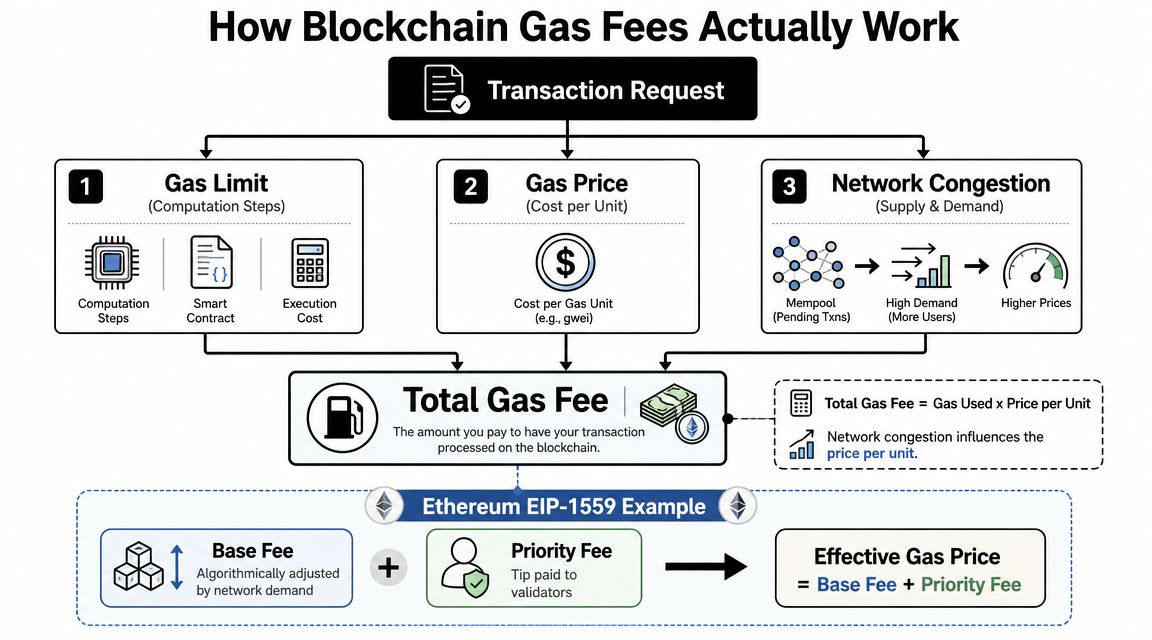
Ethereum's fee model works like a venue with a mandatory cover charge and an optional line-skip fee.
That means a swap is never just “the gas price.” It's the combination of execution complexity and the current block market.
If you want a trader-focused primer on the chain itself, this guide on Ethereum gas fees is useful background.
A plain ETH transfer is predictable. A DeFi trade isn't. A swap can touch a router, pool, token contract, approval state, and balance checks. More code paths usually mean more gas consumption uncertainty.
That's why traders get blindsided when a wallet shows one estimate on the confirm screen and the final outcome feels different. The wallet can quote the current fee environment, but your transaction's complexity still matters.
| Transaction type | What usually drives cost | What traders should expect |
|---|---|---|
| Simple transfer | Mostly current fee market | More stable estimation |
| Token approval | Contract logic and token implementation | Can vary more than expected |
| DEX swap | Router path, state changes, calldata | Higher estimation risk |
| Multi-step interaction | Combined contract execution | Biggest gap between rough estimate and actual behavior |
When blocks are calm, average wallet presets often work. When a mint, volatility spike, or copy-trading surge hits, preset labels become less useful. “Fast” only helps if the recommended fee still matches current demand.
On-chain, urgency has a price. The question isn't whether to pay it. The question is whether the trade still has enough edge after you pay it.
This is why gas literacy belongs next to slippage literacy. You're not buying computation for its own sake. You're buying a place in line.
A serious gas fee estimator does more than display a single number. It's trying to predict what fee will get your transaction included under current conditions, for a specific confirmation target.
Ethereum's own documentation makes the engineering constraint clear. Under the post-EIP-1559 model, total cost is gas used multiplied by base fee plus priority fee, and estimators have to forecast both the next-block base fee and the likely tip needed for a target inclusion time. Ethereum also notes that 1 gwei = 10^-9 ETH and gives the example of 21,000 gas at 10 gwei base fee plus 2 gwei priority fee totaling 252,000 gwei, or 0.000252 ETH (Ethereum developer gas documentation).
A useful estimator is usually combining four moving inputs.
Current base fee trend
It looks at recent block conditions to infer what the next block market may look like.
Priority fee pressure
It estimates how much tip your transaction likely needs if you care about landing quickly.
Mempool competition
Pending transactions tell the estimator whether lots of users are already bidding for inclusion.
Transaction shape
A wallet or API may simulate the call or infer likely gas usage from similar interactions.
Bad estimators behave like static averages. They can look fine during quiet periods, then fail exactly when traders need them most.
Common failure modes include:
The best estimator outputs are actionable because they answer trader questions directly.
| Estimator output | What it tells you | Trading use |
|---|---|---|
| Expected base fee | Current protocol cost floor | Whether timing is favorable |
| Suggested priority fee | Speed premium | Whether to push for faster inclusion |
| Confidence tiers | Likelihood of inclusion | Whether the trade can tolerate delay |
| Gas limit estimate | Execution complexity | Whether the contract call is routine or risky |
A good estimate doesn't promise certainty. It gives you a probability-weighted quote for access to the next few blocks. That's what makes it useful for trading decisions instead of just wallet UI decoration.
Copy trading changes the way you should read a gas estimate. You're not just asking what the chain costs. You're asking whether your entry quality survives the race to follow another wallet.

The first rule is simple. If the lead wallet already got the cleanest fill, your fee decision has to account for what price may do while you wait. A cheap transaction that lands late can be more expensive than an aggressive transaction that lands on time.
Before copying a wallet trade, read the estimate alongside the setup:
MetaMask points out that gas estimation isn't only about fee-per-gas. The gas limit matters because simple ETH or ERC-721 transfers typically use about 21,000 gas, while contract interactions vary based on state changes, storage writes, and calldata size. It recommends checking prior transactions to the same contract on a block explorer because actual gas used by other users is often the best proxy for your own path. The practical takeaway is that fee estimation errors and gas-unit estimation errors multiply each other (MetaMask gas estimation guidance).
That matters a lot in copy trading. If the wallet you follow is swapping through a contract you've never touched, your approval state and route may differ from theirs. Same token idea. Different gas path.
A quick visual helps frame the difference between guessing and trading with intent.
When the estimate comes in, make one of four calls.
Desk habit: If you wouldn't open the trade at the expected landed price, don't submit just because the target wallet already did.
Replace-by-fee works best when your original thesis is still valid. If the wallet you're copying bought a breakout and your transaction is stuck, raising the fee can save the trade. If the token already sprinted away and liquidity got thin, speeding up a bad fill only locks in a weaker position.
The same goes for slippage. A higher gas fee and a wider slippage setting both increase execution probability, but they solve different problems. Gas buys place in line. Slippage buys tolerance for price movement. Traders often overuse the second when the first was the actual bottleneck.
| Chain | Primary Fee Driver | Trader's Action | Best for |
|---|---|---|---|
| Ethereum | Base fee plus priority fee under active competition | Pay for speed when the wallet entry still has room to work | High-value trades where fill quality matters |
| Solana | Local fee pressure and priority settings | Push priority only when speed clearly affects entry quality | Fast copy trading and active rotation |
| Base | Lower-fee EVM environment with app-specific bursts | Keep fees disciplined and focus more on routing and slippage | Smaller size, testing, and frequent execution |
Batching can also help, but only when it reduces friction without bloating the transaction into something harder to land. For copy traders, separate approvals and swaps can sometimes be cleaner than one giant all-in-one attempt.
Manual clicking is fine until the trade arrives while you're away from the screen or while conditions are changing too fast to babysit settings. That's where estimator APIs help. They let you turn fee logic into execution rules.

A useful bot doesn't just fetch a gas number and fire. It should compare the estimate to the trade's expected edge.
A practical workflow looks like this:
If you're also building price-aware automation, this overview of an API for crypto prices pairs well with estimator logic because fee decisions only make sense in context of price and liquidity.
on trade_signal(signal):fee_quote = get_gas_estimate(chain=signal.chain, speed="fast")gas_limit = estimate_transaction_gas(signal.tx)if not thesis_is_valid(signal):stopif fee_is_too_expensive(fee_quote, signal.expected_edge):wait_and_recheck()tx = build_transaction(signal.tx,max_fee=fee_quote.max_fee,priority_fee=fee_quote.priority_fee,gas_limit=gas_limit)send(tx)while tx_pending(tx):if thesis_invalidated(signal):cancel_or_replace(tx)stopif inclusion_too_slow(tx) and thesis_is_valid(signal):tx = replace_with_higher_fee(tx)The traders who automate well usually do three things consistently:
Automation isn't about always paying more. It's about paying intentionally, at machine speed, when the setup still deserves it.
Most gas fee estimator content assumes the estimate is close enough if you refresh the page and pick “fast.” That's too trusting for active traders. Estimates are forecasts. Forecasts break when conditions shift.
Amberdata highlights this neglected point directly. Modern estimators often use mempool inspection and machine-learning models, but outputs can still diverge during sudden congestion spikes. It also argues that traders should know what data source an estimator uses and should sanity-check estimates against recent blocks or explorer traces (Amberdata on ETH gas estimation reliability).

Here's where estimates usually fail in practice:
Before you confirm, run through this:
For active execution, a dedicated workflow for tracking gas fees on high-frequency DeFi trades is worth building into your process.
Don't validate gas in isolation. Validate it against the trade you'll actually get if the transaction lands late.
The point isn't to find a perfect estimate. It's to avoid the lazy errors that turn a manageable fee market into a bad fill.
Gas limit is the maximum computation you allow. Gas used is what the transaction consumes. If the transaction uses less than the limit, you're not paying for imaginary work. The limit is there so execution has room to finish.
In practice, if you want a public blockchain transaction included, you need to pay according to that network's rules. Trying to force a zero-fee approach on a live market usually means your transaction won't get processed.
Because fee level and gas limit are different knobs. A high fee per unit doesn't help if you didn't allow enough units for the transaction to complete. Traders often solve the wrong problem by increasing urgency when the underlying issue is execution complexity.
They're simplified bundles of fee assumptions. The wallet is usually mapping each preset to a different target inclusion speed. That can be convenient, but it can also hide whether the recommendation reflects current mempool pressure or just a broad heuristic.
No. Choose the fee tier that still leaves the trade with edge after expected execution. Fast only makes sense when the setup is still attractive at the likely landed price.
Cancel when the thesis changed. If the wallet you copied already exited, price stretched too far, or liquidity deteriorated, a faster bad trade is still a bad trade.
If you want to turn wallet tracking into faster, cleaner execution decisions, Wallet Finder.ai helps you monitor profitable wallets, spot trades as they happen, and react before the crowd catches up. For DeFi copy traders, that means less time digging through scattered on-chain data and more time acting on real signals.