Chain Trade Size Chart: Spot Smart Money Moves

Wallet Finder

Blank calendar icon with grid of squares representing days.

May 24, 2026

You're probably staring at a token that just printed a clean volume spike. Candles look alive. Feeds are getting louder. A few wallets you recognize have touched it, but you still can't answer the only question that matters before entry.

Who is behind the move?

That's where most traders stay blind. A basic volume chart tells you activity increased. It doesn't tell you whether that activity came from scattered retail buys, a cluster of repeat midsize entries, or a few large wallets building size with intent. If you're trying to mirror profitable wallets instead of chasing delayed narratives, that gap matters.

A Chain Trade Size Chart fixes that. Instead of treating all volume as equal, it breaks flow into trade-size buckets and tracks how those buckets behave over time. Done properly, it gives you a cleaner read on participation quality, pressure, and timing. It also helps you separate noise from positioning, which is the difference between reacting late and moving with the wallets that usually get there first.

Beyond Volume Why Trade Size Distribution Matters

A lot of traders have the same failure mode. They see volume expand, check a few wallets, notice green candles, then convince themselves the move is institutional. Sometimes it is. Often it isn't.

A token can print heavy activity for bad reasons. Airdrop farmers can rotate through it. Small wallets can pile in after a social spike. Bots can hammer a low-liquidity pair and make the tape look more important than it is. If you only watch raw volume, all of that gets compressed into one blunt signal.

Why plain volume stops helping

Volume is broad. Trade size distribution is specific.

If a chart shows rising activity but nearly all of it sits in the smallest buckets, you're usually looking at crowd participation, speculation, or reactive flow. If larger buckets start appearing repeatedly while price stays relatively contained, that's a very different setup. You're no longer asking whether the market is active. You're asking which class of participant is active.

That distinction matters more than is commonly acknowledged.

Practical rule: A volume spike without trade-size context is just motion. It's not positioning.

This is also where many traders misuse wallet tracking. They copy a known wallet after it buys, but they don't check whether that buy happened in a broader pattern of similar-sized accumulation across the market. One wallet entry can be a test fill. A broader cluster of larger trades says more.

If you already use crypto volume analysis frameworks, the next step is to stop reading volume as a single line and start reading it as a stack of participants.

The real edge

The edge isn't in noticing that people traded. Everyone can see that.

The edge is in seeing that:

  • Large trades are increasing while price is still flat
  • Mid-sized participation is replacing earlier whale flow
  • Small trades are exploding after a run, which often means late entrants are taking over
  • Selling pressure is broad-based across buckets instead of isolated to one cohort

That's the kind of read that improves entries and exits.

A Chain Trade Size Chart gives structure to what good on-chain traders already do manually. It turns “this feels like smart money” into a repeatable visual process. And once you can chart that behavior, you can connect it to wallet-level execution instead of relying on vibes and screenshots.

Defining the Chain Trade Size Chart

A Chain Trade Size Chart is a market participation chart. It groups trades into value ranges, then tracks those groups across time so you can see who's driving the tape.

That sounds simple, but it changes how you read a market.

A normal volume chart answers one question: how much traded? A Chain Trade Size Chart answers a better one: what mix of trade sizes created that activity? In crypto, that's often the difference between spotting deliberate accumulation and buying into a crowded reaction.
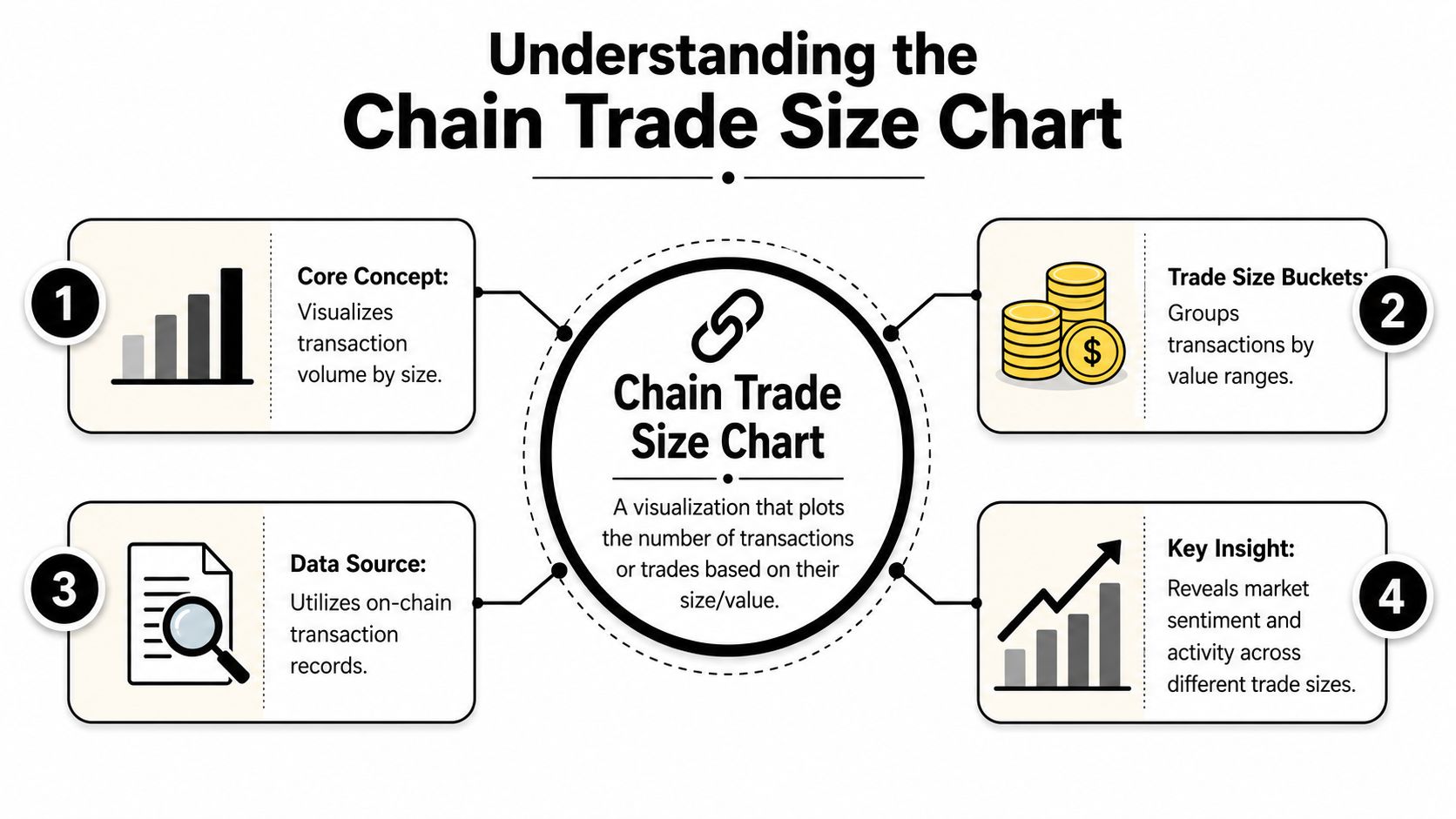
An infographic explaining the core concepts, data sources, and key insights of a Chain Trade Size Chart.

What sits on the chart

At minimum, the chart has three parts:

ComponentWhat it showsWhy it matters
X-axisTime, usually by hour or dayLets you see whether participation is building, fading, or rotating
Y-axisTrade count or traded valueShows the intensity of each bucket
SeriesTrade-size bucketsSeparates small, medium, large, and whale flow

Most traders build the buckets in dollar-value ranges. The exact ranges depend on token liquidity and your own trading universe. A memecoin on a thin pair needs different bucket thresholds than a heavily traded major.

Count versus value

There are two useful versions of the chart.

One uses transaction count. That tells you how many trades happened in each bucket. It's good for spotting crowd behavior, repeated scaling, and bursts of low-size participation.

The other uses total traded value inside each bucket. That helps when a smaller number of large trades dominates actual capital flow.

Use both if you can. Count shows behavior. Value shows financial weight.

A token with many small buys and a few heavy entries can look crowded on count and concentrated on value at the same time.

Why the word chain matters here

This article uses “chain trade size chart” in a crypto-native sense, but the logic of size-based classification isn't new. In industrial trade charts, size codes map directly to measurable geometry, not vague labels. For example, roller chain standards encode pitch in eighths of an inch, so ANSI 80 means a 1-inch pitch and ANSI 240 means a 3-inch pitch, with charts also listing exact pitch values such as 1 3/4 in. for #140, 2 in. for #160, 2 1/4 in. for #180, and 2 1/2 in. for #200. Pitch is the center-to-center distance between adjacent pins, and one guide gives the chain-length formula number of pitches × pitch (in inches) / 12 = length in feet, including the example that 84 pitches of #160 chain equals 14 feet through 84 × 2 / 12 = 14 in this chain pitch guide.

That same mindset is useful in on-chain trading. Don't treat “big volume” as a vague label. Map flow to measurable buckets and read the structure.

What this chart tells you that volume doesn't

A standard volume bar can't show whether the move came from:

  • Lots of small trades
  • A narrow band of midsize wallets
  • Repeated large entries
  • A mix that changed over time

A Chain Trade Size Chart can.

That makes it useful for identifying regime shifts. When the bucket mix changes, market character usually changes with it. And when market character changes, your tactics should too.

Reading Patterns and Signals on the Chart

Once you've built the chart, the next step is reading it like flow, not decoration. The point isn't to admire the buckets. The point is to identify who is pressing and whether that pressure is likely to continue.

A good read comes from change over time, not one isolated spike.

Accumulation

The cleanest accumulation setup usually looks boring on price and interesting on trade-size distribution. Price chops or drifts. Small trades don't dominate the entire move. Meanwhile, larger buckets keep printing with consistency.

That pattern matters because stronger hands often scale in before the market narrative catches up.

Here's a visual example of an accumulation-style pattern:

A bar chart showing trade size patterns over three days demonstrating an accumulation market signal.

If you see stable or rising large-trade participation while price stays contained, stop asking whether the token is “trending.” Start asking which wallets are building exposure discreetly.

Distribution

Distribution usually appears after a strong move, not before. The chart often shows a flattening or drop in the largest buckets while small and midsize trades rise. That shift tells you earlier participants may be handing inventory to later ones.

Many traders often get trapped. They see broad participation and think conviction is increasing. Often the opposite is happening. The strongest buyers have already done the hard part. Now the market is widening, which can mean exit liquidity is improving.

Watch for this combo:

  • Price already extended
  • Large buckets no longer growing
  • Small and mid-sized trade counts increasing
  • Wallets with strong prior timing starting to trim or rotate

That's not an automatic short signal. It is a warning that the quality of participation may be getting worse.

Exhaustion

Exhaustion often looks dramatic even before price fully rolls over. The smallest buckets explode. Social chatter gets louder. The chart starts to look crowded at the low end.

That doesn't always mean the top is in, but it usually means your reward-to-risk has worsened.

A practical way to read exhaustion is this: if your chart shows the move becoming increasingly dependent on the smallest participants, late entry quality is deteriorating. You don't need to predict the exact top. You just need to stop buying as if you're early.

Later in your process, pairing this with cumulative volume delta analysis can help you distinguish between aggressive continuation and a crowded final push.

Here's a short explainer worth watching before you start applying this live:

Capitulation

Capitulation is different. It's broad and ugly. You'll often see selling pressure surge across multiple trade-size buckets at once. Small traders panic out. Mid-sized holders cut risk. Larger wallets may either dump decisively or absorb the mess.

Traders often make the wrong read. They assume all heavy selling is bearish continuation. Sometimes it is. But if the broad flush gets followed by renewed larger-sized buying while price stops falling as hard, that can mark a local shift in control.

When every bucket is selling, focus less on the panic and more on who shows up first after it.

What actually matters in practice

When I read a Chain Trade Size Chart, I care less about textbook pattern names and more about three questions:

  1. Is participation concentrating or dispersing?
  2. Are larger buckets leading or lagging?
  3. Is price reacting proportionally to the size mix?

If larger buckets rise and price barely moves, someone may be absorbing supply. If small buckets surge and price goes vertical, late momentum may be doing the heavy lifting. If all buckets sell and price stops breaking down, forced exits may be nearing completion.

That's the level where the chart becomes tradable.

How to Create a Trade Size Chart in Wallet Finder.ai

You don't need a custom dashboard or a quant stack to build this. A spreadsheet is enough if the underlying trade data is clean.

The straightforward workflow is to export token-level trades, bucket each fill by size, then aggregate by time. After that, the chart usually makes the regime shift obvious.

A five-step infographic explaining how to create a trade size chart using the Wallet Finder platform.

Step-by-step workflow

  1. Choose the token

    Start with one token contract. Don't mix assets at this stage. The point is to isolate how participants behaved around a specific market.

  2. Pull the raw trade history

    Export the trade history from your tracking workflow. In Wallet Finder.ai, traders typically do this from Discover Trades or Discover Tokens, then work from the CSV offline.

  3. Open the file in Sheets or Excel

    You want timestamp, wallet, side, token, and trade value fields available. If the export includes more columns, keep them. You can use them later for filtering by wallet quality or direction.

  4. Create size buckets

    Add a new column that classifies each trade into a bucket based on value. Use ranges that fit the market you trade. Low-float memecoins need different thresholds than majors or deep DeFi names.

  5. Aggregate by hour or day

    Build a pivot table with time on rows and trade-size bucket as columns. Then choose either count of trades or sum of traded value.

  6. Plot the chart

    A stacked area chart works well for composition. A multi-line chart works better if you want to compare the rise and fall of each bucket clearly.

A simple bucket model

Use a bucket framework that matches liquidity. Don't copy someone else's thresholds blindly.

BucketTypical use
SmallTracks crowd flow and low-conviction activity
MediumOften captures active retail and smaller serious traders
LargeUseful for spotting committed entries
WhaleBest for identifying concentrated high-value flow

If you trade across ecosystems, keep separate templates. Solana meme flow and Ethereum DeFi flow rarely behave the same way at the same nominal trade sizes.

Spreadsheet logic that works

In practice, you only need a few helper columns:

  • Bucket column for classifying trade size
  • Rounded time column for grouping by hour or day
  • Side column cleanup so buys and sells are charted consistently
  • Optional wallet tag column if you want to isolate known profitable wallets

Once that's in place, make two versions of the chart:

  • Trade count by bucket
  • Value by bucket

They answer different questions. If count is exploding but value concentration isn't, the market may be broadening without meaningful capital commitment. If value is rising in large buckets while count stays moderate, stronger hands may be doing the work.

Field note: The first useful chart is rarely pretty. Clean enough beats perfect.

Two filters that improve signal fast

Before you trust what you see, apply these filters:

  • Exclude obvious non-trade records if your export method includes transfers, approvals, or unrelated wallet events.
  • Segment buys and sells separately because mixed-direction charts can hide what matters most.

A combined chart is fine for a first pass. For execution, split direction. A rising whale bucket means something very different depending on whether those wallets are buying or unloading.

This is also why the chart belongs inside a workflow, not as a standalone artifact. You build it to find something actionable, then move back to wallet-level review for validation.

Strategies for Identifying and Mirroring Smart Money

The chart gives you structure. The wallet data gives you execution. You need both.

A rising large-trade bucket is interesting, but it isn't enough on its own. You still need to know which wallets are responsible, whether they've earned trust, and whether they tend to scale in, ape once, or rotate fast. That's where smart money analysis stops being a concept and becomes a trade plan.

Trade size tiers and market participants

TierUSD Value RangeLikely ParticipantCommon Signal
Small$100 to $1kRetail, bots, casual momentum tradersCrowd attention, noise, reaction flow
Medium$1k to $10kActive traders, smaller high-conviction walletsEarly participation or follow-through
Large$10k to $100kSerious on-chain traders, funds, organized syndicatesDirected positioning, accumulation, rotation
Whale$100k+Large treasuries, top-performing wallets, major allocatorsHigh-conviction deployment or exit

These ranges are operating ranges, not universal laws. Adjust them to the token.

Front-run the wallet cluster, not one wallet

The best use of the chart is to find clusters, then drill down.

If the large and whale buckets start rising while price is still relatively stable, pull the underlying wallets responsible for those trades. Then inspect their history. You're looking for wallets that repeatedly enter early, size rationally, and don't rely on one lucky trade.

After that, build a watchlist and wait for confirmation. If those same wallets keep adding or related wallets start joining, your read gets stronger.

For broader context on what qualifies as high-quality tracked flow, this guide to smart money in crypto is useful.

Use trade size as a position-sizing cue

A lot of traders copy direction but ignore size. That's a mistake.

If the wallets you respect are entering in measured clips rather than one oversized market buy, that tells you something about uncertainty and liquidity. It often makes sense to mirror the behavior before you mirror the exact timing.

Use the chart to answer:

  • Are strong wallets scaling or aping?
  • Is size increasing with confirmation or decreasing into strength?
  • Are they pressing a thin market carefully or aggressively?

If large wallets are building in stages, your own position plan should probably do the same.

Wait for alignment, not just activity

A single whale print can be noise. A better setup usually has alignment across a few layers:

  • Large bucket activity is increasing
  • Known profitable wallets are involved
  • Price hasn't fully repriced yet
  • The move fits broader market context

That last point matters. If majors are weak and your target token is only getting attention from the smallest bucket, the setup is fragile. If strong wallets are accumulating into relative strength or stable conditions, the odds usually improve.

Good copy trading starts when the chart and the wallets tell the same story.

Avoiding Common Pitfalls and False Signals

The easiest way to misuse a Chain Trade Size Chart is to treat every large transaction as informed buying. On-chain data doesn't work like that. Some large movements are trades. Some are internal wallet operations. Some are routing artifacts. Some are noise dressed up as intent.

A confused person comparing a simple wallet transfer to a complex, unclear trading context with many variables.

The mistakes that cost traders money

Start with the obvious one. Wallet transfers are not trades. If your dataset isn't clean, your chart can manufacture a whale signal that never existed.

Then there's context. Token releases, claim events, treasury movements, and migration activity can all create abnormal flow that has nothing to do with live speculative demand. If you ignore those, the chart will look precise while telling the wrong story.

Low-liquidity pairs create another problem. Bots and wash activity can distort bucket distributions fast. A pair can look full of midsize and large interest when in fact, a handful of actors are bouncing flow around.

Validation checks worth doing every time

Before acting on a signal, run a few checks:

  • Check wallet quality: Review PnL history, trade consistency, and whether the wallets involved demonstrate a pattern worth following.
  • Check token context: Look for claims, token releases, migrations, and contract events that can distort trade flow.
  • Check holder structure: If supply concentration is extreme, a few actors can manufacture misleading bucket behavior.
  • Check market backdrop: A local token signal is weaker if the broader tape is breaking down hard.

One more thing. Don't let the chart become your entire thesis. It's a participation tool, not a complete model. The cleanest reads come when trade-size distribution, wallet quality, and market structure point in the same direction.


If you want to turn trade-size analysis into something executable, use Wallet Finder.ai to identify the wallets behind the buckets, review their trading history, and monitor future entries in real time. That workflow is what turns an interesting chart into a decision you can take.