How does pump.fun work? A Guide
Curious how does pump.fun work? Learn about its bonding curve, memecoin launches, and risk-aware navigation to spot opportunities.

January 6, 2026
Wallet Finder

January 5, 2026

When you're trying to figure out where the crypto market is headed, price charts only tell you half the story. Volume analysis gives you the other half. It’s the practice of looking at how much of an asset is being traded to understand the strength behind price moves and spot what might happen next.
Think of it as the market’s heartbeat. A strong, steady volume suggests a healthy, confident trend. A weak, sputtering volume? That often signals uncertainty or a lack of conviction.

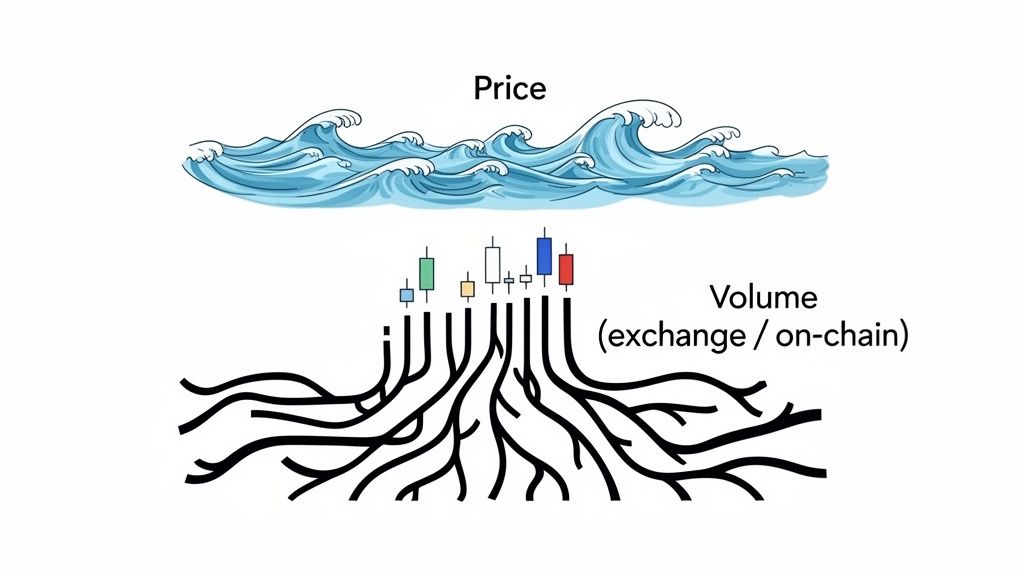
Let’s stick with an analogy. Imagine the crypto market is an ocean. The price chart shows you the waves on the surface—sometimes they're calm, other times they're choppy and violent. Volume analysis is what lets you see the powerful currents flowing deep underneath, the real forces driving the market’s direction. It’s the story of the money and conviction behind every single candlestick.
A sudden price spike without any real volume behind it is often just a blip, a bit of noise that doesn't mean much. But pair that same spike with a huge surge in volume, and you’ve got a powerful signal of strong buying pressure and genuine market interest. This is the fundamental concept that helps you stop reacting to price and start understanding the market psychology driving it.
To really get a grip on volume, you have to know its two most important forms: exchange volume and on-chain volume. They might sound similar, but they tell completely different tales about what’s happening.
Exchange Volume: This is the total amount of a crypto traded on centralized exchanges like Coinbase or Binance. It mostly reflects speculative activity—traders buying and selling, often on short timeframes, hoping to turn a quick profit. It’s useful, but it can be misleading. Wash trading and bots can easily inflate these numbers.
On-Chain Volume: This, on the other hand, tracks the actual movement of assets between wallets on the blockchain itself. This is much harder to fake and represents a genuine transfer of value. When a massive amount of a token moves on-chain, it’s often a sign that smart money or big institutions are getting ready to make a major move.
We dive deeper into this in our full guide to crypto on-chain analysis, but the distinction is critical. High exchange volume can just be market noise; a big spike in on-chain volume is a signal that demands your full attention.
By tracking the footprints of large transactions on the blockchain, you can differentiate between temporary speculation and the deliberate actions of well-informed investors.
Here’s a quick table to help you keep these two vital metrics straight and understand what each one is really telling you.
At the end of the day, both types of volume offer clues, but on-chain volume cuts through the noise to show you where the real conviction—and the real money—is flowing.
Forget price for a second. Volume is the real pulse of the market. It’s the unfiltered story of every boom, bust, and game-changing event in crypto’s history, recorded transaction by transaction.
Think of volume as the market’s memory. Every massive spike you see on a chart is a footprint left by a major event that shaped the industry. By connecting those surges to specific moments in time, you start to see the narrative of how smart money moves. To do a proper volume analysis crypto traders have to look back to understand what’s happening right now. The wallets that made the right moves during those chaotic periods are the ones worth watching today.
The growth in crypto trading volume is just staggering. Back in 2013, the entire market saw a mere $258.49 million in trading volume for the whole year. Fast forward to the ICO boom of 2017, and volume exploded by 53,020.28%, hitting an incredible $22.89 trillion. You can dig into these historical shifts over on CoinCodex.com.
This cycle of explosive growth just keeps repeating. The market bounced back from the 2018 crash, eventually peaking at $131.43 trillion in 2021. Then 2024 came along and shattered all previous records, soaring to $150.57 trillion in yearly volume. This latest wave was kicked off by the Bitcoin ETF approvals and fueled by memecoin mania on chains like Solana and Base.
These aren't just big numbers; they reveal a fundamental truth about this market.
Massive market events are always telegraphed by enormous shifts in trading volume. If you can spot these shifts early, you can catch the next big wave before everyone else.
While exchange volume gives you a sense of the overall market hype, on-chain volume tells a much more specific story. A sudden spike in transaction volume on Ethereum or Solana is often the first clue that a new, profitable trend is brewing under the surface.
Just look at the biggest crypto narratives from the past few years:
By digging into historical on-chain volume, you can pinpoint the exact wallets that were consistently ahead of these trends. This isn't just about looking at the past; it's about building a filtered list of smart money traders whose strategies have been proven to work, cycle after cycle.

So, how do you turn all that raw volume data into something you can actually trade with? This is where volume indicators come into play. They’re tools that crunch volume and price data together to expose what’s really happening under the hood—things like buying pressure, selling exhaustion, or where the "real" average price is.
Think of these indicators as different lenses for your camera. Each one gives you a unique perspective on the market's activity, helping you confirm if a trend is legit, spot when a reversal might be coming, and even see the subtle footprints left by smart money.
Some volume indicators have been around for decades, long before crypto even existed. They’re staples of technical analysis for a simple reason: they work. Mastering a few of these is a must for any serious trader.
On-Balance Volume (OBV): This is one of the simplest, most powerful tools out there. OBV is basically a running tally of volume. When the price closes up, the day's volume gets added. When it closes down, volume gets subtracted. A rising OBV alongside a rising price is a strong confirmation of an uptrend, and the opposite is true for downtrends.
Volume-Weighted Average Price (VWAP): VWAP tells you the average price an asset has traded at throughout the day, weighted by volume. Big institutions and algorithmic traders watch this line like a hawk. Trading above VWAP is typically seen as bullish, while trading below it is bearish.
Chaikin Money Flow (CMF): This indicator measures whether money is flowing into or out of an asset. A positive CMF reading (above the zero line) suggests buying pressure is dominant (accumulation). A negative value points to selling pressure (distribution).
These classic indicators give you a solid foundation. But in the world of crypto, you can get an even cleaner signal by going straight to the source: the blockchain itself.
On-chain metrics give you a level of transparency that exchange-based indicators just can't touch. They cut through the noise of high-frequency trading and bots to show you where actual capital is moving. Any serious volume analysis crypto strategy needs to incorporate these blockchain-native signals.
Exchange indicators show what traders say they're doing. On-chain metrics show what they’re actually doing. It’s the ultimate source of truth.
Here are a few on-chain metrics to watch:
Large Transaction Volume: This metric filters for big-money moves, often tracking transactions over $100,000. When you see a sudden spike here, it’s a massive clue that whales are getting into position, often right before a major price swing.
Whale Wallet Tracking: This is exactly what it sounds like—monitoring the biggest wallets holding a specific token. When you see multiple whale wallets suddenly start buying up an asset or moving it to exchanges, you get a powerful, unfiltered signal of their next move. To really dig into spotting buy and sell pressure, check out our guide on Cumulative Volume Delta.
When you start combining the classic technical indicators with verifiable on-chain data, you’re building a much more bulletproof trading framework. You can see a trend forming on an exchange chart and then confirm it with the hard evidence of real assets moving on the blockchain. That’s how you get a real edge.
Volume patterns are the market’s body language. They show you the conviction—or lack thereof—behind every single price move, telling you whether a trend has real momentum or is just running on fumes. Learning to read these patterns is a core skill in volume analysis crypto, and it will completely change how you look at charts.
Think of a strong trend like a rocket launch. For the price to blast off and keep climbing, it needs a powerful thrust of volume pushing it higher. A price that just drifts upward on weak, sputtering volume is like a rocket with a faulty engine; it probably won't get very far before it comes crashing back down.
The dance between price and volume creates distinct patterns that reveal the market's psychology at any given moment. When you learn to spot these scenarios, you can start to anticipate trend continuations, reversals, or even the traps being set by bigger players. It’s like learning to read the emotions of the crowd.
Here are the most critical patterns you need to master:
The most powerful signals in volume analysis show up when price and volume are telling you two different stories. This disagreement, known as divergence, is often the earliest warning sign that a major trend is about to run out of gas and reverse.
The most explosive market turns almost always telegraph their punch with volume signals beforehand. If you know what you’re looking for, you can spot a trend losing steam or hitting its breaking point well before the rest of the market catches on.
Two of the most potent reversal patterns are exhaustion and capitulation.
Learning to identify these patterns shifts you from being a reactive trader to a proactive one. You're no longer just chasing price; you're interpreting the market's collective mind and getting positioned ahead of the herd.
Knowing what volume patterns mean is one thing, but actually using that insight to build a profitable strategy? That’s a whole different ball game. This is where the rubber meets the road—we’re going to connect the dots and build a workflow that turns abstract volume data into a concrete playbook for finding and mirroring smart money moves.
The entire process kicks off by spotting tokens or market periods showing unusual volume. A sudden rush of on-chain volume for a small-cap gem or a massive spike across the board tells you something big is happening. These are the breadcrumbs you follow, the moments where real conviction is being shown and opportunity is brewing.
Your first job is to scan the market for these significant volume events. Market-wide shake-ups are often the best place to start. For example, back in October, the combined spot and derivatives trading volumes on centralized exchanges shot up 25.9% to a staggering $10.3 trillion, a huge jump from September's lull. For more on this, check out the data on Coindesk.com.
Massive swings like that are exactly why tools like Wallet Finder.ai are so powerful. They help you cut through the noise and pinpoint the top-performing wallets that were most active during these critical windows.
This is the typical lifecycle you'll see in a trend, moving from a healthy uptrend, to exhaustion, and finally to a reversal.

Learning to spot these phases is the key to timing your moves. It keeps you from becoming exit liquidity by buying into a trend just as it's running out of gas.
Once you've flagged a period of high volume, the next move is to find the traders who played it perfectly. With a tool like Wallet Finder.ai, you can filter for wallets that not only had significant activity but also a high PnL during that exact timeframe.
This takes you from looking at the entire market to a curated list of proven winners. The goal here isn't to watch everyone, but to watch the right ones.
With a shortlist of top wallets, it's time to become a detective. You need to dig into their trade history, specifically looking at their entry and exit points relative to those volume spikes you found earlier.
The big question you’re trying to answer is this: Did this wallet start buying before the huge volume spike and all the public hype, or did they sell into the peak mania? This is what separates the smart money from the crowd.
Here’s what your analysis workflow should look like:
This systematic approach to volume analysis crypto trading gives you a clear, repeatable process for turning on-chain data into signals you can actually trade on.

Let’s get our hands dirty and walk through a real-world example. Theory is great, but seeing how a Solana memecoin goes from zero to hero shows you just how powerful a sharp volume analysis crypto strategy can be. This is how you spot opportunities before the Twitter mobs even know what’s happening.
The story doesn't start with a flashy price chart or a big exchange listing. It starts quietly, on-chain. While the token's price was dead flat, a few freshly made wallets suddenly started making big, coordinated buys. This is the first whisper of smart money—the purest accumulation signal you can get. They're building their positions while the coin is still a total unknown.
Phase two kicks off when the token hits a decentralized exchange (DEX), something like Raydium on Solana. This is where exchange volume finally comes into play. The moment trading goes live, the volume goes absolutely vertical.
And what do we see? Those same wallets we spotted earlier are back, and they're buying more as the price starts to climb. That’s your confirmation signal right there. The smart money isn’t cashing out on the first little pump; they’re doubling down, convinced a much bigger move is on the horizon. This is a core lesson in how to track meme token volume trends.
Finally, we hit the grand finale. The coin catches fire on social media, and a massive wave of retail traders piles in, chasing that beautiful, parabolic chart. This flood of new money creates one last, insane volume spike—a classic sign of peak hype and trend exhaustion.
And that’s the exit cue. Right at the peak of the frenzy, the same smart wallets we've been tracking from the very beginning start to unload. They’re selling their huge bags to the starry-eyed newcomers. This entire cycle, from stealthy on-chain buys to a massive retail-fueled blowout, is the classic memecoin pump playbook.
Volume analysis isn't just looking at charts from yesterday; it’s about decoding the market's DNA in real time. Seeing records like 2024's $150.57 trillion in yearly volume shows just how much liquidity floods the market in bull runs, creating these exact kinds of opportunities. Discover more insights on historical market volumes on CoinMarketCap.
Even after you get the hang of volume analysis, it's natural for a few questions to pop up. Here are some of the most common ones I hear, along with clear, direct answers to help you trade with more confidence.
If you're just dipping your toes into volume analysis crypto, keep it simple. Seriously. Start by mastering the standard trading volume bars you see at the bottom of every chart.
Once you're comfortable with those, pair them with the On-Balance Volume (OBV) indicator. The volume bars give you a snapshot of the intensity in a single candle, while OBV shows you the cumulative buying and selling pressure over time. Together, they create a powerful and straightforward foundation for understanding market momentum.
Spotting fake volume, often called "wash trading," is a crucial skill, and this is where on-chain analysis becomes your superpower. Exchanges can manipulate their reported volume pretty easily with bots or coordinated schemes. On-chain transactions, however, are real asset movements that can't be faked.
An asset might look like it has millions in trading volume on an exchange, but when you check its on-chain activity, there’s barely anything happening. This is a massive red flag. Using tools that track genuine on-chain data is your best defense against getting fooled by bogus exchange signals.
Nope. Volume is not a crystal ball for picking exact price levels. Its real strength is in measuring the conviction behind a price move. It tells you how healthy or weak a trend is, not precisely where it's going to stop.
Think of it like this:
By using volume to confirm a trend's health or spot its weakness, you tilt the odds in your favor. You don't need to know the exact top or bottom to be a successful trader.
Ready to turn on-chain volume data into actionable trading signals? Wallet Finder.ai helps you discover the top-performing wallets, analyze their strategies, and get real-time alerts on their next moves. Start your 7-day trial and follow the smart money today at https://www.walletfinder.ai.