High APY Crypto Staking: A Sustainable Yield Guide
Discover how to find, vet, and profit from high APY crypto staking. Learn to identify sustainable yields and avoid common risks with our expert guide.

December 29, 2025
Wallet Finder

December 29, 2025

Predicting a crypto bull run isn't about gazing into a crystal ball. It's about systematically analyzing a mix of on-chain data, historical cycles, and big-picture macroeconomic factors to spot periods of sustained, market-wide growth.
Forget trying to "time the market" by gut feel. A data-driven framework uses specific signals, like Bitcoin halving events and shifts in institutional capital, to get ahead of these powerful uptrends before they're obvious to everyone else.
Trying to catch a bull run without a system is a recipe for disaster. You might get lucky once, but you're far more likely to get lost in the noise and volatility. This guide is all about moving beyond speculation and building a repeatable framework to identify the real early signs of a market-wide rally.
The goal here isn't just to "feel" when things are turning bullish. It's to construct a logical, data-backed approach that helps you tell the difference between a temporary pump and the genuine start of a long-term uptrend. Let's break down the essential components you need to be watching.
A reliable prediction model never hangs its hat on a single metric. Instead, it looks for confirmation across several key areas of market analysis. These pillars work in concert to paint a full picture of market health and directional momentum.
This process boils down to three core components: analyzing on-chain data, understanding historical cycles, and keeping a close eye on the macroeconomic environment.
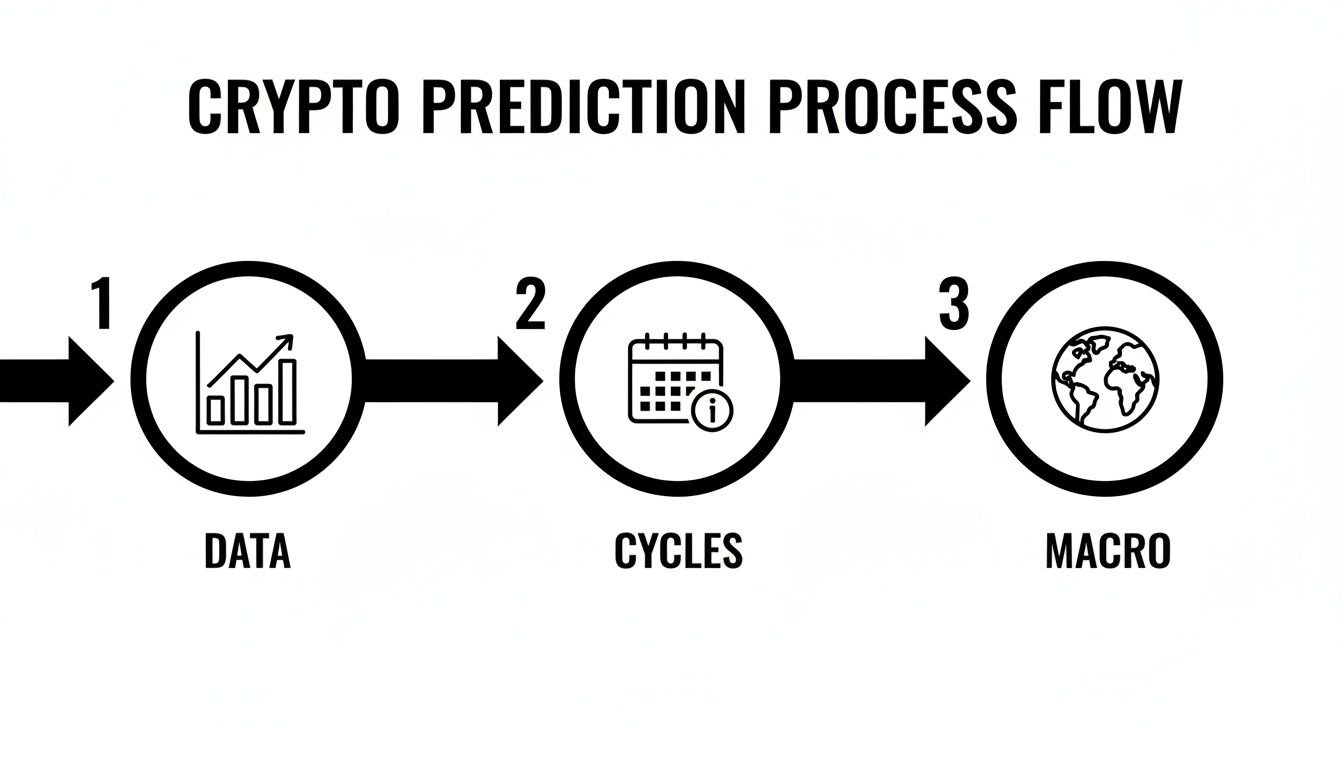
As the flow shows, a strong prediction comes from the convergence of internal market dynamics (data and cycles) with external financial conditions (macro). It’s where the rubber meets the road.
Throughout this guide, we'll dive deep into each of these categories. You'll get the tools to not just anticipate the next cycle but to act on it with confidence. The entire focus is on turning raw information into an actionable edge.
The key is creating a repeatable system. By defining what a bull run looks like and what signals precede it, you remove emotion and guesswork from your decision-making process.
To give you a clearer idea of what this framework involves, let's start with a high-level overview of the indicator categories we’ll be exploring. Each one provides a unique lens for viewing the market, and when combined, they offer a powerful perspective.
A high-level overview of the essential signal categories traders must watch to anticipate a crypto bull run, which we will explore in detail throughout this guide.
Think of these categories as the foundation of your entire prediction model. By mastering the signals within each, you'll be well-equipped to spot the next major crypto bull run before the herd arrives.
To have any shot at predicting a crypto bull run, you have to look backward first. Markets, especially crypto, are deeply cyclical—they don't repeat exactly, but they sure do rhyme. By dissecting the anatomy of past bull runs, we can pick out the recurring catalysts, investor behaviors, and market structures that give us a blueprint for what’s next.
Every major cycle has its own personality, usually driven by a powerful new narrative that captures the market's imagination. Understanding these differences is just as important as spotting the similarities. The two most recent bull runs give us a perfect contrast in what can trigger explosive growth.

The 2017 bull market was the first time crypto truly exploded into the mainstream consciousness. This cycle was almost entirely powered by retail investors, whipped into a frenzy by a perfect storm of media hype and the revolutionary, if chaotic, Initial Coin Offering (ICO) model.
Bitcoin’s rocket ship from under $1,000 to nearly $20,000 grabbed the headlines, but the real mania was happening in the altcoin market. Projects with little more than a whitepaper were raising millions of dollars in minutes, creating a wildly speculative bubble where Fear Of Missing Out (FOMO) was the only rule.
This period was all about:
The big takeaway from 2017 is just how powerful a compelling story can be when combined with easy market access for the average person. It was a cycle defined by grassroots excitement, but it lacked the foundational strength of institutional backing—a key reason it collapsed so dramatically. For a deeper dive, our guide on the crypto cycle chart helps visualize these historical patterns.
In stark contrast, the 2020-2021 bull run was defined by the arrival of "smart money" and institutional capital. While retail was still a huge force, especially during the NFT craze, the underlying momentum was coming from a completely different place.
This cycle was ignited by corporate adoption and the explosion of Decentralized Finance (DeFi). The narrative shifted from speculative "internet money" to a legitimate alternative asset class and the foundation of a new financial system.
The 2020-2021 bull run marked Bitcoin's shift from niche asset to institutional darling, exploding from about $8,000 in early 2020 to a peak of $69,000 by November 2021—a whopping 762% gain amid DeFi summer and NFT hype. Institutional inflows were massive, with firms like MicroStrategy stacking billions in BTC and Tesla dropping $1.5 billion, while PayPal's crypto integration onboarded millions of retail users. This era saw Bitcoin hit $64,000 in April 2021 before a correction, then rebound stronger, highlighting how halvings supercharge cycles—the 2020 halving preceded a 230% rally. Altcoins stole the show too, with DeFi TVL ballooning from $1 billion to over $180 billion at its peak, and NFTs like CryptoPunks fetching millions.
When you break down these two cycles, you start to see common threads and crucial differences that are vital for building any kind of prediction model. Understanding these structural elements helps you recognize what to look for in the next wave.
Here’s a quick comparison of the defining features of the 2017 and 2021 bull runs. Think of it as a blueprint for identifying what kind of cycle might be developing right now.
One of the most actionable patterns to come out of this analysis is the nature of mid-cycle corrections. In both 2017 and 2021, the market suffered terrifying pullbacks of 20-40% or more. For newcomers, these dips felt like the end of the world. But for seasoned traders, they were consistently bought up, proving to be consolidation phases before the next leg up.
Learning to see these pullbacks not as the end of the run but as a healthy reset is a critical skill. It lets you separate real, sustainable momentum from the kind of temporary hype that just fizzles out. By studying these historical blueprints, you can equip yourself to spot recurring signals in today's market with much greater clarity.
Once you have a feel for the historical cycles, it's time to dive into the live data that actually moves the market. A reliable bull run prediction isn't just about looking in the rearview mirror; it's about real-time analysis. This is where we blend on-chain metrics, which give us a transparent look under the hood of the blockchain, with the macroeconomic indicators that shape the entire financial world.
Think of on-chain data like an X-ray of the crypto market. It reveals investor behavior you just can't see on a price chart—who's buying, who's selling, and how confident the long-term players really are. When you combine those insights with major economic trends, a much clearer picture starts to emerge.
On-chain analysis is our secret weapon, allowing us to track the flow of capital directly on the blockchain. Instead of just guessing market sentiment, we can actually measure it. For spotting the early stirrings of a bull run, three of the most dependable indicators are Net Unrealized Profit/Loss (NUPL), whale accumulation, and exchange flow dynamics.
Each metric tells a unique part of the story. When they all start pointing in the same direction, you've got a powerful case for a big market shift. For a deeper dive into these techniques, check out our guide on on-chain analysis.
Net Unrealized Profit/Loss (NUPL)
This metric is a fantastic gauge of the market's overall mood. It basically calculates the total "paper profits" of all Bitcoin holders against their "paper losses." When the NUPL value is high, it means tons of investors are in profit, which can signal greed and euphoria—often seen near a market top.
Here’s an actionable breakdown of NUPL zones:
Whale Accumulation Patterns
Whales—the big players holding massive amounts of crypto—have the power to move markets. So, watching what they do is non-negotiable. When whales start buying up assets aggressively, pulling huge amounts off exchanges and into their private wallets, it’s a massive vote of confidence.
This behavior screams that the most well-capitalized players are betting on prices going up and are locking in their positions for the long haul. A steady period of whale accumulation, especially during a market slump or consolidation, is one of the most powerful leading indicators of an incoming bull run.
By tracking the largest wallets, we are essentially looking over the shoulder of the market's most influential participants. Their actions often precede major price movements, providing a valuable early warning signal.
Exchange Flow Dynamics
The amount of Bitcoin and other major cryptos sitting on exchanges is a direct signal of supply and demand. It's pretty straightforward:
While on-chain data gives us the insider's view, no market operates in a bubble. Broader economic trends and crypto-specific events play a massive role in setting the stage for a bull run.
One of the most potent crypto-native events is the Bitcoin halving. This is a pre-programmed event that happens roughly every four years, and it has historically been an undeniable catalyst for bull markets. It works by systematically cutting the new supply of Bitcoin entering circulation in half.
Bitcoin halvings have been almost spooky in their ability to predict bull runs. By slashing miner rewards, they create scarcity and have ignited multi-year rallies with mind-boggling returns. After the 2012 halving (50 to 25 BTC), prices shot up 5,200%. After 2016 (25 to 12.5), we saw a 315% jump. And following the 2020 halving (12.5 to 6.25), BTC ran up 230% on its way to $69,000. The April 2024 halving (to 3.125 BTC) set the stage for our current cycle, with Bitcoin already blasting 132% YTD to over $93,000 by November 2024. This mirrors historical patterns where the market peak hits 12-18 months after the event.
Beyond events baked into crypto's code, the global economic climate dictates the appetite for risk assets. Things like interest rates and the strength of the U.S. dollar determine how much cash is sloshing around, looking for a home in speculative markets like crypto.
The perfect storm for a crypto bull run often involves a dovish central bank (lowering rates), rising fears about inflation, and a weakening U.S. dollar. When these external forces align with positive on-chain data and a post-halving environment, the conditions become incredibly ripe for an explosive rally. By getting a handle on both sets of indicators, you can build a much more robust and well-rounded model for predicting the next big move.
Theory and data are great, but they're just noise if you can't put them into practice. This is where we pivot from looking at broad market indicators to tracking the specific moves of elite traders. A serious tool in any bull run prediction arsenal is the ability to follow "smart money"—wallets that consistently crush the market with sharp timing and high-conviction plays.
Wallet Finder.ai is built to turn these on-chain breadcrumbs into a real-time trading advantage. Instead of guessing what top performers are doing, you can see their exact moves as they happen, giving you an inside look before the rest of the market catches on.

First things first: you have to find wallets with a proven track record. Just tracking any large wallet is useless; you need to filter for traders who have a history of navigating market cycles like a pro. This means digging deeper than wallet size and focusing on actual performance.
Inside Wallet Finder, the "Discover Wallets" feature is your starting point. The goal is to isolate traders whose activity screams high conviction and sharp analysis, not just blind luck.
Here’s where I recommend you start with your filter settings:
Applying these filters transforms a chaotic sea of random addresses into a curated list of highly competent traders. This becomes the foundation of your entire smart money tracking system.
Once you’ve cherry-picked a handful of elite wallets, it’s time to organize them into a custom watchlist. This is more than a list of favorites; it's your personal alpha-generating dashboard. It lets you monitor the collective behavior of your chosen traders all in one spot.
Think of it this way: if one top trader you follow buys a new token, that's interesting. But if three of your hand-picked, high-PnL traders all pile into the same token within 24 hours, that’s a powerful signal demanding your immediate attention.
Creating a focused watchlist is all about signal amplification. You're tapping into the combined intelligence of several proven traders to spot high-conviction trends the second they emerge.
To get started, just add the wallets you found to a new watchlist in Wallet Finder. Give it a clear name like "Bull Run Accumulators" or "Top DeFi Traders" to keep your research organized. Now, instead of jumping between individual wallets, you can watch their aggregate activity. We dig into this method in more detail in our complete guide on how to build a smart money tracker and follow the best in the game.
Passive analysis is fine, but active alerts are what give you a real edge. The whole point of this strategy is to get notified the moment a wallet on your list makes a big move. This is how your research becomes a timely, actionable trading signal.
Wallet Finder.ai lets you set up instant alerts via Telegram and push notifications for specific on-chain events. This is where the magic happens, turning you from a market spectator into someone who can react to smart money plays in real-time.
You can set up alerts for all sorts of actions, but for predicting a bull run, these are the ones that matter most:
Here's a practical example of alert setups you can copy and use right away:
These alerts close the gap between knowing what smart money did yesterday and seeing what they're doing right now. In a bull market that moves at lightning speed, this time advantage is everything. It lets you ride the coattails of proven winners, entering positions based on the data-backed actions of the market's best, not just on hype.
Spotting the early tremors of a bull run is a huge win, but honestly, that's only half the battle. A profitable run comes down to execution and disciplined risk management. Without a concrete plan, even the best signals can lead to a wrecked portfolio in the chaos of a full-blown bull market.
This is where your Wallet Finder.ai alerts graduate from interesting data points to actionable trading signals. The goal is to build a clear strategy that dictates exactly how you enter positions, when you take profits, and where you cut your losses if a trade goes south. A plan is what separates professional traders from gamblers.

When an alert from a high-conviction wallet hits your Telegram, the first rule is simple: don't just blindly copy the trade. That alert is your green light to start your own due diligence, but with the added confidence that a proven trader has already spotted something promising.
Your response should follow a clear, structured process:
This methodical approach is your best defense against impulsive decisions driven by FOMO (fear of missing out), which is without a doubt the most destructive emotion during a bull run.
Before you even think about hitting the "buy" button, you need to know exactly where you plan to get out. Hope is not a strategy. Every single trade needs predefined exit points for both winning and losing scenarios.
A common and effective framework is to set multiple take-profit (TP) levels. For instance, you could plan to sell 30% of your position after a 100% gain, another 30% at a 200% gain, and then let the rest ride. This locks in profits while keeping you in the game for more upside.
Just as critical is your stop-loss (SL). This is the price you decide on beforehand where you will sell to prevent a small loss from snowballing into a catastrophic one. A typical SL might be 15-20% below your entry price, but this can vary depending on how volatile the asset is.
Sticking to your profit targets and stop-losses is non-negotiable. The market will test your discipline with violent swings designed to shake you out. Your pre-defined plan is your anchor in that storm.
The psychological pressure of a bull market is intense. Prices go parabolic, and stories of overnight millionaires are everywhere you look. This environment is practically engineered to make you abandon your strategy and chase pumps. Resisting that urge is everything.
Look back at the 2017 Bitcoin bull run—it's a classic case of explosive growth fueled by retail frenzy. Bitcoin started the year around $1,000, but by December, it had shot up to nearly $20,000. That's a mind-blowing 1,900% surge. But it wasn't a straight line up; Bitcoin had several sharp dips along the way. Each correction just shook out the weak hands before the price kept climbing, peaking right before a brutal 84% crash down to $3,200 in December 2018.
This cycle teaches us a crucial lesson: bull runs often have interim pullbacks of 20-30%. You can learn more about the history of Bitcoin bull run patterns on kucoin.com. This historical context shows that volatility is just part of the process. By having a plan, you can weather these corrections and avoid the panic-selling that traps so many investors. Your crypto bull run prediction model gets you in the door; your risk management strategy ensures you walk away with gains.
Got questions? You're not the only one. Navigating market cycles is tricky, so let's clear up a few of the most common things people ask about predicting crypto bull runs.
Forget about pinpointing the exact day a bull run will kick off—that's a fool's errand. The real goal is to identify a favorable accumulation window, not a specific date on the calendar.
Think in terms of months, not days. For instance, leading on-chain metrics like whale accumulation or a steady flow of coins leaving exchanges can start flashing bullish signals a good 3-6 months before a major breakout. Macro events like the Bitcoin halving are even more predictable, creating a runway where a bull market becomes highly probable within the following 12-18 months. It's all about spotting the zone where the risk-to-reward is stacked in your favor.
There's no magic bullet here. The strongest predictions come from a convergence of multiple signals. If you're banking your strategy on a single metric, whether it's on-chain data or a macro trend, you’re setting yourself up to get faked out.
That said, the Bitcoin Halving has historically been the most potent and consistent catalyst. It's a hard-coded supply shock that has kicked off every major crypto bull market. When that event lines up with other confirming signals—like capital moving off exchanges and central banks adopting looser monetary policies—the probability of a sustained rally gets incredibly high.
A bull trap often involves a sharp price increase on low volume and weak conviction. Smart money tracking is your best defense against getting caught.
This is where smart money analysis truly shines. A bull trap looks convincing on a price chart, but it’s all smoke and mirrors without genuine buying pressure from experienced players. The best way to validate a rally is to see if the elite wallets on your watchlist are actually participating.
It’s pretty simple:
If the best traders aren't buying the rally, that's a massive red flag. It tells you the move probably doesn't have the legs to keep running.
Ready to stop guessing and start tracking the market's top performers? With Wallet Finder.ai, you can discover elite trader wallets, set real-time alerts on their activity, and gain the edge you need to act on market signals with confidence. Start your 7-day trial today and see what smart money is doing right now. Find out more at https://www.walletfinder.ai.