Your Guide to Crypto Coin Alerts

Wallet Finder

Blank calendar icon with grid of squares representing days.

March 13, 2026

In the crypto market, timing isn’t just a big deal—it’s the only deal. A market that never sleeps demands constant attention. But who has time for that? That’s where crypto coin alerts come in.

These aren't just simple notifications. They are your eyes and ears on the market, automatically flagging critical price jumps, unusual volume spikes, and important on-chain activity. Instead of being glued to your screen, you get the intel you need, right when you need it, turning you from a passive watcher into a trader who acts with purpose.

Why Crypto Alerts Are Essential for Modern Traders

You can't possibly keep tabs on every chart, token, and transaction around the clock. It’s just not humanly possible. This is why crypto coin alerts are more than a nice-to-have; they’re the core of any smart trading strategy. Think of them as your personal scout, tirelessly watching the blockchain for the exact signals you’ve told it to find.

Without them, you’re flying blind, hoping to get lucky or burning yourself out staring at charts all day. A good alert system gives you a serious advantage, letting you jump on market-moving events faster than anyone else.

From Passive Observer to Active Participant

The real magic of alerts is how they shift your entire approach from reactive to proactive. Instead of hearing about a massive pump hours after it’s over, you get a notification the second it starts. This simple change is crucial for two of the most important actions in trading:

  • Securing Profits: A timely alert helps you cash out at a target price before the market turns.
  • Cutting Losses: A warning about a price drop can trigger your stop-loss, protecting your capital from a major downturn.

A single, well-timed alert can be the difference between cashing out at the top or watching your gains vanish.

A well-tuned alert system isn't just feeding you data; it's handing you opportunities on a silver platter. It’s the tool that helps you stick to your plan, taking the emotion and guesswork out of when to get in and when to get out.

Gaining Your Competitive Advantage

In crypto, the person with the fastest, most accurate information wins. Crypto coin alerts plug you directly into that real-time information stream, giving you a clear edge.

This setup puts you in the driver’s seat, allowing you to:

  • Act on Volatility: Get an instant ping the moment a coin breaks a key support or resistance level.
  • Spot Momentum Early: Be the first to know about a sudden spike in trading volume—often the first sign of a big move.
  • Track Expert Moves: Follow the wallets of "smart money" traders and get notified whenever they make a move.

By creating a system of crypto coin alerts, you’re building your own intelligence network perfectly tuned to your strategy. You stop reacting to what the market did and start acting on what it’s doing right now. To really dive in, explore our guide on the best crypto alerts app to see what’s possible. This is the first step toward trading with real, data-backed confidence.

Understanding the Five Key Types of Crypto Alerts

Not all crypto coin alerts are the same. Thinking of them as one big category is like saying a hammer and a screwdriver do the same job. To build an effective trading system, you need to understand the five essential types of alerts, with each one giving you a unique piece of the market puzzle.

This simple hierarchy shows how different alerts drive the three most important actions in trading: securing profits, cutting losses, and jumping on new opportunities fast.
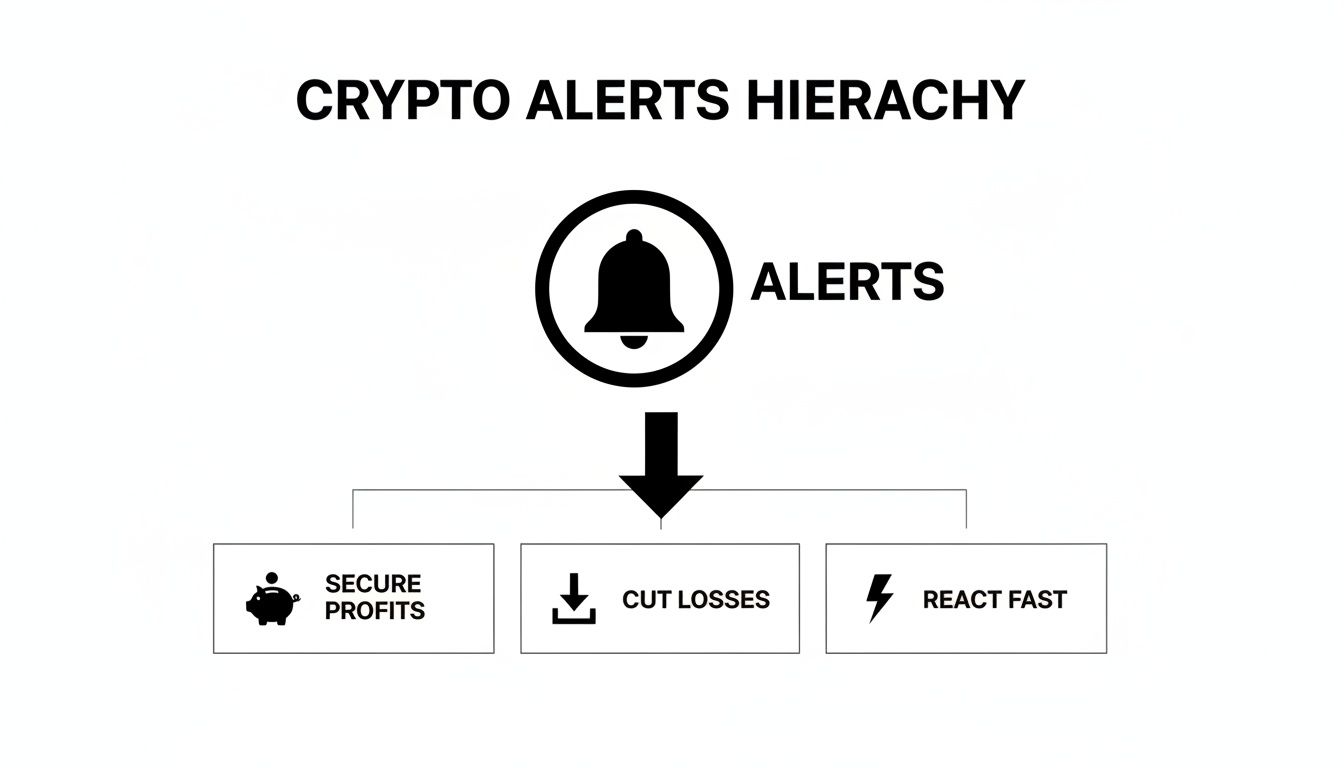
Hierarchy diagram showing crypto alerts for securing profits, cutting losses, and reacting fast.

As you can see, the whole point of setting up alerts is to trigger sharp, profitable trading decisions. Let's dig into the specific alerts that make this happen.

1. Price Alerts: Your Entry and Exit Signals

This is the alert everyone starts with, and for good reason. A price alert is a simple notification that triggers when a coin hits a specific price you've set, whether it's a take-profit target or a stop-loss floor.

Here’s how to use them effectively:

  • For Entry: If you believe Bitcoin will pop once it clears $70,000, set an alert for $70,001. The moment it dings, you know it's time to investigate an entry.
  • For Exit (Profit): Set an alert at your target price to lock in gains automatically.
  • For Risk Management: If you bought a token at $5 and won't risk more than 20%, set an alert at $4. If the price tumbles, you get the signal to cut your losses.

To master these, our guide on setting up a powerful crypto price alert is the perfect next step.

2. Volume Alerts: Your Early Warning for Momentum

Price tells you what is happening, but volume tells you how much conviction is behind the move. A volume alert goes off when a coin’s trading activity suddenly spikes past a certain level. This surge is often the first sign that a big price swing is coming.

Imagine an altcoin has been trading flat for weeks. You could set an alert to ping you if its 24-hour volume shoots up by 300%. That’s a huge signal that something is brewing—perhaps big players are accumulating or major news is about to drop—giving you a chance to get in before the price explodes.

3. On-Chain Wallet Alerts: Your Smart Money Tracker

This is where things get really interesting. On-chain wallet alerts notify you when a specific blockchain wallet makes a move. We're talking about the wallets of "smart money" traders, whales, or VCs whose every transaction is worth watching.

These alerts give you a direct window into what the proven winners are doing. For example, using a tool like Wallet Finder.ai, you can get an instant notification the second a top-performing trader buys into a new, low-cap gem. This lets you investigate the same opportunity and potentially ride their coattails.

On-chain alerts shift your focus from analyzing charts to analyzing the players themselves. It’s like having a seat at the poker table and seeing exactly when the best player decides to go all-in.

4. New Token Listing Alerts: Your Ticket to Early Opportunities

Getting into a project before it hits the big exchanges can be the difference between a nice gain and a life-changing one. New token listing alerts tell you the moment a new cryptocurrency gets listed on a major centralized exchange (CEX) like Binance or a decentralized exchange (DEX) like Uniswap.

These "listing pumps" often send a token's price flying because of the sudden rush of new buyers and liquidity. Setting up these alerts ensures you're one of the first to know, giving you a shot to buy before the rest of the market catches on.

5. Security Alerts: Your Defense Against Scams

Finally, in a market crawling with bad actors, security alerts are non-negotiable. These notifications warn you about potential threats, such as:

  • Rug Pulls: Alerts can flag when developers suddenly drain a huge chunk of a token's liquidity.
  • Phishing Scams: Warnings about fake websites or malicious contracts pretending to be legitimate airdrops.
  • Exchange Hacks: Immediate alerts about security breaches, like the $90 million hack of Nobitex, give you precious time to secure your funds.

Comparison of Essential Crypto Alert Types

Alert TypePrimary Use CaseWhat It SignalsIdeal For
Price AlertEntry/Exit TimingReaching a key price level or stop-loss.All traders, from beginners to pros.
Volume AlertMomentum ConfirmationA surge in buying or selling interest.Swing and breakout traders.
Wallet AlertCopy-TradingSmart money entering or exiting a position.DeFi traders and on-chain analysts.
Listing AlertEarly AccessA new token becoming available for trading.Speculative and high-risk traders.
Security AlertRisk ManagementPotential scams, hacks, or contract risks.Every crypto holder and investor.

By layering these five types of crypto alerts, you stop reacting to random pings and start building a cohesive intelligence system—one that finds opportunities, protects your capital, and gives you a serious edge.

How to Track Smart Money with Wallet Alerts

Price and volume alerts are great, but they often tell you what the rest of the market already figured out. The real edge—what traders call alpha—comes from seeing moves before they show up on the charts. This is where on-chain wallet alerts come in, turning raw blockchain data into your own private intelligence feed.

Forget guessing why a token is pumping. Imagine getting a ping the instant a proven, profitable trader buys into a new project. This isn’t about following the herd; it’s about following the shepherd.

Identifying and Following Smart Money

"Smart money" isn't a single type of trader. It could be a venture capital fund, a DeFi genius, or a crypto whale whose buys move markets. The common thread is their public, verifiable track record of profitable trades.

Not long ago, finding these wallets required serious technical know-how. Now, platforms like Wallet Finder.ai do the heavy lifting, letting you discover and track top-performing wallets using metrics that actually matter:

  • Profit and Loss (P&L): See the exact profit a wallet has made over time.
  • Win Rate: Pinpoint traders who consistently make winning trades.
  • Top Holdings: See what assets the best in the game are holding right now.

This turns the entire blockchain into a searchable database of trading talent. Once you find wallets that match your style, you add them to a custom watchlist and get alerted to every move they make.

Setting Up Actionable Wallet Alerts

A watchlist is just the start. The real power is in setting up your crypto alerts to send actionable signals straight to you. Using a tool like Wallet Finder.ai, you can get instant notifications on channels like Telegram the moment a wallet on your list makes a trade.

Here’s a quick look at how you might set this up:

  1. Discover a Wallet: Use filters to find a wallet with over $1 million in profit and a win rate of 70% or higher in the last 90 days.
  2. Add to Watchlist: Add this wallet’s address to your "Top Traders" watchlist.
    • New Buys: Get an alert when the wallet buys a token for the first time. This is a fantastic signal for discovering new gems.
    • Large Sells: Get a heads-up when the wallet offloads a big chunk of its holdings.
    • Swaps: Track when they pivot from one asset to another.

    This process gives you a direct, real-time feed from elite traders, letting you investigate their moves and jump on opportunities before they become common knowledge.

    A smartphone displays a crypto watchlist with 'Smart Money' highlighted, next to a magnifying glass analyzing data.

    The Wallet Finder.ai interface makes it simple to pinpoint wallets worth tracking by highlighting key data points like P&L, win rate, and recent trades.

    From Alert to Action: A Practical Workflow

    Getting a notification that a top trader just dropped $50,000 on a low-cap token is a huge signal. But it should be the beginning of your process, not the end. Blindly copying every trade is a quick way to get rekt.

    Instead, use that alert as a trigger for your own research. A professional workflow looks more like this:

    StepActionDescription
    1. AlertReceive a notification: "Wallet 0x123...abc just bought 10 ETH worth of NEWTOKEN."This is your starting signal.
    2. InvestigateClick into the wallet on Wallet Finder.ai. Review their P&L, win rate, and past trades.Confirm their track record and see if they've traded similar tokens successfully.
    3. AnalyzeResearch NEWTOKEN. Check the project's website, team, and community engagement.Determine if the project fundamentals are solid.
    4. ConfirmLook for other signals: Is trading volume increasing? Is the price breaking a key level?Find technical or social confirmation for the trade.
    5. ExecuteIf your research validates the signal, decide to open a position with a clear risk plan.Place your trade with a predetermined stop-loss and profit target.

    This structured approach combines the power of smart money signals with your own analysis. For a deeper dive into this method, check out our guide on using a crypto whale tracker.

    By following the digital footprints of top traders, you’re not just copying moves—you’re learning from their behavior. You start to see patterns in how they enter, manage, and exit positions.

    Turning Alerts Into Action: Building Your Trading Strategy

    Getting a crypto coin alert is just the beginning. That information is only powerful if you have a battle plan ready. A profitable trade isn’t about luck; it’s about having a clear framework that connects that first ping to your final execution.

    This is where you stop reacting emotionally and start building a repeatable system. Let's walk through three proven frameworks you can start using today.

    The Smart Money Momentum Strategy

    One of the most direct ways to use wallet alerts is to follow the momentum of proven winners. The idea is to use their trades as a high-quality signal to kick off your own research, finding opportunities you might have otherwise missed. A tool like Wallet Finder.ai is perfect for this.

    Here’s a simple checklist to get you started:

    • Your Alerts: Set up real-time notifications for "New Buys" from your watchlist, especially first-time token purchases.
    • Confirmation Signals: When an alert hits, look for other confirming signs, like a big spike in trading volume (over 200% in 24 hours), growing social media buzz, or a technical breakout on the price chart.
    • Risk Management: This is non-negotiable. Decide on your position size ahead of time (e.g., no more than 2% of your portfolio) and set a firm stop-loss based on your analysis.

    The Volatility Breakout Strategy

    This classic strategy works beautifully for traders looking to catch major market moves. It’s built on a simple principle: long periods of quiet trading are often followed by an explosive move. By combining price and volume alerts, you can be ready to pounce the moment a breakout starts.

    A breakout strategy is like setting a digital tripwire. You're not trying to predict which way the market will go. You're waiting for the market to show its hand and then acting on that decisive move.

    Here’s the setup:

    1. Find the Range: Look for a coin bouncing between clear support and resistance levels. For instance, a token stuck between $1.50 and $1.80.
      • Price Alert (Upside): Set an alert just above the resistance (e.g., at $1.81).
      • Price Alert (Downside): Set another alert just below the support (e.g., at $1.49).
      • Volume Alert: Set a notification for a major volume spike (e.g., 250% above its 24-hour average).
    2. Execute the Trade: When a price alert triggers, check the volume. A breakout with huge volume is a much stronger signal. If confirmed, enter a trade in the direction of the break with a tight stop-loss placed just back inside the old range.
    3. The New Listing Snipe Strategy

      Getting in on a new token listing can be one of the most profitable plays in crypto, but it's also packed with risk. This strategy uses crypto coin alerts to ensure you're one of the first to know when that listing happens. The goal is to buy moments after the token becomes tradable and sell into that first wave of FOMO-driven hype.

      New Listing Execution Plan

      StepActionCritical Detail
      1. PreparationSet up alerts for new token listings on your target exchanges (CEXs like Binance or DEXs like Uniswap).You'll need a dedicated alert service that specializes in fast listing notifications.
      2. ConfirmationThe moment an alert triggers, immediately verify the official contract address.Scammers love to create fake tokens with similar names to trick eager buyers. Always double-check.
      3. ExecutionIf it's the real deal, place a small market buy order immediately.Speed is everything. On DEXs, use a higher gas fee to make sure your transaction gets confirmed quickly.
      4. Risk ManagementHave your exit plan ready before you even buy. Set a profit target (e.g., +50%) and a stop-loss (e.g., -20%).Greed is your enemy here. Take profits fast, because these pumps can crash just as quickly as they rise.

      Each of these strategies shows how a smart system of alerts can lift you out of speculative guesswork and into methodical, plan-based trading.

      Avoiding Alert Fatigue with Smart Management

      An alert management interface with prioritized alert lists, toggle switches, and notification settings.

      While a solid system of crypto coin alerts feels like a superpower, a constant flood of notifications can quickly backfire, leading to alert fatigue. This is when so many pings hit you that you start tuning everything out—including the mission-critical signals.

      The goal is to turn your alerts into a sharp, actionable signal, not just more background noise. This is where effective alert management comes in.

      Set Intelligent Thresholds

      The fastest way to drown in notifications is by setting your thresholds too tight. A classic rookie mistake is setting price alerts for every 1% move on a wildly swinging coin.

      Instead, set your alerts around major technical levels—historical support and resistance, key psychological price points, or percentage moves that signal a real shift in momentum. For major assets, a 5-10% move might be the trigger. This way, when you get an alert, you know it means something.

      Organize Your Notification Channels

      Not every alert deserves the same level of attention. A new listing is an "act now" event, while a weekly summary can wait. Organize your notifications across different channels based on urgency.

      Here’s a simple, tiered system that works:

      • Push Notifications (High Urgency): For major price breakouts, security warnings, or a smart money wallet making a huge first-time buy. These demand immediate action.
      • Email (Medium Urgency): For important updates that aren't emergencies. Perfect for daily watchlist summaries or moderate volume spikes you want to analyze later.
      • Dedicated Feed (Low Urgency): For everything else, like general market chatter, funnel it into a dedicated feed on Telegram or Discord. You can check this on your own time.

      This structure keeps your most disruptive pings reserved for the most important events.

      “Alert fatigue is the silent killer of good trading systems. If every notification feels urgent, then no notification is. The key isn't more alerts; it's more meaningful alerts.”

      Regularly Audit and Refine Your Alerts

      The crypto market never sits still. An alert strategy that was perfect last month could be useless today. Treat your alert system like a garden—it needs regular maintenance.

      Set aside time every few weeks to go through your active alerts. For each one, ask yourself:

      • Is this alert still relevant to my current strategy?
      • Has it been firing too often, or not at all?
      • Could I adjust the threshold to get a cleaner signal?
      • Is it going to the right channel?

      This routine cleanup is critical. For example, the crypto markets hit serious turbulence in early 2026, with the total market cap dropping to USD 2.38 trillion by February—a 16.20% slide for the year. In a market like that, alerts set for a bull run would have been screaming nonstop. Adjusting them was key to navigating the volatility, as detailed in this analysis on alphanode.global.

      By treating your alert system as a living part of your trading plan, you’ll ensure it stays a powerful tool that helps you, not a distraction that adds to the chaos.

      The Future of On-Chain Intelligence and AI Alerts

      The game of crypto alerts is changing. We’re moving past simple notifications into the realm of predictive intelligence. It’s no longer just about reacting to what has happened—it's about getting a heads-up on what’s about to happen. This evolution is driven by AI that sifts through massive on-chain datasets, catching the faint signals that come before a big market move.

      AI-powered alerts aren’t just a fancier version of a price alarm. They can flag that a group of smart money wallets are quietly buying up a token before anyone else notices. Platforms like Wallet Finder.ai are pioneering this shift, turning enormous amounts of raw data into predictive insights.

      The Rise of Predictive and Regional Insights

      As the crypto market professionalizes, traders need smarter tools. Understanding how different regions trade is quickly becoming a secret weapon.

      The Asia-Pacific region, for example, has become a crypto powerhouse, driven by its advanced tech sector and high number of retail investors. At the same time, Europe's proactive approach to regulation has turned it into another major hub. You can dig deeper into these regional trends on ResearchAndMarkets.com.

      With this level of professionalization, having a real-time, data-driven alert system isn't just a nice-to-have. It’s a core part of any serious trader's toolkit.

      The future of trading alpha isn't about having more data—it's about having smarter data. AI-powered alerts deliver exactly that, filtering out the noise to give you forward-looking signals that let you trade with confidence.

      Mastering Alerts: A Foundational Skill

      The tools and strategies we've gone over aren't just trendy tricks. They represent a fundamental skill you'll need to succeed in crypto for years to come. As on-chain data gets richer, knowing how to set up, manage, and act on intelligent alerts is what will separate the winners from everyone else.

      Mastering crypto alerts turns you from a spectator into someone who actively shapes their own outcomes. Whether you're copy-trading smart money with Wallet Finder.ai or setting your own strategic breakout alerts, you're building a system that gives you a real, lasting edge. This is how you not only survive but thrive in the fast-moving world of crypto.

      Frequently Asked Questions

      Got questions about crypto coin alerts? You're not alone. Here are some quick, straightforward answers to the most common questions.

      What Is the Best Crypto Alert App?

      The “best” app depends on your needs. For basic price changes, alerts on major exchanges like Coinbase or Binance will do.

      For sophisticated strategies using on-chain data, you’ll need a specialized tool. Platforms like Wallet Finder.ai, Arkham, or Nansen offer powerful features for tracking smart money, delivering crypto coin alerts that exchanges simply can't match.

      Are Crypto Coin Alerts Accurate?

      Yes, if the data source is reliable. Price and volume alerts from reputable exchanges pull directly from real-time market activity and are extremely accurate.

      Likewise, on-chain alerts are built on public blockchain data, which is precise and unchangeable. The real question isn’t about the data's accuracy, but how well a platform can interpret that data and send you a timely, useful signal.

      Can You Get Alerts for New Crypto Listings?

      Absolutely. Many services specialize in alerting traders to new token listings on both centralized (CEX) and decentralized (DEX) exchanges. These alerts are a hot commodity for traders who want to get in on new projects early, especially before a potential "listing pump."

      How Do I Set Up Wallet Tracking Alerts?

      Setting up wallet tracking is simple with the right platform. In a tool like Wallet Finder.ai, the process is just a few quick steps:

      1. Find a wallet address you want to monitor.
      2. Add the address to your watchlist.
      3. Set up your notifications to get alerts on Telegram or other channels whenever that wallet buys, sells, or swaps tokens.

      Just like that, you’ve turned raw on-chain data into actionable trading signals sent right to your phone.


      Ready to stop guessing and start tracking the market's smartest players? With Wallet Finder.ai, you can discover top-performing wallets, analyze their strategies, and receive real-time crypto coin alerts for every move they make. Start your 7-day trial and turn on-chain data into your competitive edge.