Your Guide to a Multiple Crypto Wallet Strategy
Discover how a multiple crypto wallet strategy secures your assets and simplifies management. Get actionable tips for setting up and tracking your crypto.

December 23, 2025
Wallet Finder

December 24, 2025
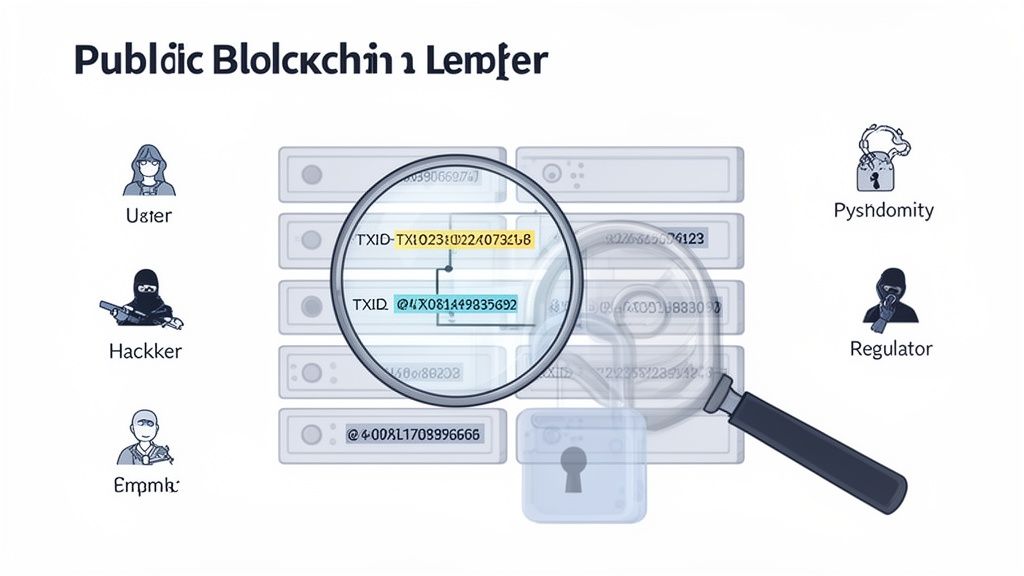
Crypto transaction tracking is the process of following digital currency as it moves across a public blockchain. Unlike the closed-off ledgers at your bank, blockchains are fundamentally transparent. This radical openness means anyone can view a permanent, unchangeable record of every transaction ever made, making it possible to trace the path of funds from one digital wallet to another.

Many newcomers get tripped up by the idea that crypto is completely anonymous. It's a common myth.
In reality, most major blockchains like Bitcoin and Ethereum are pseudonymous, not anonymous. This is a crucial distinction. While your real name isn't directly stamped onto your wallet, every single action you take leaves a permanent, public footprint on the ledger.
Think of the blockchain as a giant, public book of accounts that anyone in the world can open and read. Every transfer is a new line item, plain as day. This unlocks a massive opportunity to analyze financial flows, a practice we call on-chain analysis. If you want to go deeper, our guide on on-chain analysis breaks down how to read these market-moving signals.
The ability to follow digital money isn't just a neat technical trick; it's a critical skill in today's financial world. This transparency is a double-edged sword, creating privacy challenges while also offering huge benefits across several key areas:
The core challenge in crypto isn’t whether you can see the transactions—it’s about understanding what those transactions actually mean. By decoding the public ledger, we turn raw data into actionable intelligence.
To start tracking, you first need to understand the basic breadcrumbs every transaction leaves behind. These components are the building blocks of any investigation, allowing you to piece together the story of how and where the money moved.
This table breaks down the essential elements you'll encounter when analyzing a crypto transaction, helping you decode the data you see on any blockchain explorer.
Mastering crypto transaction tracking really just comes down to learning how to connect these pieces. You can start with a single transaction ID or wallet address and use a blockchain explorer to follow the money, uncovering a whole network of interconnected activity. This skill demystifies the blockchain and reveals the powerful stories hidden in its data.

Not all blockchains are built the same, which means the breadcrumb trails they leave behind look very different. If you want to get good at crypto transaction tracking, you first have to understand the unique accounting models of the major networks.
Each one demands a slightly different approach, kind of like a detective using different methods to track footprints in sand versus snow.
Let’s start with the original: Bitcoin. It runs on a system called the Unspent Transaction Output (UTXO) model. The easiest way to picture this is to think about physical cash.
When you use a $20 bill to buy a $5 coffee, you don’t get three-quarters of that same bill back. Instead, you get $15 in completely new bills and coins as change. Bitcoin works the exact same way. Every transaction consumes old UTXOs (the inputs) and creates brand new ones (the outputs)—one output goes to the person you're paying, and the other comes back to you as "change." This creates a complex, branching chain of transactions that analysts have to carefully piece together.
On the flip side, blockchains like Ethereum, Solana, and Base use a much more intuitive account-based model. This system works a lot more like a traditional bank account, making it far simpler to follow.
Instead of juggling inputs and outputs, every wallet just has a single balance. When you send funds, your balance goes down, and the recipient's balance goes up. Simple as that. This creates a direct, linear flow between addresses, which makes basic crypto transaction tracking much more straightforward than on Bitcoin.
This model is a game-changer when you’re tracking interactions with smart contracts—the automated programs that power DeFi. You can follow assets as they move from a user's wallet straight into a lending protocol and see exactly what happens next, whether they're being swapped, staked, or loaned out.
Within all these ecosystems, stablecoins like USDC and USDT have become the star players for anyone tracking funds. Because their value is pegged to a currency like the US dollar, they're used for everything from sending money across borders to trading in DeFi. All that activity creates a massive, clear, and easily traceable river of financial flow.
Their stability makes them a favorite for both legitimate businesses and shady actors trying to move money without worrying about price swings. This has caused their usage to absolutely explode.
In recent years, stablecoin transaction volumes have skyrocketed. They hit a record annual volume of over $4 trillion in just seven months, which is 30% of all on-chain crypto transaction volume. This explosion in trackable activity shows just how critical these dollar-pegged assets have become to the global flow of crypto. You can dive deeper into this trend in the full 2025 crypto adoption and stablecoin usage report from TRM Labs.
Things get really tricky when funds "jump" between different blockchains. This happens using tools called crypto bridges, which let someone lock an asset on one chain (like Ethereum) and get a "wrapped" version of it on another (like Solana).
This process completely breaks the trail you were following on a single ledger, creating a huge headache for analysts. An investigation that started on one blockchain suddenly hits a dead end, forcing you to pivot your entire strategy.
To connect the dots across chains, you have to:
This is a highly specialized skill that requires a deep understanding of how these bridges tick. If you're serious about mastering it, check out our dedicated guide on how to analyze cross-chain bridge transactions. By getting a handle on these different blockchain structures, you'll be able to follow the money no matter where it leads.

To make sense of the blockchain, analysts have a core set of techniques they turn to again and again. These are the clever rules of thumb—or heuristics—that help them connect the dots. Think of these methods as the fundamental tools in a blockchain detective's kit, turning raw, pseudonymous data into a story that reveals patterns you’d otherwise miss.
The most foundational technique is known as clustering. This is simply the process of grouping multiple blockchain addresses together with the assumption that they're all controlled by the same person or entity. It’s easily one of the most powerful concepts in crypto transaction tracking.
So, how do analysts know which addresses to group together? They use established heuristics based on common wallet behaviors. One of the most reliable is the co-spend heuristic, which assumes that if multiple addresses are used as inputs in a single transaction, they are probably controlled by the same wallet software—and by extension, the same owner.
Another key method is identifying common change address patterns. As we covered with Bitcoin's UTXO model, every transaction can create "change." A sharp analyst can often spot these change outputs, linking them back to the original sender and expanding their cluster of known addresses.
At its core, clustering transforms a chaotic sea of individual addresses into a manageable map of entities. Instead of tracking a hundred separate wallets, an analyst can now follow a single, consolidated actor across the blockchain.
Once a cluster starts taking shape, the next step is often address tagging. This is where analysts enrich the on-chain data with real-world intelligence. Blockchain analytics firms and the wider crypto community work to label, or "tag," addresses and clusters that are verifiably linked to known entities.
These tags provide crucial context, instantly clarifying what a transaction is all about.
This collaborative labeling effort turns a meaningless string of characters into a rich data point, dramatically speeding up any investigation.
With clusters identified and addresses tagged, analysts often turn to transaction graph analysis. This technique involves creating a visual map of how funds are moving between different entities. Instead of staring at a long list of transactions, a graph shows wallets as nodes and transactions as the lines connecting them.
This visual approach makes it much easier to spot complex money laundering patterns, such as:
Of course, bad actors are always trying to break the chain of custody using obfuscation tools. The most common are mixers (also called tumblers) and privacy coins. Mixers like Tornado Cash pool funds from tons of different users, jumble them all together, and then distribute them to new addresses, making direct tracing a nightmare.
However, advanced analytics can still pierce this veil. Analysts can use statistical analysis to calculate the probability that funds coming out of a mixer are linked to a specific deposit. For a detailed breakdown of these advanced methods, you can learn more by detecting crypto mixer transactions in our dedicated guide. Likewise, while privacy coins like Monero are designed for anonymity, tracing efforts focus on the on-ramps and off-ramps—where they are exchanged for more transparent assets.
All the theory behind crypto transaction tracking is interesting, but where does the rubber meet the road? This is where abstract ideas like wallet clustering and heuristics turn into real-world results, impacting everything from billion-dollar investigations to your personal trading strategy.
These aren't just niche skills for on-chain detectives; they're fundamental to how the modern digital economy operates.
For any crypto exchange or business that wants to stay in business, a rock-solid Anti-Money Laundering (AML) program isn't just a nice-to-have—it's the law. Regulators demand that these platforms monitor transactions to stop criminals from using them to move dirty money. Transaction tracking is the engine that powers this entire effort.
Compliance teams use specialized software to automatically screen every single deposit. If someone tries to send in funds that came from a sanctioned address, a darknet market, or a known scammer's wallet, the system flags it in an instant. This lets the exchange freeze the funds, file a Suspicious Activity Report (SAR), and shut the door on bad actors.
Imagine an exchange gets an alert: a $50,000 deposit is just two "hops" away from a wallet tied to a ransomware crew. By tracing the money's path back, the compliance team can confirm the risk and act immediately, preventing those illicit funds from being laundered.
Transaction tracking is the critical bridge between what happens on the blockchain and what regulators require. It lets exchanges go beyond basic ID checks and actively police their platforms, which is essential for building trust across the entire crypto space.
When a big DeFi protocol gets hacked or a massive scam unravels, the first question everyone asks is, "Where did the money go?" Blockchain forensics is how we find the answer. Law enforcement and private investigators use transaction tracking to follow the digital breadcrumbs left by thieves in real-time.
Investigators build out detailed transaction graphs, creating a visual map of how the stolen assets are moving. They watch as hackers try to wash the funds through mixers, jump them across different blockchains using bridges, or swap them on decentralized exchanges. Even when criminals use incredibly complex methods to hide their tracks, they almost always slip up somewhere.
A typical forensic investigation looks something like this:
This exact process has been responsible for recovering billions of dollars in stolen crypto.
The smartest traders and investment funds use crypto transaction tracking to get a leg up on the competition. Because blockchains are public, the moves of the biggest players—the "whales"—are out there for anyone to see, if you know where to look.
By keeping an eye on the wallets of massive investors or venture capital firms, analysts can spot market-moving trends before they hit the headlines. For example, if a handful of major whale wallets all start scooping up a specific token, it might signal that good news is on the horizon or a big price move is coming. This strategy, often called "smart money tracking," helps traders see around the corner.
Transaction tracking also paints a clear picture of global crypto adoption, revealing which regions are growing fastest. According to a key index, India, the US, and Pakistan are leading the pack. We can also see institutional interest surging, with transfers over $1M in North America growing by a massive 49%. To see how on-chain data uncovers these global trends, check out the full 2025 Global Crypto Adoption Index from Chainalysis.
Before throwing money at a new crypto project, smart investors do their homework. A huge part of this due diligence involves digging into the project's on-chain financial records. By tracking the project's main treasury wallet, anyone can check if their actions match the promises made in their whitepaper.
Tracking can answer some very important questions:
This on-chain snooping offers a level of transparency you just can't get in traditional finance. It allows investors to verify a project's financial health right from the source of truth—the blockchain itself.
Alright, enough with the theory. Let's get our hands dirty and actually track some crypto.
Think of this as your first field assignment. We're going to walk through a basic investigation together, breaking down the entire process into five simple, actionable steps. By the end, you'll have a real skill that turns that mess of blockchain data into a clear story of where the money went.
Let's dive in.
Every investigation kicks off with a single clue—an anchor point that lets you unravel the rest of the story. In the world of crypto tracking, this is almost always one of two things: a transaction ID (TXID) or a wallet address.
Your first job is to lock down one of these pieces of information. It's the first thread you'll pull.
Once you have your starting clue, you need the right tool to look it up. This is where blockchain explorers come into play. These are basically free search engines for the blockchain, letting you plug in any TXID or address to see all the connected details.
Different explorers are built for different blockchains, so your choice hinges on the asset you’re tracking. Here are the go-to options for the major players:
For this guide, we'll stick with Etherscan since it's one of the most popular explorers out there.

This process isn't just for internet sleuths. As the graphic shows, these skills are fundamental for everything from regulatory compliance to deep-dive research and, of course, investigations.
With your explorer open, copy and paste your TXID or address into the search bar. The page that loads up is your initial crime scene, and it's packed with clues. Don't let it overwhelm you; just focus on the essentials for now.
You’ll see key details like the sender (From), the receiver (To), the exact amount transferred, and the transaction's timestamp. This first screen confirms the basic facts and, crucially, gives you the next set of addresses to investigate.
Now the real detective work begins. From that first transaction, you can start hopping both backward and forward in time. Click on the sender's address—where did their funds come from? Next, click on the receiver's address—where did the money go after this?
This process of jumping from one address to the next is the absolute core of crypto tracking. Each click peels back another layer of the onion, letting you map out the complete flow of funds. Make sure to document each address and transaction of interest as you build out your map.
Your goal is to follow the money until you hit either a dead end (like a privacy mixer) or an exit ramp, such as a deposit into a major crypto exchange. Finding an exchange deposit is often a huge win, as it links a pseudonymous address to a real-world entity that requires identity verification.
While manually clicking through a block explorer is powerful, it can get tedious and make it hard to see the forest for the trees. When you're ready to move past the basics, that's when specialized platforms like Wallet Finder.ai become indispensable.
These tools do the heavy lifting for you. They can automatically cluster addresses belonging to a single entity, visualize complex transaction flows, and tag wallets tied to known organizations. Instead of spending hours clicking, you get an entire network of activity laid out on a single screen. This helps you spot patterns, identify risky wallets, and turn your raw data into actionable intelligence—fast.
As you start peeling back the layers of on-chain analysis, it's totally normal to have questions. Let's be honest, some of these concepts can feel a bit abstract at first, and there's a lot of misinformation out there about how transparent blockchains really are.
This section is all about tackling those common questions directly. We'll cut through the noise and give you clear, straightforward answers to help you build a solid understanding and feel more confident as you dig deeper into on-chain data.
That's a great question, and the short answer is no—not all coins are created equal in terms of traceability. The big players you hear about all the time, like Bitcoin and Ethereum, operate on public ledgers. This means every single transaction is recorded and visible to anyone who wants to look, making them highly traceable.
But then you have a special class of cryptocurrencies known as privacy coins. Think of coins like Monero. They are specifically engineered to do the exact opposite. Using clever cryptography like ring signatures and stealth addresses, they deliberately hide the details of a transaction—who sent it, who received it, and how much was sent. While forensic tools are always getting smarter, these coins make a simple, A-to-B trace incredibly difficult by design.
On its own, tracking a crypto wallet just shows you the connections between different addresses, which are really just pseudonyms. An address is like a username on a forum; it doesn't have your name, photo, or home address attached to it.
The real key to connecting a wallet to a person is almost always at the on-ramps and off-ramps—the places where crypto meets traditional finance. We're talking about centralized exchanges like Coinbase or Binance. These platforms are legally required to conduct Know Your Customer (KYC) checks, which means they have to link a user's real-world identity to their accounts.
When funds you're tracking finally land in a deposit address at one of these regulated exchanges, that’s the golden link. At that point, law enforcement can use a subpoena or other legal processes to ask the exchange for the identity of the person who owns that account. Without that exchange connection, figuring out who's behind a wallet is a massive challenge.
If you're just getting started, the best free tools are, without a doubt, public blockchain explorers. They are incredibly powerful, free to use, and give you direct access to the raw data of the blockchain. Think of them as the Google for their specific network.
Here are the top three you should bookmark right away:
Getting comfortable with these explorers is the perfect way to build a strong foundation. You'll learn the core mechanics of transaction tracking before you ever need to think about paying for more advanced platforms.
Tracking funds across different blockchains is definitely a more advanced move, but it's a crucial skill. This usually happens when someone uses a crypto bridge to move an asset from one network to another (e.g., from Ethereum to Polygon).
Tracing this kind of move is a two-step dance:
Trying to connect these two dots manually can be a real headache. You have to meticulously compare timestamps, transaction amounts, and other data specific to the bridge. This is exactly why professional analysts often use specialized tools that can automatically spot these cross-chain jumps, turning a painful manual search into a single, clean visual line.
Ready to move beyond manual tracking and see what the pros see? Wallet Finder.ai gives you the tools to automatically track smart money, discover winning trade strategies, and get real-time alerts on the wallets that matter. Start your 7-day trial and turn on-chain data into your competitive edge at https://www.walletfinder.ai.
"I've tried the beta version of Walletfinder.ai extensively and I was blown away by how you can filter through the data, and the massive profitable wallets available in the filter presets, unbelievably valuable for any trader or copy trader. This is unfair advantage."
.avif)
Pablo Massa
Experienced DeFi Trader