Crypto Wallet Address Checker Guide

Wallet Finder

Blank calendar icon with grid of squares representing days.

December 31, 2025

A crypto wallet address checker is more than a simple validation tool; it's your first line of defense against costly mistakes and a powerful lens for uncovering a wallet's entire on-chain history. Think of it as an essential security step before sending funds and a strategic tool for analyzing a wallet's performance before you copy its trades.

Why You Should Check Every Crypto Wallet Address

A crypto address is a public ledger—a transparent window into a trader's every move and a deep well of alpha if you know how to read it. Using a crypto wallet address checker should be a non-negotiable step for any serious trader, bridging the gap from basic security to advanced on-chain intelligence.

This practice is crucial for two key reasons: defense and offense.

  1. Defense: Simple address verification stops you from sending assets to the wrong address, a common mistake that results in the permanent loss of funds. It also helps you avoid known scam addresses flagged by the community.
  2. Offense: By digging into an address, you can identify patterns that signal a profitable trader, helping you discover "smart money."

The explosive growth in crypto only highlights the urgent need for tools like Wallet Finder.ai to track and analyze these addresses effectively. The global crypto wallet market was valued at a staggering USD 12.20 billion in 2025 and is projected to hit USD 98.57 billion by 2034. That's a compound annual growth rate (CAGR) of 26.7%. This boom is largely fueled by security concerns pushing users toward cold wallets, which are set to grow at an even higher CAGR of 28.3%.

For DeFi traders, this translates to billions of dollars in fresh on-chain activity to sift through. You can read more about this explosive wallet market growth on Fortune Business Insights.

The chart below from Fortune Business Insights really puts this rapid market expansion into perspective.

This data makes one thing crystal clear: as more capital flows into self-custody wallets, the volume of trackable on-chain data is multiplying. This creates an absolutely immense opportunity for those who know how to analyze it.

The most successful on-chain analysts don't just react to market news; they anticipate it by monitoring the wallets that consistently make the right moves. Checking an address is your entry point into this world of predictive analysis.

By using an advanced crypto wallet address checker, you're not just looking at raw blockchain data—you're turning it into actionable trading signals. You can pinpoint wallets with exceptional PnL, then dive deep into their history to understand how they did it. This process is the foundation for anyone serious about profiting from DeFi, from new investors to seasoned pros.

Key Functions of a Crypto Wallet Address Checker

This table outlines the primary uses of a wallet checker, from essential security verification to advanced strategic analysis.

FunctionPrimary GoalIdeal UserExample Tool
Address ValidationConfirm the address format is correct for a specific blockchain to avoid errors.Anyone sending cryptoBlockchain explorers like Etherscan
Scam DetectionCheck if an address is flagged for illicit activity or known scams.All users, especially new onesChainalysis
Portfolio TrackingView current token holdings, net worth, and historical performance.Investors and portfolio managersDeBank
"Smart Money" DiscoveryIdentify and analyze the strategies of highly profitable traders.Advanced traders and on-chain analystsWallet Finder.ai
Due DiligenceInvestigate the on-chain footprint of a project's team or early investors.Token researchers and VCsArkham Intelligence

As you can see, a wallet checker is far more than a one-trick pony. Mastering its functions is what separates casual participants from strategic, data-driven traders.

Your First Check Using a Block Explorer

Your first stop for any wallet investigation is the most fundamental tool in crypto: a block explorer. Think of explorers like Etherscan (for Ethereum), Solscan (for Solana), or Basescan (for Base) as the public ledger for the blockchain. They’re the raw, unfiltered source of truth for every transaction, making them the perfect place to start.

Before you send funds or copy a trade, a quick check on a block explorer is your first line of defense. It's a non-negotiable step that can save you from costly blunders, like sending crypto to the wrong address and losing it forever.

This simple verification is the foundation for everything that follows—security, deeper analysis, and ultimately, finding profitable opportunities.
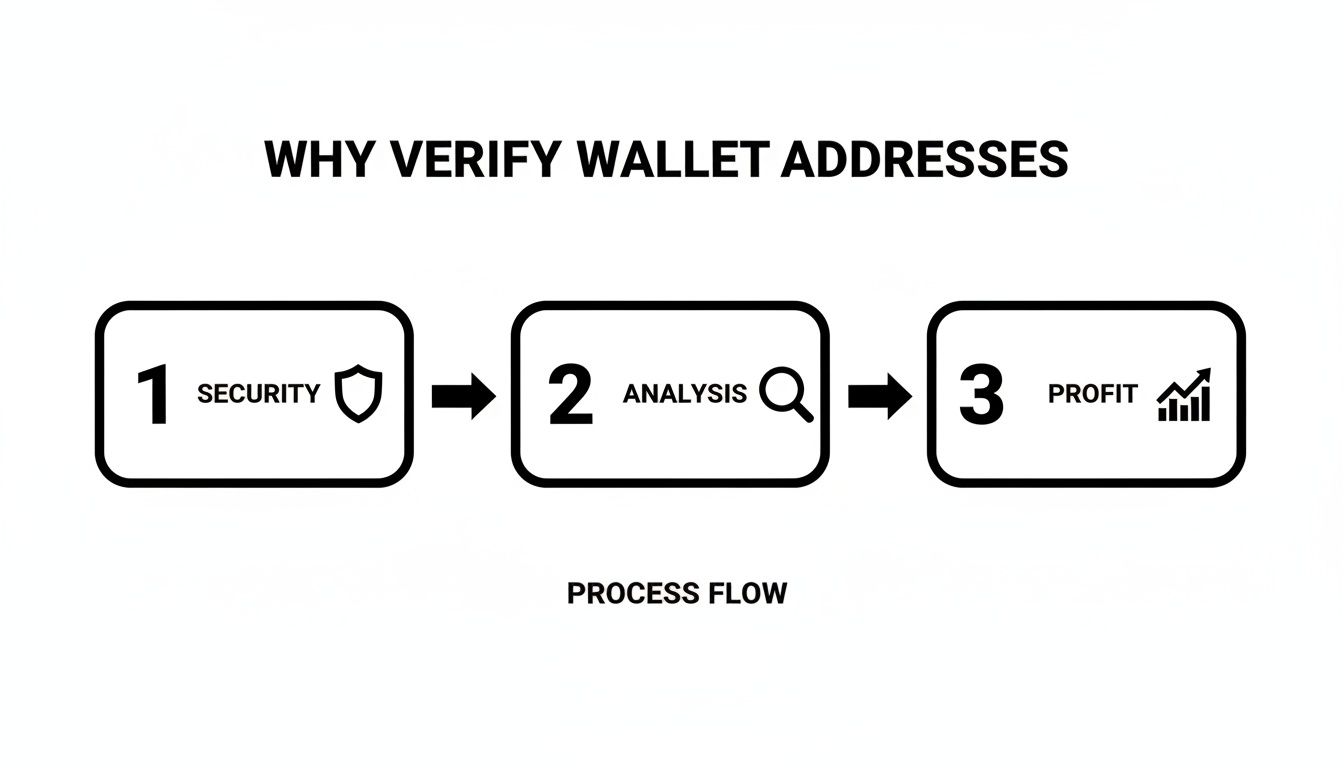
Process flow diagram showing why verifying crypto wallet addresses leads to security, analysis, and profit.

As you can see, what starts as a basic security measure quickly branches into powerful analysis that can lead you to your next big trade.

Verifying the Address Format

The first thing you’ll want to confirm is that the address format is correct for the chain you're on. Every blockchain has its own unique address structure. Sending assets to a wrongly formatted address is the crypto equivalent of mailing a letter to an imaginary country—it's gone for good.

For example, a standard Ethereum wallet address always starts with "0x" and is followed by 40 hexadecimal characters. If someone gives you an "Ethereum" address that doesn't begin with "0x," you’ve found an immediate red flag. We break down the nuts and bolts of this in our guide to the Ethereum wallet address format.

Here’s a quick cheat sheet for the major chains you’ll run into:

BlockchainAddress Format ExampleKey Identifier
Ethereum0x742d35Cc6634C0532925a3b844Bc454e4438f44eAlways starts with 0x.
SolanaEK52p216d5D5f25751944514b8a1099351052684A long string of alphanumeric characters.
Base0x4200000000000000000000000000000000000006Follows the same 0x format as Ethereum.
Bitcoin1A1zP1eP5QGefi2DMPTfTL5SLmv7DivfNa (Legacy)Starts with 1, 3, or bc1.

Always copy and paste the full address into the explorer’s search bar. Never try to type these long strings by hand.

A Practical Scenario: Checking a New Address

Let's say you find a trader on X (formerly Twitter) who seems to know what they're doing. They just posted a wallet address they’re using for a hot new memecoin. Before you jump in, you need to vet it.

Grab the address they shared and pop it into the right block explorer. Here's an actionable 60-second checklist:

  • First Transaction Date: How old is this wallet? A wallet created yesterday is far more suspicious than one with a two-year history.
  • Native Balance: How much ETH, SOL, or other native currency does it hold? A healthy balance often signals a more serious, well-capitalized player.
  • Transaction Count: Is this wallet active? A high transaction count suggests an active trader, whereas just one or two transactions could mean it's a burner wallet.

Your goal here isn't to uncover a master trading strategy just yet. It's a quick gut check to disqualify suspicious or inactive addresses and confirm you’re actually looking at a real player.

This five-minute check gives you a baseline. You can see the wallet's current holdings, its recent moves, and its general age. If it all looks good, you're clear to dig deeper. But if you see red flags—like all its funds coming from a sketchy exchange or a total lack of activity—you can confidently move on without wasting another second. This is the bedrock of good on-chain sleuthing.

Decoding On-Chain Activity and Token Holdings

Once an address checks out on a block explorer, the real detective work begins. You're moving past simple verification and starting to piece together a wallet's story, which is written publicly and permanently on the blockchain. Learning to read this on-chain activity is a non-negotiable skill for any serious trader.

A block explorer gives you a firehose of raw data. Your job is to sift through it to find actionable signals. Every transaction tells a piece of a larger story about the wallet holder's strategy, risk appetite, and expertise.

Reading the Transaction History Like an Expert

A wallet’s transaction log is a detailed, permanent record of every decision that trader has made. To understand their strategy, you must learn to distinguish between different types of on-chain actions beyond simple "IN" and "OUT" labels.

Here’s a quick breakdown of common transaction types:

  • Simple Transfers (Send/Receive): Basic peer-to-peer transactions. A wallet with mostly simple transfers might be a long-term holder or someone using crypto for payments.
  • DEX Swaps: Transactions with decentralized exchanges like Uniswap or Raydium indicate an active trader who is managing their portfolio and reacting to the market.
  • NFT Mints and Trades: Interactions with marketplaces like OpenSea or Magic Eden point to an interest in digital collectibles, signaling a strategy focused on cultural trends.
  • DeFi Protocol Interactions: Deposits into lending protocols like Aave or staking platforms like Lido suggest a yield farmer focused on generating passive income.

This screenshot gives you a feel for a typical interface that helps visualize and categorize a wallet's different activities at a glance.

A white card displaying various crypto tokens, actions like Swap and NFT Mint, and a token diversification chart.

Being able to quickly tell a simple token swap from an NFT mint is crucial for building an accurate profile of the wallet you're analyzing.

Analyzing a Wallet’s Token Portfolio

Beyond individual transactions, a wallet's token portfolio gives you a snapshot of its owner's entire investment thesis. A quick look at the "Token Holdings" tab on a block explorer or a dedicated tool like Wallet Finder.ai can reveal a massive amount about their risk tolerance.

Ask yourself these questions when analyzing a portfolio:

  • Is it conservative or aggressive? A wallet holding mostly blue-chip assets like Wrapped Ether (WETH) and USDC suggests a risk-averse strategy. A portfolio crammed with dozens of low-cap memecoins indicates a degen trader chasing 100x returns.
  • Is it diversified or concentrated? A diversified portfolio across multiple DeFi protocols signals a different approach than a wallet with 90% of its value in a single, obscure token.

A wallet's portfolio composition is a direct reflection of its owner's conviction. A portfolio with 90% of its value in a single, obscure token tells a very different story than one diversified across ten different DeFi protocols.

Understanding these portfolio differences is key. You can learn more about how to interpret these signals in our deep dive on https://www.walletfinder.ai/blog/crypto-on-chain. This knowledge helps you align your own strategy with traders who share a similar risk profile.

Identifying Revealing On-Chain Patterns

The most valuable insights come from spotting recurring patterns over time. A single transaction doesn't mean much, but a consistent pattern of behavior is a powerful signal.

Keep an eye out for these key patterns:

  1. Consistent Protocol Interaction: Does the wallet hit up the same two or three DeFi protocols every single week? This could signal deep expertise in a specific niche, making their future moves within that ecosystem particularly interesting to watch.
  2. Steady Token Accumulation: A wallet that slowly and steadily buys a specific token over weeks or months, no matter what the price is doing, often indicates a high-conviction, long-term bet. This is a classic "smart money" signal.
  3. Fresh Wallet Funding: Always pay attention to how a wallet gets its funds. If it’s funded directly from a major exchange like Coinbase and immediately buys a new token, it might be a retail trader. If it's funded by a known crypto VC fund or another whale, its actions carry a lot more weight.

These patterns are becoming even more important as global crypto adoption picks up speed. Regional trends are changing how traders hunt for alpha, with huge capital flows creating new opportunities. Recent data shows the Asia-Pacific (APAC) region is the fastest-growing, with on-chain value received jumping 69% year-over-year to $2.36 trillion. This surge demands better tracking tools for traders who want to capitalize on global smart money.

This is where tools like Wallet Finder.ai become essential, allowing users to find top Solana memecoin wallets and see their PnL in real time. For a deeper dive, the platform provides full trade histories, effectively creating a blueprint to replicate smart money moves. You can discover more insights about this booming crypto market on Cognitive Market Research.

Finding Smart Money with Advanced Wallet Checkers

Block explorers are great for a quick, basic check, but if you want a real edge in the market, you have to go deeper. This is where specialized platforms like Wallet Finder.ai come in, transforming raw on-chain data into intelligence you can actually trade on. It’s the difference between simple verification and actively hunting for "smart money."

An advanced crypto wallet address checker is built to answer one critical question: who is winning, and how are they doing it? Instead of spending hours piecing together a wallet's history, these tools give you a dashboard of performance metrics. You can filter, sort, and analyze the market's top players with incredible precision—the key to reverse-engineering a winning strategy.

Filtering for Elite Traders

The first step to finding smart money is knowing what you're looking for. A powerful checker lets you apply specific filters to cut through the noise and surface only the most promising traders.

For example, to find a top performer on the Base chain, you can set concrete criteria:

  • Realized PnL (Profit and Loss): Filter for wallets with over $100,000 in realized profit in the last 30 days.
  • Win Rate: Zero in on traders who have a win rate of 75% or higher on their recent trades.
  • Consistency: Find wallets that have been profitable for at least three consecutive months, filtering out any one-hit wonders.

This is what separates professional analysis from just looking at charts. It instantly brings the most successful wallets to your attention, saving you countless hours. You can quickly spot a wallet that turned $10,000 into $40,000 in a month—a 300% return—and then dive into its history to see exactly how they pulled it off.

Deconstructing a Top Wallet's Strategy

Once you've flagged a promising wallet, the real work begins. This isn't just about seeing what tokens they’re holding; it's about understanding their entire thought process. An advanced checker lays out a trader's complete history for you to pick apart.

Here’s a checklist of what to analyze in a top wallet:

  • Exact Entry and Exit Points: See the precise moment they bought a token and the exact price they sold it for.
  • Position Sizing: Did they ape in all at once, or did they scale into their position over time?
  • Profit-Taking Strategy: Do they sell partials on the way up, or hold for a single large exit?
  • Risk Management: How quickly do they cut losses on losing trades?

This level of detail lets you reverse-engineer their entire strategy. It’s like getting a peek inside the playbook of a highly successful trader.

The growing focus on security makes these advanced checkers even more important for building risk-aware strategies. The market for cold wallets is expected to grow with a 28.3% CAGR through 2032, as traders move to offline storage to dodge phishing and hacks. According to Technavio's crypto wallet market research, another USD 631.2 million will be added to the market's value by 2029.

For users of Wallet Finder.ai—from retail traders to prop desks—this trend highlights the need to pinpoint secure, high-performing addresses. The platform's no-key storage via AWS Cognito ensures you get safe, real-time insights to decode what top PnL leaders are doing.

This chart from Technavio shows just how much the market is growing, driven by demand for different types of wallets.

As the market expands, the ability to analyze and track the most secure and profitable wallets becomes a massive competitive advantage.

Building a Custom Watchlist for Real-Time Action

Spotting smart money is only half the job. The market moves lightning-fast, and you need to act on new information instantly. This is where custom watchlists and real-time alerts become your secret weapon.

Once you find a handful of wallets that consistently crush it, you can add them to a dedicated watchlist. This creates your own personal feed of smart money activity. You’re no longer reacting to stale market news; you're getting signals directly from the traders making moves.

A watchlist of 10 elite traders is more valuable than a newsfeed with 1,000 analysts. You're tracking actual capital flows, not just opinions.

The final piece of the puzzle is automation. The best wallet checkers offer real-time notifications. You can set up alerts to pop up directly in Telegram the moment a wallet you're tracking makes a move.

Here’s a simple, actionable workflow:

  1. Discover: Use filters to find a wallet with high PnL and a solid win rate.
  2. Analyze: Dig into its trade history to understand its strategy.
  3. Watchlist: Add the wallet to your custom list for ongoing monitoring.
  4. Alert: Set up Telegram alerts to get notified instantly of its next buy or sell.

When you get an alert that one of your tracked wallets just bought a new token, you can immediately investigate and decide if you want to follow their lead. This flips your approach from reactive to proactive, putting you in a position to move with the smart money in real time.

How to Spot Red Flags and Assess Wallet Risk

Finding a profitable wallet is one thing. Figuring out if those profits came from real skill or just blind luck is where the real work begins. When you’re digging into a wallet, you’re not just looking for a pretty PnL chart; you’re on the hunt for red flags that scream "stay away."

This is all about developing a sharp, analytical eye for risk. A few extra minutes of due diligence here can save you from a catastrophic loss.

A magnifying glass inspects multiple red warning signs above a wallet, illustrating a risk check.

Transactional Warning Signs

A wallet’s transaction history doesn't lie. Certain patterns are dead giveaways for high-risk behavior or outright manipulation.

Here's an actionable checklist of warning signs to look for:

  • Interaction with Unaudited Contracts: Does the wallet exclusively trade sketchy, brand-new tokens? A real trader's history will show a healthy mix of established protocols too.
  • Funding from High-Risk Sources: Was the wallet funded directly by a crypto mixer or an exchange known for lax KYC? This often points to an attempt to hide the origin of funds.
  • Pump, Dump, and Run Pattern: Watch for a wallet that gets a big deposit, uses it all to buy a single obscure token, and then immediately ships the profits to a brand-new, clean wallet. This pattern is designed to leave followers holding worthless bags.

A skilled trader's wallet history tells a story of research, patient accumulation, and strategic profit-taking. A scammer's history looks like a chaotic mess of high-speed, all-or-nothing gambles funded by anonymous sources.

Indicators of Market Manipulation

Going a level deeper, some wallets are used for deceptive tactics designed to create a false sense of activity. Spotting these requires looking at how a wallet interacts with other wallets and protocols.

One of the oldest tricks in the book is wash trading, where an entity buys and sells the same asset between their own wallets to fake volume and pump the price. Another is a sybil attack, where one person uses dozens of wallets to make a token look like it has a massive community when it’s really just one person.

Here’s a quick cheat sheet for spotting this kind of foul play:

Red Flag IndicatorWhat It Looks LikeWhat It Might Mean
Circular TransactionsWallet A sends to B, B sends to C, and C sends right back to A.This is textbook wash trading used to inflate volume metrics.
Identical Trade PatternsYou see dozens of wallets buying and selling the same obscure tokens at the exact same times.This strongly suggests a sybil attack coordinated by a single actor.
Mixer InteractionThe wallet frequently sends or receives funds from privacy tools like Tornado Cash.While mixers have legitimate uses, constant interaction is a major red flag. For a deeper dive, check out our guide on detecting crypto mixer transactions.

Risky Token Approvals and Permissions

One final, often overlooked, vector of risk is a wallet's token approvals. Every time you use a dApp, you grant it permission to access and move specific tokens from your wallet. Giving unlimited approvals to shady or unaudited dApps is like leaving your front door wide open.

You can use a tool like Etherscan's Token Approval Checker to see what permissions a wallet has given out. If you see it’s granted unlimited spending approval for its entire USDC balance to some random, unheard-of DEX, that’s a sign of terrible security hygiene. That wallet is a ticking time bomb, vulnerable to being completely drained at any moment.

Ultimately, assessing risk is about piecing together the full story. A single red flag might have a reasonable explanation, but a wallet showing multiple warning signs is a clear signal to walk away—no matter how incredible its recent profits might look.

Frequently Asked Questions

Got questions? Here are some straightforward answers to the questions I hear most often from traders.

Is It Safe to Use a Crypto Wallet Address Checker?

Yes, it is completely safe. Wallet addresses are public information. Using a crypto wallet address checker is a read-only action. You are only looking at public data. You never connect your own wallet or share your private keys, so your funds are never at risk. Reputable platforms also encrypt their connections and secure your login info to keep your research private.

Can You Find Out a Wallet Owner's Identity?

For the most part, no. Crypto wallets are pseudonymous, meaning an address isn't directly tied to a real-world identity. While blockchain forensics firms can sometimes link wallets to centralized exchanges (which require KYC), that's not something the average person can do.

As a trader, your focus should be on the what—the wallet's strategy, its PnL, its on-chain moves—not the who. The real alpha is in analyzing verifiable actions.

The beauty of on-chain analysis is its focus on verifiable data. A wallet's PnL and trading history are objective truths, regardless of who holds the keys.

Block Explorer vs. a Tool Like Wallet Finder.ai: What's the Difference?

This is a great question. A block explorer like Etherscan is an essential tool that gives you the raw, unfiltered data from the blockchain. It's like being handed a massive, unorganized ledger. An advanced analytics platform like Wallet Finder.ai does the heavy lifting for you by processing that raw data into clear, actionable insights—like PnL, win rate, and top-performing tokens.

Here’s a simple breakdown:

FeatureBlock Explorer (e.g., Etherscan)Advanced Checker (e.g., Wallet Finder.ai)
Data PresentedRaw, unfiltered transaction logsCurated performance data (PnL, win rate)
Primary UseVerifying a single transaction or addressDiscovering and analyzing top-performing traders
User GoalConfirmationActionable trading intelligence
Time InvestmentHigh (requires manual analysis)Low (provides filtered, sorted results)

In short, a block explorer tells you what happened. An advanced tool tells you who is winning and how they are doing it, saving you countless hours of manual grunt work.

How Do I Check a Wallet Address on Multiple Chains?

Doing this manually is a pain. You have to jump from one block explorer to the next for each chain—Etherscan for Ethereum, Solscan for Solana, Basescan for Base, and so on.

This is where integrated platforms shine. A tool like Wallet Finder.ai pulls data from major chains like Ethereum, Solana, and Base into one clean, unified dashboard. You can see a trader's entire strategy and portfolio in one place without juggling a dozen browser tabs. It gives you a much more holistic—and useful—view of their on-chain footprint.


Ready to stop guessing and start tracking the strategies of top-performing traders? Wallet Finder.ai turns raw on-chain data into actionable alpha. Discover profitable wallets, get real-time trade alerts, and replicate winning moves before they hit the mainstream. Start your 7-day trial today and find your edge at https://www.walletfinder.ai.