Crypto Pair Trading: A Market-Neutral Guide
Master cryptocurrency pair trading with a data-driven framework, risk management, and on-chain analytics for profitable, market-neutral trades.

February 24, 2026
Wallet Finder

February 24, 2026

If you've spent any time in crypto, you know most trading strategies are directional. You buy, hoping the price goes up. You short, betting it goes down. The problem? This ties your fate directly to the whims of the market, making you a passenger in a very volatile vehicle. Even a solid trading thesis can get completely wiped out by a sudden market crash or an unexpected rally.
But what if there was a way to trade that didn't depend on predicting where the whole market is headed?
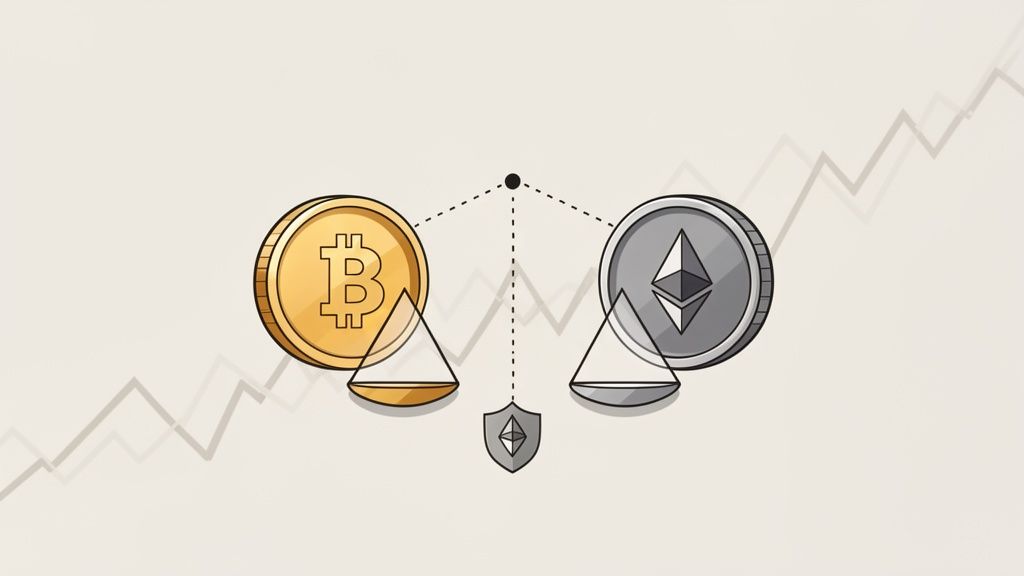
That's where cryptocurrency pair trading comes in. It's a market-neutral strategy that profits from the price difference between two related assets, not their absolute direction. The idea is to simultaneously buy an undervalued crypto and short an overvalued one, betting that their price relationship—the spread—will eventually snap back to its historical average.

Pair trading offers a totally different approach by focusing on statistical arbitrage. Think of it like a seesaw. Instead of guessing if the whole playground will get sun or rain, you're just focused on the seesaw itself. You bet that when one side goes unusually high, it will eventually come back down, bringing the other side up to meet it.
This method actually thrives on crypto's signature volatility. When the price spread between two historically linked assets, like Bitcoin and Ethereum, stretches way beyond its normal range, a pair trader sees an opportunity. They'll go long on the underperforming asset and short the outperformer, waiting for that gap to close.
The core idea is simple: You are not trading coins; you are trading the relationship between them. This fundamentally changes how you view risk and opportunity, moving away from market forecasting and toward statistical probability.
The entire strategy hinges on a powerful financial principle called mean reversion. It's the theory that prices and other metrics eventually move back toward their long-term average. When you apply this to two cointegrated crypto assets, their price spread tends to swing back and forth around a stable equilibrium.
This isn't just theory; the numbers back it up. One academic study found that a cryptocurrency pair trading strategy delivered average monthly abnormal returns of 12% over a three-year period. In another real-world example, a simple BTC-ETH pair trading system generated a total portfolio return of 43.4% during a volatile six-month stretch in 2021, just by capitalizing on these temporary price divergences. You can dig into the specifics in this crypto pairs trading study.
This guide will walk you through building a solid system to do this yourself. Before we dive in, here’s a quick overview of the essential parts we'll be covering.
By mastering these pillars, you can move away from pure speculation and build a more consistent, all-weather approach to trading the crypto markets.
The entire success of your pair trading strategy hinges on one thing: picking the right pair. It’s easy to just grab two coins that seem to move together, but that’s a surface-level approach that usually ends in frustration. The real money is made by digging deeper into their statistical relationship.
A huge mistake I see traders make is confusing correlation with cointegration. Correlation just means two assets tend to zig and zag in the same general direction. That’s a start, but it’s not enough. Cointegration is the real prize. It implies a stable, long-term economic connection between two assets, meaning that even when their prices wander apart, they have a strong statistical pull to snap back together.
Think of it like a dog on a leash. The dog (a correlated asset) can run ahead or fall behind you, but the leash (the cointegrating relationship) makes sure it never gets too far away for too long. Our job as traders is to figure out how long that leash is and place our bets when it's stretched to its absolute limit.
A great place to start is by looking for assets that share a similar story or purpose. This gives you a fundamental reason for their prices to be linked, which dramatically boosts the odds of finding a true cointegrated relationship.
Here are a few hunting grounds I’ve found to be particularly fruitful:
As you start digging into potential assets, using a tool like a CoinMarketCap watch list can be a massive help. It keeps everything organized and makes comparing potential pairs much less of a headache.
Once you’ve got a shortlist of candidates, you have to prove their relationship statistically. This isn't about gut feelings. We need to run a specific statistical test to confirm that the price difference—the "spread"—between the two assets is stationary. A stationary series is one that always wants to return to its long-term average.
The go-to tool for this is the Augmented Dickey-Fuller (ADF) test. You don’t need a Ph.D. in statistics, but you do need to understand what its results are telling you.
You run the ADF test on the historical spread of your potential pair, and it spits out a p-value.
Key Takeaway: If the p-value from your ADF test comes in below a certain threshold (the standard is 0.05), you can confidently say the spread is stationary. This is your statistical green light; it confirms the pair is likely cointegrated and a solid candidate for a mean-reversion strategy.
Let's make this concrete. Say you want to test the ETH/BTC pair.
Spread = Price(ETH) / Price(BTC). This creates a new time series representing their relationship.statsmodels).On the flip side, if the p-value was 0.35, that’s a red flag. The relationship isn't stable enough. You'd scrap that pair and move on to the next one on your list.
This disciplined, data-first approach is what separates the pros from the amateurs. It replaces hunches with hard evidence and builds a solid foundation for the entry and exit rules we're going to cover next.
Once you've found a statistically sound pair, it's time to build the engine of your trading system. This is where we shift from theory to a concrete, rules-based plan. Without objective rules, you're just gambling on gut feelings, and that's a quick way to lose money.
The first job is to turn the raw price spread into a standardized signal—something that tells you exactly how far from "normal" the pair's relationship has strayed. For this, the Z-score is your best friend. The Z-score simply measures how many standard deviations the current spread is from its historical average.
This calculation transforms chaotic price action into a simple, actionable number. A Z-score of 0 means the spread is right at its historical average. A +2.0 means it’s two standard deviations above the average, and a -2.0 means it’s two standard deviations below.
This flowchart gives you a bird's-eye view of the entire process, from finding a pair to validating it for your strategy.

As the graphic shows, a systematic approach is key. Moving from correlation to cointegration and then to deeper analysis is what creates the foundation for reliable trade signals.
Your Z-score is the trigger for your entire operation. A common and effective starting point is setting entry thresholds at +2.0 and -2.0. These levels represent a significant statistical deviation, suggesting the spread is overextended and likely to snap back.
Here’s how this translates into a clear set of rules:
This mechanical approach pulls emotion out of the equation. The numbers tell you what to do, which is critical for staying consistent in cryptocurrency pair trading. It stops you from second-guessing an exit or getting greedy and holding on too long.
Executing a pair trade means placing two orders at the exact same time. Let's walk through a real-world example with the Arbitrum (ARB) and Optimism (OP) pair. Imagine your analysis shows ARB is overvalued relative to OP, pushing the Z-score to +2.2.
Here’s what you would do:
You're now in the trade. You are effectively "net long" the OP/ARB relationship and are waiting for ARB's price to fall relative to OP's, which would bring that Z-score back toward zero.
Remember, the goal isn't for OP to go up or ARB to go down in absolute terms. You can make money even if both coins fall, as long as ARB falls more than OP.
Mean reversion is a high-probability strategy, but it’s not a sure thing. Sometimes, a fundamental change can permanently break a historical relationship. This is why a hard stop-loss is the most important rule you'll set.
A common stop-loss is a Z-score threshold of 3.0. If the spread blows past your entry and hits a Z-score of +3.0 or -3.0, it’s a massive red flag that something is fundamentally wrong. You exit the trade immediately to protect your capital. Sticking to this rule is what separates sustainable traders from those who blow up their accounts.
While you can fine-tune these rules, validating them through rigorous testing is non-negotiable. For a deeper dive on this, check out our guide on how to backtest trading strategies.
Some traders are even using more advanced models to refine these triggers. One deep learning-enhanced strategy for crypto, for example, generated 113 trading signals over several years and hit an impressive 71.68% win rate. By using neural networks to forecast spread movements, the model adapted to shifting volatility far better than static rules ever could.

Nailing your entry signal is a great start, but it's only half the battle. Without a solid risk management plan, even the most promising strategy is a recipe for disaster. When you’re pair trading crypto, your goal is market neutrality, and disciplined risk control is what separates the consistently profitable traders from the ones just getting lucky.
The absolute core principle here is to protect your capital at all costs. This lets you stay in the game long enough for your statistical edge to actually play out. It’s about more than just slapping on a stop-loss; you need to be thinking about how you size every single position before you even think about clicking "buy" or "sell."
You’ll hear the term "market-neutral" thrown around a lot, but a pair trade is only genuinely neutral if it's structured correctly. The foundation of that structure is dollar neutrality.
In simple terms, this means the total dollar value of your long position must be an exact match for the total dollar value of your short position.
This balance is what shields your trade from the wild swings of the broader market. If the entire crypto market suddenly tanks by 20%, a properly dollar-neutral position should, in theory, come out relatively unscathed. The loss on your long leg gets cancelled out by the gain on your short leg.
Let’s walk through a quick example with a hypothetical $10,000 portfolio. Say you decide to risk 2% of your capital on a single trade, which comes out to $200.
This setup ensures that for every dollar you have betting on one side of the pair, you have a dollar betting against the other. Your goal is to profit only from the spread closing, not from one coin randomly outperforming the market.
One of the most common mistakes I see is traders treating all pairs the same. A trade between two stablecoins is a completely different beast than a trade between two highly volatile altcoins. To keep your risk consistent from one trade to the next, you have to adjust your position size based on how volatile each asset is.
A really effective way to do this is with the Average True Range (ATR), a standard indicator that measures market volatility. When you normalize your position size using ATR, you're making sure that a one-ATR move against you results in the same dollar loss, no matter which pair you’re trading.
Here’s how to put that into practice:
Position Size = Risk Per Trade / ATR.For example, if you're risking $200 on a pair where the spread's ATR is $0.50, your total position size would be 400 units (200 / 0.50). You'd then go long 200 units of the undervalued coin and short 200 units of the overvalued one.
This approach stops a single, wild trade from blowing up your portfolio's performance.
Risk management doesn't stop at the individual trade level. You also have to think about your portfolio as a whole. Deciding how many pairs to trade at once and capping your total exposure are absolutely critical for long-term survival.
Spreading yourself too thin can dilute your focus, but putting all your eggs in one or two pairs is asking for trouble if those relationships suddenly break down. I’ve found a balanced approach is to trade somewhere between 3 to 7 uncorrelated pairs at any given time.
You also need a hard limit on your total capital at risk. A good rule of thumb is to never have more than 10% to 15% of your portfolio exposed at any one time. With our $10,000 example, that means your total active positions—long plus short—shouldn't top $1,500.
This hedged, risk-managed approach isn't just theory; it has been shown to work. For example, backtests on a cointegrated pair like ETC vs. FIL have produced an impressive profit factor over 5. The strategy's annualized volatility was just 17.26%, which is remarkably low in the world of crypto.
By combining dollar neutrality, volatility-adjusted sizing, and strict portfolio limits, you're building a robust system designed for sustainable growth, not just a few lucky wins. For a deeper dive into these concepts, check out this complete guide to risk management in trading to really shore up your defenses.
Building a profitable trading system from the ground up takes a serious amount of time and effort. But what if there was a powerful shortcut? Instead of starting from scratch, you can stand on the shoulders of giants by finding and mirroring the moves of elite traders already running successful pair trading strategies.
This approach flips the script. You shift from building to observing. Since the blockchain is a public ledger, every single transaction is recorded and available. By using on-chain analysis tools like Wallet Finder.ai, you can turn this firehose of raw data into actionable intelligence. It's like looking over the shoulder of a top-performing trader in real-time.
The goal here isn't blind copy-trading. It's about finding the "smart money"—wallets that consistently and profitably trade related assets—and then deconstructing their strategy to adapt it for yourself. You're essentially getting a free blueprint of what's working right now.
The first challenge is filtering through the millions of active wallets to find the ones that actually matter. A good on-chain intelligence platform lets you hunt for wallets based on specific performance metrics that signal a sophisticated trader, likely one engaged in statistical arbitrage.
You can set up your search with filters that are the hallmarks of a successful pair trader:
This kind of powerful filtering lets you cut through all the market noise and focus exclusively on wallets that exhibit the behavior of a professional pair trader.
Once you’ve identified a few promising "alpha" wallets, the real power comes from monitoring them in real time. You don’t have to be glued to your screen all day waiting for something to happen. Instead, you can set up automated alerts that notify you the instant a target wallet makes a move.
With a tool like Wallet Finder.ai, you can create a watchlist and configure push notifications or Telegram alerts for specific actions.
Imagine getting an instant alert on your phone: "Wallet 0x123... just sold 50 ETH and bought 850,000 ARB." This isn't just a signal; it's a front-row seat to a pro's execution, allowing you to react quickly and potentially mirror their trade before the opportunity is gone.
This simple setup transforms on-chain analysis from a reactive research tool into a proactive, signal-generation engine. It's the closest you can get to having a mentor tap you on the shoulder right when they're executing a trade.
Mirroring trades is a great start, but the real prize is understanding the why behind the trades. The best on-chain platforms allow you to export a target wallet's entire trading history. This dataset is an absolute goldmine.
By exporting this data to a CSV file, you can run your own offline analysis. You can start to reverse-engineer their strategy by asking key questions:
The platform's dashboard also gives you a high-level view of a trader's performance and recent activity.
This snapshot lets you quickly assess a wallet's profitability, win rate, and most-traded tokens, helping you decide if their strategy is worth a deeper dive.
This whole analytical process gives you a proven blueprint. You get to see the exact parameters that a profitable trader uses, which you can then backtest and adapt to fit your own risk tolerance and capital. You might find they use a Z-score of 1.8 for entry, or a much tighter stop-loss than you had considered.
This method of learning from the best drastically shortens your learning curve. Instead of spending months testing theories that might not work, you can start with a framework that is already proven in live market conditions. It’s a massive edge. If you're looking for more ways to find and track these high-performing traders, our guide on using a smart money tracker offers additional tips and techniques.
Once you start digging into cryptocurrency pair trading, a bunch of "what if" and "how to" questions inevitably pop up. It's one thing to understand the theory, but it's another to actually put your capital on the line.
Let’s run through some of the most common questions I hear. We'll cover the nitty-gritty of execution, risk, and what to do when your perfect setup starts to go sideways.
Everyone wants a magic number here, but the truth is, there isn't one. While you'll often see +/- 2.0 thrown around as a standard, it's just a starting point. The real answer depends entirely on the personality of the pair you're trading.
For a relatively calm pair—think two liquid staking derivatives that track each other closely—you might find a tighter Z-score like +/- 1.5 gives you more trading opportunities that are still valid. On the flip side, if you're trading two volatile altcoins, you might need to wait for a much wider deviation, maybe +/- 2.5, just to filter out the daily noise and catch a genuine signal.
There's only one way to find out what works for your pair: backtest. Run your historical data through different thresholds (1.5, 2.0, 2.5, etc.) and see which one gave you the best results without taking on a ton of risk.
Shorting is half the game in pair trading, and thankfully, it’s pretty straightforward in DeFi using lending platforms like Aave or Compound. It sounds more complicated than it is.
Imagine you need to short Asset X. Here’s how it works:
Boom. You're now short Asset X. To close the trade, you just do everything in reverse: buy back Asset X (hopefully for cheaper!), and repay your loan on the lending platform. Your profit is whatever is left over.
Technically, yes. You could pair trade something like Solana (SOL) on its native chain with Arbitrum (ARB) on its own network. But I’d strongly advise against it, especially if you're just starting out.
This isn't a simple trade anymore; it's an operational headache. You're suddenly dealing with:
Stick to pairs that live on the same blockchain. Life is so much simpler, and you can focus on the strategy itself rather than fighting the infrastructure.
This is the big one. It's the single most important risk you face in pair trading, often called a "relationship breakdown" or a structural break. This is when the fundamental reason your two assets were cointegrated disappears, and the spread stops mean-reverting. Instead, it just takes off in one direction and never looks back.
This scenario is exactly why you must have a non-negotiable stop-loss. Your strategy needs a kill switch for when a trade goes from a temporary deviation to a permanent breakup.
This could be a hard stop at a maximum Z-score, say 3.0 or 3.5, or even a time-based stop. For example, if the trade hasn't moved back toward the mean within X number of days, you cut it loose, no questions asked. A single broken pair can easily destroy the profits from ten good trades if you don't have this safety net in place.
Ready to stop guessing and start learning from the pros? Wallet Finder.ai gives you the on-chain intelligence to discover top-performing wallets, see their exact pair trading strategies, and get real-time alerts on their moves. Find your edge at https://www.walletfinder.ai.