Chain Trade Size Chart: Spot Smart Money Moves
Master the on-chain trade size chart to analyze market structure and copy trade with precision. Learn to build and read charts with Wallet Finder.ai.

May 24, 2026
Wallet Finder

May 24, 2026

USD 3,677.5 million in 2024, projected to reach USD 10,713.28 million by 2032. That's one estimate for the global risk management software market, reflecting a projected 14.3% CAGR as organizations adopt automated risk and compliance tools, according to Credence Research's market outlook.
That number matters because it changes how we should think about this category. Risk management software isn't just a compliance department purchase anymore. It has become operating infrastructure for companies that need to see threats early, assign responsibility, document mitigation, and prove that controls function as intended.
Those same principles show up far outside traditional enterprise settings. A bank tracks operational and compliance risk. A hospital tracks privacy and system risk. A DeFi trader tracks wallet behavior, token exposure, and protocol-level threats. The pace is different, but the discipline is the same. Identify uncertainty, assess it in context, act before losses compound.
A risk register used to live in a spreadsheet. Now it often lives in a system that updates as the business changes.
That shift happened because risk stopped being a periodic review task and became part of daily operations. Security teams track incidents as they happen. Finance teams monitor vendor and fraud exposure across systems. Legal and compliance teams need an audit trail that shows not just the current risk rating, but who changed it, why it changed, and what action followed.
The older approach was manageable when organizations had fewer tools, fewer integrations, and slower decision cycles. A quarterly review could still feel current. Once companies started running on cloud apps, distributed teams, outside vendors, and continuous releases, static records began to fail in predictable ways. One team updated a control. Another kept using the old assumption. Leadership saw a report that was already out of date.
Risk management software works like an air traffic control system for uncertainty. It does not fly the plane for you. It gives teams a shared screen, common signals, and a process for deciding which issue needs attention first.
That matters far beyond compliance.
A useful platform helps an organization connect incidents, controls, owners, assessments, and follow-up actions in one place. The value is coordination. People can see the same exposure, work from the same evidence, and respond before a small problem spreads into operational loss, regulatory trouble, or reputational damage.
Risk is easier to handle when it is treated as a live operating condition, not a document prepared for an annual review.
The same logic carries into DeFi, where the clock moves faster and the margin for error is thinner. A treasury team may watch vendor concentration and access controls. A DeFi trader watches wallet behavior, liquidity movement, token concentration, and smart contract exposure. The objects are different, but the discipline is familiar. You gather signals, judge materiality, and act before the situation turns against you.
That is why tools built for on-chain monitoring increasingly resemble specialized risk management software. For a concrete example, blockchain data analytics for on-chain risk monitoring turns raw wallet and transaction activity into something a trader can use. In that setting, Wallet Finder.ai serves a role similar to enterprise risk software. It helps surface patterns, track exposure, and support faster decisions under uncertainty.
Enterprise teams worry about control failures, third-party dependencies, and incident response. DeFi participants worry about contract risk, wallet clusters, liquidity exits, and adversarial behavior. The speed is different. The underlying job is the same.
You need a reliable way to spot what can hurt you, estimate the likely impact, and decide what to do next before conditions change again.
At its simplest, risk management software is a shared system for tracking what could go wrong, how serious it is, who owns the response, and how that judgment changes over time.
A useful analogy is a building's central alarm and control panel. Smoke detectors, door sensors, cameras, and sprinkler controls all feed signals into one hub. The panel doesn't replace human judgment, but it gives people a coordinated, current view of the building's condition and a way to respond consistently. Risk software plays a similar role for an organization.
A spreadsheet can list risks. It can even rank them. But it struggles with history, accountability, evidence, and coordination.
If one team updates a score, another team may not know why it changed. If a control reduces exposure, the old and new states may not be easy to compare. If an auditor asks who approved the re-rating, people start digging through email.
That's why structured systems matter.
According to Hyperproof's buyer guide, effective risk management software relies on a structured risk register that records each risk's description, likelihood, impact, and owner, while preserving an audit trail of how those assessments change over time as new controls or threats appear.
Think of a risk register as the master record for uncertainty. A strong one usually includes:
That last item is where many readers get confused. Risk isn't static. A supplier issue can worsen. A new control can lower exposure. A business change can create a new dependency. Good software preserves that story.
Practical rule: If you can't explain why a risk rating changed, you don't have a reliable risk process. You have a label.
The end goal isn't a prettier register. It's better decisions. Leaders need to know which exposures are rising, which controls are working, and where attention belongs now. The software helps by turning scattered observations into a single source of truth.
That concept also travels well into DeFi. A trader may not call it a risk register, but the logic is familiar. Which wallet are you tracking? What token is exposed? What changed in the last few hours? Who is entering, exiting, or concentrating risk? Same discipline. Different data.
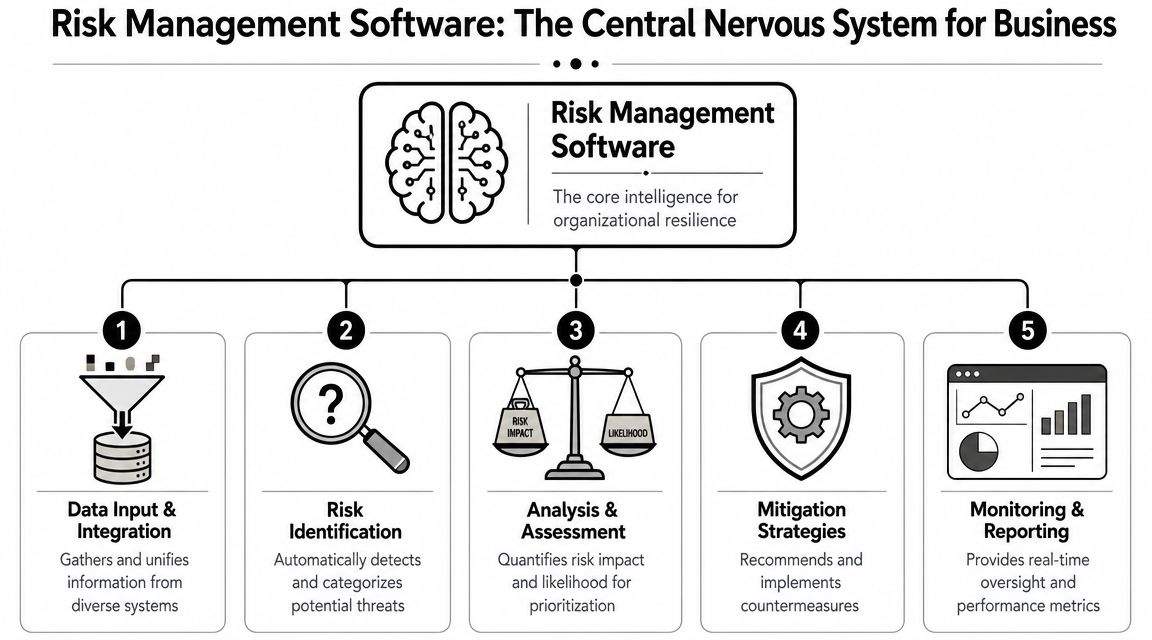
The best way to understand risk management software is to look at the moving parts. A good platform isn't one giant dashboard. It's a set of connected functions that support identification, assessment, mitigation, monitoring, and reporting.

Here's a practical breakdown.
One advanced capability matters more than many feature lists suggest. Strong tools don't assess risk in a vacuum. They connect risk records to the environment where those risks exist.
NIST's methodology emphasizes starting with system characterization before threat identification. As summarized in NIST SP 800-30, advanced risk tools improve scoring by integrating system context such as asset inventories and service dependencies.
That sounds technical, but the idea is simple. If a database supports three critical services, then a failure there has a larger blast radius than a failure in an isolated test system. Context changes impact. Ownership changes response speed. Dependencies change urgency.
A risk score without context is like a weather warning without a map. You know danger exists, but you don't know who is in its path.
A mature enterprise platform might link a cyber risk to a specific application, the business process it supports, the people who own it, and the controls already in place. A DeFi analytics stack does something similar in a different language. It links token activity, wallet behavior, transaction patterns, and timing signals to help traders judge whether a move looks credible or dangerous.
If you want to see how crypto-native tools approach that problem, this overview of DeFi analytics tools in 2026 is a useful companion. The tooling differs from enterprise GRC platforms, but the pattern is familiar. Better context leads to better decisions.
Many teams buy risk management software because an auditor, regulator, board, or customer expects formal controls. That's understandable, but it's too narrow. The primary payoff is decision quality.
When a company has a clear picture of its top exposures, leaders can allocate people, time, and budget more intelligently. They stop spreading effort evenly across every issue and start focusing on what can hurt operations, reputation, or financial performance.
Three benefits show up quickly.
That's why risk management software shouldn't be treated as just a compliance archive. A compliance-first mindset asks, “Can we prove we did the review?” A strategic mindset asks, “Did the review change a decision in time to avoid damage?”
This logic applies directly to active traders. A DeFi trader who reviews wallet concentration, recent exits, and token behavior before entering a position is doing practical risk management. The goal isn't to produce a formal board report. The goal is to avoid preventable mistakes.
A useful framework for that kind of work is portfolio-level thinking, not token-by-token guesswork. This guide to DeFi portfolio risk assessment tools and techniques is relevant because it frames risk as exposure management rather than isolated trade selection.
Good risk practice doesn't slow decision-making. It removes avoidable uncertainty so decisions can be made with clearer tradeoffs.
That's the strategic shift. Risk work creates value when it helps you act earlier, size positions better, and avoid exposures you don't fully understand.
Buying risk management software gets messy when teams compare feature grids without agreeing on the job the tool must do. Start there. Are you trying to centralize enterprise risks, support audits, manage controls, monitor incidents, or improve fast operational decisions? Different goals require different designs.
One selection mistake shows up often. Buyers ask vendors what the software can display instead of what the software can improve. Dashboards matter, but outcomes matter more.
According to Empowered Systems, buyers should focus on proving ROI through measurable outcomes such as prevented incidents or lower compliance costs, rather than relying on feature checklists alone.
Use plain questions, not vendor jargon.
| Evaluation Criterion | What to Look For | Why It Matters |
|---|---|---|
| Scope fit | Clear alignment with your use case, such as enterprise risk, cyber risk, incident tracking, or on-chain monitoring | A broad platform can still be the wrong tool if it solves the wrong problem |
| Risk register quality | Structured records for description, likelihood, impact, owner, response, and change history | This is the backbone of reliable risk tracking |
| Audit trail | Logged edits, approvals, timestamps, and evidence attachments | Teams need traceability, not memory |
| Data integration | Ability to pull in relevant system, asset, workflow, or market data | Risk scoring improves when it reflects live context |
| Workflow design | Assignments, reminders, escalations, and review cycles | Risk work fails when ownership is vague |
| Reporting | Configurable dashboards and decision-ready summaries | Leaders need trend visibility, not raw clutter |
| Usability | Interface that non-specialists can learn without heavy dependence on admins | Adoption determines whether the system becomes habit or shelfware |
| Context modeling | Support for dependencies, assets, services, counterparties, or wallet relationships | Context changes impact and priority |
| ROI proof | A credible plan for measuring outcomes after rollout | Buying software without a success test invites disappointment |
| Scalability | Room to support more teams, assets, risks, or workflows over time | The tool should grow with your exposure, not cap it |
A practical buying sequence looks like this:
For enterprise teams, that scenario might be a cyber incident or third-party review. For a DeFi desk, it might be identifying whether recent wallet activity around a token reflects accumulation, distribution, or coordinated dumping.
Traditional enterprise risk systems usually assume a world of scheduled reviews, known assets, named owners, and relatively stable operating conditions. DeFi doesn't behave that way. Risks can emerge from code, liquidity movement, wallet coordination, governance actions, social signals, or simple speed.

That gap matters. As discussed by Simio's analysis of business variability and hidden risk, traditional risk software often struggles in high-velocity environments where risk emerges through rapid feedback loops and complex behavior. In those settings, real-time analytics and predictive methods become far more important.
The underlying principles don't disappear in DeFi. You still need to:
The difference is tempo. In an enterprise setting, a quarterly review may be acceptable for some risks. In DeFi, a major wallet exit or suspicious concentration shift can matter immediately.
A trader's risk register may be informal, but the categories are real.
A useful educational resource on how these market dynamics differ is the video below.
A DeFi trader usually doesn't need a classic GRC suite. They need a focused system for monitoring wallet behavior, token flows, and entry or exit timing. In that sense, Wallet Finder.ai functions as a specialized form of risk management software for on-chain assets. It tracks wallet performance, surfaces trading histories and PnL patterns, supports watchlists, and sends real-time alerts when tracked wallets buy, sell, or swap.
That doesn't remove risk. It changes how you observe it.
If a wallet has a pattern of disciplined exits and consistent positioning, that behavior can inform your judgment. If multiple tracked wallets suddenly reduce exposure to a token you hold, that can act as an early warning. If a token's activity comes mostly from low-quality or highly erratic wallets, that may be a signal to step back rather than chase momentum.
In DeFi, you often can't verify identity first. You verify behavior first.
In this context, the enterprise analogy becomes useful again. Traditional teams link risks to assets and controls. DeFi traders link risks to wallets, tokens, and transaction patterns. Both are trying to answer the same question. What am I exposed to right now, and what is the earliest defensible action?
Yes, if decisions carry real financial or operational consequences.
A small company may not need an enterprise-wide governance platform, and a solo DeFi trader may not need approval chains or policy libraries. Both still need a reliable way to track exposure, note what changed, and decide what to do next. Memory is a poor control system, especially when conditions shift fast.
The enterprise version might track vendors, incidents, and compliance gaps. The DeFi version might track wallets, token concentration, and unusual exits. The principle is the same. You need a structured record of what can hurt you and which signals deserve action.
Project management software organizes work. Risk management software organizes uncertainty.
That sounds abstract, so it helps to separate the two by the question each tool answers. A project tool asks, “What are we building, who owns each task, and when is it due?” A risk tool asks, “What could go wrong, how serious would it be, who is watching it, and what control is in place?”
There is some overlap because both tools assign owners and track status. The difference is purpose. One is built to move work forward. The other is built to catch threats before they become losses.
Start with a simple risk register.
One list is enough at first. Record the major risks, the person responsible, the current response, and the signal that would tell you the risk is getting worse. In a company, that signal might be a missed control test or a vendor outage. In DeFi, it might be a tracked wallet reducing exposure, a sudden drop in liquidity, or abnormal token flows.
A clear list beats an expensive platform with no process behind it.
Review timing should match the speed of the environment.
A stable internal process can be reviewed on a scheduled basis because the underlying conditions do not change much day to day. DeFi trading is different. Wallet behavior, liquidity, and sentiment can shift within minutes, so the review model often needs alerts and live monitoring rather than a weekly checkpoint.
Using the same review cadence for every risk creates blind spots.
Yes. They should borrow the parts that improve judgment.
Enterprise risk teams are good at defining ownership, documenting triggers, and deciding responses before pressure builds. Those habits transfer well to DeFi because fast markets punish improvisation. If you already know what a wallet cluster exit means for your position size, you are less likely to react emotionally.
The paperwork does not need to come with it. A trader does not need committee language or long approval chains. A trader needs rules, evidence, and a repeatable way to act.
Avoid software that stores information but does not improve decisions.
Good risk tools preserve context. They show what changed, when it changed, who noticed it, and what action followed. Without that chain, the software becomes a digital filing cabinet.
That standard applies in both settings. An enterprise team should be able to trace a control issue from detection to response. A DeFi trader using Wallet Finder.ai should be able to see wallet behavior in context, not just receive disconnected alerts. Signals matter most when they are tied to a clear decision.