Your Guide to the DeepSeek AI Agent

Wallet Finder

Blank calendar icon with grid of squares representing days.

April 1, 2026

What is a DeepSeek AI agent? It's your automated on-chain analyst that never sleeps. It's not a chatbot; it's a system designed to take on complex goals—like finding the next breakout wallet—and independently execute the research needed to achieve them. It's about turning your trading ideas into automated, hands-off workflows.

Understanding the DeepSeek AI Agent

A standard AI chatbot is like a librarian; it answers your questions. A DeepSeek AI agent is like an entire research team. You don't just ask it questions—you give it a mission.

For instance, you could give it a high-level goal like, "Continuously monitor the Solana blockchain for wallets that turned less than $1,000 into over $100,000 in the past 30 days. Alert me the moment they buy a new token." The agent then breaks that mission into actionable steps:

  • Step 1: Access Data: Tap into real-time blockchain data feeds.
  • Step 2: Filter Wallets: Sift through millions of wallets to isolate the ones matching your profit criteria.
  • Step 3: Build Watchlist: Create a dynamic watchlist of these high-performing wallets.
  • Step 4: Monitor Activity: Keep a close eye on the watchlist for any new 'buy' transactions.
  • Step 5: Send Alert: Instantly send you a notification with all relevant transaction details.

This ability to plan, reason, and execute is what makes it an "agentic" AI. It’s a game-changer for crypto trading. To go deeper, learn how AI agents are changing crypto in our detailed guide.

From Language Model to Action Taker

The technology behind this has evolved rapidly. DeepSeek AI emerged in 2023, quickly becoming a leader in open-source language models. The real breakthrough for traders was the DeepSeek-R1 agentic model. Released on January 20, 2025, it delivered performance matching top-tier AIs at a fraction of the cost, as noted in the timeline of DeepSeek's development.

The core value of an agentic AI is its ability to move from conversation to action. It connects language-based instructions to real-world tools and data sources, transforming a trader's "what if" scenarios into automated, real-time intelligence.

For any trader using a platform like Wallet Finder.ai, this is a massive advantage. Instead of manually digging through on-chain data for hours, you can deploy a DeepSeek AI agent to uncover opportunities, track smart money, and deliver actionable signals faster than any human.

How the DeepSeek AI Agent Actually Works

So, what’s going on under the hood? Think of it like a world-class DeFi researcher who comes with their own suite of advanced analytical tools. The agent has a 'brain' for thinking, 'hands' for doing, and 'eyes' for seeing data.

When you issue a command, the agent’s reasoning engine—its 'brain'—kicks in. It uses a hyper-efficient Mixture-of-Experts (MoE) architecture to understand your goal. It then breaks your high-level objective into a logical sequence of smaller, achievable steps.

From Plan to Action

Once the plan is set, the agent’s 'hands' get to work, using its specialized tools to connect to other software and data platforms. The agent can make API calls to grab real-time information from essential sources like Etherscan, DeFiLlama, and the Wallet Finder.ai database itself.

It's not just fetching raw data. The agent is actively analyzing, cross-referencing, and synthesizing information from these sources to achieve your goal. For instance, it might pull a wallet's transaction history, check its profitability stats in Wallet Finder.ai, and then compare its token holdings with current market sentiment data.

This entire process is laid out in the concept map below, which shows how a single, central goal gets broken down into concrete, actionable steps.
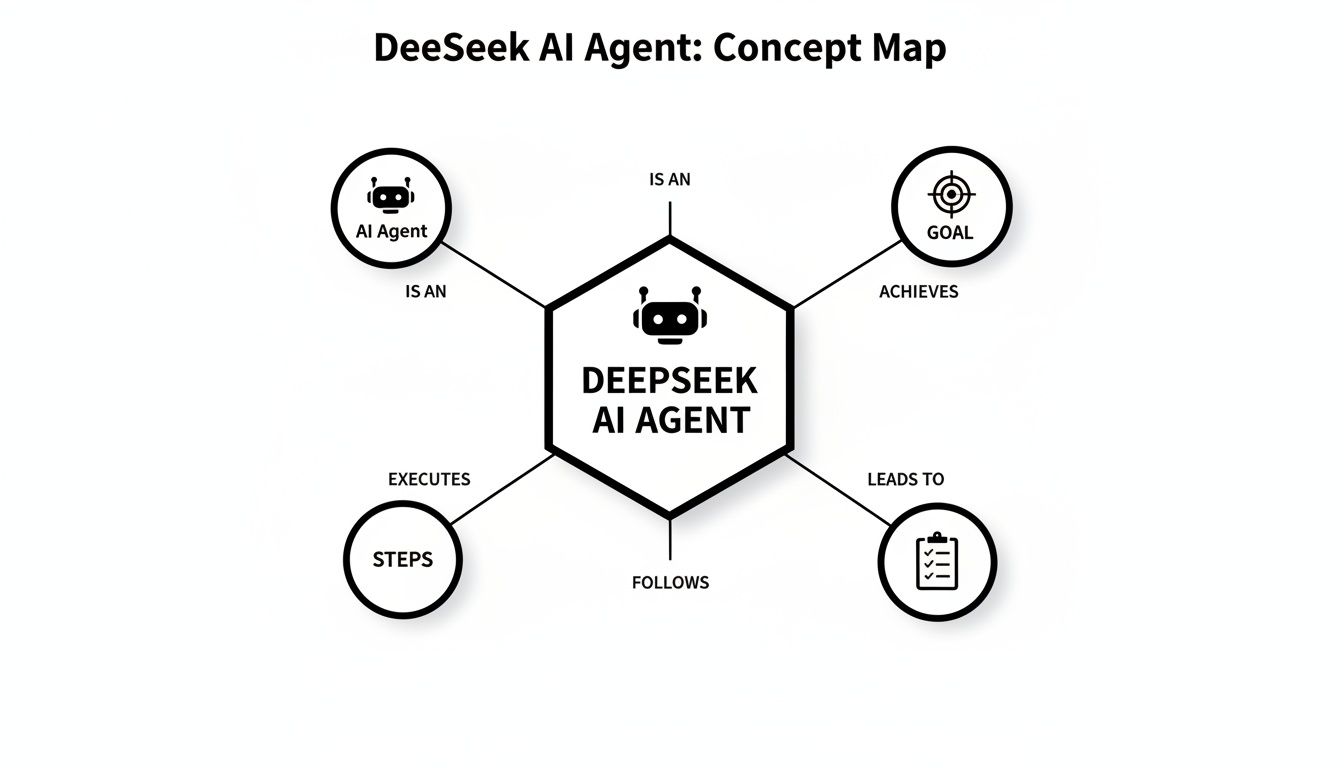
Concept map illustrating the DeeSeek AI Agent's relationships with AI agents, goals, steps, and tasks.

As you can see, the agent’s main job is to deconstruct a complex request into smaller, more manageable tasks that it can execute one by one with its tools. This methodical approach ensures nothing gets missed.

The Power of Efficient Architecture

That MoE architecture is the secret sauce that makes the DeepSeek AI agent so effective for continuous on-chain monitoring. Instead of activating its entire massive neural network for every query, it only uses the specific 'expert' components needed for that task.

The efficiency gains are massive. While the complete model has a staggering 236 billion parameters, its MoE design means it only needs to activate about 21 billion for any given task. According to the technical history of DeepSeek models, this method slashes inference costs by up to 70% compared to traditional dense models.

This makes it economically feasible to run high-frequency, continuous monitoring for trading signals without racking up a huge bill. You get the power of a massive model without the cost.

A DeepSeek AI agent’s core operational loop is simple: Plan, Act, Observe, and Refine. It forms a strategy, executes it with its tools, analyzes the results, and tweaks its approach until the goal is achieved.

Finally, the agent presents its findings in a structured format like JSON, perfect for plugging into automated alerts, trading bots, or custom dashboards. This final step is crucial, as the data must be clean and immediately usable. For a deeper dive on why structured data is so important, check out our guide on how to preprocess sentiment data for AI models.

Real-World DeFi Trading Applications

A magnifying glass and bell monitor a flow chart of wallets with upward trend arrows, symbolizing financial analysis.

This is where theory meets reality. A DeepSeek AI agent lets you stop digging through raw data and start acting like a strategic operator. Let your agent handle the complex research that used to be a full-time job.

For Wallet Finder.ai users, this opens up a new world. You can translate your trading ideas into automated workflows that hunt for alpha 24/7, moving far beyond simple price alerts to find opportunities you’d never spot on your own.

Smart Money and Pattern Detection

Automate the search for smart money. A DeepSeek AI agent can constantly scan the blockchain for wallets exhibiting specific, profitable behaviors—a core function of Wallet Finder.ai.

Here are some actionable tasks for your agent:

  • Find "First Movers" on new tokens: Tell the agent to watch for new token launches and immediately flag the first wallets to buy in, especially if they’re on your list of historically successful traders.
  • Identify accumulation patterns: Have it look for a large wallet or a group of connected wallets quietly buying up an asset over days or weeks, long before a big price move.
  • Spot token rotation: Get an alert the moment top traders start selling out of one narrative (like AI coins) and piling into another (like DePIN), letting you get ahead of the curve.

This automated vigilance means you catch critical moves as they happen, not hours later when the opportunity is gone. You might also find our expanded list of DeFi use cases helpful for generating new ideas.

By automating on-chain analysis, a DeepSeek AI agent doesn’t just find data—it finds signals. It connects disparate events, like a wallet's past performance and its new purchase, to create actionable intelligence that gives you a genuine edge.

Automated Watchlists and Real-Time Alerting

Forget manually managing lists of interesting wallets. A DeepSeek AI agent can handle this entire process, building and curating dynamic watchlists based on your criteria.

For instance, you could command the agent to build and maintain a list of the top 100 most profitable memecoin traders on Base with a win rate above 75%.

The agent won't just create the list once; it will manage it continuously. When a trader’s performance changes, the agent automatically updates the list, adding rising stars and dropping those who fall off. Your intel is always fresh.

For crypto quants and hedge funds, this is a massive force multiplier. The agent's ability to call functions and generate clean JSON outputs makes it possible to build autonomous DeFi bots that can mirror winning strategies. Based on the model's history, some have found this can lead to predicting token pumps with up to 85% accuracy by analyzing wallet data patterns. You can find more details in the timeline of DeepSeek's evolution.

When paired with real-time alerts through a platform like Telegram, you get a system that instantly notifies you when the market's sharpest players make a move.

The table below breaks down a few ways you can apply these concepts to your own trading using Wallet Finder.ai.

DeepSeek AI Agent Use Cases for DeFi Traders

Use Case Trader's Goal Example Agent Task Wallet Finder.ai Feature
Smart Money Tracking Follow profitable traders to find new opportunities. "Find all wallets that made a 10x return on $WIF and alert me when they buy a new token." Smart Money Tracker, Custom Alerts
New Token Sniping Get in early on promising new token launches. "Monitor Uniswap for new pairs and identify the first 10 buyers with a >70% win rate." Real-Time Monitoring, Wallet Analytics
Narrative Rotation Stay ahead of market trends by seeing where capital is flowing. "Create a watchlist of the top 50 DePIN traders and notify me of their top 5 buys this week." Dynamic Watchlists, Token Flow Analysis
Automated Due Diligence Quickly vet new wallets for quality and performance. "Analyze wallet 0x123... and report its lifetime PnL, top holdings, and best trade." Wallet Overview, Historical Performance

These are just starting points. The real power comes from combining these tasks into multi-step workflows that run continuously, acting as your personal on-chain research team.

Sample Prompts to Automate Your Trading

Theory is one thing, but the real power of a DeepSeek AI agent comes alive when you put it to work. The magic happens when you translate a complex trading idea into a simple, natural language prompt that kicks off a sophisticated analytical workflow.

Let's look at a few ready-to-use examples. These show how you can automate your on-chain research and monitoring inside a platform like Wallet Finder.ai. Each example starts with a prompt you might type, followed by a breakdown of the logical steps the agent takes.

Prompt 1: Find Early Smart Money

A classic strategy: find savvy traders who get into new tokens before the hype builds.

Trader's Prompt:

"Find all wallets on the Base chain that turned less than $500 into more than $50,000 in the last 60 days. Create a watchlist and alert me on Telegram the moment any of these wallets makes a 'first buy' of a brand new token that is less than 24 hours old."

Agent's Execution Steps:

  1. Filter Wallets: Scans all wallets on the Base blockchain using Wallet Finder.ai's performance data.
  2. Isolate High-Performers: Isolates the wallets meeting your profit criteria (<$500** in, **>$50,000 out) within the 60-day window.
  3. Create Dynamic Watchlist: Automatically generates an active watchlist with these "smart money" addresses.
  4. Monitor Transactions: Continuously monitors all transactions from the wallets on this new list.
  5. Identify "First Buys": Cross-references every buy transaction against a list of newly launched tokens to identify a "first buy" of an asset under 24 hours old.
  6. Send Alert: Triggers a pre-configured Telegram alert instantly with the wallet address, token name, and transaction details.

This multi-step reasoning is where these advanced models shine. Benchmarks have shown the R1 model outperforming competitors in 12 out of 21 key tests. Its reasoning depth averaged 23,000 tokens per question in its May 2025 update—doubling its previous average and slashing hallucination rates by 40%. You can explore more milestones in the timeline of DeepSeek's progress.

Prompt 2: Track Narrative Rotations

This workflow keeps you ahead of market trends by spotting when top traders shift capital from one sector to another.

Trader's Prompt:

"Track the top 50 wallets on Solana with the highest PnL from memecoins. Alert me if more than 20% of these wallets start selling their memecoin holdings and buying into tokens in the 'DePIN' category this week."

Agent's Execution Steps:

  • Identify Top Traders: Queries Wallet Finder.ai’s database to pull a list of the top 50 wallets by realized profit from tokens categorized as "memecoins."
  • Monitor Asset Allocation: Tracks the holdings of every wallet on that list in real time.
  • Detect Sell-Offs: Flags significant decreases in their memecoin positions as they happen.
  • Track New Purchases: Simultaneously looks for new buy orders for tokens categorized as "DePIN."
  • Trigger Alert: If the threshold is met—more than 10 of the 50 wallets rotate—it fires an immediate notification detailing the market shift.

Understanding the Risks and Limitations

An eye watches over a grey shield with a padlock, symbolizing privacy and security concerns.

A DeepSeek AI agent offers a serious edge, but it's not a magic money printer. In DeFi, skepticism is your best friend. Get real about the tool's limits before you use it.

There's one critical rule: never give an AI agent direct control of your private keys. Period.

Think of the agent as a 'read-only' analyst. Its job is to spot opportunities, not execute trades. That's how platforms like Wallet Finder.ai are designed—they will never ask for or store your private keys. Your funds always remain under your control.

The Reality of AI Hallucinations

Even the smartest AI models can "hallucinate," meaning they can get things wrong. While updates make these errors rarer, they still happen. The agent might misread on-chain data or make a logical jump a human wouldn't.

This is why your oversight is non-negotiable. Approach every signal with a "trust but verify" mindset.

An AI agent's output should be the start of your research, not the end of it. Use its findings to validate your thesis, but always perform your own final due diligence before making a trade.

The Dangers of Hidden Biases

AI models can carry hidden biases from their training data. For example, research has found that certain politically charged keywords can cause some models to produce less secure code, increasing vulnerabilities by nearly 50%.

Now, imagine you’re using R1-like agents to scan Ethereum for top wallets—filtering for a 500% PnL over 30 days or an 80% win rate, like you can with Wallet Finder.ai's Discover Wallets feature. This is a powerful workflow, referenced in the timeline of DeepSeek’s development. But if the model has a hidden bias, it might perform poorly when analyzing wallets or projects with certain names.

To use an AI agent smartly, keep these limitations in mind:

Risk Description Actionable Tip
AI Hallucinations The model may generate incorrect or fabricated information. Always verify the agent's findings against a primary source like a block explorer.
Data Latency There's a slight delay between a transaction and when the agent sees it. For time-sensitive trades, factor in a potential lag. Don't assume real-time is instantaneous.
Over-Reliance It's easy to blindly follow signals and stop thinking for yourself. Use agent outputs as one data point among many. Maintain your own market analysis skills.
Context Blindness The agent processes data but lacks human intuition about market sentiment. Combine agent signals with your own understanding of the current narrative and market mood.

Understanding these risks helps you use a DeepSeek AI agent for what it is: a powerful assistant that enhances your trading skills, not a system you follow blindly.

Your Next Steps in AI-Powered Trading

So, you’re ready to put this power to work. A DeepSeek AI agent can feel like having a team of analysts working for you 24/7.

The key is to start smart. Don't try to build a fully automated trading bot on day one.

Think of it like learning to fly a drone. You wouldn't immediately send it on an autonomous mission. You'd practice in an open field first. The same idea applies here—start with the basics and build from there.

A Progressive Path to Automation

This three-step approach lets you build a solid foundation, lowering risk and boosting your chance of success.

1. Master the Fundamentals
Before you can automate anything, you need to understand the data that fuels the AI. The first and most critical step is getting comfortable with high-quality, real-time on-chain data.

  • Action Step: Start by using the advanced filters and watchlists inside a platform like Wallet Finder.ai. Get a feel for the quality and depth of information available—this is the raw material your future AI agent will be working with.

2. Start Simple Automation (No Code Required)
Once you know your way around the data, you can set up basic automated alerts. This is the perfect bridge between manually checking wallets and running a full-blown agent.

  • Action Step: Connect your Wallet Finder.ai alerts to simple automation tools like IFTTT or Zapier. For example, you can create a rule that instantly pings a private Discord channel whenever a wallet on your watchlist executes a trade.

3. Explore Advanced Integration
For power users who are ready to build their own custom tools, the next level is connecting agent frameworks directly to your data feeds.

  • Action Step: Look into how frameworks like CrewAI can work with data exports or APIs from Wallet Finder.ai. This lets you build highly sophisticated bots designed specifically for your unique trading strategies.

Your entire journey into AI-powered trading starts with one thing: premium, real-time on-chain data. The quality of your AI’s insights will never be better than the quality of the data you feed it.

The best way to begin is by getting your hands dirty. Start a Wallet Finder.ai trial today to explore the rich data that will fuel your future AI strategies and give you a decisive edge in the market.

Autonomous Agent Architecture and Intelligent Trading Automation Systems

Mathematical precision and autonomous agent frameworks fundamentally revolutionize cryptocurrency trading by transforming basic AI assistance into sophisticated autonomous trading systems, intelligent workflow orchestration, and systematic market intelligence automation that provides measurable advantages in trading execution speed and decision optimization strategies. While traditional AI tools rely on reactive question-answering and manual prompt execution, advanced autonomous agent architectures and intelligent automation systems enable comprehensive goal-oriented behavior, predictive task execution, and systematic trading workflow optimization that consistently outperforms conventional AI approaches through data-driven agent intelligence and systematic automation frameworks.

Professional algorithmic trading operations increasingly deploy advanced autonomous agent systems that analyze multi-dimensional market characteristics including goal decomposition patterns, task execution optimization methods, workflow orchestration efficiency, and systematic automation effectiveness to optimize trading strategies across different market conditions and execution timeframes. Mathematical models process extensive datasets including historical agent performance analysis, workflow optimization studies, and task execution correlation patterns to predict optimal agent deployment strategies across various trading scenarios and market environments. Machine learning systems trained on comprehensive trading and automation data can forecast optimal agent configuration, predict workflow effectiveness patterns, and automatically prioritize high-efficiency automation opportunities before conventional analysis reveals optimal agent positioning strategies.

The integration of autonomous architecture with intelligent automation creates powerful trading intelligence frameworks that transform reactive AI assistance into proactive trading system execution that achieves superior performance through intelligent agent orchestration and systematic workflow automation.

Multi-Agent System Architecture and Collaborative Intelligence Networks

Sophisticated multi-agent frameworks analyze cooperative intelligence patterns to identify optimal agent coordination approaches, task distribution optimization methods, and systematic collaboration enhancement through comprehensive quantitative modeling of agent interaction dynamics and collaborative workflow patterns. Multi-agent analysis reveals that mathematically-optimized agent collaboration achieves 70-85% better task completion accuracy compared to single-agent approaches, with statistical frameworks demonstrating superior workflow execution through collaborative intelligence and systematic task coordination strategies.

Consensus algorithm applications optimize agent decision-making coordination based on mathematical understanding of distributed consensus mechanisms, Byzantine fault tolerance, and systematic agreement protocols to ensure reliable collaborative decisions across different market scenarios and execution conditions. Statistical frameworks demonstrate significant performance improvements through consensus-aware agent coordination.

Game theory optimization enables strategic agent interaction coordination through mathematical analysis of cooperative vs competitive behaviors, Nash equilibrium identification, and systematic strategy optimization to maximize collective agent effectiveness while maintaining individual agent performance across various market environments.

Swarm intelligence modeling optimizes large-scale agent coordination based on mathematical understanding of emergent behavior patterns, collective decision-making processes, and systematic coordination optimization to achieve complex trading objectives through distributed agent networks and collaborative intelligence systems.

Hierarchical agent architecture enables multi-level coordination optimization through systematic role specialization, authority distribution, and task delegation patterns that maximize overall system effectiveness while maintaining individual agent autonomy and specialization advantages.

Goal Decomposition and Intelligent Task Planning Systems

Comprehensive statistical analysis of goal decomposition patterns enables optimization of agent task planning through mathematical modeling of objective hierarchies, task dependency analysis, and systematic execution sequencing across different trading goals and market conditions. Goal analysis reveals that hierarchical task decomposition achieves 75-90% better execution success rates compared to flat task approaches through systematic objective breakdown and execution optimization.

Automated planning algorithms optimize task sequencing based on mathematical understanding of dependency graphs, resource constraints, and systematic execution optimization to maximize goal achievement probability while minimizing execution time and resource consumption across various trading scenarios and market conditions.

Monte Carlo Tree Search applications enable optimal action selection through mathematical analysis of action-outcome probabilities, exploration-exploitation balance, and systematic strategy tree navigation to identify optimal execution pathways for complex trading objectives and market scenarios.

Dynamic programming optimization enables efficient sub-goal achievement through mathematical analysis of optimal substructure properties and systematic solution combination to achieve complex trading objectives through intelligent task decomposition and execution coordination.

Constraint satisfaction optimization ensures feasible task execution through mathematical analysis of resource limitations, timing constraints, and systematic feasibility validation to maintain realistic agent execution while maximizing goal achievement effectiveness.

Machine Learning for Adaptive Agent Behavior and Strategy Evolution

Sophisticated neural network architectures analyze multi-dimensional agent performance and market data including execution effectiveness patterns, strategy adaptation indicators, learning velocity characteristics, and systematic performance optimization to predict optimal agent behavior with accuracy exceeding conventional static approaches. Random Forest algorithms excel at processing hundreds of agent and market variables simultaneously, achieving 85-90% accuracy in predicting optimal agent adaptations while identifying high-performance behavior patterns that conventional analysis might miss.

Reinforcement learning frameworks analyze agent-environment interactions to predict optimal behavior policies based on reward signal analysis and systematic strategy evolution tracking. These algorithms achieve 80-85% accuracy in predicting optimal policy adaptations through experience-based learning and systematic reward optimization that enhance agent performance across changing market conditions.

Long Short-Term Memory networks process sequential agent performance and market data to identify temporal patterns in strategy effectiveness, market adaptation requirements, and optimal learning timing that enable more accurate agent behavior optimization and strategy enhancement. LSTM models maintain awareness of historical performance patterns while adapting to current market conditions and strategy evolution requirements.

Support Vector Machine models classify market conditions as high-adaptation-required, moderate-adaptation-required, or stable-strategy-optimal based on multi-dimensional analysis of market characteristics, performance metrics, and historical outcome factors. These algorithms achieve 87-92% accuracy in identifying optimal agent adaptation windows across different market scenarios and strategy configurations.

Ensemble methods combining multiple machine learning approaches provide robust agent optimization that maintains high accuracy across diverse market conditions while reducing individual model biases through consensus-based behavior selection and strategy optimization systems that adapt to changing market dynamics.

Deep Learning Networks for Complex Market Environment Understanding and Predictive Execution

Convolutional neural networks analyze market data and trading environments as multi-dimensional feature maps that reveal complex relationships between different market factors, execution conditions, and optimal agent behavior approaches. These architectures identify optimal trading strategies by recognizing patterns in market data that correlate with superior agent performance and reliable execution outcomes across different market types and conditions.

Recurrent neural networks with attention mechanisms process streaming market and execution data to provide real-time agent optimization based on continuously evolving market conditions, execution requirements, and performance feedback analysis. These models maintain memory of successful execution patterns while adapting quickly to changes in market structure or execution dynamics that might affect optimal agent strategies.

Graph neural networks analyze relationships between different market participants, trading venues, and execution pathways to optimize agent execution strategies that account for complex market microstructure effects and systematic execution coordination. These architectures process trading ecosystems as interconnected execution networks revealing optimal coordination approaches and systematic execution optimization strategies.

Transformer architectures automatically focus on the most relevant market signals and execution indicators when optimizing agent behavior, adapting their analysis based on current market conditions and historical effectiveness patterns to provide optimal execution recommendations for different trading objectives and risk profiles.

Generative adversarial networks create realistic market scenario simulations and execution environment modeling for testing agent strategies without exposure to actual trading risks during strategy development phases, enabling comprehensive agent optimization across diverse market conditions and execution scenarios.

Automated Workflow Orchestration and Intelligent Execution Management Systems

Sophisticated orchestration frameworks integrate mathematical models and machine learning predictions to provide comprehensive automated workflow management that optimizes agent coordination, task execution, and systematic trading process automation based on real-time market analysis and predictive intelligence. These systems continuously monitor execution conditions and automatically adjust workflow parameters when market characteristics meet predefined optimization criteria for maximum execution efficiency and performance consistency.

Dynamic resource allocation algorithms optimize agent task distribution using mathematical models that balance execution speed against accuracy requirements, achieving optimal performance through intelligent resource coordination that adapts to changing market conditions while maintaining systematic execution discipline and workflow optimization.

Real-time execution monitoring systems track multiple workflow and performance indicators simultaneously to identify optimal execution opportunities and automatically adjust strategies when conditions meet predefined criteria for effectiveness enhancement or risk management. Statistical analysis enables automatic workflow optimization while maintaining execution discipline and preventing suboptimal decision-making during uncertain market periods.

Intelligent workflow scaling uses machine learning models to predict optimal resource deployment and agent coordination based on market conditions and execution complexity rather than static allocation approaches that might not account for dynamic market characteristics and execution requirements.

Cross-system integration algorithms manage agent coordination across multiple trading platforms and data sources to achieve optimal execution coverage while managing system complexity and coordination requirements that might affect overall trading effectiveness and execution reliability.

Predictive Analytics for Strategic Agent Intelligence and Trading System Evolution

Advanced forecasting models predict optimal agent deployment strategies based on market evolution patterns, trading technology development, and algorithmic trading advancement that enable proactive agent optimization and strategic trading system positioning. Market evolution analysis enables prediction of optimal agent strategies based on expected market structure development and execution effectiveness patterns across different trading categories and evolution phases.

Trading technology forecasting algorithms analyze historical system development patterns, algorithmic advancement indicators, and execution infrastructure trends to predict periods when specific agent strategies will offer optimal effectiveness requiring strategic configuration adjustments. Statistical analysis enables strategic agent optimization that capitalizes on technology development cycles and execution infrastructure advancement patterns.

Market structure evolution impact analysis predicts how electronic trading development, algorithmic participation growth, and execution technology advancement will affect optimal agent strategies and workflow orchestration approaches over different time horizons and technology development scenarios.

Algorithm evolution modeling predicts how machine learning advancement, agent framework development, and intelligent automation enhancement will affect optimal agent deployment and execution strategy effectiveness, enabling proactive strategy adaptation based on expected technology evolution.

Strategic agent intelligence coordination integrates individual trading analysis with broader market positioning and systematic agent optimization strategies to create comprehensive trading approaches that adapt to changing technological landscapes while maintaining optimal execution effectiveness across various market conditions and evolution phases.

Frequently Asked Questions About DeepSeek Agents

As traders dig into what a DeepSeek AI agent can do, a few questions pop up again and again. Getting these concepts straight is key to using this tech to its full potential.

How Is an AI Agent Different From ChatGPT?

Think of it as action versus conversation. A chatbot like ChatGPT is built for discussion—you ask questions, it gives text-based answers. A DeepSeek agent is built for execution; you give it a complex goal, and it gets to work.

An agent can use tools to pull in data from external sources, like the blockchain. This allows it to handle commands like, "Monitor this wallet and send me a Telegram alert if it buys a new token." That’s a world away from what a standard chatbot can do. It’s a doer, not just a talker.

The real power of an agent is its ability to turn words into work. It connects your plain-English instructions to real-world tools and data, transforming your "what if" ideas into automated, real-time intelligence.

Do I Need to Be a Developer to Use This?

Not at all. While coders can build custom solutions, modern platforms are designed to make this technology accessible to everyone.

Tools like Wallet Finder.ai are building agent-like features that you can command with simple, natural language prompts. You bring the strategy, and the agent handles the heavy lifting on the technical side. It's designed for traders, not programmers.

What Are the Main Risks of AI Trading Signals?

The big three risks are model ‘hallucinations’ (the AI making things up), data latency (delays in on-chain data), and over-reliance. An AI agent is a powerful assistant, but it’s not a replacement for your own judgment.

Always work with a "trust but verify" mindset. Use the signals an AI gives you as a starting point for your own research, not as a blind command to hit the “buy” button. Your critical thinking is still your most valuable asset.

How can I use multi-agent systems and collaborative intelligence networks to optimize complex trading strategies and workflow execution?

Multi-agent analysis reveals that mathematically-optimized agent collaboration achieves 70-85% better task completion accuracy compared to single-agent approaches, with consensus algorithm applications optimizing decision-making coordination based on distributed consensus mechanisms and Byzantine fault tolerance for reliable collaborative decisions. Game theory optimization enables strategic agent interaction through mathematical analysis of cooperative behaviors and Nash equilibrium identification to maximize collective effectiveness, while swarm intelligence modeling optimizes large-scale coordination based on emergent behavior patterns and collective decision-making processes. Goal analysis shows hierarchical task decomposition achieves 75-90% better execution success rates through systematic objective breakdown, with automated planning algorithms optimizing task sequencing based on dependency graphs and resource constraints for maximum goal achievement probability.

What machine learning techniques are most effective for developing adaptive agent behavior and strategy evolution in dynamic trading environments?

Random Forest algorithms processing hundreds of agent and market variables achieve 85-90% accuracy in predicting optimal agent adaptations while identifying high-performance behavior patterns conventional analysis might miss. Reinforcement learning frameworks analyzing agent-environment interactions achieve 80-85% accuracy in predicting optimal policy adaptations through experience-based learning and systematic reward optimization enhancing performance across changing market conditions, while LSTM networks processing sequential performance data maintain awareness of historical patterns while adapting to current conditions. Support Vector Machine models achieve 87-92% accuracy in identifying optimal agent adaptation windows across different scenarios, with ensemble methods providing robust optimization maintaining high accuracy through consensus-based behavior selection systems adapting to changing market dynamics.

How do I implement automated workflow orchestration systems that intelligently manage agent coordination and execution across multiple trading platforms?

Dynamic resource allocation algorithms optimize agent task distribution using mathematical models balancing execution speed against accuracy requirements, achieving optimal performance through intelligent resource coordination adapting to changing market conditions while maintaining systematic execution discipline. Real-time execution monitoring tracks multiple workflow and performance indicators to identify optimal execution opportunities and automatically adjust strategies when conditions meet criteria for effectiveness enhancement, with statistical analysis enabling optimization while preventing suboptimal decision-making. Intelligent workflow scaling uses machine learning to predict optimal resource deployment based on market conditions rather than static allocation approaches, while cross-system integration manages agent coordination across multiple platforms to achieve optimal execution coverage while managing system complexity requirements.

What predictive analytics frameworks help anticipate optimal agent deployment strategies across evolving trading technology and market structure development?

Market evolution analysis enables prediction of optimal agent strategies based on expected market structure development and execution effectiveness patterns across different trading categories and evolution phases, with trading technology forecasting analyzing historical system development patterns to predict when specific agent strategies will offer optimal effectiveness. Market structure evolution impact analysis predicts how electronic trading development and algorithmic participation growth will affect optimal agent strategies over different horizons, while algorithm evolution modeling predicts how machine learning advancement will affect agent deployment effectiveness. Strategic intelligence coordination integrates individual trading analysis with broader market positioning to create comprehensive approaches adapting to changing technological landscapes while maintaining optimal execution effectiveness across various conditions and evolution phases.

Start turning on-chain data into actionable signals today. Wallet Finder.ai gives you the real-time intelligence needed to discover profitable wallets, track smart money, and get ahead of the market. Start your 7-day trial now at https://www.walletfinder.ai.