10 Actionable DeFi Use Cases to Watch in 2026

Wallet Finder

Blank calendar icon with grid of squares representing days.

January 17, 2026

Decentralized Finance (DeFi) has evolved far beyond a niche concept into a robust ecosystem of powerful financial tools. While headlines often focus on volatility, the real story lies in the practical, value-generating applications available to savvy traders and investors. These DeFi use cases offer unprecedented access to lending, trading, and yield generation, all operating on transparent, permissionless blockchain networks. Forget the theoretical jargon; this guide is about real-world application.

This article moves past the surface-level explanations to provide a deep dive into the 10 most impactful DeFi strategies active today. We will dissect the mechanics behind each use case, from high-frequency arbitrage to strategic memecoin trading and sophisticated yield farming. More importantly, we'll show you how to translate on-chain data into profitable actions.

For each strategy, you will learn to identify the critical on-chain signals that precede major market moves. We'll provide a strategic breakdown of what to look for, from unusual wallet activity to shifting liquidity pools, and detail how to leverage these insights. This isn't just a list of what's possible; it's a playbook for execution. You will discover how tools like Wallet Finder.ai give you a critical edge by revealing where the smart money is moving before it becomes common knowledge. This guide is designed to equip you with replicable methods and actionable takeaways to navigate the complex world of DeFi and capitalize on its most lucrative opportunities. We will cover a comprehensive range of topics including DEX trading, yield farming, memecoin discovery, and advanced cross-chain strategies.

1. Smart Money Tracking & Copy Trading

One of the most powerful DeFi use cases is the ability to track the on-chain activity of highly profitable traders, often called "smart money," and automatically replicate their trades. This strategy merges real-time blockchain data analysis with automated execution, allowing retail investors to mirror the strategies of seasoned professionals and capitalize on opportunities they might otherwise miss.

By monitoring wallets with a proven history of high returns, you gain insight into emerging trends, new token launches, and effective portfolio management. Platforms like Wallet Finder.ai aggregate this data, making it easy to identify top-performing wallets based on metrics like profit and loss (PnL), win rate, and holding duration.

Strategic Analysis & Application

The core strategy involves identifying a wallet demonstrating consistent profitability and then using a copy trading tool to automatically mirror its buys and sells. This democratizes access to sophisticated trading techniques that were once exclusive to institutional desks. It’s particularly effective in fast-moving markets like memecoins, where early entry is critical.

Key Insight: The transparency of the blockchain is the foundation of this use case. Every transaction is public, allowing anyone with the right tools to deconstruct successful strategies and apply them. This creates a more level playing field between institutional and retail participants.

Actionable Takeaways

To effectively implement this strategy, follow a structured approach:

  • Filter & Vet: Use filters to find wallets matching your risk tolerance. Look for a minimum holding duration to avoid traders who are simply lucky on a few transactions.
  • Diversify: Don't put all your capital behind a single wallet. Create a watchlist of several top performers to diversify your risk and smooth out returns.
  • Monitor Performance: Continuously track the PnL and win streaks of the wallets you follow. Be prepared to stop copying a wallet if its performance starts to decline.
  • Adjust Sizing: Set your own position sizing rules based on your portfolio and risk management strategy, rather than blindly copying the exact trade size.

This method transforms blockchain data from a passive information source into an active, automated trading advantage, making it an essential DeFi use case. To delve deeper into how on-chain data is reshaping finance, explore this analysis of BankSocial and its role in crypto.

2. Decentralized Exchanges (DEX) and Liquidity Provision

Decentralized exchanges (DEXs) are the cornerstone of DeFi, enabling peer-to-peer token swaps without the need for a central intermediary. They operate through automated smart contracts, most commonly using an Automated Market Maker (AMM) model. This system relies on liquidity providers (LPs) who deposit pairs of tokens into pools, earning trading fees in return for facilitating swaps. This is one of the most fundamental DeFi use cases, forming the bedrock for token discovery and passive income generation.
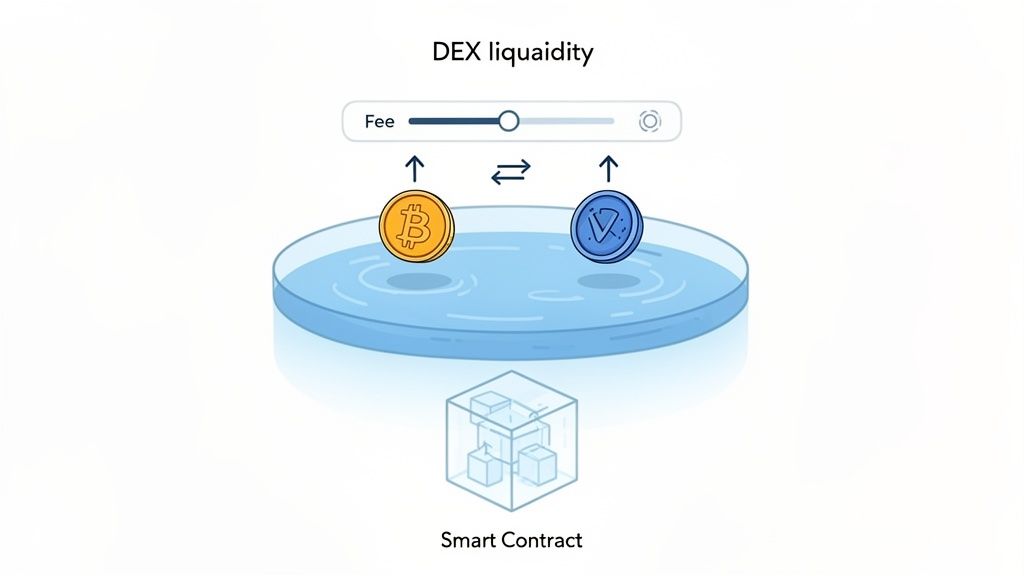
Illustration of a DEX liquidity pool, Bitcoin, another crypto, fees, and smart contract.

Pioneered by platforms like Uniswap, this model allows anyone to become a market maker. LPs face a unique risk known as impermanent loss, which occurs when the price ratio of the tokens in the pool changes significantly. However, the fee revenue can often offset this risk, making liquidity provision a popular strategy for generating yield on crypto assets.

Strategic Analysis & Application

The core strategies involve either swapping tokens on a DEX or providing liquidity to earn fees. For traders, DEX aggregators like 1inch and Paraswap are essential tools that find the best swap rates across multiple liquidity sources. For LPs, the goal is to identify high-volume token pairs where fee income is likely to outperform potential impermanent loss. This is especially true for stablecoin pairs on platforms like Curve Finance or for new, trending tokens where trading volume is explosive.

Key Insight: DEXs and liquidity pools turn every participant into a potential market maker. This decentralization of market infrastructure not only enhances censorship resistance but also creates a dynamic, competitive environment where capital efficiency and strategic positioning determine profitability.

Actionable Takeaways

To effectively engage with DEXs and liquidity provision, a strategic approach is necessary:

  • Track Smart LPs: Use Wallet Finder.ai to identify smart money wallets that are actively providing liquidity. Analyze which pools they are entering and exiting to spot trending pairs and potentially profitable opportunities.
  • Analyze Fee Structures: Not all pools are equal. A 0.30% fee tier is often suitable for stable pairs, while more volatile assets might be better served in a 1% fee pool to compensate for higher impermanent loss risk.
  • Use Concentrated Liquidity: On DEXs like Uniswap V3, use concentrated liquidity to provide assets within a specific price range. This amplifies your fee-earning potential by making your capital more efficient, though it also increases risk if the price moves outside your set range.
  • Calculate Impermanent Loss: Before providing liquidity, use an impermanent loss calculator to model potential outcomes based on different price movements. This helps you understand the risks involved and set realistic expectations.

3. Yield Farming and Liquidity Mining

Yield farming is a core DeFi use case where users supply liquidity to a protocol in exchange for rewards, typically paid in the protocol's native governance token. This process, also known as liquidity mining, bootstraps liquidity for new projects while allowing users to generate passive income from their idle crypto assets. It’s a symbiotic relationship that fuels growth and distributes ownership across a decentralized ecosystem.

By providing assets to liquidity pools on platforms like Curve or lending them out on protocols such as Aave, users earn not just trading fees or interest but also additional token incentives. This dual-reward system can lead to exceptionally high annual percentage yields (APYs), making it one of the most popular strategies for capital-efficient returns in DeFi.

An illustration showing a Bitcoin plant growing in a safe-like pot, symbolizing yield farming and APY.

Strategic Analysis & Application

The primary strategy is to allocate capital to pools offering the highest sustainable APY, factoring in both the underlying asset risk and the farmed token's price stability. Advanced strategies involve using yield optimizers like Yearn Finance, which automatically compound rewards and move funds between different protocols to maximize returns. Protocols like Convex Finance further enhance this by boosting rewards on Curve, creating a layered incentive structure.

Key Insight: Yield farming is essentially a decentralized marketing and liquidity acquisition strategy. Protocols offer a slice of their future value (governance tokens) in exchange for the critical liquidity needed to operate effectively. Smart farmers analyze the underlying tokenomics to determine if the rewards outweigh the risks of impermanent loss and token price volatility.

Actionable Takeaways

To succeed in yield farming, a methodical and data-driven approach is essential:

  • Identify Top Farms: Use Wallet Finder.ai to track which new pools and farms "smart money" wallets are entering. Their activity often signals a high-conviction opportunity before it becomes widely known.
  • Assess APY Sustainability: Scrutinize the source of the yield. High APYs driven solely by token emissions can be short-lived. Compare the emission rate to the protocol's revenue (e.g., trading volume) to gauge long-term viability.
  • Diversify Strategies: Mitigate risk by spreading capital across different types of farms, such as stablecoin pools, ETH liquid staking (Lido), and newer L2 liquidity mining campaigns on platforms like Arbitrum.
  • Automate & Optimize: Use yield aggregators to automate the compounding process. This saves significant time and gas fees, maximizing your net returns over time.

This strategic allocation of capital turns your assets into productive instruments within the DeFi ecosystem, representing one of the most dynamic defi use cases available today. To explore this topic further, discover more about DeFi yield farming.

4. Lending and Borrowing Protocols

One of the foundational DeFi use cases is the creation of decentralized money markets where users can lend their crypto assets to earn interest or borrow against their collateral without intermediaries. Platforms like Aave and Compound use smart contracts to automate loan origination, interest rate adjustments, and collateral management, creating a more accessible and efficient financial system.

These protocols allow asset holders to generate passive yield on their idle tokens by supplying them to a liquidity pool. Borrowers, in turn, can access capital by depositing collateral, enabling them to leverage their positions, fund new investments, or avoid selling assets with long-term potential. The entire process is permissionless, transparent, and operates 24/7.

Strategic Analysis & Application

The core strategy for lenders is to find protocols offering the highest sustainable yield for their preferred assets. For borrowers, it's about securing capital at the lowest possible interest rate while carefully managing their collateral to avoid liquidation. Sophisticated traders use these platforms to execute complex strategies, such as shorting an asset or leveraging a long position by borrowing stablecoins against a volatile asset like ETH.

Key Insight: Decentralized lending is powerful because it unlocks the liquidity of otherwise static assets. An investor holding ETH can borrow USDC against it to farm yield in another protocol, effectively making their capital work in two places at once. This composability is a hallmark of DeFi.

Actionable Takeaways

To safely and effectively use lending protocols, consider these steps:

  • Track Smart Money: Use Wallet Finder.ai to see which assets top traders are supplying as collateral. This can signal conviction in an asset's long-term value, as they are willing to risk liquidation to borrow against it.
  • Monitor Liquidation Levels: Always be aware of your loan-to-value (LTV) ratio and liquidation price. Set alerts to add more collateral or repay part of your loan if the market moves against your position.
  • Diversify Protocols: Reduce smart contract and systemic risk by spreading your lending and borrowing activities across multiple established platforms like Aave, Compound, and MakerDAO.
  • Analyze Interest Rates: Before supplying or borrowing, check if interest rates are variable or stable. Variable rates can change quickly based on supply and demand, impacting your profitability or borrowing costs.

5. Memecoin Trading and Token Discovery

One of the most volatile yet potentially lucrative DeFi use cases is identifying and trading memecoins before they gain mainstream traction. These highly speculative tokens, often driven by social media hype and community momentum rather than fundamental utility, present a high-risk, high-reward environment where early entry is paramount for capturing exponential gains.

Success in this arena relies on sophisticated on-chain analysis to spot emerging tokens at inception. By tracking new liquidity pools, monitoring whale accumulation, and analyzing smart contract deployments, traders can front-run the broader market. Platforms like Wallet Finder.ai are indispensable, providing tools to filter for new tokens, track the wallets of proven memecoin snipers, and assess contract safety.

Strategic Analysis & Application

The core strategy involves using on-chain data to pinpoint new tokens with the potential for viral growth and executing trades before they are listed on major exchanges or catch the attention of influencers. This requires a deep understanding of tokenomics, contract security, and community sentiment indicators. Traders often look for signals like renounced contract ownership and locked liquidity, which reduce the risk of scams like "rug pulls."

Key Insight: The memecoin market operates on speed and information asymmetry. While social media provides the narrative, the blockchain provides the verifiable truth. On-chain data reveals genuine accumulation patterns and developer activity, allowing savvy traders to separate high-potential projects from fleeting trends and scams.

Actionable Takeaways

To effectively navigate the high-stakes memecoin market, a disciplined approach is essential:

  • Find Early Signals: Use tools on Wallet Finder.ai to track "smart degen" wallets that consistently find new tokens early. Monitor their initial buys in newly created liquidity pools.
  • Vet the Contract: Always verify that the token contract has renounced ownership and that a significant portion of the liquidity is locked for an extended period. This mitigates the most common scam vectors.
  • Use Strict Risk Management: Only allocate a small percentage of your portfolio that you are willing to lose. The binary nature of memecoins means many will go to zero.
  • Set Profit Targets: Define your exit strategy before entering a trade. Take profits systematically at key milestones (e.g., 2x, 5x, 10x) to secure gains, as reversals can be swift and brutal.

6. Staking and Validator Operations

One of the most foundational DeFi use cases is staking, where users participate in a blockchain’s consensus mechanism to secure the network and validate transactions. By locking up their crypto assets, participants earn rewards, typically from network inflation and transaction fees. This process can be done via solo staking, which requires significant technical expertise, or by delegating to professional validators.

Staking directly contributes to the security and decentralization of Proof-of-Stake (PoS) networks like Ethereum and Solana. The introduction of liquid staking derivatives (LSDs) has further revolutionized this space. Protocols like Lido issue tokenized receipts (e.g., stETH) for staked assets, allowing users to earn staking rewards while their capital remains liquid and usable in other DeFi applications.

Strategic Analysis & Application

The core strategy is to generate a relatively stable yield on crypto holdings by contributing to network security. For investors, this creates a passive income stream that often outperforms traditional finance yields. For traders, analyzing staking data provides powerful signals about network health and market sentiment. For example, a surge in staked ETH, currently at over 16% of the total supply, indicates strong long-term conviction in the network.

Key Insight: Staking transforms a passive digital asset into a productive one, creating a native "risk-free" rate for a given blockchain ecosystem. Liquid staking derivatives add a layer of capital efficiency, allowing users to stack yields by deploying their staked assets in lending, borrowing, or farming protocols.

Actionable Takeaways

To effectively leverage staking as part of your DeFi strategy, consider the following steps:

  • Compare Yields & Risks: Evaluate the APY across different options: solo staking, delegating to a validator, or using a liquid staking provider. Platforms like Marinade Finance on Solana often offer competitive yields compared to direct delegation.
  • Assess Validator Health: Before delegating, research a validator’s uptime, commission fees, and slashing history. Diversifying your stake across multiple validators mitigates the risk of a single point of failure.
  • Monitor Staking Trends: Use tools like Wallet Finder.ai to track how much "smart money" is allocating to staking protocols. A large inflow into liquid staking assets like stETH can be a bullish signal for the underlying network.
  • Leverage Liquid Staking: If you need capital flexibility, opt for liquid staking. This allows you to earn staking rewards without locking up your assets, preserving your ability to react to market opportunities.

7. Arbitrage and Price Discrepancy Trading

One of the most foundational and lucrative DeFi use cases is arbitrage, which involves exploiting price differences for the same asset across different exchanges, DEXs, or chains to secure a risk-free profit. Arbitrageurs use automated bots, flash loans, and sophisticated monitoring tools to execute near-instantaneous trades, profiting from market inefficiencies and, in the process, helping to stabilize prices across the ecosystem.

This practice is the engine of market efficiency in decentralized finance. By identifying and acting on price discrepancies between venues like Uniswap and Curve or even across different blockchains like Ethereum and Polygon, traders capture value while ensuring that asset prices remain consistent. The speed and complexity required mean this is often the domain of bots and highly technical traders.

Strategic Analysis & Application

The core strategy is to simultaneously buy a token at a low price on one venue and sell it at a higher price on another. For example, if ETH is trading for $3,000 on Uniswap but $3,005 on Sushiswap, an arbitrage bot can execute a multi-leg trade to capture the $5 difference, often leveraging a flash loan to perform the transaction with zero upfront capital. This extends to cross-chain opportunities and even stablecoin pegs, where deviations from $1.00 create profitable trades.

Key Insight: DeFi arbitrage is a game of speed, fees, and information. The profit margin on any single trade is often razor-thin, so success depends on high-frequency execution, precise gas fee calculation, and avoiding pitfalls like front-running through MEV protection services.

Actionable Takeaways

To effectively approach arbitrage, a systematic and technical approach is required:

  • Identify Opportunities: Use Wallet Finder.ai to find and track the wallets of known arbitrage bots. Analyze their transaction history to understand which pairs, DEXs, and chains they target most frequently.
  • Calculate Profitability: Always factor in gas fees for both transactions, protocol swap fees, and potential price slippage. A seemingly profitable trade can easily become a loss if transaction costs are not precisely calculated.
  • Leverage Flash Loans: For capital-intensive arbitrage, use flash loans from protocols like Aave or dYdX to execute large trades without needing to post collateral, repaying the loan within the same transaction.
  • Protect Your Trades: Utilize MEV-protection services like Flashbots Protect RPC to prevent your arbitrage transactions from being front-run by other bots, which would erase your profit margin.

This systematic process turns market inefficiencies into a consistent source of profit, making it a cornerstone of advanced DeFi use cases.

8. Portfolio Rebalancing and Asset Management

One of the most powerful DeFi use cases for sophisticated investors is automated portfolio rebalancing and on-chain asset management. This involves using smart contracts and DeFi primitives to maintain a desired asset allocation, execute complex strategies, and manage digital asset portfolios with unparalleled transparency and efficiency. It automates what was once a manual, time-consuming process for traditional fund managers.

DeFi protocols like Balancer and Yearn Finance have pioneered this space. Balancer’s self-balancing liquidity pools automatically adjust token weights through arbitrage, while Yearn’s vaults execute complex, multi-protocol yield strategies. These tools allow both individual investors and large funds to deploy capital according to a predefined strategy that runs autonomously on-chain.

Strategic Analysis & Application

The core strategy is to define target asset allocations and allow smart contracts to automatically execute trades to maintain those targets. For example, an index protocol like the DeFi Pulse Index (DPI) automatically rebalances its underlying basket of DeFi tokens, saving investors the gas fees and effort of doing it themselves. This approach ensures a portfolio doesn't drift too far from its intended risk profile and captures gains by systematically selling winners and buying underperformers.

Key Insight: DeFi's composability is the key enabler. Asset management protocols can plug into various liquidity sources, lending platforms, and derivatives markets to execute rebalancing transactions at the best possible rates. This creates a hyper-efficient financial infrastructure that minimizes costs and slippage.

Actionable Takeaways

To effectively leverage on-chain asset management, consider the following steps:

  • Analyze Managers: Use tools like Wallet Finder.ai to track the on-chain rebalancing activities of top-performing funds and portfolio managers. Observe their allocation changes to gain insight into their market sentiment.
  • Set Thresholds: When using automated tools, define clear rebalancing thresholds (e.g., rebalance when an asset deviates by 5% from its target). This prevents excessive trading and gas fee consumption while managing portfolio drift.
  • Verify Audits: Before depositing funds into any automated strategy or protocol, thoroughly review its smart contract audit reports. Ensure the code has been vetted by reputable security firms to minimize technical risk.
  • Maintain Overrides: For active managers, it's crucial to have a manual override capability. This allows you to intervene during extreme market volatility or "black swan" events where the automated logic may not be sufficient.

This method transforms portfolio management from a periodic, manual task into a continuous, automated, and transparent on-chain process, making it a cornerstone DeFi use case.

9. Token Launch and Initial DEX Offering (IDO) Strategies

Initial DEX Offerings (IDOs) are a core DeFi use case, enabling projects to raise capital and launch tokens directly on decentralized exchanges. This process bypasses traditional gatekeepers like centralized exchanges, allowing early participants to acquire tokens at a set launch price before they become available for public trading. Success in this high-risk, high-reward arena hinges on deep due diligence and strategic on-chain analysis.

By monitoring the blockchain, investors can track which IDO projects are attracting capital from proven "smart money" wallets. This provides a powerful signal for vetting new opportunities. Platforms designed for on-chain intelligence can reveal which top-performing traders are participating in private sales or acquiring whitelist allocations, offering a data-driven edge in a landscape filled with speculative projects like the Arbitrum airdrop or Optimism token launch.

Strategic Analysis & Application

The primary strategy is to leverage on-chain data to identify IDOs with strong backing from credible, historically profitable wallets. Instead of relying solely on project marketing, you can verify genuine interest by observing the capital flows of successful investors. This method helps filter out noise and focus on launches that demonstrate real market conviction before they hit the open market.

Key Insight: The public nature of wallets involved in IDO whitelist and vesting contracts provides a transparent look into who is backing a project early on. Tracking these wallets before, during, and after a launch reveals insider sentiment and potential sell-pressure points tied to token unlocks.

Actionable Takeaways

To effectively navigate the IDO landscape, adopt a rigorous and data-informed approach:

  • Follow the Smart Money: Use tools like Wallet Finder.ai to create a watchlist of wallets that have a strong track record with IDOs. Monitor their activity around new launchpad platforms and vesting contracts.
  • Analyze Tokenomics: Scrutinize the project's tokenomics, paying close attention to vesting schedules. Large, imminent token unlocks for early investors or the team can create significant selling pressure.
  • Vet the Team: Research the founding team's background, previous projects, and on-chain history. A team with a proven track record is a much stronger bet.
  • Diversify and Manage Risk: IDOs are extremely high-risk. Allocate only a small portion of your portfolio that you are willing to lose, and diversify across several promising projects rather than concentrating on one.

10. Cross-Chain Bridge Trading and Multi-Chain Strategies

One of the most expansive DeFi use cases involves leveraging cross-chain bridges to move capital between different blockchain ecosystems. This enables traders to execute multi-chain strategies, such as arbitraging price differences for the same asset on different networks or hunting for the highest yields across various Layer 1 and Layer 2 protocols. It transforms DeFi from a siloed, single-chain activity into a fluid, interconnected market.

By moving assets like USDC from Ethereum to a newer chain like Base, traders can capitalize on emerging opportunities, such as higher liquidity farming rewards or lower transaction fees. Protocols like Stargate Finance and LayerZero facilitate these transfers, allowing capital to flow to where it is most productive. This creates a dynamic environment where nimble investors can gain an edge.

Illustration of a cross-chain bridge facilitating Bitcoin transactions between two blockchain server stacks.

Strategic Analysis & Application

The core strategy is to treat the entire crypto landscape as a single, unified market. Smart money traders constantly monitor yield discrepancies and token prices across chains like Ethereum, Solana, and Arbitrum. For example, they might bridge assets to a new L2 to provide early liquidity and earn inflated rewards, then move the capital back once yields normalize. This is also crucial for arbitrage between DEXs on different networks, buying an asset on a Base DEX where it is cheaper and selling it on Ethereum's Uniswap for a profit.

Key Insight: Capital efficiency is the primary driver of multi-chain strategies. By bridging assets, traders unlock opportunities that are inaccessible to single-chain participants, allowing them to constantly reallocate their portfolio to the most profitable ventures in real-time.

Actionable Takeaways

To effectively implement a multi-chain strategy, a systematic approach is necessary:

  • Track Capital Flows: Use tools like Wallet Finder.ai to monitor large capital movements across bridges. This often signals that smart money is positioning for a new opportunity on a different chain.
  • Assess Bridge Security: Not all bridges are created equal. Research the security audits, track record, and decentralization model of any bridge before transferring significant funds.
  • Calculate Net Yield: Always factor in bridging fees, gas costs on both chains, and potential slippage. A high yield on another chain might not be profitable after accounting for all transaction expenses.
  • Diversify Across Chains: Reduce single-point-of-failure risk by diversifying your portfolio across two to three promising ecosystems rather than concentrating all your capital on one.

This approach expands your investment universe beyond a single network, making it a critical DeFi use case for maximizing returns. To better understand the mechanics of moving assets, explore this guide on executing a chain swap in crypto.

Top 10 DeFi Use Cases Comparison

Use CaseBest ForKey RiskActionable First Step
Smart Money TrackingInvestors seeking proven strategiesOver-reliance on a single walletBuild a watchlist of 5 top-performing wallets
DEX & Liquidity ProvisionPassive income seekersImpermanent Loss (IL)Provide liquidity to a stablecoin-ETH pool
Yield FarmingAggressive yield seekersSmart contract exploits & token volatilityStart with a reputable yield aggregator like Yearn
Lending & BorrowingAsset holders wanting leverage or yieldLiquidation risk from price dropsLend a small amount of stablecoins on Aave
Memecoin TradingHigh-risk speculatorsHigh probability of total loss ("rug pull")Use an on-chain tool to find new pairs with locked liquidity
StakingLong-term holdersSlashing penalties & illiquidityStake ETH via a liquid staking provider like Lido
Arbitrage TradingTechnical/quant tradersGas fees & failed transactionsMonitor price discrepancies between two major DEXs
Portfolio Management"Set-and-forget" investorsProtocol & smart contract bugsInvest in a well-established index token like DPI
IDO StrategiesEarly-stage investorsToken unlocks causing price dumpsResearch an upcoming launchpad project's tokenomics
Cross-Chain BridgingYield hunters & arbitrageursBridge exploits & hacksBridge a small test amount of funds to a Layer-2

Your Edge in the Evolving DeFi Landscape

The journey through the diverse landscape of Decentralized Finance has revealed a powerful, unifying truth: success in this domain is not random. From the rapid-fire trades on a DEX to the patient accumulation of yield farming rewards, the most profitable strategies are driven by information, precision, and a deep understanding of on-chain mechanics. We've explored ten critical DeFi use cases, moving beyond surface-level definitions to uncover the actionable signals that separate the novice from the professional.

The era of simply holding and hoping is over. The modern DeFi participant must be an active analyst, constantly seeking an edge. This edge is no longer hidden in exclusive chat groups or insider reports; it is transparently recorded on the blockchain for anyone with the right tools to see.

From Theory to Action: Key Strategic Takeaways

As you move forward, the concepts we've discussed should form the foundation of your on-chain playbook. The core lesson is to shift your perspective from being a passive user to an active strategist who leverages the inherent transparency of DeFi.

Here are the most critical takeaways to implement immediately:

  • Follow the Smart Money: The single most powerful strategy is observing the actions of proven winners. Tracking their token discoveries, their DEX swaps, and their yield farming rotations provides a real-time, high-conviction source of alpha.
  • Data Over Hype: Social media sentiment can be misleading. On-chain data, such as an influx of smart money wallets into a new token or a sudden spike in a lending protocol's utilization rate, is an incorruptible source of truth.
  • Risk is Multifaceted: Your analysis must extend beyond just price volatility. Smart contract risk, impermanent loss in liquidity pools, and oracle manipulation are all tangible threats. Successful traders actively monitor and hedge against these factors.
  • Composability is Opportunity: DeFi protocols are "money legos." The most innovative and profitable strategies often involve combining multiple DeFi use cases-for example, borrowing an asset on one platform to provide liquidity and farm yield on another.

Strategic Insight: The most significant opportunities in DeFi are found at the intersection of these use cases. An arbitrage bot isn't just a DEX tool; it relies on oracles for price data, bridges for cross-chain execution, and lending protocols for flash loans. Understanding these connections is how you anticipate the next big play.

Your Next Steps in Mastering DeFi

Mastering the practical application of these DeFi use cases requires a systematic approach. It's not about trying everything at once, but about building expertise in a few core areas and then expanding.

  1. Identify Your Archetype: Are you a fast-moving memecoin trader, a steady yield farmer, or a technical arbitrage specialist? Focus on the use cases that align with your risk tolerance and time commitment.
  2. Build a Smart Money Watchlist: Your first, most crucial action is to identify a cohort of 5-10 highly profitable wallets. Use their activity as your primary source of new ideas and market validation.
  3. Paper Trade with Data: Before deploying significant capital, use on-chain data to simulate trades. If a group of smart wallets enters a new position, track its performance. Analyze their entry and exit points to refine your own timing.
  4. Embrace the Tools: The sheer volume of blockchain data makes manual analysis impossible. Integrating a platform that deciphers and alerts you to significant on-chain events is no longer a luxury; it is a necessity for anyone serious about generating returns in DeFi.

The financial landscape is undergoing a radical transformation, and you are positioned at its very core. By harnessing the power of on-chain data and adopting the strategies of the most successful participants, you can move from being a spectator to a formidable player. The transparency of the blockchain is your ultimate advantage, offering an unprecedented opportunity to learn from the best and carve out your own path to profitability in this dynamic and ever-evolving frontier.


Ready to turn on-chain data into your competitive advantage? Wallet Finder.ai is the ultimate intelligence platform for tracking smart money, discovering emerging tokens, and acting on DeFi opportunities in real time. Start your free trial today and see firsthand how the top traders navigate the world of DeFi use cases. Explore Wallet Finder.ai.