Does Crypto Trade 24/7? The Complete Guide

Wallet Finder

Blank calendar icon with grid of squares representing days.

January 9, 2026

The short answer? Yes. Unlike the stock market with its opening bells and closing times, the crypto market is always on. Bitcoin doesn't wait for anyone; you can trade it on a Saturday night just as easily as you can on a Monday morning. This non-stop nature is a core feature of the digital asset world, and it's a game-changer.

Crypto Trades 24/7, But With Critical Exceptions

Think of the New York Stock Exchange (NYSE) as a traditional retail store with set business hours. It opens at 9:30 AM ET and closes promptly at 4:00 PM ET, locking its doors on weekends and holidays. No exceptions.

The cryptocurrency market, on the other hand, is like a global, automated vending machine that never runs out of stock and never needs a cashier.
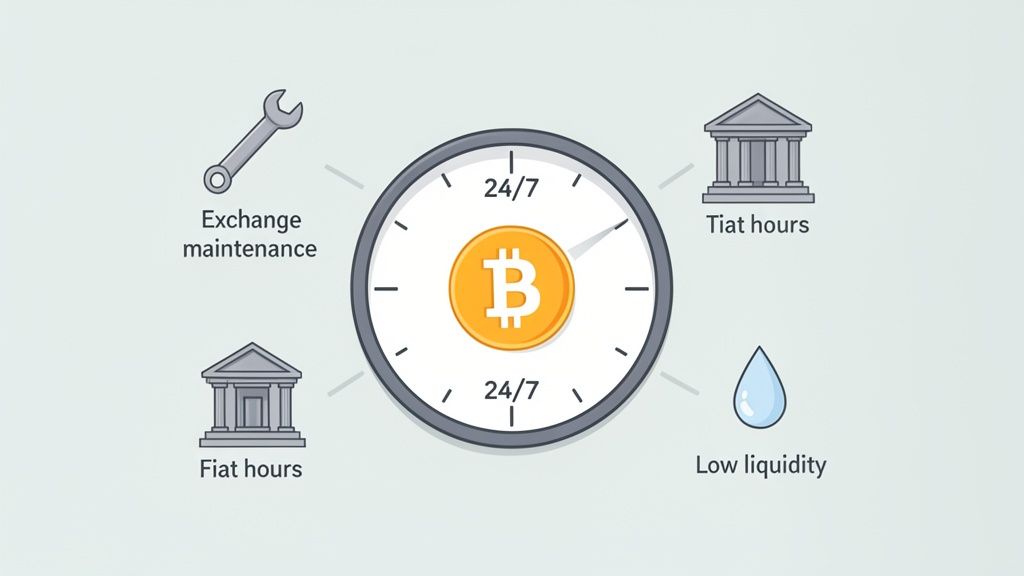
An infographic showing Bitcoin in a 24/7 clock, highlighting real-world limitations like maintenance and fiat hours.

This fundamental difference is completely by design. Crypto markets are built to be open globally 24/7, unbound by banking hours or gatekeepers. As S&P Global notes, this is a stark contrast to equity venues that only operate for about 6–8 hours per weekday. This structure allows for continuous trading across every time zone, without a single break.

But here's the catch: while the core technology never sleeps, your ability to interact with it isn't always seamless. Think of it this way: the highway is always open, but sometimes your specific on-ramp is closed for construction.

Practical Pauses in an Always-On Market

For any active trader, several real-world factors can create temporary interruptions or "hidden pauses." Understanding these is absolutely crucial for timing your moves.

  • Centralized Exchange Maintenance: Platforms like Coinbase or Binance have to perform system upgrades and maintenance now and then. During these windows, which can last anywhere from a few minutes to several hours, trading for everyone on that specific exchange is completely halted.

  • The Fiat Bottleneck: While you can trade one crypto for another anytime, converting your dollars or euros into crypto still depends on the old-school banking system. If you need to deposit cash to buy a dip at 3 AM on a Sunday, you’ll probably have to wait until your bank opens on Monday morning.

  • Low Liquidity Periods: Just because the market is technically open doesn't mean it's buzzing with activity. Trading volume ebbs and flows, and during quiet hours—like late on a weekend—there are far fewer buyers and sellers. This "low liquidity" can lead to much higher price volatility and make it tough to execute large trades without accidentally moving the price yourself.

To make this clearer, let's break down how crypto and traditional markets stack up side-by-side.

Crypto vs. Traditional Market Hours

This table quickly shows the key differences in operating hours, which is the root of so many strategic considerations for traders.

Market ComponentTypical AvailabilityWhy It Matters for Traders
Decentralized Crypto Trading24/7/365The core blockchain networks never stop, allowing peer-to-peer and DEX trades anytime.
Centralized Crypto ExchangesMostly 24/7, with occasional planned downtime.Your main trading venue (e.g., Binance, Kraken) can temporarily go offline for maintenance.
US Stock Markets (NYSE, NASDAQ)9:30 AM to 4:00 PM ET, Mon-FriClosed on weekends and holidays, creating distinct "trading sessions" and after-hours markets.
Fiat On-Ramps (Bank Transfers)Standard Banking Hours (approx. 9 AM - 5 PM, Mon-Fri)Getting fresh cash into the crypto ecosystem is often restricted by traditional finance schedules.

As you can see, the "always on" nature of crypto has some important asterisks. The digital asset itself is always moving, but the bridges connecting it to the traditional financial world and the platforms we use to trade it have their own schedules.

Why the Crypto Market Never Sleeps

So, what’s the secret sauce that keeps the crypto market buzzing around the clock, even when Wall Street is dark for the weekend? It really boils down to its core design, which was built to mirror the internet itself—a decentralized, global network that doesn't have a central 'off switch.' This is the single biggest difference between crypto and traditional finance.

Think about a stock exchange like the NYSE. It has a physical location and set business hours. When the closing bell rings, trading stops. Crypto doesn't have a closing bell. A network like Bitcoin or Ethereum is run by thousands of computers (nodes or validators) scattered across the globe.

When it’s 3 AM in New York, it's the middle of the business day in Tokyo. Because these participants are in every time zone imaginable, someone is always online to process transactions and keep the blockchain chugging along.

A Truly Global and Automated System

This worldwide distribution means there’s no single point of failure and no big boss who can just decide to shut things down for the day. The entire system is engineered to be perpetually online, ensuring you can send or trade crypto whenever you want. It's a massive shift from old-school finance, which is still tied to the 9-to-5 workday of a specific country.

The "always-on" nature of crypto comes from two key ingredients:

  • Decentralized Network: Thousands of participants (miners and validators) are located across every time zone. As long as some are active, the network runs continuously.
  • Automated Protocols: The rules are coded directly into the software. These protocols execute transactions based on code, not human operators, so they never need to sleep or take a break.

This powerful combination means the market is open to anyone with an internet connection, no matter where they are or what time it is.

Automated Market Makers: The Robotic Traders

Beyond the blockchain itself, another piece of tech keeps the 24/7 trading engine humming: Automated Market Makers (AMMs). Imagine an AMM as a trading robot that’s always on standby, ready to help you swap one token for another on a decentralized exchange (DEX) like Uniswap.

Instead of matching buyers and sellers the old-fashioned way, AMMs use pools of tokens that other users have supplied. These liquidity pools are governed by a simple algorithm, allowing you to trade directly with the protocol instead of waiting for another person.

An AMM doesn't have business hours. It's just code living on the blockchain, offering constant liquidity without needing anyone to manage it. This is why you can swap tokens at 3 AM on a Sunday just as easily as you can at noon on a Wednesday.

This blend of a globally distributed network and automated tools like AMMs is what makes crypto a market that genuinely never sleeps. It’s not just a cool feature; it’s woven into the very fabric of how it works.

The Hidden Pauses in 24/7 Crypto Trading

Even though the core blockchain technology never sleeps, the reality for an active trader is a bit different. Yes, the decentralized network is always on, but the platforms and systems we use to plug into it definitely are not.

Understanding these "hidden pauses" is the key to avoiding nasty surprises. So, while the short answer to "does crypto trade 24/7" is yes, the practical answer is a little more complicated.

An illustration showing a conveyor belt with green cubes, representing limitations of centralized exchanges, closed banks, and limited market hours.

These aren't tech failures; they're just the practical speed bumps that come with building a new financial world on top of an old one. If you ignore them, you risk getting locked out of a trade at the worst possible moment.

Centralized Exchange Maintenance

The most common interruption you'll run into is scheduled maintenance on big centralized exchanges like Binance, Coinbase, or Kraken. These platforms are massive operations handling huge volumes, and they have to hit the pause button occasionally to update systems, patch security holes, or squash bugs.

When this happens, trading can stop for certain assets or even the entire platform. Exchanges are pretty good about announcing these downtimes in advance, but they can last anywhere from a few minutes to several hours. That's long enough to effectively freeze your positions and leave you helpless if big market news breaks.

The Fiat On-Ramp Bottleneck

Another huge headache is what I call the "fiat bottleneck." You can swap one crypto for another any time, day or night. But moving traditional money—like US dollars or euros—into the market? That's a whole different story.

This process still depends on the old-school banking system, which famously sticks to a rigid Monday-to-Friday, 9-to-5 schedule.

Key Takeaway: Your crypto exchange might be open for business 24/7, but your bank most certainly is not. If you want to buy a sudden dip over the weekend, you’d better have your funds already sitting on the exchange.

This disconnect between the always-on crypto world and the time-gated banking system is a constant source of friction. It's a clear reminder that crypto is still tethered to traditional financial plumbing. You can actually see how this plays out by looking at the temporal patterns in crypto transactions, which often align with global business hours.

Crypto Derivatives and Traditional Hours

Finally, it's important to remember that not all crypto products trade around the clock. Some of the more regulated crypto derivatives, especially CME Group’s Bitcoin futures, follow traditional market hours. They shut down on Friday afternoon and don't reopen until Sunday evening.

This creates what traders call the "weekend gap."

Any big news or price swings in the spot market over the weekend can cause the futures price to open way higher or lower than its Friday close. This gap is a massive source of volatility—and both a huge risk and a huge opportunity for traders who know it's coming.

Here’s a quick breakdown of these trading interruptions.

Type of PausePrimary CauseImpact on Traders
Exchange MaintenancePlatform upgrades and security fixesTrading is completely frozen on the specific exchange.
Fiat BottleneckTraditional banking hoursPrevents new cash deposits during evenings and weekends.
Derivatives GapsRegulated market schedules (e.g., CME)Creates weekend price gaps and potential volatility on Monday.

How 24/7 Trading Fuels Volatility and Affects Liquidity

The crypto market’s relentless, 24/7 rhythm is a true double-edged sword. On one hand, it gives anyone, anywhere, incredible access. On the other, it creates an environment where market reactions are instant and often wildly dramatic, feeding directly into crypto's infamous volatility.

Think about the stock market. When trading closes for the day, there's a built-in "cool-down" period. Traders have time to digest news, analyze charts, and plan their next moves without pressure. Crypto doesn't have that luxury. A major regulatory announcement out of Asia at 2 AM New York time can send prices spiraling before most of the Western hemisphere has even had its morning coffee. The market processes everything in real-time, with no breaks.

This constant motion means your risk exposure never really sleeps. The market doesn’t care if you've logged off for the night, making solid risk management a round-the-clock necessity.

The Ebb and Flow of Global Liquidity

Just because the market is always open doesn't mean it's always busy. The number of active buyers and sellers—what we call liquidity—isn't a constant. It literally follows the sun around the globe, creating predictable peaks and valleys that smart traders learn to navigate.

Liquidity is at its highest when major financial hubs overlap.

  • Asian Session (approx. 00:00 - 09:00 UTC): Things start to heat up as markets in Tokyo, Hong Kong, and Singapore come online.
  • European Session (approx. 07:00 - 16:00 UTC): Activity swells as London and other European centers join the fray.
  • US Session (approx. 13:00 - 22:00 UTC): We often see peak liquidity during the overlap between European and US hours, when the most capital is active.

When things quiet down—say, late on a Saturday or in the dead of night for most major regions—liquidity can dry up fast. This makes the market much more fragile. A smaller trade that would barely make a ripple during peak hours can suddenly cause a massive price swing, a nasty phenomenon known as slippage. This is why understanding how assets behave within a liquidity pool in crypto is absolutely critical for managing your trades effectively.

This 24/7 structure is baked into how all market data is presented. Analytics platforms don't use fixed "daily" sessions; they use rolling 24-hour windows. You'll see global market cap displayed alongside a continuously updating 24-hour trading volume, timestamped to the minute. You can see this live on major data sites like the continuously updated charts on CoinMarketCap.

This chart from CoinMarketCap perfectly illustrates the constant, real-time flow of global market data.

Look closely at how the key metrics like total market cap and 24h volume are timestamped. It’s a clear visual reminder that this is a market that truly never stops.

Key Takeaway: The 24/7 crypto market isn't a flat, uniform landscape. It has distinct peaks and valleys of activity dictated by global time zones, which directly impacts both your risk and your opportunities. Learning to navigate these cycles is a fundamental skill for survival.

Actionable Strategies for the Always-On Market

So, how do you trade a market that never sleeps without losing sleep yourself? The secret isn't being glued to your screen 24/7. It's about setting up smart systems that act for you. This means ditching manual trading and letting automation protect your capital and snag opportunities, no matter what time it is.

Automate Your Risk Management

Before you even think about profits, you have to protect your downside. This is rule number one. In a 24/7 market, a nasty price swing can happen while you're asleep, at dinner, or just away from your desk. Automated orders are your first and best line of defense.

  • Stop-Loss Orders: Your non-negotiable safety net. A stop-loss automatically sells your position if the price drops to a preset level, capping your losses.
  • Take-Profit Orders: On the flip side, this order automatically sells when your asset hits a price target, locking in gains before a market reversal.

Using these two together is a pro move. You define your exact risk and reward before you even enter the trade. That kind of discipline is absolutely essential if you want to survive long-term in the crypto game.

By setting both a stop-loss and a take-profit order, you create a "bracket" around your trade. This guarantees your position is managed automatically, whether the market moves in your favor or against you. It's a huge peace-of-mind booster in an always-on environment.

Here are the most essential risk management strategies you can implement right away:

StrategyHow It WorksBest For
Position SizingLimiting each trade to a small percentage (1-2%) of your total capital.All traders. Prevents a single loss from causing significant portfolio damage.
Stop-Loss OrdersAn automated order that sells an asset when it hits a specific price.Day traders and swing traders who can't monitor charts 24/7.
Take-Profit OrdersAn automated order that sells an asset when it reaches a profit target.Traders who want to lock in gains systematically and avoid emotional decisions.
Trailing StopsA stop-loss order set at a percentage below the market price, which moves up as the price rises.Trend followers looking to maximize gains on a winning trade while still protecting profits.
Portfolio DiversificationSpreading investments across different crypto assets and sectors (e.g., DeFi, L1s, gaming).Long-term investors looking to reduce the impact of a single asset's poor performance.

These aren't just suggestions; they're foundational habits that separate consistently profitable traders from those who burn out.

Identify High-Liquidity Trading Windows

Crypto trades 24/7, but not all hours are created equal. Trying to trade when liquidity is low is a recipe for disaster—you'll face higher slippage and choppy, unpredictable price action. The goal is to be active when the market is at its busiest and most stable.

This timeline gives you a great visual of how global crypto liquidity flows through a typical 24-hour cycle.

Infographic showing global crypto market 24/7 liquidity flow across Asia, Europe/US overlap, and US close, with UTC times.

As you can see, that sweet spot when the European and US market hours overlap is often when liquidity is deepest. That's the prime window for executing bigger trades with the least amount of price impact.

Use Smart Tools to Seize Opportunities

Managing risk is half the battle. Capitalizing on opportunities is the other. It's flat-out impossible for one person to scan the entire market for good moves around the clock. This is where a smart wallet tracking tool like Wallet Finder.ai becomes a complete game-changer.

Instead of burning your eyes out watching charts, you can set up real-time alerts on the wallets of top traders. The moment a pro buys a new token or dumps a position, you get an instant notification. This lets you react to what the smart money is doing as it happens, no matter your time zone.

Suddenly, the 24/7 market shifts from a defensive headache to an offensive advantage.

How Wallet Finder AI Helps You Master 24/7 Trading

Navigating a market that never stops requires more than just defensive moves like setting stop-losses. If you really want an edge, you need tools that can translate the constant flood of data into a clear, actionable signal. This is exactly how Wallet Finder.ai changes the game.

Instead of just reacting to price charts, you can get ahead of the curve by monitoring the moves of elite traders. The platform lets you tune out all the noise and focus exclusively on what the "smart money" is doing, the moment they do it.

Uncover Pro Traders' Time Zone Specializations

You'll quickly notice that top traders often have a preferred window of activity. Some are masters of the volatile Asian trading session, while others execute their biggest moves when US market hours bring in a tidal wave of liquidity. Wallet Finder.ai gives you the power to dissect a trader's entire history to spot these exact patterns.

By analyzing their past trades, you're essentially figuring out their 'digital time zone.' This gives you a massive advantage. You can start anticipating when they are most likely to be active, letting you prepare for potential market-moving trades before they even happen. For a deeper look into this strategy, check out our guide on how wallet analytics improve trade timing.

By understanding a top trader's schedule, you move from simply copying their trades to anticipating their strategy. This transforms the 24/7 market from a constant threat into a predictable landscape of opportunity.

Build Custom Watchlists for Precision Alerts

Let's be real—the sheer volume of transactions in a 24/7 market is enough to make anyone's head spin. Wallet Finder.ai helps you cut through the static by letting you create custom watchlists of wallets you want to follow. This feature turns the chaotic on-chain firehose into your own curated intelligence feed.

Here’s a simple way to put this into action for better 24/7 trading:

  • Build a "Top Wallets" List: Add a handful of consistently profitable traders to a dedicated watchlist.
  • Set Instant Alerts: Configure real-time notifications through Telegram or push alerts for any new buy or sell from these wallets.
  • Act on High-Signal Data: Instead of guessing, you get immediate, hyper-specific notifications on moves that actually matter, allowing you to act decisively anytime, anywhere.

This kind of strategic filtering means you no longer need to be glued to your screen. Wallet Finder.ai does the heavy lifting, monitoring the market for you and ensuring you never miss a critical move from the traders who consistently get it right.

Frequently Asked Questions About 24/7 Crypto Trading

Even when you get the basics of the always-on crypto market, some practical questions always pop up. Let's tackle some of the most common ones traders ask when they're getting their feet wet in the 24/7 world of digital assets.

Are There Any "Official" Trading Hours for Crypto?

Nope. There’s no opening or closing bell in the crypto world. Unlike the New York Stock Exchange or the NASDAQ, which run on a strict schedule, the crypto market just… keeps going. The closest thing we have to "trading hours" are the natural peaks and troughs of activity as different parts of the world wake up and start trading. The busiest times are usually when European and US time zones overlap.

Can I Trade Crypto on Weekends and Holidays?

Absolutely. For the core crypto market, a Saturday is no different from a Tuesday. You can buy, sell, and swap your favorite coins on both decentralized and most centralized exchanges without missing a beat. Just be aware that liquidity often dips during these times, which can crank up the volatility and lead to wider spreads between buy and sell prices.

Why Do Some Crypto Futures Follow Traditional Market Hours?

This is where things get a little more complicated. Certain crypto derivative products, especially those offered by big, regulated players like the CME Group, are built to play nicely with the traditional financial system. That means they stick to old-school trading hours, closing down on Friday afternoons and firing back up on Sunday evenings.

This schedule is what creates the infamous "weekend gap." The price of a futures contract can open on Sunday at a completely different level than where it closed on Friday, all because the underlying spot market was moving the whole time.

The existence of these scheduled gaps is a key reason why the answer to does crypto trade 24 7 has nuances. While the underlying asset trades non-stop, the regulated derivatives market takes a weekend break, creating unique risks and opportunities for traders.

Is It Safe to Leave Trades Open Overnight or on Weekends?

Leaving a trade open while you're away from the screen is a totally normal part of trading, but you have to do it smartly. The market can make huge moves while you're asleep or out for the weekend. The only safe way to do it is with a solid risk management plan.

That means using automated orders like a stop-loss to protect your capital from a sudden crash and a take-profit order to automatically lock in your gains if the price hits your target. Never, ever leave a position open without a clear exit strategy in place.

What Is the Best Time of Day to Trade Crypto?

There isn't a single "best" time that works for everyone, but most experienced traders look for periods of high liquidity. Why? Because it means tighter spreads, less slippage, and a better chance of getting your orders filled at the price you want.

This sweet spot often happens during the overlap of the European and US trading sessions, which is roughly between 13:00 and 17:00 UTC. During this window, the market is usually at its deepest, making it easier to execute large trades without causing a massive price swing.


We've put together a quick table to answer some other common questions that come up.

QuestionAnswer
How does crypto's 24/7 nature affect prices?It can lead to higher volatility, as news and events from any time zone can impact the market instantly. There are no "after-hours" moves; every move is a live market move.
Do all centralized exchanges operate 24/7?Mostly, yes. However, they occasionally schedule downtime for system maintenance or upgrades. They usually announce these in advance, but it's a brief exception to the rule.
Are fiat deposits and withdrawals also 24/7?This depends on your bank. While the crypto exchange is always open, the traditional banking system (the "fiat rails") often operates on standard business hours, which can delay deposits or withdrawals.
Is volatility higher on weekends?It can be. With fewer institutional traders and lower overall volume, it can take less capital to move the market, leading to more sudden and dramatic price swings.

Hopefully, these answers clear up some of the practical details of navigating a market that never sleeps.


Ready to turn the 24/7 market into your competitive advantage? Wallet Finder.ai gives you the real-time alerts and smart money insights you need to capitalize on opportunities around the clock. Start your free trial today and see what the pros are trading, as it happens. Discover winning strategies with Wallet Finder.ai.