The Orion Protocol: A Guide to Aggregated Trading
Discover how the orion protocol aggregates liquidity across major exchanges and boosts trading efficiency.

January 7, 2026
Wallet Finder

January 6, 2026

Ever wonder how you can instantly swap one crypto token for another on a decentralized exchange (DEX) without waiting for a buyer or seller on the other side? The magic behind that seamless experience is the crypto liquidity pool.
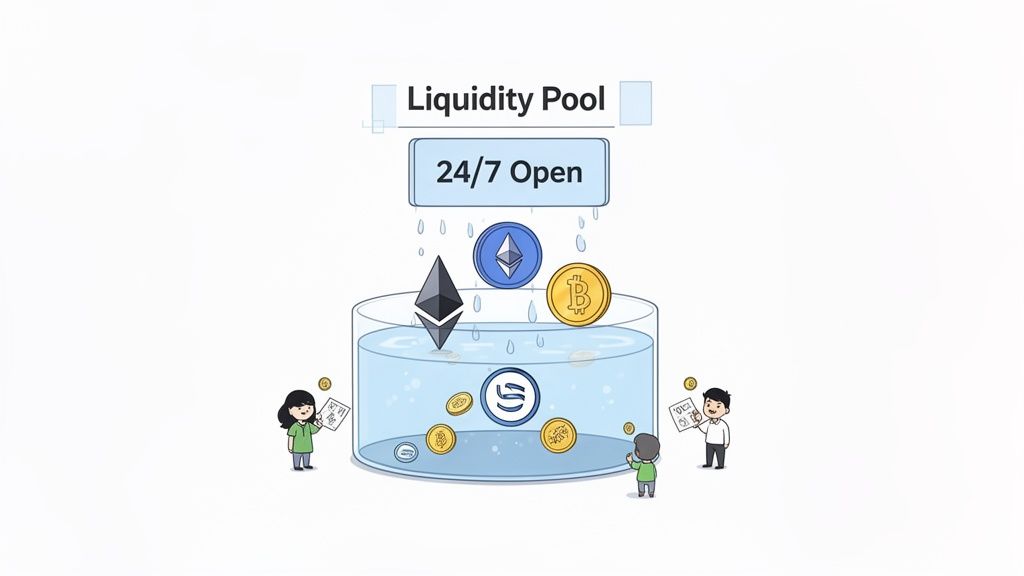
In simple terms, a liquidity pool is a big, crowdsourced pot of digital money locked away in a smart contract. These pools are the engine of decentralized trading, making it possible to trade tokens instantly.

Picture a 24/7 currency exchange booth that operates without an owner. Anyone can walk up, contribute to its cash reserves, and in return, earn a small cut of every transaction that happens there. That's a liquidity pool in a nutshell. They're the core technology powering most of the decentralized finance (DeFi) world, enabling billions of dollars in trades every single day.
Traditional exchanges like Coinbase or Binance rely on an order book—a constantly updated list of buy and sell orders. This works, but it requires matching a buyer with a seller. Liquidity pools solve a huge problem for DEXs: how do you make sure there's always enough of a token available for someone to trade, especially for newer or less popular assets?
The people who supply the crypto to these pools are known as Liquidity Providers (LPs). They are regular users who deposit their own crypto assets into a pool to help make trades possible for everyone else. By doing this, they provide the "liquidity" that keeps the exchange running smoothly.
So, why would anyone lock up their valuable assets? For a simple financial incentive: to earn a share of the trading fees generated every time someone swaps tokens. It’s a powerful way to put your idle crypto to work and generate passive income.
This setup creates a win-win-win situation:
A liquidity pool flips the script on trading. Instead of a peer-to-peer model (matching buyers and sellers), it becomes a peer-to-contract model where you trade directly with the pool's smart contract.
At its heart, a liquidity pool is usually made up of two different tokens locked in a smart contract. A common example is an ETH and USDC pair. To become a liquidity provider for this pool, you’d need to deposit an equal value of both tokens. So, if 1 ETH is worth $3,000, you would deposit 1 ETH and 3,000 USDC.
This 50/50 value split is crucial because it establishes the initial price and keeps the pool balanced. The whole system runs on an underlying algorithm that automatically manages token prices and executes trades. It’s an elegant design that completely removes the need for middlemen, making trading faster, cheaper, and more open for everyone. We'll dive into that algorithm next.
If a liquidity pool is the engine of decentralized trading, then the Automated Market Maker (AMM) is the computer running the whole show. This is the "magic" that lets you swap tokens instantly without ever waiting for another person to take the other side of your trade.
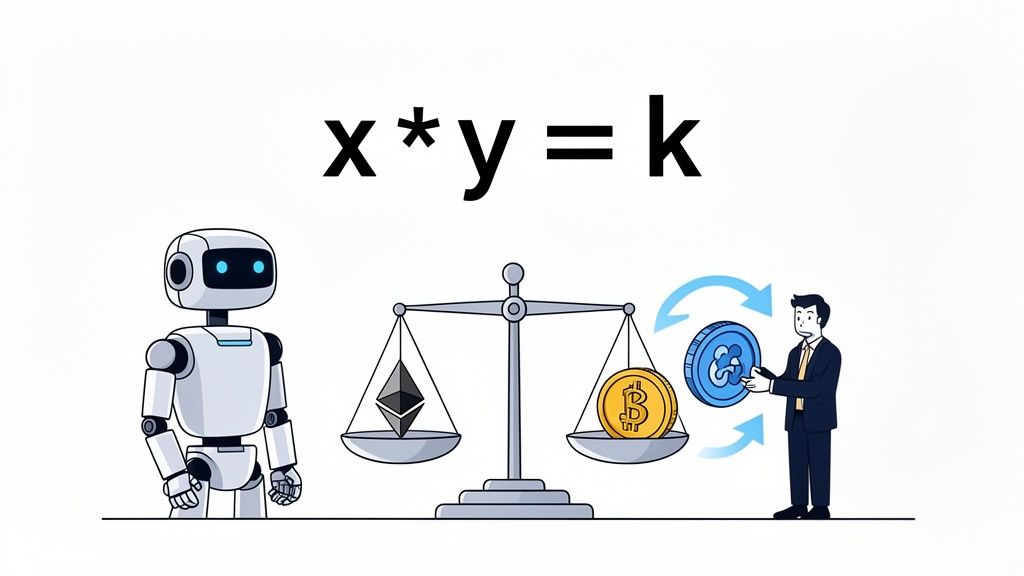
Don't think of an AMM as a person or a company. Think of it as a robotic banker that’s programmed to follow one simple, unbreakable mathematical rule. It doesn't negotiate, it doesn't haggle—it just follows its code, which is baked into a smart contract on the blockchain. The AMM’s only job is to manage the assets in the pool, set token prices, and process trades automatically.
The whole thing is transparent and permissionless, forming the core of how decentralized exchanges work. To get the bigger picture, our guide on what a DEX does gives you more context on the ecosystem where these AMMs live. This autonomous design is what makes the entire system so incredibly efficient.
So what's the unbreakable rule? Most AMMs are built around the constant product formula, famously written as x * y = k. This elegant little equation is the secret sauce that keeps the liquidity pool balanced and functioning.
Here’s a quick breakdown:
x is the amount of Token A in the pool.y is the amount of Token B in the pool.k is the constant, a fixed number representing the pool's total liquidity.The AMM’s prime directive is to make sure k always stays the same (ignoring fees for a moment). This means when a trader pulls some of Token A (x) out of the pool, they have to put enough of Token B (y) back in to keep the product of the two constant. This forced rebalancing is how prices are set algorithmically.
Let's see this in action. Imagine a popular ETH/USDC liquidity pool with:
First, we calculate our constant, k:10 (x) * 30,000 (y) = 300,000 (k)
The AMM will now do everything in its power to keep that k value at 300,000. Now, say a trader shows up wanting to buy 1 ETH.
When they take out 1 ETH, the pool's balance drops to 9 ETH. To keep the x * y = k rule intact, the amount of USDC must go up. The AMM calculates exactly how much USDC the trader needs to add to maintain that 300,000 constant.
9 (new x) * ? (new y) = 300,000 (k)? (new y) = 300,000 / 9? (new y) = 33,333.33
So, the trader has to deposit 3,333.33 USDC to get their 1 ETH. The trade is complete, and the pool now holds 9 ETH and 33,333.33 USDC. The constant k is still the same.
Did you catch what happened to the price? Before the trade, ETH was implicitly priced at $3,000 (30,000 / 10). After, the price is higher. The pool's new implied price is 33,333.33 / 9 = $3,703.70 per ETH. This automatic price adjustment, called slippage, is a fundamental feature of how AMMs operate.
The AMM is a price-setting machine. It doesn't look up prices on CoinGecko; it creates the price based purely on the ratio of assets within its own crypto liquidity pool.
This is a complete departure from the old-school order book model used by centralized exchanges like Binance or Coinbase. The differences really highlight why AMMs are such a game-changer for traders.
This elegant, always-on liquidity model is the engine of modern decentralized finance. It cuts out the middleman and opens up financial markets to anyone with a crypto wallet, creating a more accessible and efficient system for everyone.
When you deposit your crypto into a liquidity pool, you aren't just sending it off into the digital ether. In return, the smart contract immediately issues you a special token: an LP (Liquidity Provider) token. Think of it as your digital receipt, proof that you own a specific slice of that pool.
It’s a bit like a coat check ticket at a high-end restaurant. You hand over your valuable assets (your coat), and you get a ticket that proves it’s yours. That ticket is the only way to get your coat back later, and in the world of DeFi, it's also your key to earning a share of the profits.
The number of LP tokens you get is tied directly to how much you put in. If your contribution makes up 10% of the pool's total value, you’ll receive LP tokens that represent a 10% stake. Simple as that.
The most straightforward way you make money is by collecting a tiny piece of every single trade that happens in your pool. Each time someone swaps tokens, the protocol charges them a small fee—usually around 0.3%, though this can vary. That fee revenue is then divided among all the liquidity providers.
This is where your LP tokens really matter. The fees are distributed proportionally according to your share of the pool. So, if your LP tokens represent a 10% stake, you get 10% of all the trading fees collected. It’s a passive income stream that trickles in with every swap, 24/7.
For example, if you are in an ETH/USDC pool that does $1,000,000 in daily trading volume with a 0.3% fee, that generates $3,000 in total fees. If your stake is 5%, you’d earn $150 that day.
Your LP tokens are constantly working for you. They are not just a receipt; they are your claim on a perpetual stream of trading fees generated by the pool's activity.
Beyond just collecting trading fees, those LP tokens unlock a more advanced strategy called yield farming. This is where you can really make your capital work overtime, earning from multiple sources at once.
Yield farming means taking your LP tokens from one platform and "staking" them in a different DeFi protocol, like a yield aggregator or a dedicated farm. By locking up your LP tokens there, the second protocol rewards you with an additional layer of earnings, typically paid out in its own native token.
This strategy can seriously amplify your returns. You're still earning the base trading fees from your original liquidity pool, but now you're also stacking a completely separate reward on top.
By combining these methods, a single deposit can generate multiple income streams. You earn from the base layer of trading and then amplify those earnings through strategic yield farming, turning a simple deposit into a powerful financial tool.
While the rewards for providing liquidity look great on paper, they definitely don't come for free. Anyone thinking about becoming a liquidity provider needs to wrap their head around the single biggest risk involved: impermanent loss (IL). It's a weird, often counterintuitive concept that’s baked into the DNA of every liquidity pool in crypto.
Simply put, impermanent loss is the difference in value between keeping two assets in a liquidity pool versus just holding them in your wallet. It kicks in when the prices of the tokens you deposited start to drift apart.
The sheer amount of money locked up in DeFi shows just how many people are willing to take on this risk. Total Value Locked (TVL) in protocols that rely on liquidity pools exploded from about $1 billion in June 2020 to a staggering peak of nearly $180 billion in November 2021—that's an 18,000% jump. Even after the market cooled off, the TVL is still a hefty $82.882 billion, proving that LPs aren't going anywhere.
Let's break this down with a real-world example. Imagine you want to add liquidity to an ETH/USDC pool.
Step 1: Initial Deposit
You jump in when the price of ETH is $3,000.
Step 2: The Market Moves
A week later, the market goes on a tear, and the price of ETH doubles to $6,000. If you had just held onto your assets in your wallet (the classic "HODL" strategy), your bag would now be worth:
Step 3: How the AMM Reacts
But your funds are in a liquidity pool, not your wallet. As ETH's price shot up, arbitrage bots and traders swarmed in. They bought the "cheap" ETH from your pool and sold it elsewhere for a profit, adding USDC back into the pool as they did. The AMM’s job is to keep the pool balanced, constantly adjusting your holdings to maintain its formula.
When you decide to pull your money out, you'll find that the pool's rebalancing act means you don't have 1 ETH and 3,000 USDC anymore. Your share of the pool has shifted. You now have something like:
Your total value upon withdrawal is $8,484.
The Impermanent Loss Calculation
Value if You HODLed: $9,000
Value from the LP: $8,484
The Difference (Your Impermanent Loss): $516
In this case, you walked away with $516 less than if you had just done nothing. That gap is your impermanent loss. To play around with different numbers and see how this works in various scenarios, check out our impermanent loss calculator.
This flow shows the basic mechanics of how you earn in a liquidity pool.

It boils down to three simple actions: putting your assets in, getting LP tokens back as a receipt, and then earning fees from all the trading activity your liquidity enables.
The loss is called "impermanent" because, technically, it only exists on paper until you actually withdraw your funds. If the price of ETH in our example crashed back down to the original $3,000, the IL would vanish, and the ratio of your tokens would return to what you started with.
But don't let the name fool you. If you pull your liquidity out while that price difference is still there, that loss becomes very, very permanent. The bottom line for any liquidity provider is whether the trading fees you're earning are enough to outweigh the impermanent loss you're taking on.
While you can never completely eliminate impermanent loss, there are smart ways to manage it. Here is an actionable checklist:
The idea of a crypto liquidity pool is simple enough, but how protocols actually build them varies wildly across different blockchains. Not all pools are the same—far from it. Each is designed with a specific job in mind, playing to the strengths of its home turf.
Let's dive into some of the top liquidity protocols to see what this looks like in the real world.
The story really starts on Ethereum, the OG of DeFi. Protocols there have been in a slugfest for years, constantly tweaking and improving the original AMM model to handle billions in daily trading.
When you think of liquidity pools, you probably think of Uniswap. It's the undisputed pioneer that took this concept mainstream, and it’s still the first stop for a massive range of token pairs. The real game-changer came with its v3 update, which introduced concentrated liquidity.
This feature lets liquidity providers put their money to work within specific price ranges instead of spreading it thin across all possible prices. You can focus your capital where the action is, earning way more in fees from the same amount of cash. It's about being smarter, not just bigger.
Curve Finance took a completely different path. It zoned in on pools for assets that should trade at roughly the same price, like stablecoins (USDC/USDT) or different flavors of wrapped Ether (wETH/stETH). Its special algorithm is built for incredibly low slippage on these pairs, making it the undisputed king for huge stablecoin swaps.
The sheer scale of these platforms shows just how fundamental liquidity pools have become. In 2025 alone, stablecoins powered a jaw-dropping $10.66 trillion in transaction volume. These aren't just speculative toys anymore; they're becoming the rails for global payments. And with DeFi's Total Value Locked hitting $123.6 billion in Q2 2025, it's obvious these protocols are handling institutional-level money. You can find more insights on why this growth signals a new era for crypto infrastructure.
Ethereum may have started the party, but its high gas fees sent developers looking for faster, cheaper alternatives. Solana, famous for its lightning speed and low costs, quickly became a hotbed for new liquidity protocols.
Raydium is a perfect example. It took a unique hybrid approach by plugging into Serum's central limit order book. This means Raydium's liquidity pools share liquidity with the order book, giving traders better prices and more depth than a standard AMM could ever offer on its own. It's a model that truly sings on a high-speed chain like Solana, where fast arbitrage is key.
By blending the AMM model with a classic order book, Raydium created a much more dynamic and efficient trading environment, taking full advantage of what the Solana blockchain can do.
At the same time, Layer 2 networks are bringing that speed and affordability back to the Ethereum ecosystem. Aerodrome Finance, built on the Base network, has exploded in popularity. It runs on a clever "ve(3,3)" model that rewards users for locking up its native AERO token. Those who lock their tokens get to vote on which liquidity pools receive emissions, which kicks off a fascinating flywheel where other protocols bribe voters to drive rewards to their own pools.
Each protocol brings something different to the table, adapting the core crypto liquidity pool model to solve a different problem.
This diverse lineup makes one thing clear: there's no single "best" solution. From Ethereum's established giants to the speed demons on Solana and the economic experiments on Layer 2s, the world of liquidity pools is in a constant state of evolution, always getting more efficient, specialized, and easier to access.
Understanding the theory behind liquidity pools is the easy part. The real challenge? Finding a pool that’s actually profitable. With thousands of pools spread across different chains, trying to manually sift through them to find a winner is a recipe for analysis paralysis.
This is where the concept of following the "smart money" comes into play. Instead of throwing darts at a board, you can track the wallets of top-performing liquidity providers and see exactly what they're doing. It’s about turning theory into an actionable trading plan by learning from those who are already winning the game. You just need the right tools to uncover their moves.
This is precisely the problem platforms like Wallet Finder.ai were built to solve. By pulling and organizing on-chain data, they make it incredibly simple to spot wallets that are consistently turning a profit by providing liquidity.
The "Discover Wallets" feature lets you zero in on what matters. You can filter wallets based on specific criteria that point to real success:
Here’s a look at how you can use the Wallet Finder dashboard to filter for these top-tier wallets and see their on-chain activity at a glance.
By digging into these wallets, you get an instant shortlist of promising liquidity pools they’re active in—pools you might have never found on your own.
Spotting a profitable wallet is a great start, but the real advantage comes from acting on their strategies the moment they make a move. Manually refreshing a wallet's page is slow, clumsy, and simply not effective in a market that moves 24/7. This is why automated alerts are absolutely essential.
You can set up notifications that trigger the moment a wallet you're tracking makes a key move, allowing you to mirror their strategy almost instantly.
Set up an alert, and you'll get a notification the second a profitable wallet adds or removes liquidity. This is your signal to investigate the opportunity and decide if you want to follow their lead—often before the rest of the market even knows what's happening.
This approach essentially lets you outsource your market research to some of the most successful players in DeFi. Instead of you having to analyze every single pool, you can stand on the shoulders of giants by observing their actions.
Of course, blindly copying isn't a strategy. You still need to understand why a pool might be attractive. To sharpen your own analysis, dive into the top metrics for liquidity pool performance and learn how to properly evaluate the opportunities these smart wallets uncover.
Ultimately, this method gives you a systematic way to navigate the liquidity pool crypto space. It combines data-driven discovery with lightning-fast execution, giving you a clear edge in capitalizing on proven, profitable strategies.
Jumping into the world of crypto liquidity pools is exciting, but it's natural to have a few questions about how it all works, especially when it comes to the risks and rewards. Let's clear up some of the most common ones so you can make smarter decisions.
Absolutely. While you're earning trading fees as a liquidity provider, the big risk you need to understand is impermanent loss.
If the prices of the two tokens you've deposited start to drift apart, the total value of your assets when you pull them out could be less than if you had just held onto them in your wallet. Profitability is a constant balancing act—your goal is for the fees you rack up to outweigh any potential impermanent loss.
It's easy to mix these two up since both are popular ways to earn yield in DeFi. But they serve completely different functions and come with their own risk profiles.
Finding a pool that's actually worth your time takes a bit of research. A good starting point is to look for a combination of high trading volume and a reasonable Total Value Locked (TVL). High volume means more fees are being generated, but if the TVL is massive, your slice of the pie will be tiny.
The most critical factor, though, is the asset pair itself. Stablecoin pairs (like USDC/USDT) carry minimal impermanent loss risk but usually offer lower fees. On the other hand, volatile pairs can generate much higher fees but come with a much greater risk of impermanent loss.
Always dig into the protocol's security history and track record. An even better approach? Use tools to see where experienced, profitable traders are putting their capital. It's one of the most powerful ways to spot promising opportunities before everyone else does.
Ready to stop guessing and start tracking the smart money in DeFi? Wallet Finder.ai gives you the tools to discover top-performing liquidity providers, analyze their strategies, and get real-time alerts on their moves. Find your next profitable LP position by visiting https://www.walletfinder.ai.