7 Best Meme Coin Trading Tools for 2026
Discover the 7 best meme coins trading platforms and tools for 2026. Get actionable insights, find winning wallets, and trade smarter on CEXs and DEXs.

February 20, 2026
Wallet Finder

February 15, 2026

So, what exactly is Full Send Coin? Imagine a digital asset built almost entirely on community hype and high-risk, high-reward speculation. That’s FULLSEND in a nutshell.
This token is a classic memecoin on the Binance Smart Chain, and it wasn't built for your retirement portfolio. Instead, it’s designed for traders who are actively chasing those explosive, short-term pumps. Its entire world revolves around a clever incentive system that rewards you for holding and penalizes you for selling.
Thinking about trading FULLSEND? Here's what you need to know before you risk a single dollar:

Think of FULLSEND as a high-stakes digital poker game where the house rules encourage players to stay at the table. It works on a simple but powerful idea called frictionless yield. Every single time someone buys, sells, or even just moves FULLSEND tokens, a tax kicks in, creating a ripple effect that directly impacts every single holder.
This tax is the secret sauce. It's what attracts traders who thrive on volatility and what makes the token so interesting to watch. FULLSEND isn’t pretending to be the next Bitcoin; it fully embraces its identity as a speculative playground in the wild west of decentralized finance (DeFi). For on-chain analysts, this makes it a fascinating case study in market psychology and smart money moves.
To give you a clearer picture, here’s a quick rundown of the token's key details.
Every memecoin has a story. Full Send's is a textbook case of hype, greed, and what happens when the music stops.
FULLSEND launched in mid-2021, right when the memecoin craze was at its peak. SafeMoon had just exploded. Everyone with a keyboard was launching tokens with "frictionless yield" and "deflationary tokenomics." The playbook was simple: promise passive income through redistribution, promise scarcity through burns, and watch retail flood in.
Full Send followed this exact formula. The team wasn't trying to reinvent the wheel—they were copying what worked and hoping to catch lightning in a bottle.
For about three weeks, it worked. The token pumped, early buyers made multiples on their money, and social media went crazy. Trading volume hit $5.48 million during the peak—absolutely massive for a new memecoin.
Then reality hit.
The problem with tokens that promise passive income is they require infinite growth. Think about it: if everyone's getting "free" tokens from the 5% redistribution, where's the value coming from? It's coming from new buyers.
The moment new buyers stopped showing up, the whole thing collapsed. Whales who'd accumulated during the initial pump started moving tokens to exchanges. Smart money saw the pattern and followed. Retail, as always, was left holding bags.
By late 2021, trading had essentially stopped. The token still existed, but for all practical purposes, it was dead.
Let's be brutally honest about why Full Send failed:
Problem #1: Zero UtilityThe promised "Olympus" educational app never materialized. Without it, FULLSEND was just another tax token with no reason to exist beyond speculation.
Problem #2: Terrible TokenomicsOne quadrillion initial supply meant even massive burns barely made a dent. You're burning billions while trillions remain. The math doesn't work.
Problem #3: Anonymous TeamNo one knew who was behind the project. When things went south, there was no accountability. The team just... disappeared.
Problem #4: Market TimingLaunching in June 2021 meant they had maybe 3-4 months before the entire crypto market entered a brutal bear market. Memecoins always die first in downturns.
Remember that educational app they promised? The one that would teach new traders about crypto and create actual utility for the token?
It never happened.
The whitepaper mentioned it vaguely. The website teased it. Social media hyped it. But months passed with zero updates. Eventually, people stopped asking.
This is a common tactic in memecoin land: promise some future utility to justify the speculation, then hope people forget when you never deliver.
Today, Full Send exists in what traders call "zombie status." The token hasn't been officially abandoned, but there's no meaningful activity:
The contract still functions. You can technically still buy and sell. But why would you? There's no liquidity, no community, and no reason to believe it'll ever recover.
Full Send's story teaches you everything about memecoin cycles:
Lesson #1: Hype Has an Expiration DateThe initial pump lasted three weeks. If you weren't in early and out fast, you lost.
Lesson #2: Redistribution Isn't IncomeGetting "free" tokens is worthless if the token's price drops 95%. You're earning more of something that's becoming worthless.
Lesson #3: Promises Aren't DeliverablesNever trade on what a team says they'll build. Only trade on what exists right now.
Lesson #4: Anonymous Teams Are Red FlagsWhen there's no accountability, there's no reason for anyone to follow through on promises.
Lesson #5: Exit Strategy Matters More Than EntryKnowing when to sell is more important than knowing when to buy. Set profit targets before you enter and stick to them.
This table breaks down the essential characteristics of the FULLSEND token, providing an actionable overview for traders.
MetricDetailsWhy It Matters to a TraderToken NameFull Send CoinBrand recognition drives hype.TickerFULLSENDThe symbol you'll use on exchanges.BlockchainBinance Smart Chain (BSC)Expect fast transactions and low fees.Token TypeBEP-20 (Memecoin)Highly speculative; driven by community.Core Mechanism10% Transaction TaxAffects every buy/sell, impacting your PnL.Tax Allocation5% Burned, 5% RedistributedCreates holding incentives and deflation.Primary Use CaseSpeculative Trading & RewardsNot a utility token; a pure trading vehicle.
These are the fundamentals that drive the token's behavior and make it a unique asset to track on-chain.
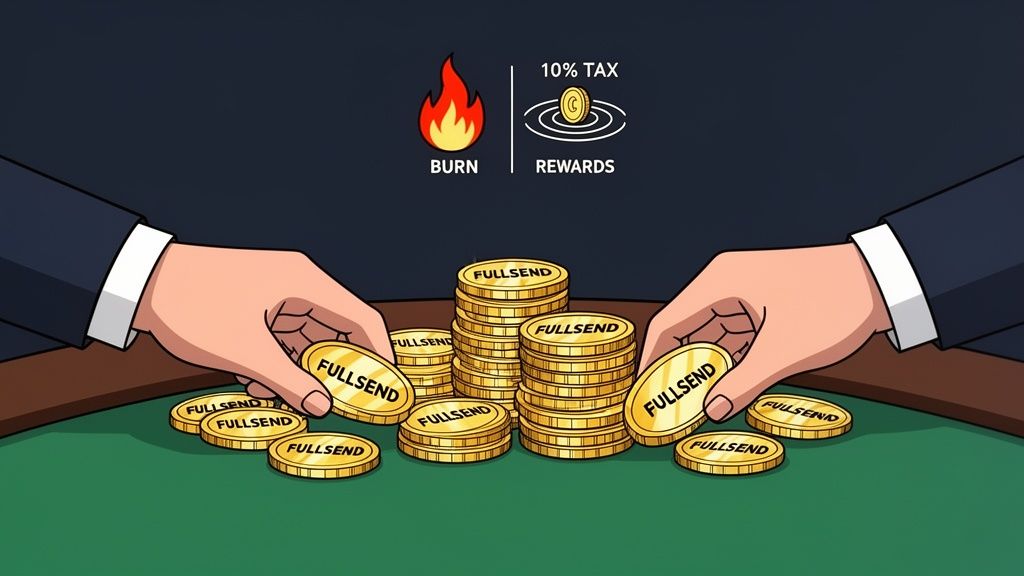
At the heart of Full Send Coin's design is its 10% transaction tax. This fee is automatically skimmed off every transaction and split right down the middle, with each half serving a very specific purpose. The whole point is to create a built-in reason to hold on tight and think twice before selling.
Here's how that 10% is divided and what it means for your strategy:
This two-pronged system creates a feedback loop where trading activity constantly feeds value back into the ecosystem, rewarding loyalty and penalizing itchy trigger fingers. For anyone digging into memecoins, getting a handle on this core mechanic is absolutely crucial. To see how these dynamics play out visually, check out our guide on how to read a meme coin chart.
To get a real feel for any crypto project, you have to pop the hood and look at its tokenomics. These are the rules that control how tokens are made, supplied, and even destroyed. For a project like Full Send Coin, these rules aren't just boring technical details—they're the engine that drives the whole thing. The tokenomics determine scarcity, how holders get rewarded, and ultimately, what pressures move the price.
First, let's clear something up: the difference between total supply and circulating supply. FULLSEND launched with a massive one quadrillion tokens, but that number is designed to be a bit misleading. A huge chunk of that supply gets systematically taken out of circulation, which makes the tokens you can actually trade much scarcer.
This whole process is fueled by an aggressive 5% burn rate on every single transaction.
Everyone talks about the 10% tax like it's some revolutionary feature. Let's break down what's actually happening and who profits.
Every single movement of FULLSEND triggers the tax. It doesn't matter if you're buying, selling, or just moving tokens between your own wallets. The smart contract automatically takes 10% and splits it.
You buy $1,000 worth of FULLSEND:
You've lost 10% before you even start. Your tokens need to appreciate 11% just for you to break even.
Now let's say the price goes up and you want to sell your $900 for $1,200:
But wait—you also collected redistribution rewards while holding. Let's say you earned $30 from other people's transactions during your hold period.
Final accounting:
So yes, you made money, but 21% of your trade value was eaten by taxes. In traditional markets, you'd have paid maybe 0.1-0.5% in fees total.
This is where it gets interesting. The tax doesn't benefit everyone equally.
Early buyers benefit most:They accumulate before price pumps and collect redistribution from every transaction during the hype phase when volume is massive. They're getting 5% of millions in daily volume.
Late buyers get destroyed:They buy near the top, pay 10% immediately, then watch the price collapse. The redistribution they collect is from minimal volume during the crash. They're getting 5% of almost nothing.
Whales dominate:The redistribution is proportional to holdings. If a whale holds 5% of supply, they get 5% of all redistribution rewards. Small holders get crumbs.
Real world example from the 2021 peak:
The whale made more in a day than most small holders invested total.
Everyone loves to talk about burns creating scarcity. Let's do the math on whether it actually matters for FULLSEND.
Initial supply: 1,000,000,000,000,000 (1 quadrillion)
Let's say we burned aggressively:
Total burned after 3 years: 300 trillionRemaining supply: 700 trillion
You burned 30% of the supply and there's still 700 trillion tokens. For perspective, Bitcoin's total supply is 21 million. You're burning trillions and barely making a dent.
To create meaningful scarcity, you'd need to burn:
At current transaction volumes (often under $100K daily), burns are removing maybe 1-2 trillion tokens per year. At that rate, you'd need decades to burn enough to matter.
Here's something most people don't realize: as volume dies, redistribution rewards become worthless.
During the peak:
After the crash:
Let's say you hold $1,000 worth of FULLSEND (0.01% of supply):
Peak redistribution:
Current redistribution:
You went from making $750/month to $7.50/month. The redistribution feature only works when there's volume. When volume dies, so does your passive income.
The 10% tax was supposed to create a holding incentive. Instead, it created exit barriers.
The problem:
Compare that to trading Bitcoin on Coinbase:
FULLSEND is 20x more expensive to trade. This doesn't encourage holding—it traps people. Once you're in, the exit cost is so high that you're forced to hold and hope for a massive pump just to break even.
Smart traders saw this immediately and either stayed out entirely or got in early with plans to dump on late retail. The tax didn't create diamond hands—it created bagholders.
Picture the burn mechanism like slowly taking puzzle pieces off the board and throwing them away for good. Every time someone buys, sells, or transfers FULLSEND, 5% of that amount is permanently destroyed. This constant chipping away at the total supply is meant to create deflationary pressure.
Over time, as more transactions happen, the available pool of FULLSEND tokens just keeps shrinking. This growing scarcity is a key part of its economic model. The idea is that this will make the remaining tokens more valuable, as long as demand stays the same or goes up.
This deflationary story is a big deal for memecoins. It gives people a concrete reason to believe the price could go up, beyond just hype. But remember, the burn only works if people are actively trading. No activity, no burn.
The other half of that 10% transaction tax is the 5% redistribution to holders. Think of this as a loyalty rewards program that runs 24/7. For every transaction on the network, 5% of the value is instantly shared among all the wallets holding FULLSEND.
This effectively creates a form of passive income. The longer you hold—and the more tokens you have—the more you earn from everyone else's trading. It's a clever way to discourage people from selling and encourage them to stick around for the long haul, which can help create a more stable price floor. Seeing how these rewards pile up in the top wallets is a big part of on-chain analysis, and you can dig deeper into that by using a token distribution analyzer.
Let's be real: the world of DeFi is full of scams. Scammers love to create fake tokens with similar names to trick you into buying the wrong thing. To make sure you're dealing with the real Full Send Coin, you must always use its official contract address on the Binance Smart Chain.
0x48c744ebb23171405079a61e01f6057a6e118302Before you do anything, always double-check this address on a block explorer like BSCScan. The safest move is to copy the address directly from an official source (like their website or verified social media) and paste it into a decentralized exchange like PancakeSwap. This one simple step can save you from a very expensive mistake and ensures you're buying the actual asset.

The market for a memecoin like Full Send Coin is often pure chaos, marked by breathtaking highs and gut-wrenching lows. Its price history is a classic case study of the boom-and-bust cycle you see in highly speculative assets.
The token saw a massive surge to its all-time high, pumped up by pure hype, only to come crashing down just as fast. Anyone who bought at the peak saw their investment wiped out in the blink of an eye.
This wild volatility is all about trading volume. A token like FULLSEND can go completely silent for long stretches, with barely any activity. Then, out of nowhere, you'll see an explosive spike in volume. That's your signal that something is happening under the surface.
These sudden bursts are often the first sign of whale activity or a coordinated pump, where big players jump in to manipulate the price. If you want to survive in this game, you have to learn how to read these signals.
To cut through the noise, you need to look past the price chart. A few key metrics can give you a much clearer read on market sentiment and the real health of a token. Getting a handle on these can help you spot opportunities and sidestep disaster.
Here are the critical numbers to watch when analyzing any "full send" coin:
When you look at these metrics together, they tell a much richer story than the price alone. They help you figure out if a price jump is backed by real trading or if it's just smoke and mirrors.
Liquidity is the absolute lifeblood of any token. Think of it as the ease with which you can buy or sell without tanking the price. For a memecoin, liquidity is everything. When it's low, it creates a dangerous trap where you can't sell your coins, even if they look profitable on paper.
FULLSEND’s recent 24-hour trading volumes have been all over the place, peaking at $5.48M during a price surge—a massive jump from a 7-day average that was close to zero. Other data points show volumes bouncing between $70,483 and $79,316, with a volume-to-market-cap ratio ranging from a tiny 0.09% to 1.48%.
These huge spikes show sudden floods of cash that completely dwarf its small market cap, creating the perfect setup for spotting high-conviction trades. You can dig into some of these market dynamics on Blockchain.com.
The real danger of a liquidity trap is painfully simple: you can buy in, but you can't get out. When the liquidity vanishes, there are no buyers left to take the tokens off your hands, leaving you stuck holding a worthless bag.
This is exactly why you must analyze the liquidity pool on a decentralized exchange before you even think about entering a trade. As you dive deeper, it’s crucial to understand why low liquidity increases meme token volatility and how to avoid getting caught in these situations.

In the wild west of memecoins, knowing what not to buy is just as crucial as picking a winner. Before you even think about putting money into a token like full send coin, you need to do your homework. The beauty of the blockchain is its transparency—all the warning signs are right there in the open, as long as you know where to look.
Protecting your capital starts with a quick run-through of the most common red flags. Think of it as a pre-flight check. These indicators can help you quickly figure out if a project is a hidden gem or just a well-disguised trap. Skipping this step is one of the fastest ways to get wrecked in DeFi.
Follow these actionable steps to perform your own research before investing:
Use this quick checklist to evaluate any memecoin at a glance. A "Fail" on any of these points should be considered a serious red flag.
CheckpointPass CriteriaFail CriteriaTool to UseHolder CentralizationTop wallet (non-exchange) holds <5% supply.A single wallet holds >10% of supply.BSCScan (Holders Tab)Liquidity StatusLP tokens are verifiably locked for 6+ months.Liquidity is unlocked or lock is short-term.Unicrypt, DXSaleContract OwnershipContract ownership has been renounced.Creator still has control over the contract.BSCScan (Contract Tab)Pool DepthSufficient liquidity to absorb normal trades.Low TVL causes high slippage on trades.PancakeSwap, PooCoin
Think of these checks as your first line of defense. If a token fails on one or more of these points, it's often best to just walk away. There will always be another opportunity around the corner.
The price chart only shows you what’s already happened. To get a real edge, you need to see what’s happening before it moves the market. This is where on-chain analysis comes in—the blockchain is a public ledger, and every single transaction leaves a permanent footprint for anyone to see.
If you can learn to read these footprints, you can stop guessing and start making data-driven moves. Instead of just reacting to a price pump, you can spot the whale activity that causes it in the first place. For a token like full send coin, this isn't about some complex algorithm; it’s just about knowing where to look and what you’re looking for.
Whales are wallets holding a massive amount of a token. Their movements can signal major price shifts. Here’s a simple, step-by-step process to start tracking them today:
This isn't about spotting a single transaction. What you're really looking for is a pattern. Consistent buying from several large wallets is a huge tell—it signals coordinated accumulation and rising confidence, often right before a major rally.
Beyond just tracking individual whales, the overall spread of token holders tells its own story about market sentiment. Is the token getting more concentrated in the hands of a few big players, or is it spreading out to a wider base of smaller retail investors?
A healthy sign is seeing the number of unique holders grow over time. This suggests genuine community interest and decentralization are on the rise. On the flip side, if you notice the top wallets are bulking up their share while smaller holders are selling off, that could be a huge red flag for an impending dump.
By checking the "Holders" tab regularly, you can catch these trends as they form, giving you a layer of insight that the price chart alone will never show you. This is how you start thinking like a market analyst, not just another trader.
On-chain data gives you a completely transparent window into what's happening in the market, but just looking at raw numbers won't get you very far. The real magic happens when you turn those insights into a concrete, actionable trading plan. This is where a specialized tool like Wallet Finder.ai comes in, letting you move past simple observation and start making strategic moves based on what proven traders are doing, especially with a volatile token like full send coin.
This whole approach shifts wallet tracking from a tedious research chore into a genuine, real-time trading edge. Instead of spending hours digging through transactions by hand, you can automate the entire process. The goal is to get instant signals the moment a top wallet makes a move, giving you a chance to front-run major price swings by mirroring traders with a track record of success.
The process is pretty straightforward. You're essentially moving from broad market tracking to specific, targeted action.

As you can see, it's a clear progression: track the market, monitor the key players, and then use their behavior to inform your own trades.
First things first, you need to build a targeted watchlist of influential wallets. We're not just talking about the wallets holding the most tokens. The real gold is in finding wallets that show consistently smart and profitable trading patterns with FULLSEND and similar tokens.
A platform like Wallet Finder is perfect for this. You can filter wallets based on specific performance metrics that actually matter:
Once you’ve found a handful of wallets that look promising, add them to a custom watchlist. This creates your own private, curated feed of smart money activity focused specifically on the token you're trading. It's way more effective than trying to drink from the firehose of the entire market.
With your watchlist built, the next move is to set up automated alerts. This is where your analysis becomes a seriously powerful, real-time weapon. You can set up notifications through a platform like Telegram to get an instant ping the second a wallet on your list makes a trade.
By getting an alert the moment a top trader buys or sells, you get a massive time advantage. This lets you react to important market moves as they happen—not after everyone else has—giving you a shot at getting in or out of a position before the rest of the market catches on.
Imagine this: you get an alert that several wallets on your watchlist start accumulating FULLSEND within a few minutes of each other. That's not just noise; it’s a powerful signal of coordinated buying pressure. This data-driven alert system effectively turns the moves of expert traders into your own personal buy or sell signals.
So you're looking at FULLSEND or similar zombie tokens and wondering if there's any way to make money. The answer is yes, but not how you think.
This is for tokens that still have some volume but are clearly dying.
Setup:Use BSCScan to monitor top 10-20 wallet addresses. Set up alerts (manually check twice daily if you can't automate).
Entry signal:When 2+ whale wallets move significant amounts (20%+ of their holdings) to PancakeSwap or exchange deposit addresses within 24 hours.
Execution:This is your signal they're preparing to sell. If you can short the token (through margin trading if available), do it immediately. If you can't short, simply don't buy—or if you're holding, sell immediately.
Time horizon: 12-72 hours
Expected move: 15-40% drop after whales dump
Win rate: 70-80% because whale dumps almost always work on low-liquidity tokens
Risk: Whales might just be moving tokens around, not selling. Verify by watching for actual sells within 48 hours.
After a major crash, even dead tokens bounce briefly as bottom fishers try to "buy the dip."
Setup:Token crashes 60-80% in 1-7 days on high volume.
Entry signal:
Execution:Buy a tiny position (0.5% of portfolio max) when price has been flat for 2 days. Set sell orders at +30%, +40%, and +50% from entry.
Exit rules:
Expected move: 25-60% bounce
Win rate: 40-50% (many attempts fail as token just continues dying)
Why it sometimes works: Some whales or algos automatically buy oversold tokens hoping for the bounce. Sometimes it works briefly.
Zombie tokens occasionally see random volume spikes (pump groups, bots glitching, random whale interest).
Setup:Monitor volume on PooCoin or DEXTools. Set alerts for 5x+ normal daily volume.
Entry signal:Volume spike happens AND price is up 20%+ on the day.
Execution:Don't chase the initial pump. Wait for first pullback (usually 10-15% retracement). Enter there.
Exit rules:
Time horizon: Hours to 2 days maximum
Expected move: 20-50% from your entry (not from the low)
Win rate: 55-65%
Why it works: Pumps attract FOMO buyers. You're selling to them, not buying with them.
This is advanced and requires understanding DEX mechanics.
Setup:Check FULLSEND liquidity pool on PancakeSwap. Note the total value locked (TVL).
Entry signal:TVL suddenly increases by 20%+ in one transaction. Someone just added significant liquidity.
What it means:Either the team is trying to stabilize price, or a whale is setting up for a pump. Either way, there's now more liquidity to trade against.
Execution:Wait 24-48 hours. If price hasn't moved much, buy a small position. Someone adding liquidity usually plans to pump the price within days to maximize their profit before they withdraw liquidity.
Exit rules:
Time horizon: 3-14 days
Expected move: 40-100% if the pump happens
Win rate: 35-45% (very hit or miss)
Regardless of which strategy you try:
Position sizing:Never exceed 1-2% of total portfolio in any zombie memecoin trade. These are lottery tickets, not investments.
Stop losses:Always use them. Never hope. Never average down. Never "diamond hands" on a dead token.
Profit taking:Take profit early and often. Your goal is 30-50% gains, not 10x. Be realistic.
Time limits:Set maximum hold periods (usually 7-14 days). If nothing happens, exit and move on.
Liquidity check:Before entering ANY trade, verify you can actually exit. Try a small test trade first if you're unsure.
Full Send isn't officially dead—the contract still functions, and you can technically trade it. But for all practical purposes, it's a zombie token.
Why it matters:Dead doesn't mean "can never pump again." Zombie tokens occasionally see brief 50-200% pumps from pump groups or random whale interest. But these are temporary. The underlying project has no future.
Bottom line: Treat it as dead. If you're going to trade it, use the dead token strategies (short-term scalps only), never buy-and-hold.
No. Not realistically.
The 2021 peak required perfect conditions that no longer exist:
All of these are gone. Today, there are thousands of memecoins competing for attention. FULLSEND has no team, no development, no community, and a reputation as a failed project.
If FULLSEND is currently at $0.0000003 and the ATH was $0.000003, that's a 10x move. To achieve this, you'd need:
Where would this capital come from? Why would anyone choose FULLSEND over thousands of newer projects?
More realistic question: Could it pump 50-100% on random speculation? Yes, occasionally. But ATH recovery? Forget it.
It was abandoned. The team stopped development (or possibly never started) and stopped communicating about it.
This is called "vaporware"—software that's announced but never delivered. It's extremely common in crypto, especially with memecoins trying to justify their existence.
The pattern:
FULLSEND followed this playbook exactly. The whitepaper mentioned Olympus vaguely. The website teased it. Then... silence.
This is critical due diligence that most people skip.
Step 1: Go to BSCScan and search for FULLSEND contract address
Step 2: Click the "Contract" tab
Step 3: Look for "Liquidity Lock" or check holders list for lock contracts like:
Step 4: If you see a lock address, click it and verify:
What you'll likely find with FULLSEND:Either no lock (liquidity is unlocked and at risk) or an expired lock. This means the team could theoretically remove liquidity at any time, making the token untradeable.
Why locked liquidity matters:Unlocked liquidity means rug pull risk. The team could drain the liquidity pool in one transaction, making your tokens worthless with no way to sell them.
Absolutely not.
The redistribution rewards only make sense when:
FULLSEND fails all three criteria.
Real math:If you buy $1,000 of FULLSEND today and hold for 30 days:
Meanwhile, the token's price is unstable and could drop 30-50% in that same month, costing you $300-$500.
You're earning $11 while risking $300-$500 in price losses. The math doesn't work.
Redistribution was attractive in 2021 when:
Those conditions are gone and won't return.
If you're holding FULLSEND and want out, here's the practical guide:
Step 1: Check Current LiquidityGo to PancakeSwap, connect wallet, and input your FULLSEND amount to see:
Step 2: Set Realistic ExpectationsIf you hold a lot of tokens relative to the liquidity pool, you'll face massive slippage. A $5,000 sell into a $30,000 liquidity pool could mean 40-60% slippage.
Step 3: Decide Your Approach
Option A - Sell Everything Now:
Option B - Sell in Tranches:
Option C - Wait for a Pump:
Step 4: Tax Loss HarvestingIf you're sitting on losses, selling for tax purposes might make sense. Consult a tax professional about claiming capital losses to offset other gains.
Reality check:If you bought at or near the peak, you're probably down 90-95%. Focus on getting something out rather than hoping for a recovery that won't happen.
There are thousands of tokens with similar mechanics (redistribution + burns). Most are also dead or dying.
If you're looking for similar plays:
All follow the same model. All have seen similar boom-bust cycles.
Better question to ask yourself:Why are you attracted to these tokens? If it's for the "passive income" from redistribution, you're chasing something that doesn't really work in practice.
More reliable strategies:
The redistribution model is designed to benefit early adopters at the expense of late buyers. Unless you're consistently early (which requires being the smart money you're trying to follow), you'll lose.
Stop guessing and start strategizing. With Wallet Finder.ai, you can follow the smart money, get instant trade alerts, and copy the moves of the most profitable traders. Start your free trial today and find your next big win.