Crypto Asset Score: A Trader's Guide

Wallet Finder

Blank calendar icon with grid of squares representing days.

February 16, 2026

Ever tried to pick a winning crypto project by just looking at its price chart? It’s like trying to judge a car's quality by its paint job alone—you're missing what’s under the hood. This is where a fundamental crypto asset score comes into play.

What Is a Fundamental Crypto Asset Score
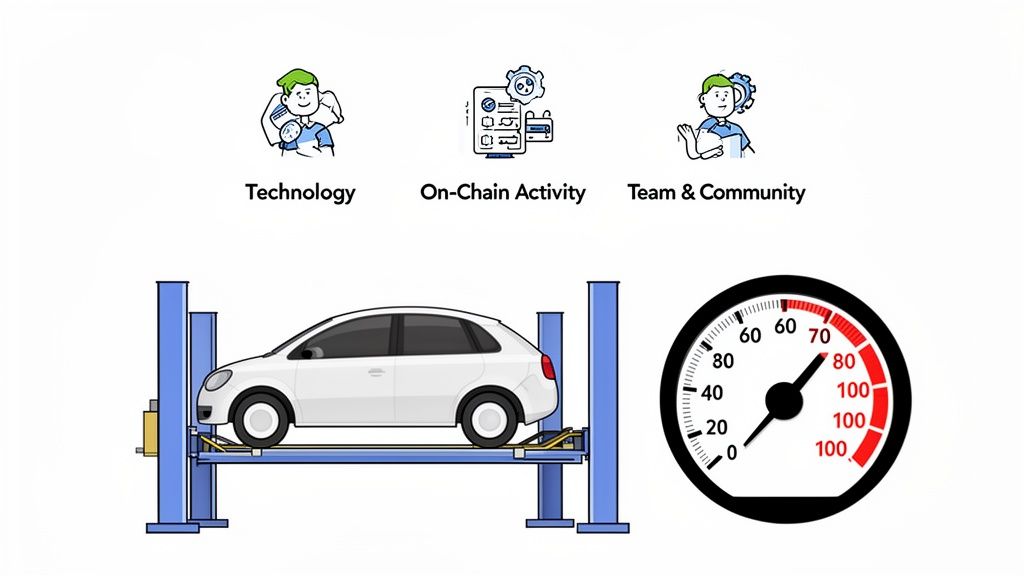
Diagram illustrating a fundamental crypto asset score, including technology, on-chain activity, and community metrics.

Think of it as a credit score, but for crypto. It’s a single, digestible number that gives you a snapshot of a project's overall health and potential. Instead of getting caught up in fleeting market hype, this score forces you to look at the project's actual, intrinsic strengths.

Relying on price alone in the crypto world is a recipe for disaster. A fundamental score is your compass in the storm, offering a data-driven look at an asset’s true value and long-term staying power. It consolidates all the tedious due diligence—checking the engine (technology), reviewing the mileage (on-chain activity), and verifying the ownership records (team and community)—into one clear rating.

Why This Score Matters in Modern Trading

This kind of deep analysis is non-negotiable for anyone serious about making informed decisions. The top traders, especially those using platforms like Wallet Finder.ai to follow smart money, aren’t just chasing pumps. They dig into an asset's underlying strengths to get ahead of the curve, and a fundamental score is their shortcut.

By putting a number on a project's health, a fundamental crypto asset score helps separate the real deals from the speculative noise. It’s a vital layer of risk management in a market that rarely offers any.

A fundamental score helps you answer critical questions that price charts can't:

  • Is anyone actually using this project? (User Adoption)
  • Is the development team credible and active? (Team & Technology)
  • Is the token's economic model sustainable or designed for a crash? (Tokenomics)
  • Does the project have a clear purpose and a plan to achieve it? (Vision & Roadmap)

The Building Blocks of a Reliable Score

A solid score isn't just pulled from thin air; it’s built from several key pillars of data. Each piece of the puzzle gives you a different angle on the project's health. For traders, knowing what goes into the score is the first step to using it effectively. If you want to go deeper on this, our guide to crypto on-chain analysis is a great place to start.

Here’s a quick breakdown of the core components that make up a trustworthy fundamental score.

Key Pillars of a Fundamental Crypto Asset Score

ComponentWhat It MeasuresExample MetricActionable InsightOn-Chain ActivityThe real-time pulse and user engagement of the network.Daily Active AddressesShows if the user base is growing, shrinking, or stagnant.Project FundamentalsThe quality of the technology, team, and project roadmap.GitHub Commit FrequencyIndicates if the project is being actively developed and improved.TokenomicsThe economic model and incentive structure of the token.Token Distribution ScheduleReveals potential sell pressure from team or VC unlocks.Market MetricsThe asset's liquidity, social sentiment, and market presence.Trading VolumeDetermines how easily you can enter or exit a position without slippage.

Understanding these pillars is crucial because they form the foundation of the final rating. We'll dive into each of these areas in the next sections to show you exactly how they contribute to a score you can actually use to make trading decisions.

Deconstructing the Core Signals of a Crypto Score

A solid fundamental crypto asset score isn't just some magic number pulled out of thin air. It’s a composite rating, carefully built from distinct, measurable signals.

Think of it like a skilled mechanic diagnosing a car. They don’t just listen to the engine and make a guess. They check the electronics, inspect the tires, and review the service history. A robust crypto score does the same, analyzing an asset from four key angles to give you a complete picture of its health and potential.

These four pillars are on-chain metrics, project fundamentals, tokenomics, and market metrics. By breaking an asset down into these core components, you can see past the surface-level hype and understand what truly drives its long-term value.

Let's dig into each one.

On-Chain Metrics: The Project's Real-Time Pulse

On-chain metrics are the digital footprints left on the blockchain. This data gives you an unfiltered, real-time look at network activity and user engagement. It’s incredibly powerful because it’s nearly impossible to fake and reflects genuine adoption. This is how you tell if people are actually using the network, or if it's just a ghost town propped up by speculative buzz.

Here's an actionable checklist for analyzing on-chain signals:

  • Check Daily Active Addresses (DAA): Is the number of unique wallets interacting with the protocol consistently growing over a 30-day period? A steady climb indicates organic user adoption.
  • Analyze Transaction Volume: Look for high volume but filter out potential wash trading. A healthy sign is volume that corresponds with price increases, not artificial spikes on low-liquidity exchanges.
  • Monitor Network Growth: Are new wallets being created at a healthy rate? A positive growth rate, especially during a market downturn, is a strong green flag for long-term health.
  • Evaluate Holder Distribution: Is the token supply concentrated in a few wallets or widely distributed? Use a block explorer to check the top 100 holders; high concentration is a risk factor.

For a deeper dive into these raw numbers and how they paint a picture of real-world utility, check out our guide on the top metrics for wallet performance analysis.

Goodhart's Law: When Metrics Become Targets

The article's on-chain checklist correctly identifies Daily Active Addresses (DAA), transaction volume, and wallet growth as key health indicators. The critical limitation — documented extensively in data science but rarely discussed in crypto scoring guides — is Goodhart's Law: "When a measure becomes a target, it ceases to be a good measure."

Once DAA and transaction volume became standard inputs in fundamental crypto asset scores and widely cited metrics on platforms like CoinGecko, Messari, and Glassnode dashboards, projects began deliberately manufacturing these numbers. The practice is widespread, systematic, and nearly invisible to standard analysis.

Wash address farming operates as a coordinated service: networks of bots cycle small transactions between thousands of addresses on a schedule calibrated to produce smooth, growing DAA charts without anomalous spikes that would trigger volume analysis flags. A project paying for this service shows exactly the kind of "healthy, organic" DAA growth pattern that scores well — consistent upward trend, reasonable day-over-day variance, no suspicious volume clustering. The signal looks perfect because it was manufactured to look perfect.

Distinguishing Genuine from Manufactured On-Chain Activity

Real adoption leaves different traces than manufactured activity. Cross-checking multiple metrics simultaneously makes manufacturing significantly harder and more expensive:

  • Transaction value distribution: genuine user activity shows a natural power-law distribution of transaction sizes (many small transactions, few large ones). Manufactured activity using bots tends to cluster around specific transaction sizes programmed into the bot's parameters — look for unusual concentration at specific round-number values ($10, $100, $500)
  • Address cohort retention: new addresses created during genuine adoption continue transacting in subsequent weeks. Bot-farmed addresses are typically created and used 1-3 times then abandoned — check whether new addresses from any given month show 30-day and 90-day retention rates consistent with older cohorts
  • Gas/fee patterns relative to network load: genuine activity correlates with varying fee conditions as users compete for block space. Manufactured activity often shows suspiciously consistent fee levels because bots are programmed with fixed parameters rather than responding to real-time fee markets
  • Cross-metric coherence: genuine adoption shows correlation across multiple metrics simultaneously (DAA up + TVL up + revenue up + developer activity up). Gaming typically elevates one or two visible metrics while leaving others flat — a project with rising DAA but flat protocol revenue and zero TVL growth warrants deep skepticism

Project Fundamentals: The Who and Why

While on-chain data shows you what's happening, the project fundamentals tell you who is behind it and why it even exists. This pillar is all about the human element and the strategic vision steering the ship. A project with shaky fundamentals is like a ship with no captain or map—it might look impressive sitting in the harbor, but it’s probably not going anywhere good.

Here’s an actionable checklist for analyzing project fundamentals:

  • Investigate the Development Team: Are the founders public (doxxed)? Do they have a proven track record on LinkedIn or past projects? Anonymous teams are a significant red flag.
  • Scrutinize the Whitepaper and Roadmap: Does the whitepaper clearly solve a real-world problem? Is the roadmap detailed with specific, achievable milestones, or is it full of vague promises like "Marketing Push Q3"?
  • Verify Developer Activity: Go to the project's GitHub. Look for consistent code commits over the past 3-6 months. A dead GitHub often means a dead project.
  • Assess Community and Partnerships: Is the community genuinely engaged, or is it just bots spamming "wen moon"? Have they announced meaningful partnerships that add real value to the ecosystem?

Tokenomics: The Economic Blueprint

Tokenomics is the science behind a token's economic design. It dictates everything from creation and distribution to management, which directly shapes its supply, demand, and ultimately, its value. A project can have world-changing tech and an all-star team, but if the tokenomics are broken, it's set up to fail.

Sustainable models are built for the long haul, while risky ones are often engineered for a quick pump. For years, a solid fundamental score has been the north star for analysts using platforms like Wallet Finder.ai to track smart money. Assets with high scores—often backed by strong tokenomics and dev activity—have consistently led market cycles. For example, Bitcoin's market dominance shot past 70% after the 2018 crash, a powerful testament to its sound fundamentals. You can see historical data like this for yourself by exploring past market performance on CoinMarketCap.

Here’s a quick guide to spotting the good from the bad.

Sustainable vs Risky Tokenomics Models

A comparative look at token economic models to help traders identify long-term potential versus short-term hype.

FeatureSustainable Model (Green Flag)Risky Model (Red Flag)Total SupplyCapped or deflationary supply creates scarcity and drives value.Unlimited or highly inflationary supply constantly dilutes value.DistributionA fair launch or wide distribution that prevents centralization.Huge chunks are given to the team and VCs with short vesting periods.Token UtilityA clear use case within the ecosystem (e.g., governance, fees).No real purpose beyond speculation or basic staking rewards.Vesting ScheduleLong vesting periods (e.g., 2-4 years) for team/investor tokens.Short vesting periods or large "cliff" unlocks that create sell pressure.

It's crucial to understand these distinctions because they often separate projects with lasting power from those that are just flashes in the pan.

A project's tokenomics model is its economic DNA. A well-designed model aligns incentives between the team, investors, and users, creating a self-sustaining ecosystem built for the long haul.

Market Metrics: The Public Perception

Finally, market metrics tell you how the asset is seen and traded out in the wild. These signals reflect its liquidity, social relevance, and overall standing in the crypto world. Strong market metrics suggest an asset is resilient, accessible, and has captured the community's attention.

Here's an actionable checklist for analyzing market metrics:

  • Evaluate Market Capitalization: Compare the market cap to direct competitors. Is it reasonably valued, or does it seem over-inflated for its current stage of development?
  • Check Liquidity and Volume: Is there enough liquidity on major exchanges to support large trades without significant price impact? Low liquidity is a major risk.
  • Review Exchange Listings: Is the token listed on reputable, high-volume exchanges (e.g., Binance, Coinbase) or just smaller, less-regulated ones? Top-tier listings are a sign of credibility.
  • Gauge Social Sentiment: Use tools to track sentiment on platforms like X. Look for genuine discussion and growing interest, not just bot activity or spam.

By weaving together these four pillars—on-chain activity, project fundamentals, tokenomics, and market metrics—a fundamental crypto asset score delivers a complete, nuanced view of a project's true potential.

How to Calculate and Weight a Fundamental Score

Alright, let's get practical. How do you go from a pile of raw data to a single, clean number that tells you a project's health? This isn't about some secret, magic formula. It's about building a logical system that weighs different signals based on how much they actually matter.

The key is a weighted model. Let's be real—not all metrics are created equal. Some, like genuine on-chain activity, give you a much clearer picture of long-term potential than, say, short-term market hype, which can swing wildly based on a single tweet.

By giving more importance to the solid, hard-to-fake stuff, we can build a score that really means something.

A process flow diagram illustrating four core crypto signals: On-Chain, Fundamentals, Tokenomics, and Market.

This process shows how we can funnel data from our four core pillars—On-Chain, Fundamentals, Tokenomics, and Market—into one comprehensive score.

A Practical Weighting Framework

To build a score that’s actually useful, you have to decide how much each of those pillars influences the final number. A solid approach is to lean heavily on the factors that reflect real adoption and a sustainable economic model.

Here’s a sample weighting you can use as a starting point for your own analysis:

  • On-Chain Metrics (30%): This gets a big slice of the pie because it shows real-world use. Things like daily active users and transaction volume are direct proof that people are actually using the network.
  • Tokenomics (30%): Just as critical, tokenomics defines the rules of the game. A bad economic model can kill even the most brilliant technology, so this deserves equal weight.
  • Project Fundamentals (25%): Is the team legit? Does the whitepaper make sense? Is development actually happening? This pillar checks the project's foundation and strategic direction.
  • Market Metrics (15%): Market cap and social sentiment are part of the picture, but they get the smallest share. Why? Because they’re often volatile, easily swayed by hype, and tend to be lagging indicators.

This setup prioritizes what's tangible—network health and economic design—over the more speculative signals, giving you a much more stable and reliable read on an asset's true value.

From Raw Data to a Component Score

Once your weights are set, the next move is to turn raw numbers into a standardized score. A simple 1-100 scale works perfectly for this. This step, known as normalization, is what lets you compare apples to oranges—like transaction volume against developer activity.

For example, you might decide that 100,000 daily active users is fantastic and equals a score of 90/100 for that metric. A project with just 5,000 might only get a 20/100. You'd do this for every single metric across all four pillars.

Let's Calculate a Score for "Token ALPHA":

  1. On-Chain Score: Active addresses (85/100) + Transaction volume (75/100) = Average of 80. Weighted Score: 80 * 0.30 = 24
  2. Tokenomics Score: Token distribution (60/100) + Inflation rate (80/100) = Average of 70. Weighted Score: 70 * 0.30 = 21
  3. Fundamentals Score: Team experience (90/100) + Developer activity (70/100) = Average of 80. Weighted Score: 80 * 0.25 = 20
  4. Market Score: Liquidity (70/100) + Social sentiment (60/100) = Average of 65. Weighted Score: 65 * 0.15 = 9.75

Final Fundamental Score for Token ALPHA = 24 + 21 + 20 + 9.75 = 74.75

Boom. Now you have a single, quantifiable number that sums up the asset's fundamental health.

Interpreting the Final Score

A score is just a number until you give it meaning. By setting clear thresholds, you can turn that number into a quick, actionable signal for your trading decisions. These bands help you instantly categorize an asset's risk profile.

Here's a simple framework for interpreting a 1-100 score:

Score RangeInterpretationActionable Step for Traders80-100Excellent (Blue Chip)Suitable for long-term holds. Prioritize these for the core of your portfolio.60-79Good (Promising)Good for swing trades. Look for strong technical setups to confirm entry points.40-59Average (Speculative)High risk/reward. Allocate only a small portion of your capital and conduct deep research.0-39Poor (High Risk)Avoid or monitor for a turnaround. These are often fundamentally flawed projects.

By getting your head around how these scores are built and weighted, you can stop taking ratings at face value. This knowledge gives you the power to critique any score you see—and even build your own simple models for a much smarter trading strategy.

Using Scores to Find Winning Wallets on Wallet Finder

Knowing how a fundamental crypto asset score is built is one thing, but actually using it to make smarter trades is where the real magic happens. Theory is nice, but platforms like Wallet Finder.ai are designed to turn these scores into actionable trading signals, helping you spot opportunities before the rest of the market catches on.

Instead of just chasing random price pumps, a fundamental score lets you follow the smart money—the traders who invest in projects with real substance. This is the heart of a data-driven strategy: find wallets that consistently back fundamentally sound assets, and then use their moves to inform your own.

Filtering for Top Wallets by Asset Quality

First things first, you need to find the traders who actually know what they're doing. A truly winning wallet isn't just one with a massive PnL; it's one that gets those returns by consistently picking assets with strong underlying health. Wallet Finder.ai lets you filter wallets based on the quality of the assets they hold, which is a game-changer. You're essentially surfacing traders who prioritize projects with a high fundamental crypto asset score.

This simple step cuts through so much of the market noise. You can tune out the lucky gamblers who caught a one-off memecoin pump and instead focus on the strategic investors whose portfolios are built on a solid foundation. You're not just finding profitable wallets; you're finding sustainable, repeatable trading strategies you can learn from.

For a deep dive into this technique, our guide on how to track crypto wallets effectively is the perfect place to start building out your monitoring strategy.

Discovering Undervalued Tokens Before the Hype

Let’s be honest, one of the biggest challenges in crypto is finding the next big thing before it goes vertical. The 'Discover Tokens' feature on Wallet Finder.ai is an incredible tool for exactly this, especially when you pair it with fundamental analysis. It shows you which assets are quietly being accumulated by smart money wallets before they hit the mainstream radar.

Here’s a simple, powerful workflow:

  1. Identify Emerging Tokens: Use the 'Discover Tokens' feature to see what new or low-cap assets are being snapped up by top-performing wallets.
  2. Analyze Their Score: Now, dig into the fundamental crypto asset score for those specific tokens. Look for assets with scores that are not just high, but also trending upward.
  3. Spot the Signal: When you see a token being bought by smart money that also has a rapidly improving fundamental score, that's an incredibly strong buy signal. It tells you that savvy traders see underlying strengths that the broader market hasn't priced in yet.

This approach flips the script. You stop being a reactive trader buying the top of a rally and become a proactive one who identifies genuine value based on improving fundamentals.

Validating Smart Money Moves

Following a smart money wallet can be insanely profitable, but blindly copy-trading every move is just asking for trouble. A top trader might make a move based on info you don't have, or maybe they're just taking a small, speculative shot. This is where a fundamental crypto asset score becomes your ultimate BS detector.

When a wallet you're tracking makes a big trade, don't just ape in. Cross-reference that move with the asset's score.

By checking an asset's fundamental score before mirroring a trade, you add a critical layer of confirmation to your strategy. It’s the difference between blindly following and making an informed, data-backed decision.

This two-step validation process is absolutely crucial. In the wild west of crypto, the fundamental crypto asset score has become a game-changer for DeFi traders looking to mirror top wallets. For instance, copy traders on Wallet Finder.ai who tracked wallets favoring high-score assets saw average PnL boosts of 40-60% in backtests across Ethereum and Solana. Why? Because smart money consistently gets into fundamentally sound tokens before the retail frenzy kicks in.

The screenshot below shows exactly how you can use the Wallet Finder.ai interface to sort and identify these top wallets, which is the very first step in this whole process.

Laptop screen displays 'Wallet Finder.ai' with digital wallets and FCAS score highlighted.

This view lets you filter wallets by performance, setting you up for a deeper dive into the fundamental quality of what they’re actually holding. After all, a wallet with a high PnL backed by a portfolio of high-scoring assets is a much stronger signal than one just coasting on a single lucky bet.

Limitations and Best practices for Using Scores

While a fundamental crypto asset score is a seriously powerful tool, it's crucial to understand where its power ends. Thinking of it as a flawless crystal ball is a rookie mistake. These scores are built on historical and current data, which means they’re a snapshot of what has happened, not a guarantee of what will happen.

A high score can't see the future, especially when it comes to sudden market shocks or "black swan" events. A surprise regulatory crackdown, a major protocol exploit, or a sudden geopolitical crisis can torpedo an asset's value overnight, no matter how solid its fundamentals looked yesterday. The score is a tool for reducing risk, not a machine for predicting the future.

Recognizing Potential Pitfalls

Beyond huge, unpredictable market events, the very data feeding into a score can sometimes be manipulated. A clever—and malicious—team can absolutely find ways to game the system, painting a misleading picture of a project's health.

Keep an eye out for these specific risks:

  • Data Manipulation: Bad actors often use tricks like wash trading—where they simultaneously buy and sell an asset to create fake volume. This makes a project seem way more popular and actively used than it actually is, artificially pumping up its on-chain metrics.
  • Subjective Weighting: Let's be honest, components like "team quality" or "roadmap clarity" are subjective. Different scoring models will weigh these factors differently, which can lead to surprisingly different scores for the exact same asset.
  • Static Snapshots: A score is just a single moment in time. A project might have a fantastic score today, but underlying problems could be brewing that will cause it to tank tomorrow.

A fundamental crypto asset score is best viewed as a sophisticated compass, not an autopilot system. It provides direction and helps you avoid obvious hazards, but you still need to be the one steering the ship and watching the horizon.

Best Practices for Smart Integration

To really get the most out of a fundamental score, you have to weave it into a broader, more complete trading strategy. It should be the start of your research, never the final word.

Here are three essential best practices for putting scores to work effectively:

  1. Combine with Technical Analysis: A high fundamental score helps you figure out what to consider buying, but technical analysis (TA) tells you when. Use the fundamental scores to build a watchlist of solid projects, then pull out your TA charts to pinpoint the best entry and exit points based on price action.
  2. Analyze Trends Over Time: Don't just look at a single score. Track how an asset's score changes over weeks or even months. A score that's consistently climbing can be a powerful sign of strengthening fundamentals. On the flip side, a steady decline is your early warning to start asking questions.
  3. Always Do Your Own Due Diligence (DYOR): Never, ever blindly follow a single number or tool. Use the score to bring promising assets to your attention, then roll up your sleeves and dig in yourself. Read the whitepaper, check the developer activity on GitHub, and see what the community is saying on platforms like X or Telegram. A score is an incredible shortcut, but it’s no replacement for your own critical thinking.

Frequently Asked Questions

Even with a good handle on how fundamental crypto scores work, you probably have a few practical questions. Let's clear up the common ones so you can start using this tool with confidence.

How Often Is a Fundamental Crypto Asset Score Updated?

A fundamental score isn't a "set it and forget it" number. It's a living metric, and its real power comes from how it dynamically reflects new information. But not all parts of the score update at the same speed.

Think of it like a car's dashboard. Your speedometer changes instantly, but your "check engine" light only comes on when there's a specific, significant event. A crypto score is pretty similar:

  • Real-Time Updates: On-chain metrics (like transaction volume) and market metrics (like price and social chatter) can update every few minutes. These give you the immediate pulse of the market and network.
  • Periodic Updates: The big stuff—project fundamentals—updates less often. A team might drop a new roadmap once a quarter, or a major tech upgrade might happen a couple of times a year. These are huge events, but they don't happen daily.

This means the overall score is always being fine-tuned. A sudden rush of new active wallets will nudge the score right away, while something like a successful mainnet launch will cause a more significant, periodic jump.

Can a Memecoin Have a High Fundamental Score?

This is a fantastic question because it gets right to the heart of what a fundamental score actually tells you. The short answer is yes, a memecoin can get a high score, but that score usually tells a very specific, high-risk story.

Memecoins often score off the charts in a couple of areas, especially market and on-chain metrics. They can have massive, fired-up communities driving insane social sentiment and eye-watering trading volumes. For a short time, this can absolutely push their overall score into the "Good" or even "Excellent" range.

A high score on a memecoin is a flashing light. It shows you its strength in community hype and market momentum, but it also exposes gaping holes in its core fundamentals like token utility and team credibility. It's a lopsided profile that screams extreme risk.

But where do they usually fall flat? In the areas that signal long-term health and stability:

  • Project Fundamentals: Most memecoins have no real roadmap, no experienced dev team, and zero technological innovation.
  • Tokenomics: Their economic models are often just inflationary with no real-world use case beyond speculation, making them completely unsustainable.

So, while a memecoin might rock a high score today, it's a score built on a very fragile foundation of hype. That's a critical distinction for any trader to understand.

Is a High Score a Guarantee of Profit?

Absolutely not. This is probably the most important thing to remember: a high fundamental crypto score is a risk management tool, not a crystal ball for predicting profits. It can't guarantee you'll make money tomorrow or protect you from crypto's wild volatility.

What a high score does tell you is that a project has a healthy foundation—it has real users, sound economics, and a team that knows what it's doing. This dramatically increases the probability that it will survive and thrive long-term. It's about filtering out the projects that are most likely to go to zero.

Here’s an analogy: you're better off betting on a company with strong earnings and a popular product than one drowning in debt with no customers. The strong company's stock can still drop in a bad market, but its solid fundamentals give it a much better shot at bouncing back. A high score is your way of spotting that underlying strength in crypto.

Where Can I Find Reliable Fundamental Scores?

Finding a trustworthy, data-driven score is what makes this whole strategy work. As more traders start looking beyond price charts, more platforms are beginning to offer this kind of analysis. The key is to find a provider that's transparent about how they calculate their scores and what data they use.

Here are a few places to start your search:

  1. Integrated Analytics Platforms: Tools like Wallet Finder.ai are leading the pack here. They don't just give you a score; they build it right into their wallet and token discovery tools. This lets you actively filter for assets and top traders based on fundamental strength.
  2. Reputable Crypto Data Providers: Many of the big data aggregators are developing their own scoring systems. It's always a good idea to cross-reference scores from a few different sources to get a more rounded picture.
  3. Specialized Research Firms: Some firms do nothing but deep-dive fundamental analysis, offering detailed reports and proprietary scores. These are often aimed at institutional clients but show how valuable this approach is becoming.

When you're checking out a source, always look for their methodology. Transparency is the number one sign of a reliable provider.

Ready to stop gambling on hype and start trading with data-backed conviction? Wallet Finder.ai integrates powerful fundamental analysis to help you discover the next big token before the crowd and track the wallets of traders who consistently pick winners.

Start your 7-day trial of Wallet Finder.ai today!