Recovery Factor Calculation for Smart Traders
Master the recovery factor calculation to measure a strategy's resilience. Learn the formula, see DeFi examples, and find top wallets with Wallet Finder.ai.

June 20, 2026


Wallet Finder
May 14, 2026
You open X or Telegram during an exchange scare, and someone posts the same line every time: funds are safu.
Sometimes it's a joke. Sometimes it's reassurance. Sometimes it's dangerous because it makes traders treat a meme like a guarantee.
That confusion matters most when markets get ugly. If you leave size on a centralized exchange, you need to know exactly what SAFU means, what it might cover, and what it definitely doesn't. A reserve fund can help after certain exchange-side failures. It can't replace self-custody, access discipline, or basic operational security.
When traders say funds are safu, they usually mean one of two things.
First, they mean the meme. In crypto slang, SAFU is internet shorthand for "safe." People use it during volatility, outages, liquidation cascades, and routine exchange drama. It's part reassurance, part sarcasm.
Second, they mean the branded Secure Asset Fund for Users, the emergency reserve associated with Binance. Those two meanings overlap in conversation, and that's where many traders lose precision. A meme is sentiment. A corporate reserve fund is a specific risk-control tool with boundaries.

If you're holding coins on an exchange, the phrase can create a false mental shortcut.
You see "SAFU" and assume:
None of those assumptions should be your default.
Practical rule: Treat "funds are safu" as a statement that needs conditions attached. Safe from what. Safe under whose control. Safe under what payout rules.
For active traders, the useful framing is simple. SAFU is not the same thing as private ownership of keys. If an exchange holds your assets, you hold a claim on assets inside someone else's operating system. That claim may be honored. It may be delayed. It may depend on the event.
When I see "funds are safu" in a fast market, I translate it into a checklist:
That mindset is more useful than taking comfort from the phrase itself. The phrase is popular because it sounds final. Real security never is.
SAFU didn't begin as a formal risk term. It became famous because crypto culture tends to compress stress into jokes, and jokes into lore.
The phrase took off after Binance-related maintenance drama in 2018, then spread through a viral parody video and endless trader repetition. Over time, "funds are safu" stopped being just a typo joke and became one of crypto's default comfort phrases. That's why people still use it whenever a platform freezes, wallets lag, or traders start wondering whether they'll be able to withdraw.
Near the top of that cultural arc, the phrase also turned into a token.
The memecoin Funds are SAFU (SAFU) is a useful cautionary example because it shows how little protection a familiar phrase provides once it becomes a trade.
According to CoinMarketCap's listing for Funds are SAFU, the token has fallen 99.46% from its all-time high of $0.004663, with a market cap of about $25.26K and minimal trading volume. That's not a safety story. That's a liquidity and volatility story.
The same listing shows a total and maximum supply of 1 billion tokens, a self-reported circulating supply matching that full amount, and a holder count of 3.85K. It also notes an all-time low of $0.00001974 on March 29, 2026, followed by a rebound of 27.98% from that low. For traders, that combination usually means one thing: price can move sharply, but exits may still be poor if liquidity is thin.
A token named after safety can still behave like any other fragile, low-cap memecoin.
That matters because narrative familiarity often lowers discipline. Traders see a known phrase, assume stronger community reflexivity, then size too large relative to exit conditions. If you're trading meme names, execution quality matters more than branding.
Useful habits include:
A lot of traders learn this only after they're trapped in a chart that looks active on social media and inert on execution.
Later, the phrase got institutionalized in a different way through Binance's reserve fund. The meme and the fund share a name, but they shouldn't share your risk assumptions.
A reminder of the phrase's cultural roots is still worth watching:
A meme can calm a chat room. It can't underwrite your position.
An exchange SAFU fund isn't insurance in the regulated, retail-finance sense generally perceived. It's an exchange-controlled emergency reserve built to absorb specific platform-side losses.
The clearest example is Binance's Secure Asset Fund for Users. According to OctoBot's explanation of the Binance SAFU fund, Binance established SAFU in 2018, funded it with 10% of all trading fees, and by January 2022 the fund had reached a $1 billion valuation held in public, multi-signature cold wallets.
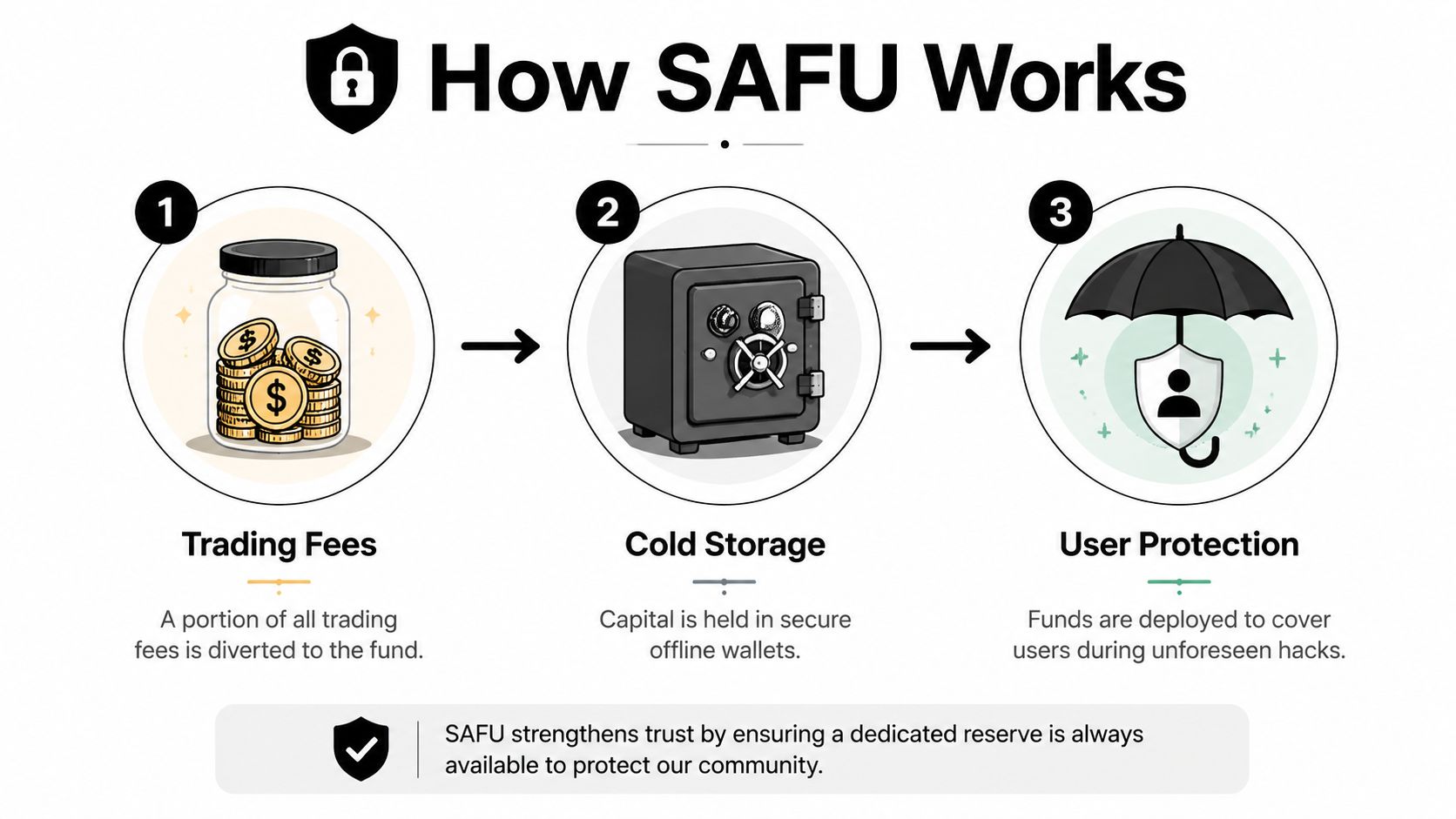
At a practical level, the flow looks like this:
The exchange routes part of fee revenue into a reserve
SAFU wasn't funded by an external insurer. It was built internally through fee allocation.
The reserve sits in segregated storage
The cited description highlights public, multi-signature cold wallets. That's important because it separates the reserve from ordinary hot wallet operations and lets users inspect wallet balances on-chain.
The reserve is intended for exchange-side security incidents
This is the key scope point. The reserve exists to cover losses from platform-level breaches or failures on the exchange side. It isn't a universal backstop for every account problem.
A dedicated reserve is better than vague promises.
The strengths are straightforward:
For custody due diligence, it also helps to review reserve transparency alongside broader exchange solvency signals. This breakdown of Binance proof of reserve is useful as a companion framework.
Most users hear "insurance fund" and picture a guaranteed personal claims mechanism. That's usually the wrong mental model.
An exchange reserve is closer to a discretionary emergency buffer managed by the platform itself. Coverage scope depends on the incident. Timing depends on the operator. Documentation quality depends on what the operator publishes.
If the exchange controls the reserve, the claims standard, and the communication process, you're relying on governance as much as on capital.
That doesn't make the fund useless. It means the fund should sit low in your trust stack. Use it as one layer of exchange risk mitigation, not as the reason you leave more capital on-platform than your strategy requires.
The biggest problem with exchange SAFU branding is that it sounds broader than it is.
A reserve fund may help after certain exchange-side failures. It doesn't turn custodial risk into non-custodial safety. It doesn't guarantee your personal reimbursement path. And it can introduce its own concentration risks depending on how the reserve is structured.
One of the least discussed issues is the most basic one. If your funds are affected, how do you make a claim?
The public discussion around SAFU often focuses on the reserve itself, not the user workflow after a loss event. Yet CoinMarketCap Academy's glossary entry on Secure Asset Fund for Users points to a real gap: public materials don't clearly explain the claims process, eligibility rules, deadlines, per-user payout limits, or whether compensation is automatic or discretionary. The same source also notes that Binance had to top the fund back up from $735M to $1B in November 2022.
That creates several unanswered questions for traders:
For anyone running size, uncertainty around those mechanics is itself a risk factor.
There's also a newer structural issue. Binance's SAFU fund is being converted to hold 100% Bitcoin, according to CryptoRank's report on Binance shifting SAFU entirely into Bitcoin.
That changes the risk profile in an important way. A reserve made entirely of BTC is no longer a mixed buffer. Its value now rises and falls directly with Bitcoin.
If the market breaks hard during a period of exchange stress, the reserve can lose value at the same time users most want reassurance. The same CryptoRank report notes a commitment to maintain a minimum $800M value, but the practical enforcement and verification questions remain part of the broader trust problem.
The worst time to discover reserve volatility is during the same market event that triggers the need for the reserve.
Here's the cleanest way to think about it.
| Feature | Custodial (Exchange Wallet) | Non-Custodial (Your Own Wallet) |
|---|---|---|
| Key control | Exchange controls access | You control access |
| Withdrawal ability | Depends on platform operations | Depends on your own wallet security and network conditions |
| Recovery after exchange breach | May depend on reserve decisions and internal processes | Not applicable in the same way if assets aren't on the exchange |
| Counterparty risk | High by design | Lower on custody, higher on personal responsibility |
| User error risk | Some mistakes can be mediated by the platform | Your mistakes are usually final |
| Best use case | Active trading, fast execution, temporary capital staging | Storage, treasury management, long-term holdings |
This table doesn't argue that self-custody is easy. It argues that the risks are different. With an exchange, you're outsourcing key control and inheriting counterparty exposure. With self-custody, you remove that counterparty but take full responsibility for operational security.
Even without a published universal exclusion list, traders should assume a reserve fund does not protect them from many common losses:
That is why "funds are safu" can become dangerous shorthand. It blurs the line between exchange assistance and personal responsibility. Good traders keep those lines sharp.
You don't need a slogan. You need operating habits that hold up on bad days.
The checklist below is what reduces risk for active traders who move between exchanges, browser wallets, DeFi protocols, and copy-trading setups.

This is the cleanest custody rule.
Leave on-platform only the capital you need for near-term execution, hedging, or collateral management. Move long-term holdings and inactive balances off exchanges. The point isn't purity. It's reducing the blast radius if a platform freezes withdrawals, changes terms, or suffers an incident.
Many traders still run everything through one hot wallet. That's convenient and fragile.
A better split looks like this:
That structure contains damage. If one wallet gets compromised through a bad approval or malicious site, the rest of your stack doesn't automatically go with it.
The seed phrase is the account.
Most wallet losses don't come from cryptography failing. They come from traders exposing recovery material through screenshots, cloud notes, copied text, fake support chats, or phishing forms. This guide on seed phrase wallet security covers the mindset well.
Write your recovery process before you need recovery. Stress ruins memory and judgment.
DeFi traders tend to focus on entries and ignore residual permissions.
Make a habit of checking token approvals after interacting with unfamiliar contracts. If a contract no longer needs spending rights, remove them. Convenience accumulates risk. Old approvals are one of the most common ways a wallet remains exposed long after a trade is closed.
A large share of wallet compromises come from ordinary browsing behavior.
Practical habits that work:
Most traders don't have one. They improvise after a compromise, and improvisation is expensive.
Your plan should answer:
A written response plan beats confidence every time.
The phrase funds are safu survived because it captures what every trader wants to hear under stress. But hearing it and being protected aren't the same thing.
The meme version is culture. The exchange-fund version is a limited reserve mechanism. Neither one removes the core reality of crypto risk, which is that custody, access, and signing behavior decide most outcomes long before a slogan or reimbursement discussion enters the picture.
A serious trader treats exchange SAFU funds as a secondary control. Useful, but narrow. The primary controls are still the ones you own: positioning only necessary capital on exchanges, segmenting wallets, protecting recovery material, reducing stale approvals, and assuming every urgent message is malicious until verified.
Real safety in crypto isn't passive. It's operational.
If you want your funds to be safu in the only sense that matters, don't ask whether an exchange has a reserve. Ask whether your setup still holds together when the exchange is slow, the market is falling, your browser is noisy, and someone is trying to rush you into a bad signature.
Wallet Finder.ai helps traders turn on-chain behavior into a security and execution advantage. You can use Wallet Finder.ai to study how experienced wallets move size, spot risky behavior before copying it, and track trades with more context instead of reacting to hype after the fact.

A premier DeFi analytics platform empowering traders to discover and analyze profitable blockchain wallets, trades and tokens.