A DeFi Trader's Loss Prevention Strategy Guide

Wallet Finder

Blank calendar icon with grid of squares representing days.

May 17, 2026

Most DeFi traders don't blow up from one bad idea. They blow up from a loose process. A position gets oversized because conviction feels high. A stop gets moved because the chart "still looks fine." A wallet dump hits before the candle confirms. Then the week ends with a stack of avoidable losses that look random on the surface but came from the same root problem. No operating rules.

That's why I treat loss prevention strategy as a trading discipline, not a defensive afterthought. In retail, shrink from theft, fraud, and errors amounts to over $112.1 billion in losses according to SafetyCulture's loss prevention overview. Retailers didn't solve that by telling staff to "be more careful." They built systems, alerts, controls, and review loops. DeFi needs the same mindset if you want to stay solvent long enough to catch the big moves.

Beyond Stop-Losses The Need for a Real Strategy

A stop-loss helps. It doesn't protect you from every way capital leaks out.

In DeFi, losses come from more than price moving against you. You can get trapped in thin liquidity, front-run on exits, chopped by volatility, baited by copy-trading noise, or stuck in a thesis that technically hasn't invalidated but is clearly getting weaker on-chain. A single stop order or mental line on the chart won't handle that.
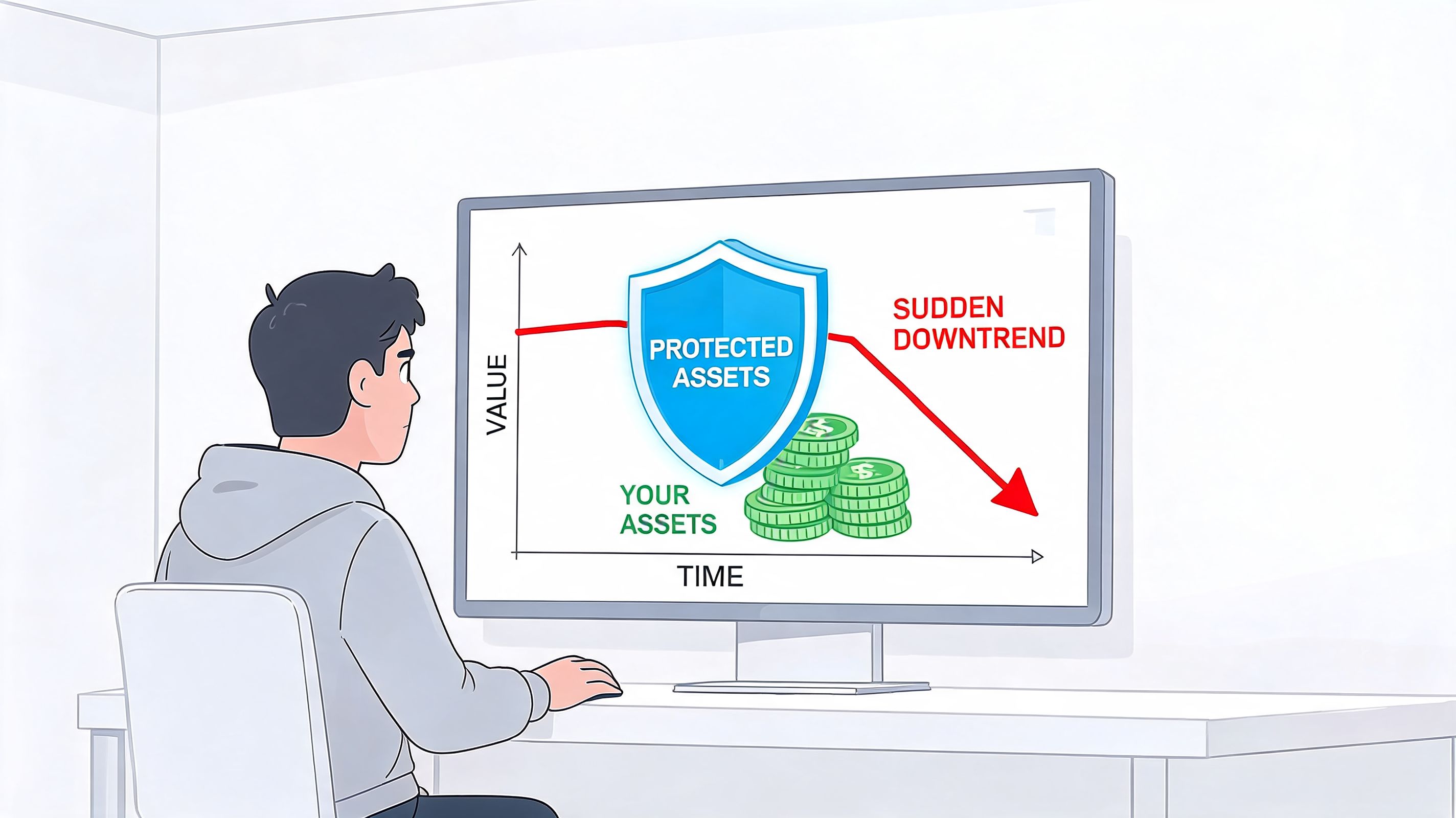
A person looking at a digital chart illustrating asset protection during a sudden market downtrend.

What works is a layered model. Retail loss prevention evolved from guards and cameras into a measured operating system built around inventory accuracy, analytics, surveillance, and review cycles, as described in SafetyCulture's guide to loss prevention. Traders need the equivalent. Not just "where do I stop out?" but also:

  • What am I allowed to risk today: Before emotions, before entries.
  • What type of setup is this: Momentum chase, smart money follow, mean reversion, event trade.
  • What breaks the trade first: Price, time, wallet behavior, liquidity shift, or thesis drift.
  • What requires immediate reduction: Treasury movement, clustered exits, failed reclaim, or unusual flow.
  • What gets reviewed later: Every avoidable mistake and every rule violation.

Practical rule: If your only defense is a stop-loss, you don't have a strategy. You have an emergency brake.

A real loss prevention strategy does something important. It gives you permission to trade aggressively when the setup is clean because your downside is already caged. Without that structure, most traders do the opposite. They hesitate on good entries and then freestyle risk management once the trade is live.

The traders who last don't think like gamblers protecting a bet. They think like operators protecting inventory.

Defining Your Core Risk Framework

Before entry logic, before wallet tracking, before any "alpha," you need a constitution. This is the part of your process you don't negotiate with when the market gets loud.

Retail operators use a closed loop: define baselines, segment losses, deploy controls, train people, and review performance. The trader version is similar. As noted in GoDaddy's loss prevention guide, expert-level programs work by defining baselines, segmenting loss sources, deploying layered controls, training personnel, and reviewing results. For a trader, that means setting risk limits, classifying trade types, writing rules, and reviewing the journal.
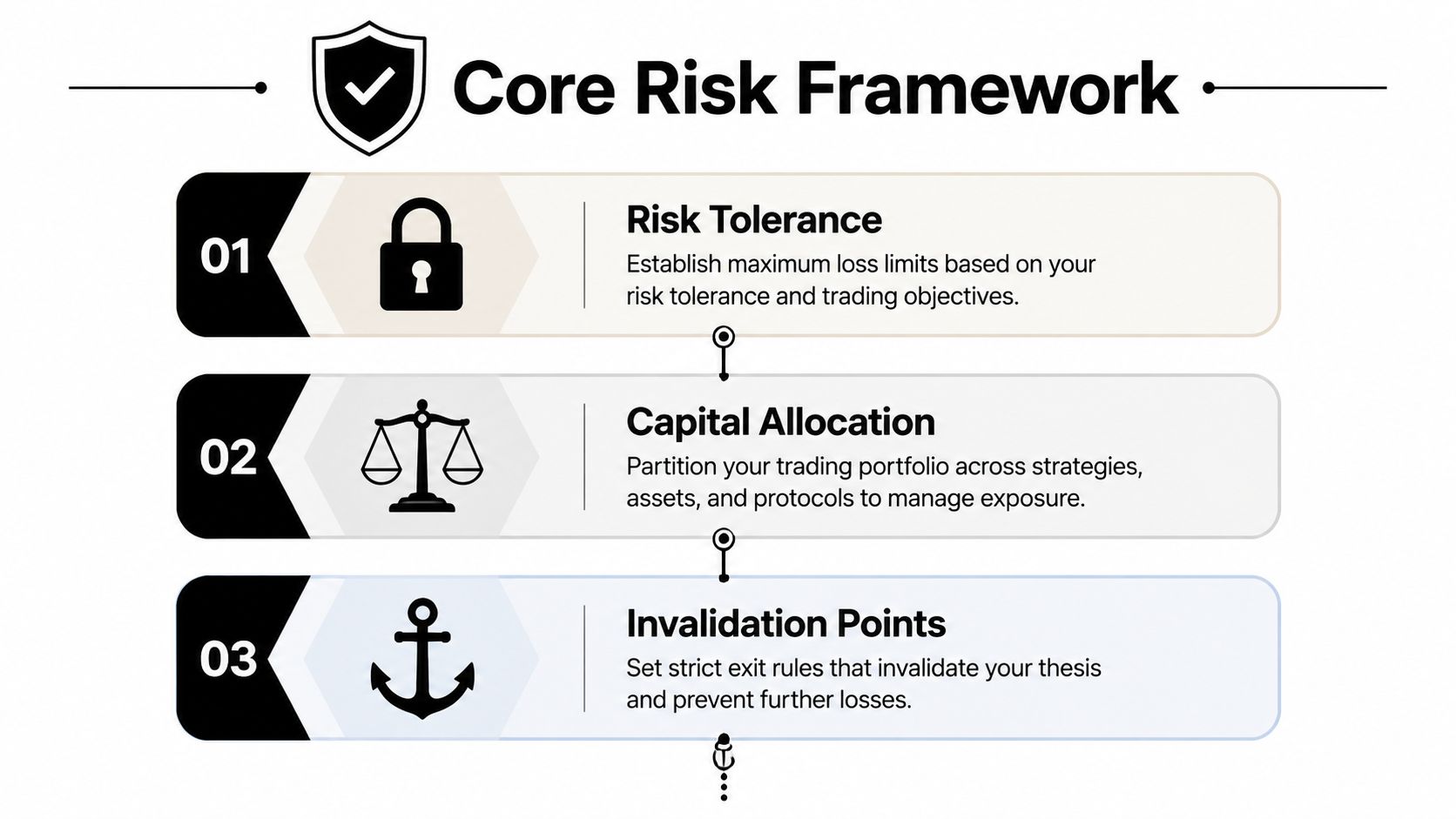
A three-step core risk framework graphic explaining risk tolerance, capital allocation, and trading invalidation points.

Write your non-negotiables first

Most traders start with setups. Start with limits.

Your framework should answer these questions in writing:

Rule areaWhat to defineWhy it matters
Account protectionYour maximum drawdown before you stop trading and reassessPrevents one bad streak from turning into a full account spiral
Trade riskYour max risk per tradeStops conviction from silently turning into overexposure
Portfolio exposureYour max open exposure across all positionsCorrelated trades can behave like one giant bet
Category capsSeparate limits for majors, DeFi blue chips, new launches, and memecoinsNot all risk belongs in the same bucket
Execution rulesWhat invalidates an entry, when you trim, when you fully exitKeeps decisions consistent under stress

If this isn't documented, you'll rewrite your rules in real time. Real-time rule writing is usually just emotional justification.

Segment risk by trade type

A clean mistake I see all the time is treating every token the same. That's how traders use "safe" sizing on assets that trade nothing alike.

Break your book into categories. A liquid large-cap DeFi position can have one set of exposure rules. A fresh launch with unstable liquidity needs another. A memecoin copied from a hot wallet needs tighter leash logic than a swing on an established protocol token.

Use simple buckets like these:

  • Core positions: Slower decisions, wider invalidation, lower churn
  • Tactical swings: Medium holding time, chart plus flow confirmation
  • Event-driven trades: Catalyst-dependent, quick review cycle
  • Speculative clips: Small size, immediate invalidation, no averaging down

If you can't explain why a trade belongs in a category, you probably don't know how it should be managed.

Build controls before you need them

Rules are only useful when they already exist before you're under pressure. I prefer controls that remove discretion at the dangerous moments.

That usually means:

  1. Predefined invalidation points written before entry
  2. Hard sizing caps by trade category
  3. Daily loss limits that shut down new entries
  4. Exposure limits for correlated positions
  5. A review cadence for fixing recurring mistakes

A lot of traders think this makes them slower. It usually makes them cleaner. You stop wasting attention on preventable problems.

Treat review as part of risk, not admin

Most losses don't come from hidden complexity. They come from repeated sloppiness. Late entries. No thesis note. Averaging into weakness. Ignoring a wallet exit because "it's probably just profit taking."

Your framework needs a standing review rhythm. Weekly is for execution mistakes and rule breaks. Monthly is for category performance, recurring invalidations, and whether your rules still fit the market you're trading.

Mastering Position Sizing and Exit Logic

Position sizing is your volume knob. Exit logic is your kill switch. If either one is weak, your loss prevention strategy breaks at trade level.

A lot of traders obsess over entries because entries feel smart. Sizing and exits feel boring. That's backwards. Entries create opportunity. Sizing and exits decide whether you survive your own ideas.

Size from invalidation, not conviction

The cleanest way to size is to start with the point where your trade is wrong, then work backward.

That means:

  • Define the exit first: Chart break, failed reclaim, wallet dump, or liquidity deterioration
  • Measure the distance to that exit: Tight or wide, depending on setup quality and market structure
  • Fit the size to the distance: Wider invalidation means smaller size. Tighter invalidation can support larger size within your account rules

If you want a practical framework for this in volatile markets, this position sizing guide for high-volatility trades is a useful reference for mapping size to the reality of fast-moving setups.

Here's the core idea in plain language:

Trade conditionSizing implication
Wide invalidationSmaller position
Thin liquiditySmaller position
High conviction but weak execution qualitySmaller position
Strong setup plus clear exit levelNormal planned size
Late chase after first moveReduced starter only or no trade

The mistake isn't just oversizing. It's oversizing relative to how messy the exit will be.

Use more than one exit trigger

A fixed stop can work, but DeFi trades often fail before price prints the obvious damage. Good exit logic uses multiple trigger types.

Price invalidation

This is the standard one. The setup breaks a level that mattered when you entered. Exit.

Simple. Necessary. Not enough on its own.

Time invalidation

Some trades aren't wrong because they dump. They're wrong because they go nowhere while better opportunities appear elsewhere.

Use time exits for catalyst trades, breakout attempts, and copy trades that should move quickly if the signal is real.

Flow invalidation

This matters more in on-chain markets than many traders admit. If the wallets or clusters that gave you confidence start unloading, your reason for being in the trade may be gone before the chart fully reflects it.

The best exit is often the one that fires before the crowd agrees with it.

Liquidity invalidation

If liquidity thins out, slippage risk changes the trade. A setup that looked manageable can become unexitable at your intended size. That's not a chart issue. It's a risk issue.

Build an exit stack

Instead of asking "where is my stop," ask "what can remove me from this trade?"

A practical exit stack looks like this:

  • Hard exit: Price hits the invalidation level
  • Soft exit: Key wallet behavior turns against the thesis
  • Time exit: No progress within your expected window
  • Risk reduction: Trim on failed momentum continuation
  • Full close: Multiple warning signs line up

This keeps you from turning every trade into an all-or-nothing drama. Some positions deserve a reduction before they deserve a full kill.

Using On-Chain Data for Proactive Defense

Reactive defense waits for the chart. Proactive defense watches behavior.

That's the major upgrade. Retail loss prevention increasingly relies on data-driven exception management instead of endless manual review. IntelliShop's loss prevention article describes how transaction-pattern analysis helps teams focus on suspicious irregularities instead of broad surveillance. In DeFi, the equivalent is monitoring wallet flows and transaction clusters so you can react to irregular behavior before price fully reprices the risk.

Screenshot from https://www.walletfinder.ai/

What counts as an exception signal

Most on-chain data is noise unless you define what matters in advance. You're not trying to watch every wallet. You're trying to catch behavior that changes the risk profile of an open trade or invalidates a planned entry.

Good exception signals include:

  • Tracked wallet exits: A wallet you use as a reference sells or starts scaling out
  • Clustered selling: Multiple related wallets reduce exposure around the same window
  • Treasury movement: Project-linked funds move in a way that changes confidence
  • Abnormal transaction behavior: Returns, repeated sells, fragmented unloading, or unusual routing
  • Rotation out of sector: Smart money leaves one narrative and reallocates elsewhere

For this workflow, check on-chain activity with this guide if you want a practical starting point for turning wallet behavior into actionable review triggers.

Why this beats chart-only defense

The chart shows consequence. Flow often shows intent first.

If a top wallet exits and you're still waiting for a candle close to "confirm weakness," you're behind. Not always. But often enough that it matters. On-chain defense doesn't replace price. It gives price context.

That changes how you respond:

Signal typeTypical reaction
Single tracked wallet trimReview, not immediate panic
Multiple high-conviction wallets exitingReduce or close, depending on setup
Treasury or team-linked movementReassess thesis fast
No wallet support after entryTighten leash
New accumulation by watched walletsHold if other conditions remain intact

One tool used for this is Wallet Finder.ai, which tracks wallet activity across major ecosystems, surfaces trading histories and PnL patterns, and supports alerts when watched wallets buy or sell. That's useful when your loss prevention strategy depends on acting on behavior, not waiting for post-move confirmation.

Here's a walkthrough that helps visualize the workflow in practice:

Don't become a slave to every wallet ping

At this juncture, traders mess it up. They go from blind to hyper-reactive.

You don't need to copy every move from every profitable wallet. A useful signal should pass through your own system first:

  1. Does this wallet matter to this trade thesis
  2. Was the move large enough to be meaningful
  3. Is it isolated or clustered
  4. Does price and liquidity support the same warning
  5. What action does my rulebook require

Watch wallets for information, not permission.

That distinction keeps on-chain monitoring from turning into panic-driven micro-management.

Example Rule Sets Using Wallet Finder Signals

You catch a wallet buy, ape a full position, and feel smart for ten minutes. Then liquidity thins, the wallet trims into strength, price loses the level, and a manageable loss turns into dead capital because you treated a signal like a green light instead of a risk event.

That is the job of this section. Build defensive rules around wallet signals so they prevent bigger losses instead of pulling you into bad entries.

The broader shift toward analytics-backed prevention is already visible outside crypto too. The global in-store analytics segment for loss prevention and security generated USD 664.9 million in 2022 and is projected to reach USD 1,890.3 million by 2030, with a 12.3% CAGR from 2023 to 2030, according to Grand View Research's in-store analytics forecast. The takeaway for DeFi is simple. Fast operators use data to catch risk early.

Here is how that looks in practice.

Scenario 1: One good wallet buys, but your job is to control downside

A tracked wallet with a strong record enters a liquid token. Price has moved, but it has not gone vertical. Liquidity is still there. At this point, traders usually overpay for confirmation.

My rule is defensive from the start:

  • Entry: Starter only
  • Size cap: No more than a small allocation until a second confirmation appears
  • Invalidation: Exit if the wallet exits fast, price fails to hold the breakout, or liquidity drops
  • Time stop: If the trade does nothing after the expected reaction window, cut it

The point is not to predict perfectly. The point is to keep a single wallet ping from becoming a full-size mistake.

Scenario 2: Several watched wallets accumulate in the same zone

Clustered buying is stronger than one isolated transaction, but it still does not justify loose risk. Better signal quality should tighten your process before it increases your exposure.

Check three things before adding size. Are the buys spread across real size, not dust? Are they close enough in time to suggest shared conviction? Can the token absorb your exit if the setup breaks?

If the answer is yes, I move from starter size to a planned swing size. If one wallet buys and another starts distributing into the same range, I pass. Mixed flow is where traders invent conviction and then pay for it.

If you want a cleaner workflow for building and monitoring wallet cohorts, this guide to tracking smart money wallets is useful on the watchlist side.

Scenario 3: The wallet signal weakens after you are already in

Loss prevention happens here.

A wallet trim on its own is noise. A wallet trim plus fading bids, weaker volume response, and no follow-through is a downgrade. Wallet Finder.ai matters here because the value is not just spotting buys. It helps catch changes in behavior while there is still room to act.

Use a downgrade ladder:

  1. One warning: Tighten stop or reduce planned adds
  2. Two warnings: Cut part of the position
  3. Three warnings: Exit the rest
  4. After exit: Log which trigger failed first, flow, price, liquidity, or time

That keeps small damage small.

Summary framework

These are defensive rules, not copy-trading instructions.

Wallet Finder.ai SignalDefensive ActionExposure RuleExit Trigger
Smart money buy in a liquid tokenStart small only if price is not overextendedSmall starterExit on wallet reversal, failed continuation, or weaker liquidity
High win-rate trader entry in a new tokenTreat as a probe, not a conviction tradeSmall onlyExit fast on weak follow-through or quick wallet exit
Multiple watched wallets accumulatingScale only after confirming the cluster is realMedium at most, inside portfolio limitsReduce on first exit cluster, close on broader reversal
Tracked wallet re-entry after prior winWait for proof it is not a scalpSmall starterExit if momentum stalls or wallet flips
Treasury-linked or team-linked movement against thesisStop adding and review immediatelyZero new exposure, reduce if neededExit aggressively if thesis changes

Good wallet signals improve timing. Good loss prevention rules keep timing errors cheap.

Making Your Strategy a Living Process

You log into your dashboard on Sunday, check the week, and realize the biggest hit was avoidable. The entry was fine. The loss came from ignoring a wallet exit, adding after liquidity thinned, or holding past the time stop you wrote down and then ignored.

That is why a strategy has to stay active.

In retail loss prevention, analysts at Motorola Solutions' retail loss prevention perspective describe the tension between better visibility and overreach as monitoring tools get more advanced. DeFi has the same problem in trader form. You need enough on-chain visibility to catch behavior changes early, but your process also needs filters so every wallet shuffle does not shake you out of a valid position.

Journal the trigger chain, not just PnL

A journal that only tracks entry, exit, and PnL will miss the part that matters. In DeFi, the useful record is the trigger chain.

Log each trade with the exact wallet addresses, alert source, and signal sequence that got you in and out. If Wallet Finder.ai flagged a smart-money cluster, record the wallet tags, timestamp, chain, token contract, liquidity at entry, and whether the first warning was wallet selling, failed continuation, spread deterioration, or pool depth fading.

Use tags like:

  • Setup category: Core, swing, event, speculative
  • Thesis source: Price structure, wallet cluster, catalyst, sector rotation, or mixed
  • Tracked wallets: Specific addresses or saved wallet groups that triggered attention
  • Entry condition: Breakout held, pullback held, wallet accumulation continued, liquidity stayed healthy
  • Exit condition: Wallet reversal, price invalidation, time stop, liquidity breakdown, or rule violation
  • Execution grade: Followed fully, entered late, sized too large, ignored first warning, or discretionary override
  • Failure point: What broke first on-chain

This shows whether the loss came from a weak setup, bad execution, or poor signal quality. Each one needs a different fix.

Use two review loops

Run one short loop and one slower loop. They serve different jobs.

Review cadenceWhat to check
WeeklyRule violations, late reactions to wallet exits, bad adds into thin liquidity, missed time stops, overtrading, alert noise
MonthlyWhich wallet cohorts still lead, which signals have degraded, setup win rate by category, whether exposure caps still fit current volatility and liquidity conditions

Weekly review catches slippage in discipline while the mistake is still fresh. Monthly review updates the playbook without rewriting it every time the market throws a fake signal.

A stale strategy is as dangerous as one that changes daily and turns into noise.

Keep the checklist short enough to use under stress

Good process design matters less than repeatable execution. If your review routine takes an hour after every trade, you will stop doing it the first time the market gets fast.

A working checklist looks like this:

  • Before the week starts: Review open exposure, category caps, and the wallet groups that still deserve alerts
  • After each trade: Log the contract, entry reason, invalidation, exit trigger, tracked wallet tags, and whether you followed the plan
  • End of week: Pull every avoidable loss and mark the first broken rule
  • End of month: Remove weak signals, tighten rules that held up, and archive wallet lists that no longer matter

That last step is where DeFi traders usually improve or stall. Wallet behavior changes. Meta changes. Liquidity moves. The strategy has to adapt through scheduled review, not impulse edits made after one bad trade.

If you're building a rules-based on-chain workflow, Wallet Finder.ai can fit into that process by helping you track profitable wallets, monitor trades and token activity across major ecosystems, and set alerts that feed into your existing entry and exit rules. Use it as an input inside a disciplined system, not as a substitute for one.