Recovery Factor Calculation for Smart Traders
Master the recovery factor calculation to measure a strategy's resilience. Learn the formula, see DeFi examples, and find top wallets with Wallet Finder.ai.

June 20, 2026


Wallet Finder
May 18, 2026

A humpback circles below a bait ball, releases a rising wall of bubbles, and then surges straight through the opening it created. Traders see a version of that pattern on-chain all the time. They just usually notice it after the move.

In the ocean, bubble netting whales don't chase every fish one by one. They shape the environment first. They confine prey, control direction, reduce escape routes, and only then make the decisive feeding move. That sequence matters more than the final lunge.
On-chain, strong wallets often behave the same way. They rarely announce intent with one obvious buy. They build conditions. A few wallets accumulate discretely. Liquidity gets framed. Attention starts to rise. Then the visible move arrives, and late traders mistake the climax for the beginning.
That mistake is expensive.
Most retail traders still trade the surface. They watch candles, trending posts, and volume spikes. But coordinated activity usually leaves traces before price fully reacts. When you study the market like a field observer studies whale behavior, you stop asking, "Why did this pump?" and start asking, "What contained liquidity before the pump?"
The whale analogy works because it isn't just poetic. It's operational.
Practical rule: Don't anchor on the final candle. Track the structure that made the candle possible.
A lot of traders want a single wallet to follow. In practice, the better edge often comes from identifying a pattern of coordination. One wallet can be noise. A group of wallets funding, buying, rotating, and sizing in similar ways starts to look like intent.
That's where the nature model helps. Whale behavior looks chaotic from the surface. Underwater, it's structured. Crypto feels the same until you start reading wallet relationships instead of isolated transactions.
Bubble-net feeding is one of the clearest examples of a learned hunting system in the wild. Research reported by the University of St Andrews in January 2026 found that the recovery of humpback whales in the northeastern Pacific depended not only on population growth, but also on the spread of this culturally learned feeding behavior through social networks, with immigrant whales helping introduce the technique into the recovering Canadian Pacific population, according to the University of St Andrews report on bubble-net knowledge spread.
That point is easy to miss. This isn't just an animal doing a clever trick. It's a socially transmitted method with population-level consequences. In plain terms, the whales that know the technique don't just eat differently. They change what the whole group can do over time.
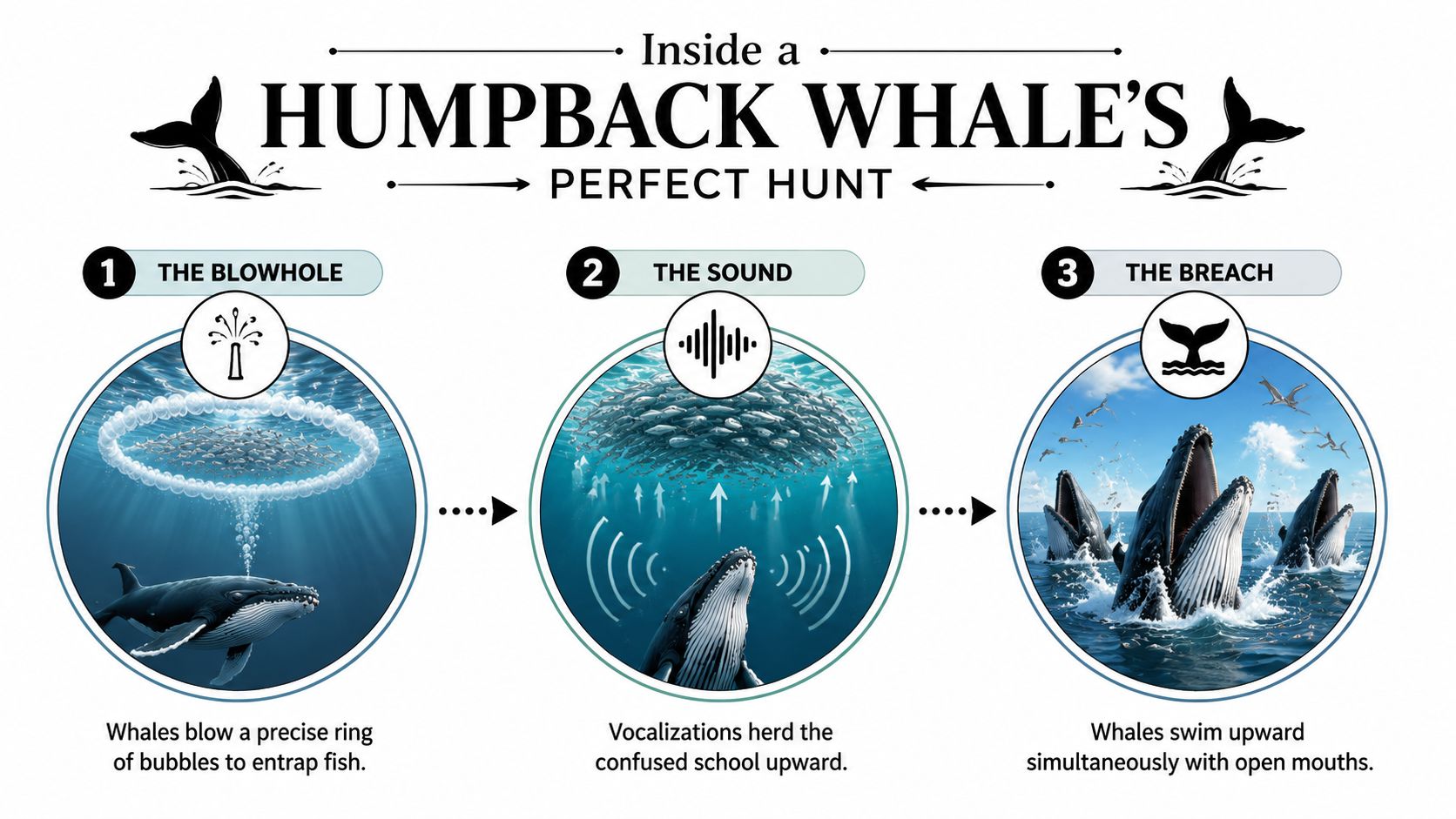
A bubble-net feed isn't random froth on the water. The sequence is deliberate.
Positioning below prey
The whale, or group, gets under a school of fish and starts setting the geometry of the trap.
Bubble release and containment
Bubbles rise in a structured ring or spiral. Recent underwater imaging showed solitary humpbacks creating structured bubble-nets with internally tangential rings and tuning the number of rings, net depth, and bubble spacing to shape prey capture geometry, as described in the PMC study on solitary humpback bubble-net structure.
The upward lunge
Once the prey is compacted and disoriented, the whale drives upward through the concentrated patch with its mouth open.
The public version of this behavior is dramatic. The useful version is mechanical. The whales don't win because they move harder. They win because they shape the target first.
Not every baleen whale can execute this maneuver. A University of Hawaiʻi study reported in 2025 found that among seven baleen whale species, only the humpback whale was capable of the high-performance turns required for bubble-net feeding, with humpbacks using their large pectoral flippers to generate nearly half of the force needed to turn, according to the University of Hawaiʻi report on humpback turning performance.
That specialization matters for traders because it maps cleanly to market structure. A strategy can look simple after the fact, but the edge often depends on capabilities most participants don't have. In whales, that's maneuverability. In crypto, it's visibility into coordinated wallet behavior before the crowd notices.
A related field summary notes that humpbacks were observed making tight, high-speed turns with outer and inner bubble rings averaging about 15.7 m and 9.9 m, with the tightest turn at 6.5 m, and older dive work identified an approximate 20 m depth limit for effective bubble-net use, based on the Whale Scientists summary of bubble-net biomechanics. Good setups have physical constraints. Market setups do too.
The hunt works because it increases density at the point of attack. That's the whole game.
If you want more context on how whales are categorized and why humpbacks stand out physically, this overview of the largest whales in order is a useful companion read.
Here's footage worth watching before applying the metaphor to markets.
The real lesson isn't that whales are powerful. It's that they create favorable conditions before they strike.

The cleanest way to use the bubble-netting whales model in crypto is to stop thinking in terms of single transactions and start thinking in staged containment.
Large market participants don't always need blatant manipulation. They need sequence. They need enough coordinated behavior to gather liquidity, shape attention, and create a narrow path for everyone else to follow. When traders say a chart "came out of nowhere," that usually means they weren't watching wallet behavior closely enough.
Here's the practical translation.
| Whale hunt element | Crypto equivalent | What it looks like in practice |
|---|---|---|
| Pod coordination | Related wallets or aligned buyers | Several wallets enter the same asset in a compressed window |
| Bubble ring | Containment of liquidity and narrative | Repeated buys, support behavior, or persistent presence without a full breakout |
| Trapped prey | Reactive participants | Retail enters after visible momentum or social amplification |
| Upward lunge | Repricing event | Sharp move up, liquidity sweep, or distribution into demand |
The key detail is that the trap forms before the headline candle. That's why chart-only traders arrive late. They wait for confirmation that already includes the easy part of the move.
There are two common mistakes when traders borrow the whale metaphor.
Mistaking size for coordination
One large buy can be treasury movement, rotation, or noise. Coordination is a pattern, not a wallet balance.
Confusing hype with structure
Social buzz without wallet alignment is often just churn. The better setups show behavior on-chain first, then narrative catches up.
Buying the lunge instead of the setup
The final expansion can still work, but risk gets worse fast. Entries are cleaner when accumulation is visible and price still looks boring.
What tends to work better is a layered read:
This framework gives traders a way to think probabilistically. You're not trying to prove collusion. You're trying to identify whether a token is being prepared.
That distinction matters. A market can move for many reasons. But when you repeatedly see smart wallets arrive before broad participation, you don't need perfect certainty. You need a better process than chasing green candles.
If the only thing you can see is price, you're trading the splash, not the hunt.
The bubble-net model is valuable because it turns a vague intuition into an observable sequence. First containment. Then attention. Then expansion. Then, often, exit pressure.
Most traders notice whale activity only when a token is already moving. That's too late for clean risk. The better entries usually come when the on-chain footprint is visible but the crowd hasn't fully reacted.
The strongest data point in this article sits here. An on-chain analysis from 2025 found that coordinated token accumulations by wallets acting in a "bubble-net" pattern preceded price pumps of over 300% in 68% of observed cases for mid-cap tokens, according to the Wallet Finder.ai blog analysis of bubble-net wallet patterns. That doesn't mean every cluster is tradable. It means the pattern deserves a formal checklist.
You don't need to prove that wallets belong to the same person. You need to determine whether their behavior is sufficiently aligned to justify attention.
| Signal Pattern | What It Suggests | Potential Trader Action |
|---|---|---|
| Several wallets buy the same token in a tight window | Interest isn't isolated | Start a watchlist and delay entry until you inspect wallet quality |
| Wallets are funded in a related way before buying | Possible coordination or shared upstream source | Check funding paths and prior overlap before taking size |
| Accumulation continues while price stays relatively contained | Position building may be underway | Consider scaling in before broad visibility arrives |
| Repeated small buys appear instead of one obvious large entry | Buyers may be avoiding attention or slippage | Track continuation rather than waiting for a dramatic print |
| Social attention rises after on-chain accumulation starts | Narrative may be catching up to wallet action | Use social momentum as confirmation, not as the primary trigger |
| The same wallet cluster appears across earlier winners | Process may be repeatable | Review prior trades from the cluster and build a model of timing |
| Fast inflows are followed by thinning liquidity and vertical price action | The lunge phase may be starting | Tighten risk, avoid oversized late entries, and plan exits in advance |
A signal is stronger when it has stacking evidence. One of the biggest improvements traders can make is requiring more than one kind of confirmation.
Look for combinations like these:
Behavior plus timing
Multiple wallets enter early, not after the candle has already expanded.
Funding plus repetition
Wallets don't just buy once. They show similar setup behavior across more than one token.
Accumulation plus restraint
Price hasn't gone vertical yet, which gives you room to structure a trade instead of reacting emotionally.
If you only track one variable, you'll overtrade noise. If you wait for every variable, you'll miss most moves. The balance is simple. Demand enough evidence to avoid random chasing, but not so much evidence that you're always entering after the crowd.
Use this before taking a trade built on whale clustering.
Check wallet quality first
A cluster of weak wallets is still weak. Look for consistency in prior behavior, not just token overlap.
Study sequence, not snapshots
The order of events matters. Funding, buys, follow-on accumulation, then attention is more meaningful than random activity in reverse.
Respect price condition
If price has already gone parabolic, the setup has changed. You're no longer trading formation. You're trading momentum.
Define invalidation early
If cluster buying stops or reverses quickly, step back. Don't hold onto the metaphor after the evidence fades.
For a basic workflow on reading wallet and token flows, this guide on how to check on-chain activity is a good starting point.
Field note: The best bubble-net setups often look slightly boring at first. That's why they remain available.

A metaphor only matters if it changes execution. In practice, tracking bubble netting whales on-chain means building a repeatable workflow for cluster detection, wallet qualification, and alerting.
One option is Wallet Finder.ai, which tracks wallet activity across major chains, shows trading histories, and supports watchlists plus Telegram and push alerts. Used properly, it helps turn "that token moved fast" into "these wallets were building before the move."
Start with token discovery, not wallet obsession. Most traders reverse that and waste time staring at famous addresses that may not be active in the category they want.
Scan for unusual inflows into a token
Begin with assets attracting fresh smart-money style activity rather than trending coins that already exploded. You're looking for early clustering behavior.
Open the buyer list and filter for wallet quality
Remove tourists. Keep the wallets with stronger historical execution patterns, cleaner timing, and consistent activity.
Inspect wallet histories manually Manual inspection earns you the edge. Check whether the same wallets entered similar tokens before. See whether they rotate together or only coincidentally overlap once.
A cluster is actionable only when the wallets pass basic quality control.
Funding relationships
If several wallets are funded in a related sequence, pay attention. It doesn't prove a single operator, but it strengthens the coordination thesis.
Trade style consistency
Some wallets scalp. Others build and distribute over longer windows. If you're swing trading a token using scalper wallets as your lead signal, you'll get chopped up.
Position sizing behavior
Compare whether wallets are probing or committing. A light test buy isn't the same as deliberate accumulation.
At this stage, advanced filtering becomes practical rather than cosmetic. If you want a closer look at how filtering improves whale research, review these advanced filters for whale wallet tracking.
Once you've identified a credible cluster, don't keep redoing the same work from scratch. Operationalize it.
Create a custom watchlist
Group the wallets that appear related by behavior, not just by size.
Set alerts for fresh buys and sells
Real-time notice matters because the useful part of the move often happens before social channels catch up.
Track the next token, not only the current one
A strong wallet cluster can become more valuable as an ongoing source of ideas than as a one-off trade.
Review exits as hard as entries
Traders love studying accumulation and ignore distribution. The same cluster that gave you the signal can also tell you when conditions changed.
A lot of traders sabotage this process in predictable ways.
First, they follow too many wallets. That creates noise and weakens attention. Second, they mirror without context. Even a good wallet can make a trade that doesn't fit your timeframe or liquidity tolerance. Third, they ignore cluster decay. If the coordinated behavior stops, the bubble-net thesis weakens quickly.
A better routine is narrower. Pick a chain, a token category, and a wallet style you understand. Build a short list. Monitor repeatedly. Refine after every missed move and every bad entry.
Good tracking isn't about seeing every whale. It's about seeing the right group early enough to matter.
The point of studying bubble netting whales isn't novelty. It's pattern recognition.
Humpbacks don't rely on chaos. They rely on structure, timing, and coordination. Strong on-chain operators often do the same. They don't always enter with one giant print that everyone can see. They shape the trade first, then force attention, then use the reaction.
That shift in perspective changes how you trade. You stop treating every pump as a mystery and start reading the setup conditions behind it. You stop asking whether a candle looks strong and start asking whether a cluster of wallets created the conditions for that candle. That's a much better question.
The practical edge is simple:
If you do that consistently, you move out of the prey mindset. You're no longer reacting to the lunge. You're trying to identify the ring while it's still forming.
That won't remove risk. Nothing does. But it gives you a framework that's closer to how coordinated markets behave, and that's where better entries usually come from.
If you want to apply this workflow with less manual digging, Wallet Finder.ai can help you monitor wallet clusters, review trading histories, build watchlists, and get alerts when tracked wallets move. Used with discipline, it's a practical way to spot bubble-net style accumulation before the herd fully arrives.

A premier DeFi analytics platform empowering traders to discover and analyze profitable blockchain wallets, trades and tokens.