A Guide to Raydium Liquidity Pool Profits
Unlock the secrets of the Raydium liquidity pool. This guide explains how to analyze pools, manage risk, and use on-chain data to mirror smart money strategies.

January 2, 2026
Wallet Finder

January 2, 2026

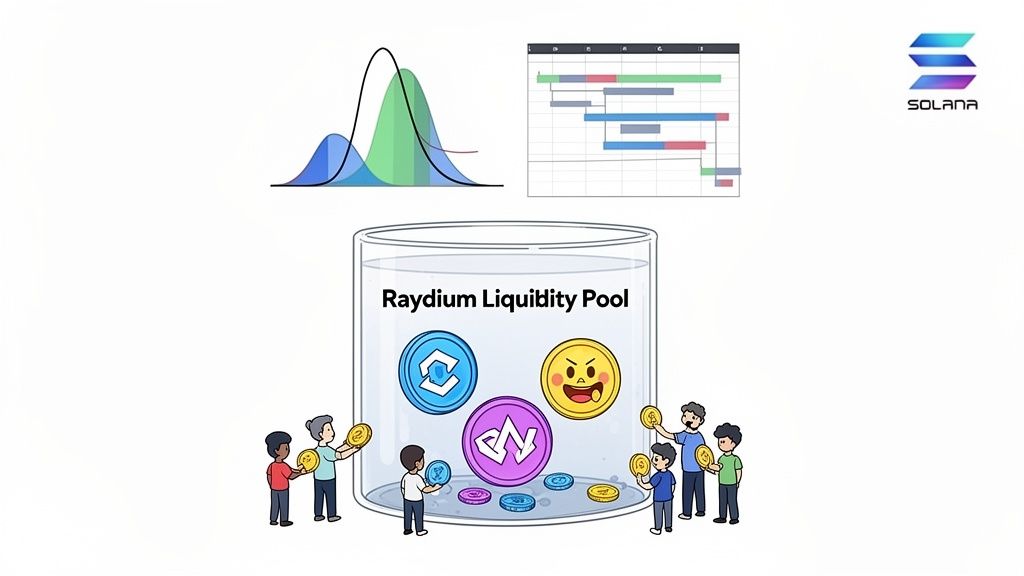
Think of a Raydium liquidity pool as a big, decentralized pot of cryptocurrency on the Solana blockchain. Instead of a bank, these pools let anyone swap tokens instantly. You can add your own crypto to the pot and earn a slice of the trading fees, making you part of the exchange itself.

At its heart, a Raydium liquidity pool is like a community-run currency exchange. Picture a kiosk that needs both US Dollars (USDC) and Euros (SOL) to serve travelers. To get it started, you can deposit an equal value of both currencies.
Every time someone swaps their dollars for euros, they pay a tiny fee. A piece of that fee goes straight into your pocket as a thank-you for providing the cash. That’s the core idea behind providing liquidity in decentralized finance (DeFi). If you want to go deeper, we've covered the basics in our detailed guide on crypto liquidity pools.
Raydium's pools run on an Automated Market Maker (AMM). This is a smart contract that uses a math formula to set token prices based on the assets in the pool. If someone buys a lot of SOL with USDC, the amount of SOL in the pool drops, and the AMM automatically nudges the price of SOL higher.
This setup ensures there’s always a market ready for traders, eliminating the need to wait for another person to match an order.
So, what makes Raydium special? It’s how it connects to the Serum decentralized exchange (DEX). Most AMMs are isolated, but Raydium's pools also feed liquidity directly into Serum's central limit order book—the same system pros use on major trading platforms.
This hybrid approach creates much deeper liquidity. That means you can execute bigger trades with less price impact, or slippage. It gives both casual swappers and serious traders a much better deal.
This powerful design is a big reason why Raydium has become a cornerstone of the Solana ecosystem. It’s no surprise that its liquidity pools have handled a jaw-dropping $577.373 billion in cumulative DEX volume, drawing in traders looking to copy the moves of top-performing wallets. You can dig into all the numbers on Raydium's DeFiLlama page.
This table sums up the key players in a Raydium pool and what they mean for you as a user or provider.
Each of these elements works together to create a fluid and efficient trading environment, combining the ease of an AMM with the power of a traditional order book.

Putting your assets into a Raydium liquidity pool is just the first step. The real magic begins when that capital starts working for you, generating returns through a powerful, two-pronged approach. Getting a handle on these income streams is crucial to unlocking your position's full potential.
The most straightforward way you earn is from trading fees. Every single time a trader swaps tokens using the pool, the protocol takes a small fee. This fee is then split up and distributed to all the liquidity providers based on their share of the pool.
Think of yourself as a silent partner in a currency exchange. You’ve fronted some of the cash, and for every transaction that goes through, you get a tiny slice of the commission. When thousands of these trades happen every day, those little cuts can add up to a serious passive income stream.
Trading fees provide a steady base return, but the second method—yield farming—is where you'll often find the highest Annual Percentage Yields (APYs). This is Raydium's way of saying "thanks" for strengthening its ecosystem.
To encourage deep liquidity in certain pools, Raydium offers extra rewards, usually paid out in its native RAY token. To participate, you must "stake" the LP tokens you received when you first deposited your assets. This involves locking your proof-of-ownership tokens in a separate smart contract, signaling a long-term commitment.
Once staked, you start earning RAY tokens on top of the trading fees you're already collecting, creating a powerful dual-income engine.
This layered reward system turns a simple deposit into a dynamic, yield-generating machine. You're not just earning from market activity; you're also being rewarded for directly contributing to the platform's stability and growth.
This powerful combination is exactly what makes Raydium liquidity pools a cornerstone of Solana's high-speed DeFi world. With thousands of pools to choose from, the platform is a magnet for savvy traders using tools like Wallet Finder to spot the next big opportunity. You can learn more about how to monitor Raydium liquidity pools to stay ahead of the game.
Your total return from a Raydium pool is a blend of two sources. Here’s a quick breakdown:
The combined APY is what makes participating in a Raydium liquidity pool so compelling. A pool might offer a modest 5% APR from fees but add an extra 40% APR from RAY rewards. This structure lets you build a strategy that balances steady income from fees with the high-growth potential of token rewards.

Jumping into a Raydium liquidity pool without checking its vital signs is like buying a car without looking under the hood. To tell the winners from the duds, you need to get comfortable with a few core metrics. These numbers tell a story about a pool's health, its popularity, and its potential to make you money.
The first number to look at is Total Value Locked (TVL). This is the total dollar value of all tokens deposited in the pool. Think of it as a gauge of the pool's size and community trust. A high TVL usually points to better stability and deeper liquidity.
Next up is the 24-Hour Volume. This metric shows you exactly how much trading action the pool has seen in the last day. Higher volume is almost always a good thing, as volume is what generates the trading fees that land in your pocket.
A pool with a huge TVL but tiny volume is like a massive, empty department store—it looks impressive, but it’s not making any money. You can find more data on how pros are tackling this and discover insights on Raydium LP analytics.
While volume is great, what you really care about is your actual return. The Fee APR (Annual Percentage Rate) shows the yield generated only from trading fees, separate from any bonus RAY rewards.
But the real magic happens when you combine these ideas. The single most powerful metric is the Volume-to-TVL ratio. This is the ultimate indicator of capital efficiency. It answers one simple question: "For every dollar locked in this pool, how much trading volume is it generating each day?"
A high Volume-to-TVL ratio means the money in that pool is working hard, cranking out fees relative to its size. A low ratio signals inefficiency—too much capital sitting idle. This metric is your secret weapon for finding pools that punch well above their weight.
To help you size up a pool at a glance, this table breaks down what high and low values for each metric usually mean. Use it as your quick reference guide when you're hunting for your next opportunity in a Raydium liquidity pool.
By keeping an eye on these four metrics, you'll be able to quickly assess whether a pool is a healthy, profitable environment for your capital.
The high yields in a Raydium liquidity pool don't come without risk. Getting a handle on the dangers involved is the most important step to protect your capital. Successfully navigating these risks is what separates the pros from those who lose their entire stack. Let's break down the three biggest threats.
The most infamous risk for any liquidity provider is Impermanent Loss (IL). This occurs when the prices of the tokens you've pooled diverge, leaving you with less value than if you’d just held the assets in your wallet.
Imagine you deposit an equal value of SOL and USDC. If SOL's price moons, the AMM sells some of your SOL for USDC to maintain the 50/50 balance. When you withdraw, you'll have more USDC but less SOL than you started with, missing out on the full upside of that SOL pump.
Impermanent loss is the opportunity cost of being a liquidity provider. Your position's dollar value might go up, but you could have made even more just by holding. The "loss" isn't real until you withdraw your liquidity.
A smart approach is to model different scenarios using a dedicated impermanent loss calculator. It helps you see how a price swing could affect your investment before you commit.
Every Raydium liquidity pool runs on smart contracts. While a battle-tested protocol like Raydium undergoes extensive audits, the risk of bugs or exploits is never zero. For instance, a bug was once found in Raydium's cp-swap program that could have let an attacker drain pools. The team patched it fast, but it’s a stark reminder of the tech risk you’re taking on.
The last major risk is the rug pull, a scam common in pools for new, hyped-up tokens. A developer launches a new token, pairs it with a trusted asset like SOL, and pumps the price. Once enough investors swap their SOL for the new token, the developer pulls all the real liquidity (the SOL) out of the pool and disappears, crashing the token price to zero.
Here is an actionable checklist to avoid getting rugged:
Because the blockchain is public, every winning trade is recorded forever—if you know where to look. By using a powerful tool like Wallet Finder.ai, you can turn this firehose of raw data into your personal playbook.
First, you need to find the wallets that consistently win. Smart money isn't defined by one lucky trade; it's a clear pattern of profitable decisions over time. A dedicated platform is essential here. Wallet Finder.ai lets you cut through the noise of millions of Solana wallets to pinpoint the ones with proven track records.
Here's an actionable filter setup to find elite traders:
This filtering process creates a curated watchlist of elite traders whose strategies you can analyze.
The infographic below shows the common risks that smart money traders have to navigate. Understanding these threats is part of building a winning strategy.

This visual breaks down the critical threats—impermanent loss, smart contract bugs, and rug pulls—that every LP has to manage.
Once you have your list of target wallets, the real work begins. The goal is to dissect their activity inside a Raydium liquidity pool to figure out why they're making certain moves. You're not just blindly copying trades; you're learning from their actions.
A smart money tracker gives you a direct, live window into their operations. You can learn more about these techniques in our complete guide on how to use a smart money tracker to find alpha. The key is to look for specific patterns and signals that reveal their game plan.
By observing a top wallet's complete trading history—including entry points, exit timing, and position sizing—you can reverse-engineer their strategy and apply their insights to your own decisions.
What should you look for? Watch for wallets that consistently enter new memecoin pools within hours of launch. This suggests they have a system for spotting promising projects early. Conversely, you might find top wallets that stick to blue-chip pairs like SOL-USDC, grinding out steady yield.
The crypto market moves too fast for passive analysis. The final step is to turn your observations into an actionable, real-time alert system. This is how you act on opportunities as they happen, not hours later.
Set up custom alerts for the smart money wallets you’ve identified. You can get notifications sent straight to you via Telegram or push notifications the second a tracked wallet makes a key move.
Actionable Alerts to Configure:
This alert system closes the information gap between you and the market's best performers, turning on-chain data into your own powerful edge.
Success in a Raydium liquidity pool isn't about luck—it's about having an edge. You now know how to generate yield, analyze pools, and sidestep major risks. This knowledge alone puts you miles ahead of the average LP.
But the real secret is having an information advantage. The best traders in DeFi act on superior data, spotting market shifts before the crowd. They don’t guess; they use on-chain intelligence tools like Wallet Finder.ai to turn the chaotic public ledger into a clear playbook of winning strategies.
Your edge comes from tapping into the insights of proven winners to sharpen your own decisions. It’s about ditching speculation for a data-driven framework that helps you spot real opportunities and manage risk like a pro.
To truly find and keep your edge in any Raydium liquidity pool, you need a repeatable process:
Jumping into a Raydium liquidity pool can feel like learning a new language. Let's clear up some of the most common questions.
Yes, absolutely. The biggest risk is impermanent loss (IL), which happens when the prices of the two tokens in your pair move too far apart. You can end up with less value than if you had just held the tokens separately. Other risks include smart contract bugs and "rug pulls," where developers drain all the funds from a pool and disappear. Always do your homework before diving in.
Both measure potential earnings, but they do it differently.
If you're just getting started, stick with stability. Look for pools that pair two well-established, less volatile assets. The classic example is the SOL-USDC pool. These pools usually have deep liquidity, which minimizes slippage, and the token prices don't swing as wildly against each other, reducing your risk of severe impermanent loss.
There's no official minimum; you can technically start with just a couple of dollars. However, you'll pay a small transaction fee on Solana for every action. It's best to start with an amount that you're genuinely okay with losing. This lets you learn the ropes and understand the risks firsthand without putting significant capital on the line.
Ready to stop guessing and start seeing what the most profitable traders are doing? Wallet Finder.ai gives you a real-time view into the strategies of top-performing wallets on Raydium and across DeFi. Find your edge, copy winning moves, and trade with confidence. Start your 7-day trial at Wallet Finder.ai today.